Many common fluids–like air and water–are Newtonian fluids, meaning that stress in the fluid is linearly proportional to the rate at which the fluid is deformed. Viscosity is the constant that relates the stress and rate of strain, or deformation. The term non-Newtonian is used to describe any fluid whose properties do not follow this relationship; instead their viscosity is dependent on the rate of strain, viscoelasticity, or even changes with time. A neat common example of a non-Newtonian fluid is oobleck, a mixture of cornstarch and water that is shear-thickening, meaning that it is resistant to fast deformations. Like the cornstarch-based custard in the video above, these fluids react similarly to a solid when struck, resisting changing their shape, but if deformed slowly, they will flow in the manner of any liquid.
Search results for: “shear”
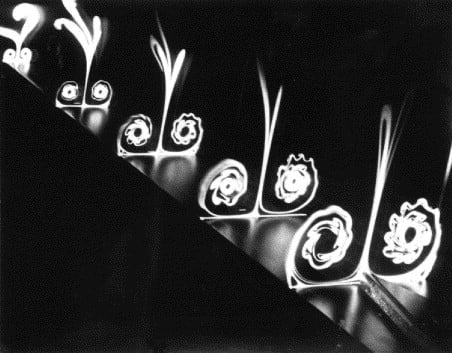
Vortex Cross-Sections

The photos above show cross-sections through the leading edge vortices on a highly swept delta wing at angle of attack. Flow in the photos is from the upper left to lower right. Notice how the vortices grow and develop waviness as they move downstream. When perturbations enter the vortex–for example, due to the shear between the vortex fluid and the freestream–some will grow and eventually cause a break down to turbulence, as in the lower picture. (Photo credits: R. Nelson and A. Pelletier)

Fractal Fluids
These images from a numerical simulation of a mixing layer between fluids of different density show the development and breakdown to Kelvin-Helmholtz waves. The black fluid is 3 times denser than the white fluid, and, as the two layers shear past one another, billow-like waves form (Fig 1(a)). Inside those billows, secondary and even tertiary billows form (Fig 1(a) and (b)). Fig 1 (c)-(e) show successive closeups on these waves, showing their beautiful fractal-like structure. (Photo credit: J. Fontane et al, 2008 Gallery of Fluid Motion) #

Getting Ketchup to Flow
Most everyone is familiar with the difficulty of getting ketchup out of its bottle. Part of the trouble is that ketchup is a shear-thinning fluid, meaning that its viscosity decreases with an increasing rate of shear. Thus, a shear-thinning fluid flows better once it starts moving. This is why the ketchup moves much faster once it is initially disturbed. LiquiGlide, a new coating material demonstrated above, has gained a lot of popular attention in the press recently for solving the difficulty of the stuck condiments. It appears that the coating reduces the static coefficient of friction between the food and the bottle, meaning that the ketchup starts sliding down the wall even before an increase in shear stress starts the flow. (submitted by @szescstopni)

Simulated Turbulence
This image, taken from a direct numerical simulation, shows turbulence in a stably stratified flow in which lighter fluid sits atop a denser fluid. In the image lighter colors represent denser fluid. Turbulence is created by the shear forces caused when the lighter fluid on top moves faster than the denser fluid on the bottom; however the stable stratification will tend to counteract or stabilize the turbulence. Note the vast variety and detail of the scales involved in turbulence; this is what makes it such a difficult process to simulate and model. (Image credit: G. Matheou and D. Chung, NASA/JPL-Caltech)
Microgravity Cornstarch
We’ve seen the effects of vibration on shear-thickening non-Newtonian fluids here on Earth before in the form of “oobleck fingers” and “cornstarch monsters”, but, to my knowledge, this is the first such video looking at the behavior in space. The vibrations of the speaker cause shear forces on the cornstarch mixture, which causes the viscosity of the fluid to increase. This is what makes it react like a solid to sudden impacts while still flowing like a liquid when left unperturbed. In microgravity there is one less force working against the rise of the cornstarch fingers, so the formations we see in this video are subtly different from those on Earth.

How Are Sea Waves Created?
There are many different kinds of sea waves, some of which have fluid dynamical origins and some of which don’t. For example, tsunamis are caused by the sudden displacement of the ocean floor caused by earthquakes and the tides are caused by the pull of the moon on Earth’s oceans. But many of the waves we are accustomed to seeing are caused by the wind moving across open water, whether in the ocean, in a lake or a sea, or even a river or pond. When the wind blows across the free surface of the water, the difference in velocity between the two fluids causes shearing and the development of surface waves as a result of the Kelvin-Helmholtz instability. (Incidentally, this is why other examples of the K-H instability look so much like ocean waves.)
These wind-generated waves can take several forms. Ripples–or capillary waves–remain visible only as long as the wind is blowing. But under steady conditions, or after the wind has affected a large enough area, waves can form that will persist at the surface even if the wind stops blowing. At that point, even though the wind generated the waves, it is gravity that allows them to persist. This is the source of most of the waves we see on large bodies of water. (Photo credit: Travis Weins)
Fixing Potholes with Oobleck
Shear-thickening non-Newtonian fluids like oobleck become more viscous as force is applied to them. This behavior causes them to form finger-like structures when vibrated, makes it good liquid armor, and even enables people to run across a pool of it without sinking. Now undergraduates at Case Western Reserve University have found a new use for such fluids: pothole filling. They have created a pothole patch that consists of a waterproof bag filled with a dry solution that, when mixed with water, creates a non-Newtonian fluid capable of flowing to take the shape of the pothole but resisting a car tire like a solid. They cover the patch with a layer of black fabric so that drivers don’t avoid the patch. See the video above for a demonstration and ScienceNOW for more. (submitted by aggieastronaut)
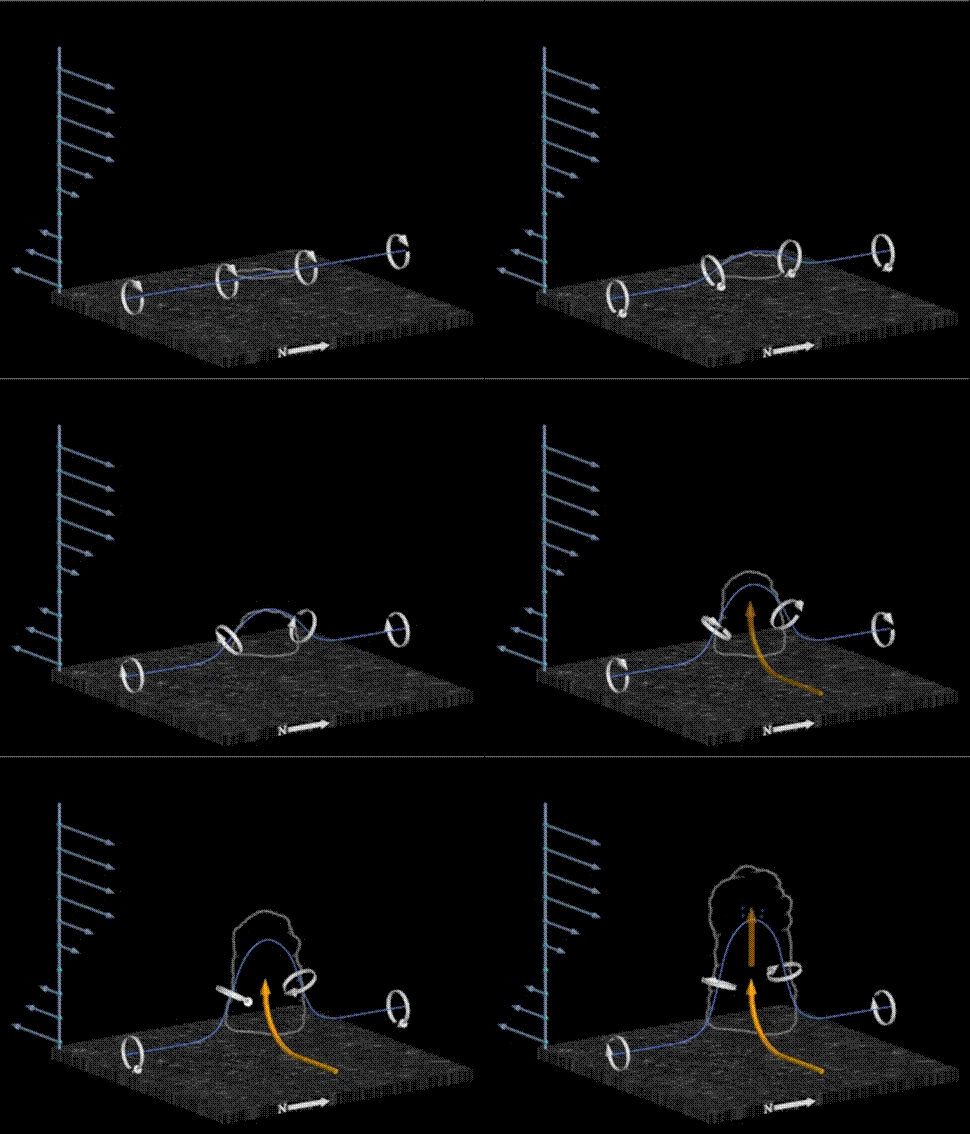
Tornadogenesis
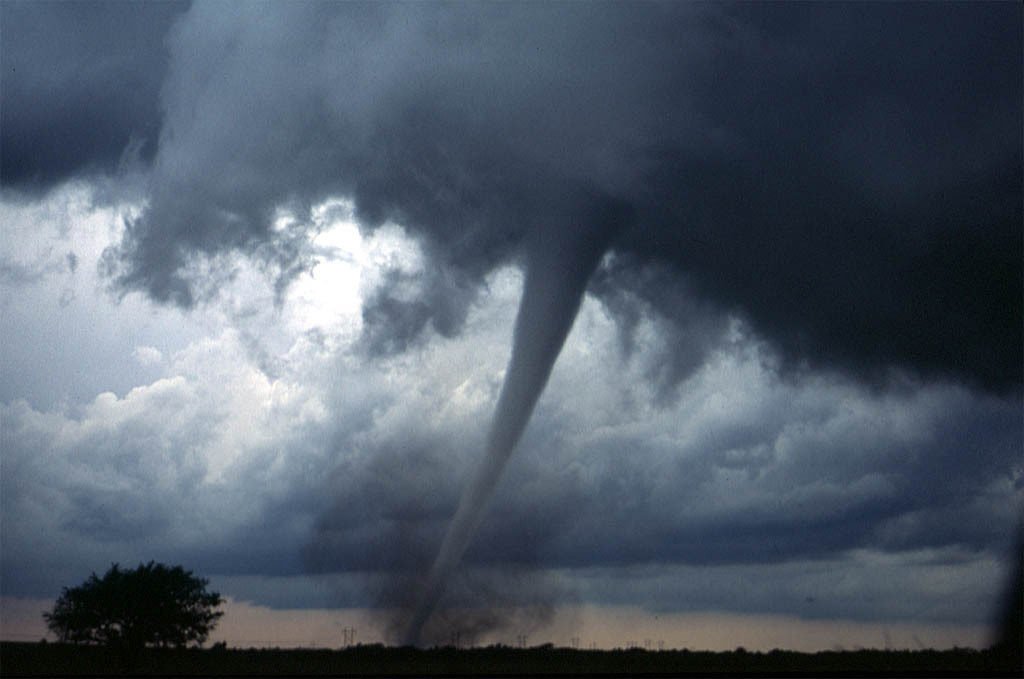
Tornadogenesis–the formation of tornadoes–remains a topic of active research as there is relatively little direct experimental data, owing to the difficulty of prediction as well as measurement. Initially, a variation of wind speed at different altitudes in the atmosphere causes shearing, which can lead to the formation of a horizontal column of rotating air–a vortex line similar to a roll cloud. Beneath a developing storm, the updraft of warm local air can pull this vortex line upwards, creating vertical rotation in the cloud, thereby birthing a supercell. Supercells do not always spawn tornadoes, and the exact causes that result in tornadic or nontornadic supercells are not fully understood. However, the formation of tornadoes within the supercell seems dependent on the downdraft of cool air within the storm as well as stretching of the vortex line, which increases its rate of rotation. For more information, check out this explanatory video and some of the talks by Paul Markowski. (Thanks to mindscrib, aggieastronaut and others for their submissions related to this topic! Photo credits: P. Markowski and D. Zaras)
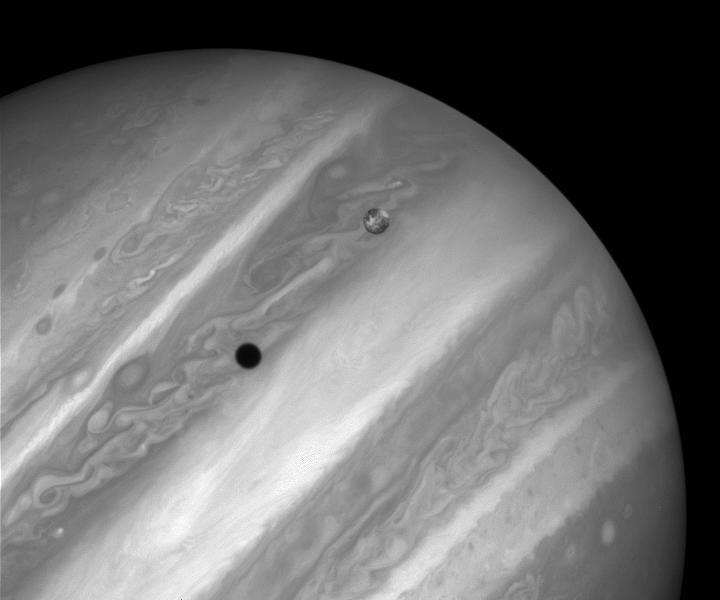
Where Jupiter Got Its Swirls
When layers of a fluid are moving at different relative velocities, they shear against one another. This shear can trigger the Kelvin-Helmholtz instability, which develops as a waves along the interface. Here Hubble captures Kelvin-Helmholtz waves along the cloud bands of Jupiter, but such clouds are also not uncommon here on Earth. (Photo credit: J. Spencer and NASA)