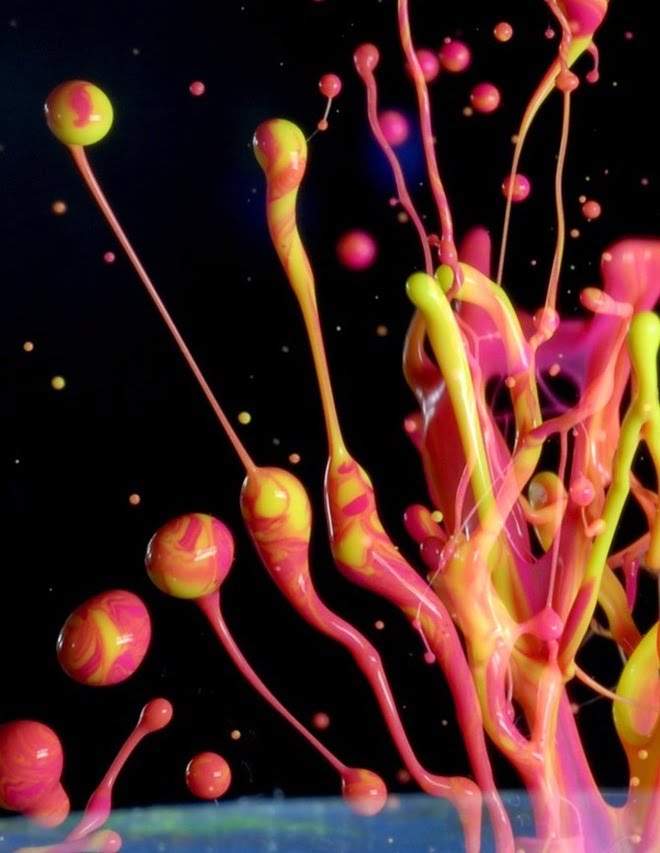
Paint vibrated on a loud speaker explodes in multi-colored jets and droplets. Most paints are shear-thinning non-Newtonian fluids (like ketchup, shampoo, or whipped cream), meaning that their viscosity decreases as they are sheared. This allows them to flow more readily once they are perturbed. #
Search results for: “shear”

Venom Properties
Most venomous snakes deliver venom to their prey via grooves in their fangs, rather than through a pressurized bolus through hollow fangs. New research shows that these venoms are shear-thinning non-Newtonian fluids. The surface tension of the venom is such that a drop of venom will tend to flow into and down the groove. Once moving, the shear-thinning properties of the venom decrease the venom’s viscosity, increasing its flow rate down the fang and into the snake’s prey. (via Scientific American; Photo: green mamba, banded snake fang)

Upside-Down Umbrellas
When a heavier fluid is suspended over a lighter fluid (as with ink or food coloring in water), the interface between fluids is subject to the Rayleigh-Taylor instability. As the heavier fluid starts to sink, it forms “fingers”, which develop into mushroom-cap shapes as the fluid continues falling. Sometimes the shear stress between the heavier fluid and lighter fluid causes secondary Kelvin-Helmholtz instabilities as well. (Photo by Leonardo Aguiar)
Hawaiian Fissures
[original media no longer available]
New fissures opened on Mount Kilauea in Hawaii earlier this month, resulting in some fountain-like eruptions of lava. This molten rock is a non-Newtonian fluid with shear-thinning and thixotropic properties. This is what allows the lava to flow long distances before it cools and solidifies. (via jpshoer)

Pouring Paint
In this artwork by Holton Rower, paint (typically a non-Newtonian fluid) is poured down a rectangular prism; the result is a neat demonstration of shearing in laminar flows. Paint is usually shear-thinning, meaning that its viscosity decreases under shear; this is why the color stripes on the vertical panels expand more than those on the horizontal surfaces do. # (submitted by Stephan)
Cornstarch Monsters
The patterns formed when vibrating a liquid on a speaker cone are standing waves known as Faraday waves. With a large enough amplitude, this produces some very cool effects with a shear-thickening non-Newtonian fluid like oobleck. (It would actually be interesting to see what happens when you vibrate a shear-thinning liquid like shampoo…) This video also details how you can set up this demonstration yourself at home.
Thixotropic and Rheopectic Fluids
There’s more to non-Newtonian fluids than shear-thickening and shear-thinning. The viscosity of some fluids can also change with time under constant shear. A fluid that becomes progressively less viscous when shaken or agitated is called thixotropic. The opposite (and less common) behavior is a fluid that becomes more viscous under constant agitation; this is known as a rheopectic fluid. This video demonstrates both types of fluids using a rotating rod as the agitator. The rheopectic fluid actually appears to climb the rod–similar to the Weissenberg effect–while the thixotropic fluid moves away from the rod.
Reader Question: Oswald de Waele
fyeahhexagons-deactivated201103 asks:
Could you do a quick post explaining the Oswald de Waele relationship please? Thanks!
Sure! The Oswald-de Waele relationship (a.k.a. a power-law fluid) is an attempt to generalize the relationship between shear stress and shear rate in fluids. For a Newtonian fluid, that relationship is linear:

This relationship describes many fluids–like air or water–very well. But there are plenty of non-Newtonian fluids as well, both shear-thinning (paint, shampoo, ketchup) and shear-thickening (oobleck). The Oswald-de Waele relationship approximates the behavior of these fluids using:

Values of n less than one correspond to shear-thinning (or pseudoplastic) fluids; a value greater than one is a shear-thickening (or dilatant) fluid. And n = 1 corresponds to a regular Newtonian fluid. #
Vibrating Oobleck
[original media no longer available]
This video explores some of the non-Newtonian behaviors of oobleck when shaken. The pattern across the surface once the vibrations start is called Faraday waves, a type of nonlinear standing wave that forms once a critical vibrational frequency is passed and the flat surface of the fluid becomes unstable. Toward the end of the video, the frequency of the vibrations is increased until “finger-like protrusions” form. This is a behavior exhibited by shear-thickening non-Newtonian fluids.

Oil Chandeliers
What you see above is a composite of images of an oil droplet falling into alcohol from two different heights. The top row of images is from a height of 25 mm and the bottom from a height of 50 mm. The first droplet forms an expanding vortex ring which breaks down via the Rayleigh-Taylor instability due to its greater density than the surrounding alcohol. The second droplet impacts the alcohol with greater momentum and is initially deformed by viscous shear forces. Eventually it, too, breaks down by the Rayleigh-Taylor mechanism. This image is part of the 2010 Gallery of Fluid Motion. # (PDF)

