Tag: shear-thinning

  • Baseball’s Mysterious Rubbing Mud

    Baseball’s Mysterious Rubbing Mud

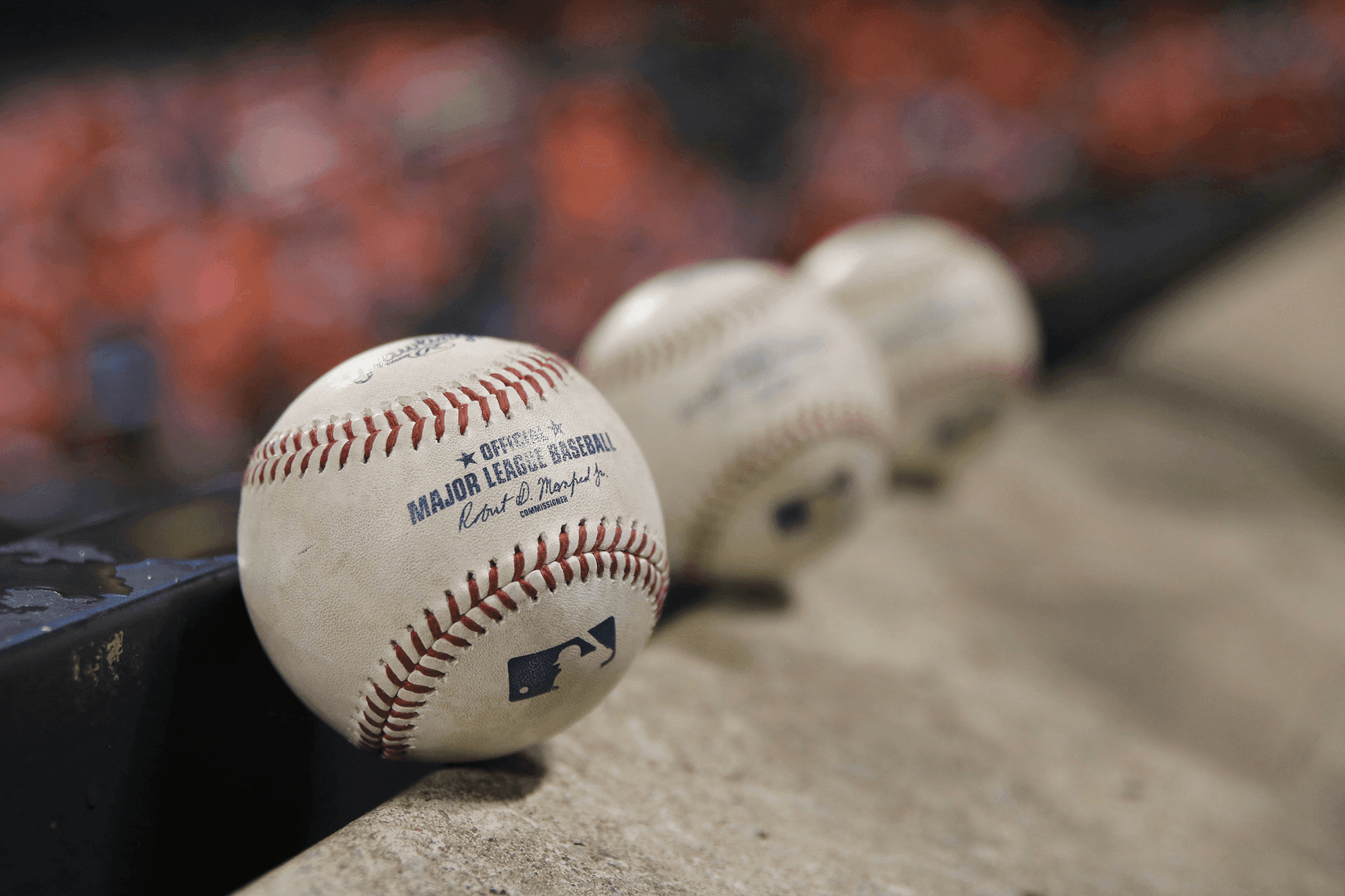
    Since 1938, every ball in Major League Baseball has been covered in a special “rubbing mud” harvested from a secret location in New Jersey. Although the league has tried in the past to replace the mud with an alternative, it’s never stuck. Researchers wondered just what makes this mud so special, so naturally, they brought some to the lab to study its composition and rheology.

    The mud consists of clay, silt, and sand with a smattering of organic particles. The make-up was pretty typical of river mud in the region, although researchers noted a drop-off in large particle sizes that probably indicates some sieving. In terms of rheology, the mud is shear-thinning, meaning it behaves a bit like lotion. It sits solidly in the hand until it’s deformed, at which point it smoothly coats the surface as a liquid would.

    So how does the mud change the baseballs? The researchers found three effects. First, the mud’s shear-thinning allowed it to fill in any pores or imperfections in the ball’s surface, creating a more uniform surface. Second, the dried mud’s residue doubled the ball’s contact adhesion. And, finally, the occasional large sand particles glued to the ball by the dried mud added friction. As the researchers put it, the rubbing mud “spreads like skin cream and grips like sandpaper.” (Image credit: L. Juarez; research credit: S. Pradeep et al.; via EOS)

    Fediverse Reactions
  • Featured Video Play Icon

    “One”

    A 4-minute, unedited one-shot video of colorful paint sliding down a sheet? Yes, please.

    Beautiful visuals aside, there are some really interesting physics involved here. It’s unclear whether the there’s any change in the speed at which paint gets deposited at the top of the incline over the course of the video, yet we see huge changes in the visual patterns. This happens, in part, because the layer of paint is getting thicker and heavier over time, changing the dynamics of its slide under gravity. There may even be some shear-thinning going on, given that paint is usually non-Newtonian. I can imagine some connections to landslides, avalanches, and other gravity currents with non-Newtonian fluids. (Video and image credit: R. De Giuli)

  • Featured Video Play Icon

    Building In a Stingless Hive

    Honeybees, with their stingers, get lots of attention, but the Americas have plenty of stinger-less honeymakers, too. These stingless bees are native to Mexico, where beekeepers cultivate them for pollination. Without stingers and venom, the bees use their building prowess to keep out unwanted visitors. Much of the hive — from the entrance’s nightly gate to the pods where young are stored — is built from cerumen, a substance the bees create by mixing wax with resins they collect from nearby trees. Just as they do with pollen, worker bees collect drops of resin and store them on their hind legs before flying back to the hive. The viscous fluid sticks well, until a swipe of a leg shears it enough to lower its viscosity and slide it off. (Video and image credit: Deep Look)

  • Saving Screens with Shear-Thinning Fluids

    Saving Screens with Shear-Thinning Fluids

    These days glass screens travel with us everywhere, and they can take some big hits on the way. Manufacturers have made tougher glass, but they continue to look for ways to protect our screens. Recently, a study suggested that non-Newtonian fluids are well-suited to the task.

    The team explored the physics of sandwiching a layer of fluid between a glass top layer and an LCD screen bottom layer, mimicking structures found in electronic devices. Through simulation, they searched for the fluid characteristics that would best minimize the forces felt by the solid layers during an impact. They found that shear-thinning fluids — fluids that, like paint or shampoo, get runnier when they’re deformed — provided the best protection. Having the impact energy go into reducing the local viscosity of the fluid stretches the length of time the impact affects the glass, which lowers the bending forces on it and helps avoid breakage. (Image credit: G. Rosenke; research credit: J. Richards et al.; via Physics World)

  • Evolving Fingers

    Evolving Fingers

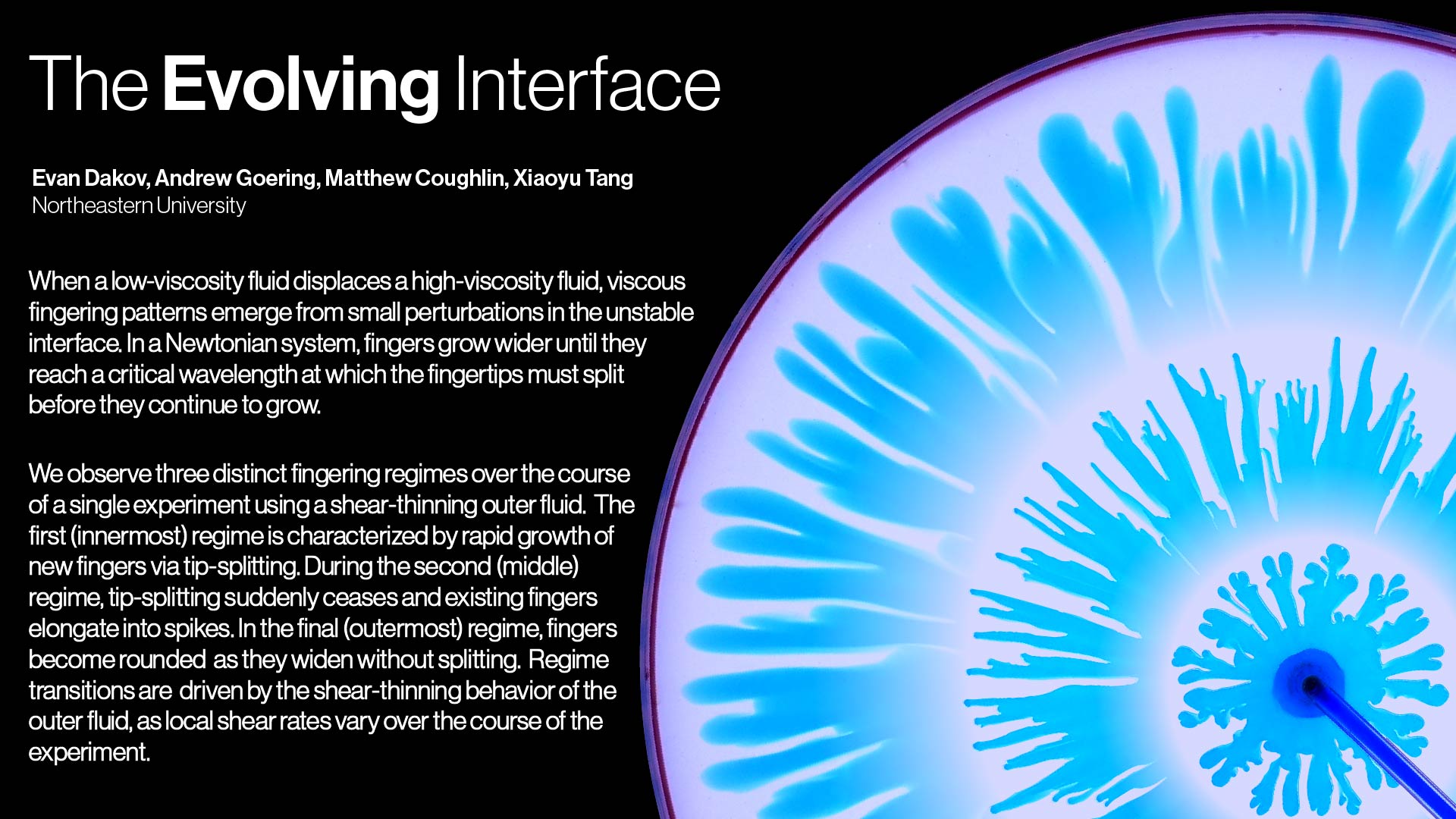
    If you sandwich a viscous fluid between two plates and inject a less viscous fluid, you’ll get viscous fingers that spread and split as they grow. This research poster depicts that situation with a slight twist: the viscous fluid (transparent in the image) is shear-thinning. That means its viscosity drops when it’s deformed. In this situation, the fingers formed by the injected (blue) fluid start out the way we’d expect: splitting as they grow (inner portion of the composite image). But then, the tip-splitting stops and the fingers instead elongate into spikes (middle ring). Eventually, as the outer fluid’s viscosity drops further, the fingers round out and spread without splitting (outer arc of the image). (Image credit: E. Dakov et al.; via GoSM)

  • Dendritic Painting Physics

    Dendritic Painting Physics

    In the art of Akiko Nakayama, colors branch and split in a tree-like pattern. In studying the process, researchers found the physics intersected art, soft matter mechanics, and statistical physics. In dendritic painting, the process starts with an underlying layer of acrylic paint, diluted with water. Atop this wet layer, you place a drop of acrylic ink mixed with isopropyl alcohol.

    The combination of both layers is key. The alcohol-acrylic drop on a Newtonian substrate will show spreading, driven by Marangoni forces, but no branching. It’s the slightly shear-thinning nature of the diluted acrylic paint substrate that allows dendrites to form. As the overlying drop expands, it shears the underlayer, changing its viscosity and allowing the branches to form. You can see video of the process here. (Image credit: A. Nakayama; research credit: S. Chan and E. Fried; via Physics World)

  • Featured Video Play Icon

    A Toad’s Sticky Saliva

    Frogs and toads shoot out their tongues to capture and envelop their prey in a fraction of a second. They owe their success in this area to two features: the squishiness of their tongues and the stickiness of their saliva. The super squishy toad tongue deforms to touch as much of the insect as possible. That shape-changing helps deliver the saliva, which is an impressively fast-acting, shear-thinning fluid. Under normal circumstances, the saliva is sticky and about as viscous as honey. But the shear from the tongue’s impact makes the saliva flow like water, spreading across the insect’s body. Then it morphs back into its viscous, sticky self, providing enough adhesive power that the insect can’t escape the toad pulling its tongue back in. (Video credit: Deep Look/KQED; research credit: A. Noel et al.)

  • Featured Video Play Icon

    A Look at Hagfish

    Hagfish are the lords of slime. Their viscoelastic protection mechanism is so effective that they’ve hardly changed up their game in the past 300 million years. Instead, at the first sign of trouble, they release a mucus that rapidly expands in salt water. When attacking fish try to pull water into their gills, they get clogged with slime instead, sometimes suffocating and becoming the hagfish’s meal instead. To get out of their slime, hagfish knot themselves and wipe it away, thanks to its shear-thinning properties. (Image and video credit: Deep Look)

  • Finger Painting Physics

    Finger Painting Physics

    Spreading paint with a brush or with fingers is familiar activity for most people. It’s also similar to processes used in industry for spreading thin layers of paint and other complex fluids. In a recent study, researchers took a look at how a soft, elastic blade (similar to a paintbrush or one’s fingers) spreads shear-thinning fluids (like paint) and Newtonian fluids (like water). Surprisingly, they found that it actually takes 30% more mechanical work to spread a shear-thinning fluid than the same volume of an equivalent Newtonian one. That’s pretty much the opposite of what we’d expect since the action of spreading (and shearing) the complex fluid should reduce its viscosity. However, they did find that the shear-thinning fluid spreads to a thin layer more consistently than the Newtonian fluid does. (Image credit: A. Kolosyuk; research credit: M. Krapez et al.)

  • Studying Active Polymers Using Worms

    Studying Active Polymers Using Worms

    I’ve covered some odd studies in my time, but this might be the strangest: to understand how active polymers affect viscosity, researchers loaded drunk worms into a rheometer. Active polymers are long-chain molecules that, like worms, can move on their own using stored energy or by extracting energy from their surroundings. Their dynamics are tough to study, though, because individual polymers are almost impossible to observe while a suspension of them is being deformed.

    Enter the humble sludge worm. Often sold as fish food, these worms — like the polymers they’re meant to imitate — are individually quite wiggly but, given their size, are far easier to observe. Researchers placed them in a custom rheometer in a solution of water and observed how the worm mass responded when sheared by a spinning top plate (Image 3). Like active polymers, the worms exhibited shear-thinning; the faster the plate spun, the lower the worms’ viscosity, likely because the additional force helps align the worms.

    But how do active worms compare with passive ones? The obvious solution would be to repeat their tests with dead worms, but the researchers found a more humane method: by adding some alcohol to the water, they temporarily reduced the worms’ activity, allowing them to compare active and passive worms (Image 2). Once rinsed in water, the worms sobered up and returned to their normal activity levels.

    The researchers found that both the active and passive worms exhibited shear-thinning as the force on them increased, but the shear-thinning in the active worms was not as pronounced, presumably because the movements of individual worms prevented them from aligning smoothly. (Image and research credit: A. Deblais et al.; via Gizmodo and APS Physics)