
In nature, birds and other flying animals often use unsteady flow effects to enhance the lift their wings generate. When a wing sits at a high angle of attack, it stalls; the flow separates from the upper surface, and its lift force is suddenly lost. If, on the other hand, that wing is in motion and pitching upward, lift is maintained to a much higher angle of attack. The reason for this is shown in the flow visualization above. This montage shows a rectangular plate pitching upwards. Flow is left to right. Each row represents a specific angle of attack and each column shows a different spanwise location on the plate. As the plate pitches upward, a vortex forms and grows on the leading edge of the plate. Eventually, the leading-edge vortex separates, but not until a much higher angle of attack than the plate could sustain statically. This effect allows birds to maintain lift during perching maneuvers and is also key to helicopter rotor dynamics. (Image credit: K. Granlund et al.)
Search results for: “lift”

Oil Flow Viz
Fluorescent oil sprayed onto a model in the NASA Langley 14 by 22-Foot Subsonic Wind Tunnel glows under ultraviolet light. Airflow over the model pulls the initially even coat of oil into patterns dependent on the air’s path. The air accelerates around the curved leading edge of the model, curling up into a strong lifting vortex similar to that seen on a delta wing. At the joint where the wings separate from the body those lifting vortices appear to form strong recirculation zones, as evidenced by the spiral patterns in the oil. Dark patches, like those downstream of the engines could be caused by an uneven application of oil or by areas of turbulent flow, which has larger shear stress at the wall than laminar flow and thus applies more force to move the oil away. Be sure to check out NASA’s page for high-resolution versions of the photo. (Photo credit: NASA Langley/Preston Martin; via PopSci)

Wind Tunnel Testing
Wind tunnel testing is an important step in designing new aircraft. This video shows footage of visualization tests of the 21-ft wingspan Boeing X-48C model in NASA Langley’s Full-Scale Tunnel. The X-48C is a blended wing body design capable of higher lift-to-drag ratios than conventional aircraft, which should lead to a higher range and greater fuel economy. The video shows some smoke visualization that illustrates airflow around the airfoil-shaped craft. The long probe sticking forward from the starboard wing is used to measure air pressure, angle of attack, and sideslip angle of the model. Notice how smoke from the wand is pulled from below the leading edge of the wing up and over the top of the wing. This is because there is lower pressure over the top of the wing than the bottom, and, like an electrical charge seeking the path of least resistance, fluids flow preferentially toward lower pressures. (Video credit: NASA Langley)
Falcon vs. Raven
Earth Unplugged has posted some great high-speed footage of a peregrine falcon and a raven in flight. Notice how both birds draw their wings inward and back on the upstroke. By doing so, they decrease their drag and thus the energy necessary for flapping. On the downstroke, they extend their wings fully and increase their angle of attack, creating not only lift but thrust. The falcon boasts an incredibly streamlined shape, not only along its body but also along its wings. In contrast, the raven has broader wings with large primary feathers that fan out near the tips. Splaying these large feathers out decreases the strength of the bird’s wingtip vortices, thereby reducing downwash and increasing lift, much the same way winglets do on planes. That extra lift and control the big primaries provide is important for the raven’s acrobatic skill. (Video credit: Earth Unplugged; via io9)
Flow Over a Delta Wing
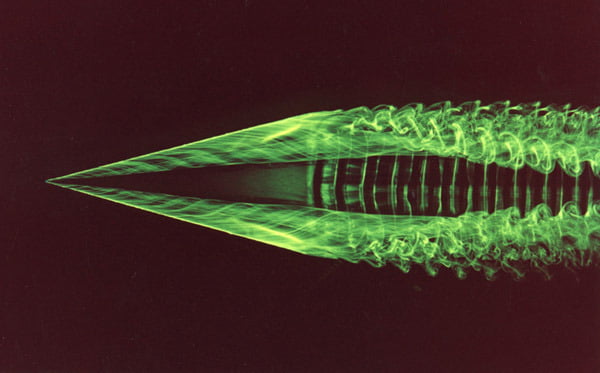
Fluorescent dye illuminated by laser light shows the formation and structure of vortices on a delta wing. A vortex rolls up along each leading edge, helping to generate lift on the triangular wing. As the vortices leave the wing, their structure becomes even more complicated, full of lacy wisps of vorticity that interact. Note how, by the right side of the photo, the vortices are beginning to draw closer together. This is an early part of the large-wavelength Crow instability. Much further downstream, the two vortices will reconnect and break down into a series of large rings. (Photo credit: G. Miller and C. Williamson)

Fluids Round-up – 13 July 2013
Prepare yourselves for lots of links in today’s fluids round-up!
- Longtime FYFD favorite Mark Stock (see here, here, and here) and his collaborator James Susinno have unveiled a new interactive art piece, “Everything is Made of Atoms” that utilizes some impressive real-time fluids simulation. NVIDIA’s blog has some details on the computing.
- ScarbsF1 takes a detailed look at the F-duct used to stall an F1 car’s rear wing to reduce drag. (submitted by Vinnie)
- Just in time for summer fun, National Geographic talks about the physics of water slides.
- SpaceX’s reusable Grasshopper rocket has set a new altitude test of over 1000 ft. Check out this feat of aerodynamic control over at io9.
- Stanford engineers are using high-speed video of birds in the wild to study the mechanics of flapping flight. If you check out their video, you’ll notice how the birds rotate their wings as they flap in order to maximize lift throughout the flapping cycle. (via io9)
- Speaking of io9, they highlighted a couple of great examples of meteorological fluid dynamics recently: roll clouds and water spouts.
- New research suggests that thresher sharks may whip their tails quickly enough to produce cavitation-induced shockwaves to stun their prey. If so, they join the pistol and mantis shrimp in utilizing this technique for hunting.
- If you’re looking for some casual games, Liquid Sketch is a fun fluids puzzle game for iOS (submitted by Keri B)
- Finally, congratulations to Toronoto’s AeroVelo for capturing the AHS Sikorsky Prize with their human-powered helicopter. Check out this video from their historic flight (submitted by Chris R).
(Photo credit: AeroVelo)
What is Pressure?
Pressure is a critical concept in fluid dynamics – a driving force behind everything from weather patterns to lift on a wing. But where does pressure come from? Like many macroscopic forces dealt with in fluid dynamics, pressure can be traced to the effects of individual molecules within a fluid. Kinetic theory describes gases as a collection of small particles which are all in constant, random motion. These particles’ collisions with each other and with their container create a multitude of tiny forces, as in the demonstration in the video above. When all of these collisions are summed together, their net effect is expressed as pressure, a force per area. (Video credit: Sixty Symbols)
Simulating a Curveball
Spinning an object in motion through a fluid produces a lift force perpendicular to the spin axis. Known as the Magnus effect, this physics is behind the non-intuitive behavior of football’s corner kick, volleyball’s spike, golf’s slice, and baseball’s curveball. The simulation above shows a curveball during flight, with pressure distributions across the ball’s surface shown with colors. Red corresponds to high pressure and blue to low pressure. Because the ball is spinning forward, pressure forces are unequal between the top and bottom of the ball, with the bottom part of the baseball experiencing lower pressure. As with a wing in flight, this pressure difference between surfaces creates a force – for the curveball, downward. (Video credit: Tetra Research)
The Silence of Owls
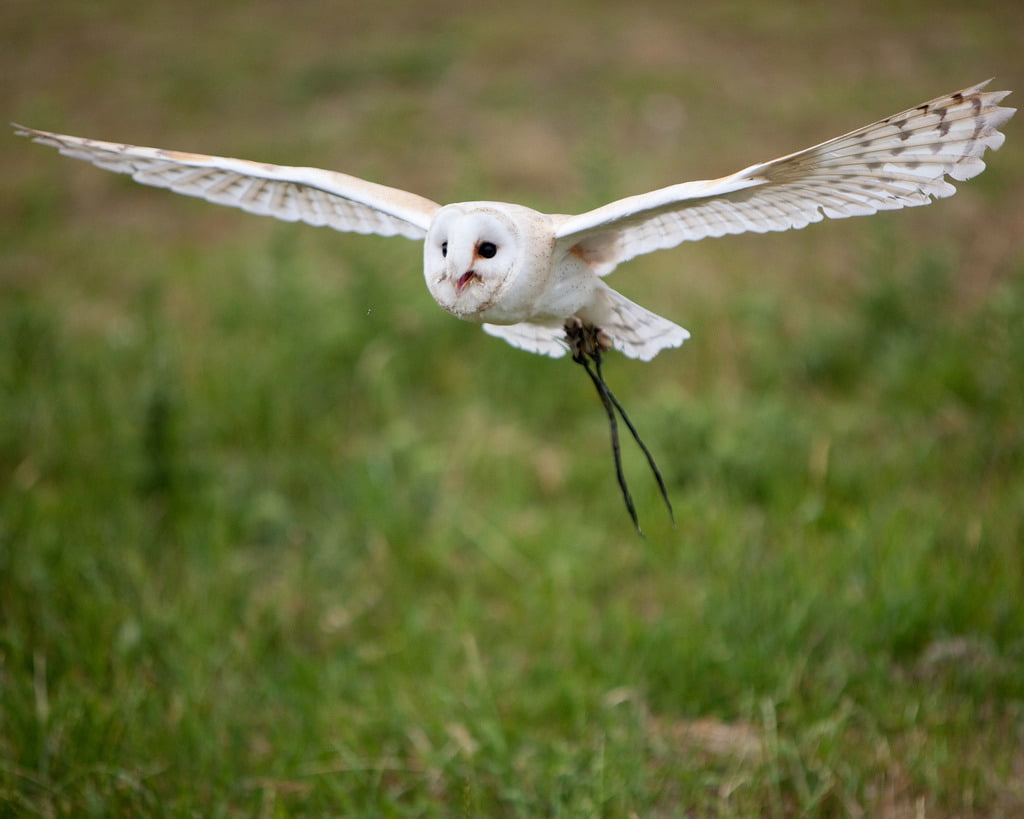
Owls are nearly silent hunters, able to swoop down on their prey without the rush of air over their wings giving away their approach, thanks to several key features of their feathers. The trailing edge of their feathers–or any lifting body, like an airplane wing–are a particular source of acoustic noise due to the interaction of turbulence near the surface with the edge. Since owls are especially good at eliminating self-produced noise in a frequency range that overlaps human hearing, investigators want to learn what works for owls and apply to it aircraft. A recent theoretical analysis uses a simplified model of the feather as a porous, elastic plate. The researchers found that the combination of porosity with the elasticity of the trailing edge significantly reduced noise relative to a rigid edge. (Photo credit: N. Jewell; research credit: J. Jaworski and N. Peake)
Watching the Boundary Layer Go By
In experiments, it can be difficult to track individual fluid structures as they flow downstream. Here researchers capture this spatial development by towing a 5-meter flat plate past a stationary camera while visualizing the boundary layer – the area close to the plate. The result is that we see turbulent eddies evolving as they advect downstream. Despite the complicated and seemingly chaotic flow field, the eye is able to pick out patterns and structure, like the merging of vortices that lifts eddies up into turbulent bulges and the entrainment of freestream fluid into the boundary layer as the eddies turn over or collapse. It is also a great demonstration of how the Reynolds number relates to the separation of scales in a turbulent flow. Notice how much richer the variety of length-scale is for the higher Reynolds number case and how thoroughly this mixes the boundary layer. (Video credit: J. H. Lee et al.)