The ends of an airplane’s wings generate vortices that stretch back in the wake of the plane. Most of the time these vortices are invisible, even if their effects on lift are distinctive. Here an A-340 coming in for a foggy landing demonstrates the size and strength of these vortices. Notice how the fog gets swept up and away by the vortices. Pilots will sometimes use this effect to their advantage in clearing a runway of fog by making repeated low-passes to clear the fog before landing. (Video credit: A. Ruesch; submitted by Jens F.)
Search results for: “lift”

Rock Skipping Tips
Almost everyone has tried skipping rocks across the surface of a pond or lake. Here Professor Tadd Truscott gives a primer on the physics of rock skipping, including some high-speed video of the impact and rebound. In a conventional side-arm-launched skip, the rock’s impact creates a cavity, whose edge the rock rides. This pitches the rock upward, creating a lifting force that launches the rock back up for another skip. Alternatively, you can launch a rock overhand with a strong backspin. The rock will go under the surface, but if there’s enough spin on it, there will be sufficient circulation to create lift that brings the rock back up. This is the same Magnus effect used in many sports to control the behavior of a ball–whether it’s a corner or free kick in soccer or a spike in volleyball or tennis. (Video credit: BYU Splash Lab/Brigham Young University)
Stalling
[original media no longer available]
At high angles of attack, the flow around the leading edge of an airfoil can separate from the airfoil, leading to a drastic loss of lift also known as stall. Separation of the flow from the surface occurs because the pressure is increasing past the initial curve of the leading edge and positive pressure gradients reduce fluid velocity; such a pressure gradient is referred to as adverse. One way to prevent this separation from occurring at high angle of attack is to apply suction at the leading edge. The suction creates an artificial negative (or favorable) pressure gradient to counteract the adverse pressure gradient and allows flow to remain attached around the shoulder of the airfoil. Suction is sometimes also used to control the transition of a boundary layer from laminar to turbulent flow.

Unmanned Aerial Vehicles


In recent years unmanned aerial vehicles (UAVs) have grown in popularity for both military and civilian application and are shifting from a remotely controlled platform to autonomous control. Since no pilot flies onboard an UAV, these craft are much smaller than other fixed-wing aircraft, with wingspans that may range from a few meters to only centimeters. At these sizes, most fixed-wing airfoil theory does not apply because no part of the wing is isolated from end effects. This complicates the prediction of lift and drag on the aircraft, particularly during maneuvering and necessitates the development of new predictive methods and control schemes. Shown above are flow visualizations of a small UAV executing a perching maneuver, intended to allow the craft to land as a bird does by scrubbing speed with a high-angle-of-attack, high-drag motion. (Photo credit: Jason Dorfman; via Hizook; requested by mindscrib)

Rocket Exhaust
A fiery jet of exhaust remains amid plumes of smoke as a Soyuz rocket lifts off from Baikonur Cosmodrome bound for the International Space Station. The lengthscales of such turbulence range from tens of meters to only millimeters, highlighting the incredible difficulty of accurately capturing and describing the fluid motion of a practical engineering problem. (Photo credit: NASA/Carla Cioffi; via Visual Science)

Viscous Fingers
High viscosity silicon oil is sandwiched between two circular plates. As the upper plate is lifted at a constant speed, air flows in from the sides. The initially circular interface develops finger-like instabilities, due to the Saffman-Taylor mechanism, as the air penetrates. Eventually the fluid will completely detach from one plate. (Photo credit: D. Derks, M. Shelley, A. Lindner)
Magnus Force
Physics students are often taught to ignore the effects of air on a projectile, but such effects are not always negligible. This video features several great examples of the Magnus effect, which occurs when a spinning object moves through a fluid. The Magnus force acts perpendicular to the spin axis and is generated by pressure imbalances in the fluid near the object’s surface. On one side of the spinning object, fluid is dragged with the spin, staying attached to the object for longer than if it weren’t spinning. On the other side, however, the fluid is quickly stopped by the spin acting in the direction opposite to the fluid motion. The pressure will be higher on the side where the fluid stagnates and lower on the side where the flow stays attached, thereby generating a force acting from high-to-low, just like with lift on an airfoil. Sports players use this effect all the time: pitchers throw curveballs, volleyball and tennis players use topspin to drive a ball downward past the net, and golfers use backspin to keep a golf ball flying farther. (Video credit: Veritasium)
Wingtip Vortices
Any finite length wing produces wingtip vortices–potentially intense regions of rotational flow downstream of the wing’s ends. These vortices are associated both with the production of lift on the wing and with unavoidable induced drag. The tabletop demonstration above shows the region of the vortices’ influence and how strong the rotation is there. Note also that the two vortices have opposite rotational senses–the left side induces a clockwise rotation, whereas the right side induces an anti-clockwise rotation. The larger an aircraft, the stronger and longer lasting its vortices; this can be a source of danger for smaller aircraft passing through the wake. If a pilot crosses one wingtip vortex and overreacts to compensate, crossing the second counter-rotating vortex can cause even greater damage.
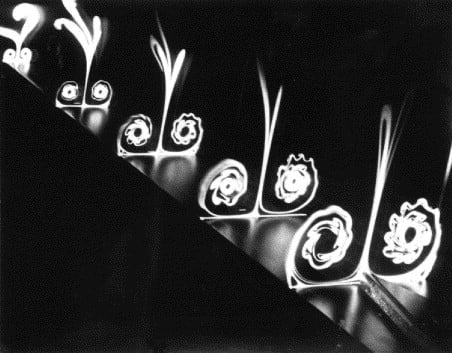
Vortex Cross-Sections

The photos above show cross-sections through the leading edge vortices on a highly swept delta wing at angle of attack. Flow in the photos is from the upper left to lower right. Notice how the vortices grow and develop waviness as they move downstream. When perturbations enter the vortex–for example, due to the shear between the vortex fluid and the freestream–some will grow and eventually cause a break down to turbulence, as in the lower picture. (Photo credits: R. Nelson and A. Pelletier)

London 2012: Discus Physics


Like the javelin, the discus throw is an athletic event dating back to the ancient Olympics. Competitors are limited to a 2.5 m circle from which they throw, leading to the sometimes elaborate forms used by athletes to generate a large velocity and angular momentum upon release. The flight of the discus is significantly dependent on aerodynamics, as the discus flies at an angle of attack. Spin helps stabilize its flight both dynamically and by creating a turbulent boundary layer along the surface which helps prevent separation and stall. Unlike many other events, a headwind is actually advantageous in the discus throw because it increases the relative velocity between the airflow and the discus, thereby increasing lift. The headwind also increases the drag force on the discus, but research shows the benefits of the increased lift outweigh the effects of increased drag, so much so that a discus flies further in air than it would in a vacuum. (Photo credits: P Kopczynski, Wiki Commons, EPA/K Okten)
FYFD is celebrating the Olympics by featuring the fluid dynamics of sports. Check out our previous posts, including why corner kicks swerve, what makes a pool fast, how an arrow flies, and how divers avoid splash.