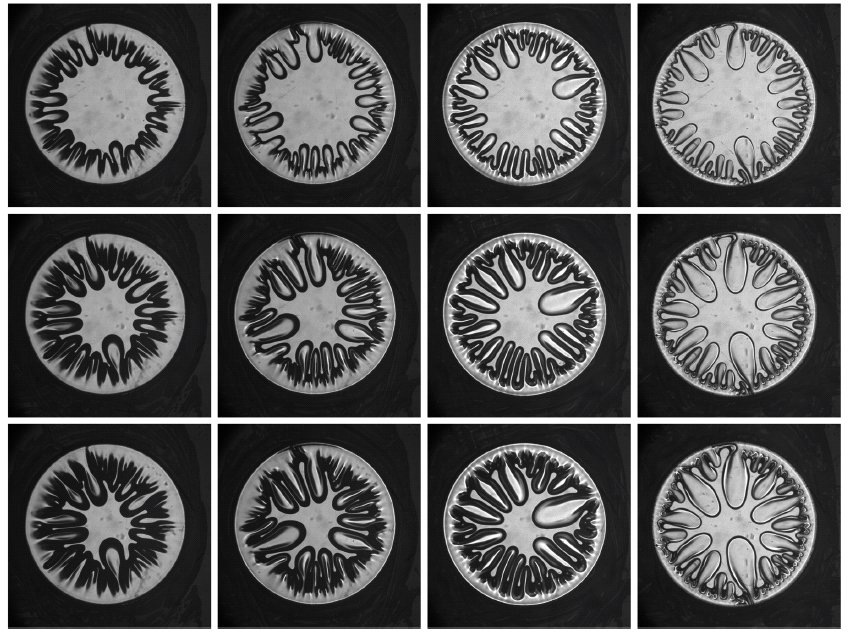
Viscous liquid placed between two plates forms a finger-like instability when the top plate is lifted. The photos above show the evolution of the instability for four initial cases (top row, each column) in which the initial gap between the plates differs. Each row shows a subsequent time during the lifting process. As the plate is pulled up, the viscous liquid adheres to it and air from the surroundings is entrained inward to replace the fluid. This forms patterns similar to the classic Saffman-Taylor instability caused when less viscous fluid is injected into a more viscous one. (Photo credit: J. Nase et al.)
Search results for: “lift”

Tiny Fliers
There’s an apocryphal story claiming that, aerodynamically speaking, honeybees should not be able to fly. Obviously, they can, but it’s true that a small, flapping creature and a large, fixed-wing aircraft will not generate lift exactly the same way. NYU professor Leif Ristroph has a lot of projects exploring flapping flight on smaller scales, as seen in this video. His oscillatory fliers and rotating flapping flight simulator have both been featured previously. Part of the beauty of these projects is their size; in a field that’s historically required giant wind tunnels and room-length wave tanks, Ristroph’s work provides insight into long-standing problems using apparatuses that fit on a countertop. (Video credit: Cool Hunting/L. Ristroph et al.)

Wingtip Vortices
Newton’s third law says that forces come in equal and opposite pairs. This means that when air exerts lift on an airplane, the airplane also exerts a downward force on the air. This is clear in the image above, which shows a an A380 prototype launched through a wall of smoke. When the model passes, air is pushed downward. The finite size of the wings also generates dramatic wingtip vortices. The high pressure air on the underside of the wings tries to slip around the wingtip to the upper surface, where the local pressure is low. This generates the spiraling vortices, which can be a significant hazard to other nearby aircraft. They are also detrimental to the airplane’s lift because they reduce the downwash of air. Most commercial aircraft today mitigate these effects using winglets which weaken the vortices’ effects. (Image credit: Nat. Geo./BBC2)
Hawk in Flight
For a little more than century, mankind has taken flight in fixed-wing aircraft. But other species have flown for much longer using flapping techniques, the details of which humans are still unraveling. To really appreciate flapping flight, it helps to have high-speed video, like this beautiful footage of a goshawk attacking a water balloon. The motion of the hawk’s wings is far more complex than the simple up and down flapping we imitate as children. On the downstroke, the wings and tail stretch to their fullest, providing as large an area as possible for lift. During steady flight, the bird flaps while almost horizontal for minimal drag, but as it approaches its target, it rears back, allowing the downstroke to both lift and slow the bird. In the upstroke, the bird needs to avoid generating negative lift by pushing air upward. To do this, it pulls its wings in and simultaneously rotates them back and up. Its tail feathers are also pulled in but to a lesser extent. Leaving them partially spread probably maintains some positive lift and provides stability. At the end of the upstroke, the hawk’s wings are ready to stretch again, and so the cycle continues. (Video credit: Earth Unplugged/BBC; h/t to io9)
Viscosity’s Impact
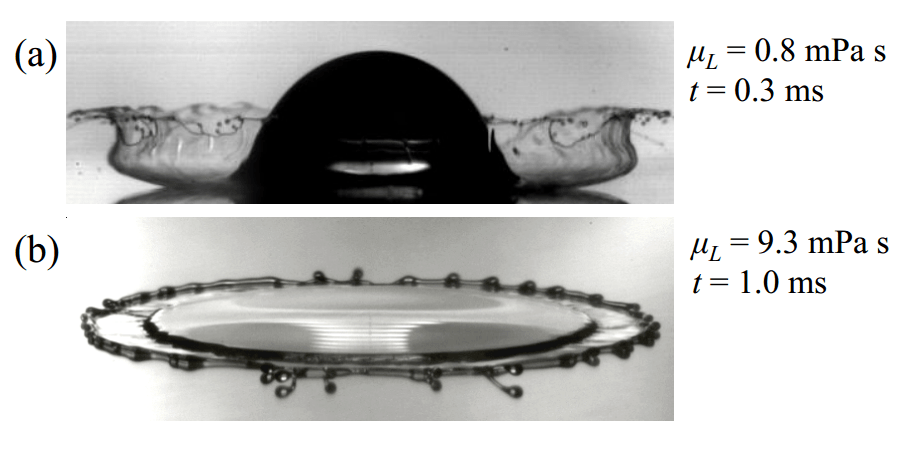
Everyone has seen drops of liquid falling onto a dry surface, yet the process is still being unraveled by researchers. We have learned, for example, that lowering the ambient air pressure can completely suppress splashing. Viscosity of the fluid also clearly plays a role, but the relationship between these and other variables is unclear. The images above show two droplet impacts in which the viscosity differs. The top image shows a low viscosity fluid, which almost immediately after impact forms a thin expanding sheet of fluid that lifts off the surface to create a crownlike splash. In contrast, the higher viscosity fluid in the bottom image spreads as a thick lamella with a thinner outer sheet that breaks down at the rim. Researchers found that both the high- and low-viscosity fluids have splashes featuring these thin liquid sheets, but the time scales on which the sheet develops differ. Moreover, lowering the ambient pressure increases the time required for the sheet to develop regardless of the fluid’s viscosity. (Image credit: C. Stevens et al.; submitted by @ASoutIglesias)
Sand Ripples
Wave motion in a bay or near a beach can cause significant sediment transport. Individual granular particles, like sand, can be lifted by the passage of a single wave, but, over time, complex patterns form as the granular bottom surface shifts due to the waves. This video shows time-lapse footage of the ripples that form and move in submerged sand during many hours of wave motion. A slight imperfection in the surface causes a network of sand ripples to grow and spread. Once formed, those ripples shift and reform depending on changes in the wave conditions. (Video credit: T. Parron et al.)
Sochi 2014: Ski Jump, Part 2
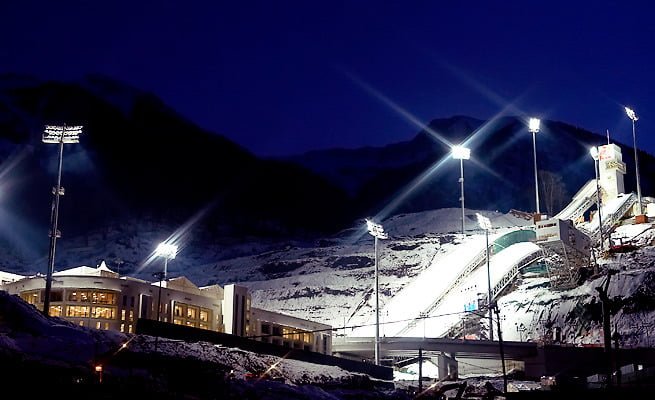
Yesterday we talked about the technique ski jumpers use to fly farther. Generating lift without too much drag is the key to a good jump. But jumpers are subject to ever-changing wind conditions, and those can help or hurt them. Unlike most sports, in ski jumping a headwind is desirable. This is because the added relative air velocity increases the jumper’s lift and helps them fly farther. A tailwind, on the other hand, saps their speed. Since 2009, ski jumping competitions have included a wind compensation factor that tries to account for these effects. Wind velocity is measured at five points along the jumper’s flight path and the tangential (i.e. head- or tailwind) components are weighted and averaged. The weighting factors seem to be individual to each hill – not all hills are built with the same profile. This average tangential wind speed is then a linear variable in an equation for wind factor. The goal of the wind factor is as much to make the competition run smoothly as it is to increase fairness. The trouble is that the wind speed effect is non-linear; in other words, a headwind does not help a jumper as much as a tailwind can hurt them. In one simulation study, researchers found a 3 m/s headwind carried jumpers 17.4 m further while a tailwind of the same magnitude shortened the jump by 29.1 m. The wind differences in competition may not be as drastic, but truly evening the playing field may require a more complicated compensation system. (Photo credit: B. Martin/Sports Illustrated)
FYFD is celebrating the Games with a look at fluid dynamics in the Winter Olympics. Check out our previous posts on the aerodynamics of speed skating, why ice is slippery and how lugers slide so fast.

Sochi 2014: Ski Jump
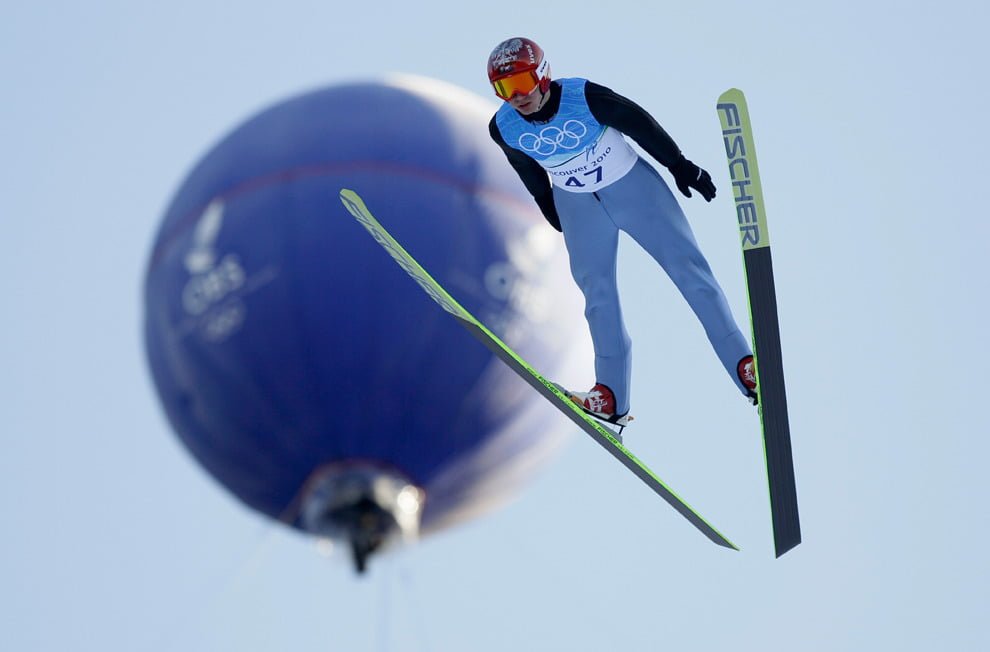
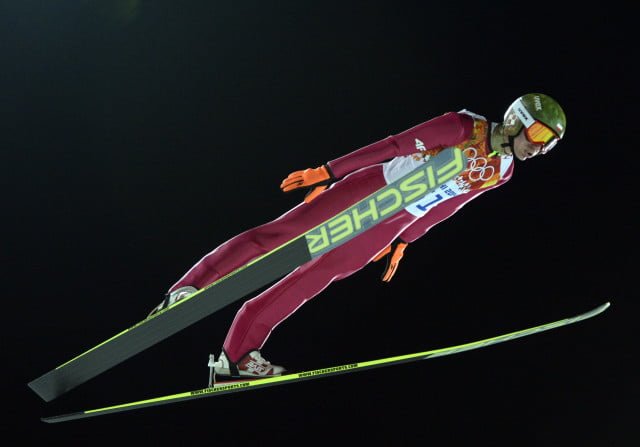
Great ski jumpers are masters of aerodynamics. There are four main parts to a jump: the in-run, take-off, flight, and landing. An athlete’s aerodynamics are most vital in the in-run and, naturally, the flight. During the in-run, the athlete is trying to gain as much speed as possible, so she tucks down and pulls her arms behind her back to streamline her body and keep her frontal area as small as possible. This limits her drag so that she can maximize her speed at take-off. Once in the air, though, the jumpers act like gliders. In flight, there are three forces acting on the the jumper: gravity, lift, and drag. Gravity pulls the jumper down, and drag tends to push her backwards up the hill, but lift, by counteracting gravity, helps keep jumpers aloft for a greater distance. To maximize lift, a jumper angles her skis outward in a V and holds her arms out from her sides. This configuration turns the jumper’s body and skis into a wing. The best jumpers will tweak their positions with training jumps and wind tunnel time to maximize their lift while minimizing their drag in flight and on the in-run. Technique is critical in ski jumping, but conditions play a significant role as well. Tomorrow’s post will discuss why and how judges account for changing conditions. (Photo credits: L. Baron/Bongarts/Getty Images; D. Lovetsky/AP; E. Bolte/USA Today)
FYFD is celebrating the Games with a look at fluid dynamics in the Winter Olympics. Check out our previous posts on the aerodynamics of speed skating, why ice is slippery and how lugers slide so fast.
Fluid Juggling
It’s that time of the year – the 2013 APS Division of Fluid Dynamics meeting is not far off, and entries to this year’s Gallery of Fluid Motion are starting to appear. This week we’ll be taking a look at some of the early video submissions, beginning with one that you can recreate at home. This video demonstrates a neat interaction between a slightly-inclined liquid jet and a lightweight ball. The jet can stably support–or, as the authors suggest, juggle–the ball under many circumstances, as seen in the video. Initially, the jet impacts near the bottom of the ball and then spreads into a thin film over the surface. This decrease in thickness between the jet and the film is accompanied by an increase in speed due to conservation of mass. That velocity increase in the film corresponds to a pressure decrease because of Bernoulli’s principle. This means that there is a region of higher pressure where the jet impacts the ball and lower pressure where the film flows around the ball. Just as with airflow over an airfoil, this generates a lift force that holds the ball aloft. (Video credit: E. Soto and R. Zenit)
How Air Dancers Dance
Air dancers–those long fabric tubes with fans blowing into the bottom–are a popular way for shops to draw attention. They bend and flutter, shake and kink, all due to the interaction of airflow in and around them with the fabric. When the interior flow is smooth and laminar, the tube will stand upright, with very little motion. As the air inside transitions, some fluttering of the tube can be observed. Ultimately, it is when the air flow becomes turbulent that the cloth really dances. Variations in the flow are strong enough at this point that the tube will occasionally buckle. Behind this constriction, the flow pressure increases until its force is enough to overcome the weight of the tube and lift it once more. (Video credit: A. Varsano)