Tag: meteorology

  • Coriolis

    Coriolis

    There’s an infamous supposition about drains swirling one way in the Northern Hemisphere and the other way in the Southern Hemisphere. Destin from Smarter Every Day and Derek from Veritasium have put the claim to the test with experiments on either side of the globe. First, go here and watch their synchronized videos side-by-side. (To synchronize, start the left video and pause it at the sync point. Then start the second video and unpause the first video when the second video hits the sync point.) I’ll wait here.

    That was awesome, right?! The demonstration doesn’t work with toilets because they’re driven by the placement of jets around the circumference. And your bathtub doesn’t usually work either because any residual vorticity in the tub gets magnified by conservation of angular momentum as it drains. It’s like a spinning ice skater pulling their arms in; the rotation speeds up. So, to get around that problem, Destin and Derek let their pools sit for a day to damp out any motion before draining. At that point, the Coriolis effect is strong enough to cause the pools to rotate in opposite directions when drained. You may wonder why the effect is so slight for the pools when it’s pretty stark with hurricanes and cyclones. The answer is a matter of scale. The pools are perhaps 2 meters wide, which means that the difference in latitude across the the pool is very slight and therefore, the differential speed imparted by the Earth’s rotation is also very small. Because hurricanes and cyclones are much larger, they experience stronger influence from the Coriolis effect. (Image credits: Smarter Every Day/Veritasium; via It’s Okay To Be Smart)

  • Featured Video Play Icon

    Cloud Formation

    Clouds are so ubiquitous here on Earth that it’s easy to take them for granted. But there’s remarkable complexity in the mechanics of their formation. This great video from Minute Earth steps through the processes of evaporation and condensation that drive basic cloud formation. After evaporation, buoyancy lifts warm, moist air upward. That warm air expands and cools until it reaches an altitude where water droplets can condense onto dust particles in the atmosphere. These droplets form the wispy cloud we see. Turbulence mixes these droplets and helps them collide and grow. Interestingly, although we understand the basic process of cloud formation, relatively little is understood about the details, and the subject is still very much an area of active research. (Video credit: Minute Earth; via io9)

  • Featured Video Play Icon

    Foggy Canyon

    Timelapse photography reveals the tide-like motions of fog that filled the Grand Canyon last week. This unusual meteorological condition was created by a temperature inversion. Usually air near the ground is warmest and the atmosphere cools as the altitude increases. But occasionally a mass of warm air will trap a layer of cooler air beneath it. In the case of the Grand Canyon, cool foggy air was capped by a warmer air mass, resulting in a sea of fog. Depending on the conditions, temperature inversions can create other distinctive weather patterns like cloud streets or even supercell thunderstorms. (Video credit: Vox; via Flow Visualization)

  • Pyrocumulus Clouds

    Pyrocumulus Clouds

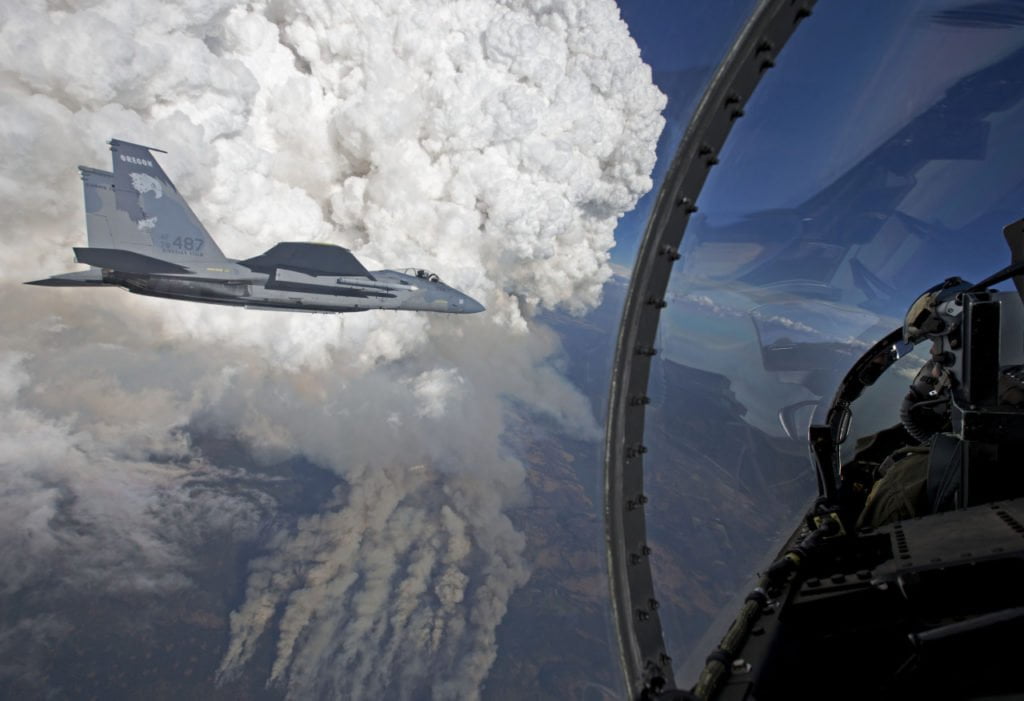
    Pyrocumulus clouds tower tall above a wildfire in these photos taken last week from an Oregon National Guard F-15C. Most cumulus clouds form when the sun-warmed surface heats air, causing it to rise and carry moisture upward where it condenses to form clouds. In pyrocumulus clouds, the driving heat is supplied by a forest fire or volcanic eruption. The hot, rising air carries smoke and soot particles upward, where they become nucleation sites for condensation. Pyrocumulus clouds can be especially turbulent, and the gusting winds they produce can exacerbate wildfires. In some cases, the clouds can even develop into a pyrocumulonimbus thunderstorm with rain and lightning.  (Photo credit: J. Haseltine; via NASA Earth Observatory)

  • Typhoon Neoguri

    Typhoon Neoguri

    Astronaut Reid Wiseman has been posting photos of Typhoon Neoguri in his Twitter feed this week. From our perspective on the ground, it’s easy to forget how three-dimensional the typhoons and hurricanes in our atmosphere are. But Wiseman’s photos capture the depth in the storm, especially the depression of the eye. From the top, the typhoon looks much like a vortex in a bathtub, or what’s more formally known as a free surface vortex. To understand why a vortex dips in the middle, imagine a container of water on a rotating plate. As the water is spun, its interface with the air takes on a paraboloid shape. Two external forces are acting on the fluid: gravity in the downward direction and a centrifugal force in the radial direction. The free surface of the fluid adopts a shape that is always perpendicular to the combination of these two forces. This ensures that the pressure along the free surface is a constant. (Photo credits: R. Wiseman 1,2,3)

  • Waterspouts

    Waterspouts

    Waterspouts are commonly thought of as tornadoes over water, but this is only partially true. Some waterspouts do begin as tornadoes, but waterspouts are more commonly non-tornadic or fair-weather in origin. These non-tornadic waterspouts form when cold, dry air moves over warm water. As the warm, moist air rises, entrainment and conservation of angular momentum cause the air nearby to begin rotating. The spout does not actually suck water up from the surface. Instead, the humid rising air cools and the water vapor condenses, forming the cloud wall of the spout. Waterspouts are typically very short-lived and last 5 to 10 minutes before the inflowing air cools and the vortex weakens and dissipates.  (Photo credit: U.S. Navy/K. Wasson)

  • Measuring Wind Speed by Satellite

    Measuring Wind Speed by Satellite

    Weather modeling and forecasting in recent decades have benefited enormously from the availability of more data. For example, satellites now measure wind speeds over the open ocean, instead of data simply coming from isolated ships and buoys.  The satellites do this by measuring the roughness of the ocean using radar or GPS signals bounced off the ocean surface. From this researchers can construct a map of wave height and direction like the one in the animation above. For a large body of water, waves are primarily generated by wind shearing the water at the interface. The waves we see are a result of the Kelvin-Helmholtz instability between the wind and ocean. Because this is a well-known behavior, it is possible to connect the waves we observe with the wind conditions that must have generated them. (Image credit: ESA; animation credit: Wired; submitted by jshoer)

  • The Atmospheric River

    The Atmospheric River

    Atmospheric rivers are long, narrow corridors of concentrated water vapor transport in the atmosphere. They often occur when winds from storms over the ocean draw moisture together and project it ahead of a cold front. The phenomenon was only recognized in the 1990s, but subsequent research has shown that atmospheric river conditions account for many instances of heavy rainfall and flooding in areas along the West Coast of the United States. Forecasters can now recognize the phenomenon in forecast models, allowing them to predict potential flood-inducing rainfall days in advance. To learn more, check out NOAA’s atmospheric river Q&A. (Image credit: NOAA)

  • Featured Video Play Icon

    Supercell Timelapse

    The storm chasing group Basehunters captured this stunning timelapse of a supercell thunderstorm forming in Wyoming. This class of storm is characterized by the presence of a mesocyclone, seen here as a large, rotating cloud. These rotating features form when horizontal wind shear is redirected upright by an updraft. This requires a strong updraft, which is often formed by a capping inversion, where a layer of warm air traps colder air beneath it. Supercells can be very dangerous in their own right, releasing torrential rains and large hail, but they are also capable of spawning violent tornadoes. (Video credit: Basehunters; via Bad Astronomy; submitted by jshoer)

  • Dust Storm in Texas

    Dust Storm in Texas

    This aerial photo shows the leading edge of a haboob–an intense dust storm–sweeping across Texas last week. Although dust can be stirred up under many circumstances, haboobs are a specific meteorological phenomenon with winds as high as 100 kph and towering clouds of dust kilometers high. This particular storm swept through five US states last week along an incoming cold front. The winds accompanying the cold front swept up silt, dirt, and dust from the drought-ridden Southwest and carried it along to envelope towns and cities along the way. Although the term is Arabic in origin, haboobs occur throughout the world, typically at the leading edge of a cold front or thunderstorm.  (Photo credit: R. Scott)