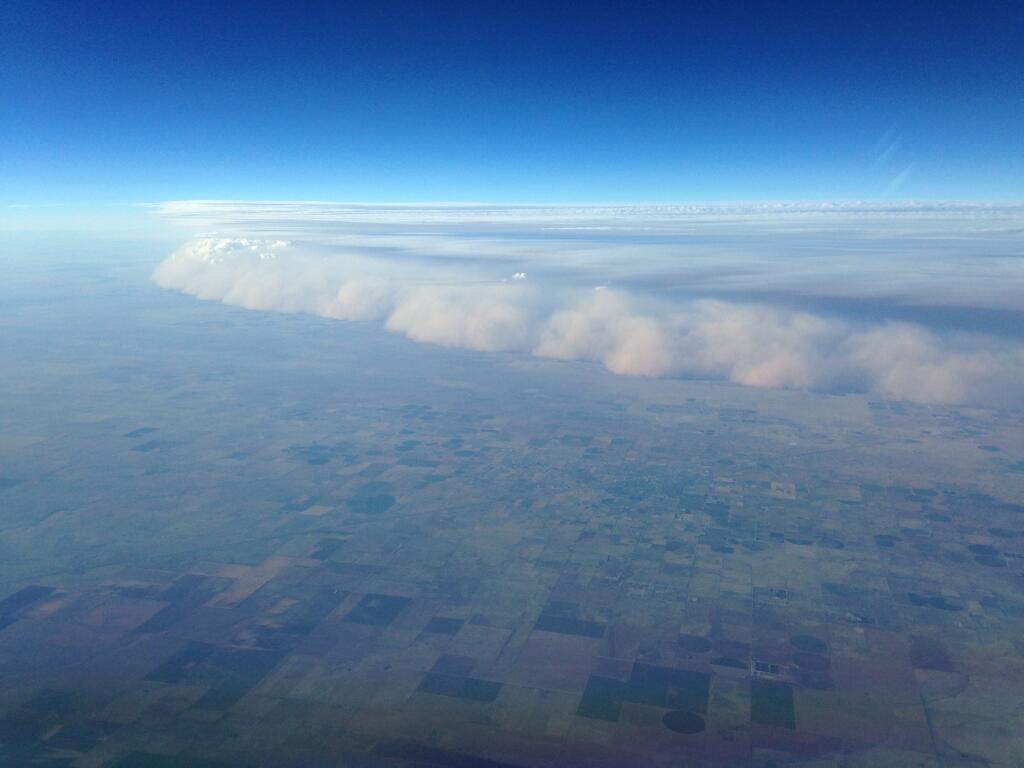
This aerial photo shows the leading edge of a haboob–an intense dust storm–sweeping across Texas last week. Although dust can be stirred up under many circumstances, haboobs are a specific meteorological phenomenon with winds as high as 100 kph and towering clouds of dust kilometers high. This particular storm swept through five US states last week along an incoming cold front. The winds accompanying the cold front swept up silt, dirt, and dust from the drought-ridden Southwest and carried it along to envelope towns and cities along the way. Although the term is Arabic in origin, haboobs occur throughout the world, typically at the leading edge of a cold front or thunderstorm. (Photo credit: R. Scott)
Tag: meteorology

Wind and Waves Visualized

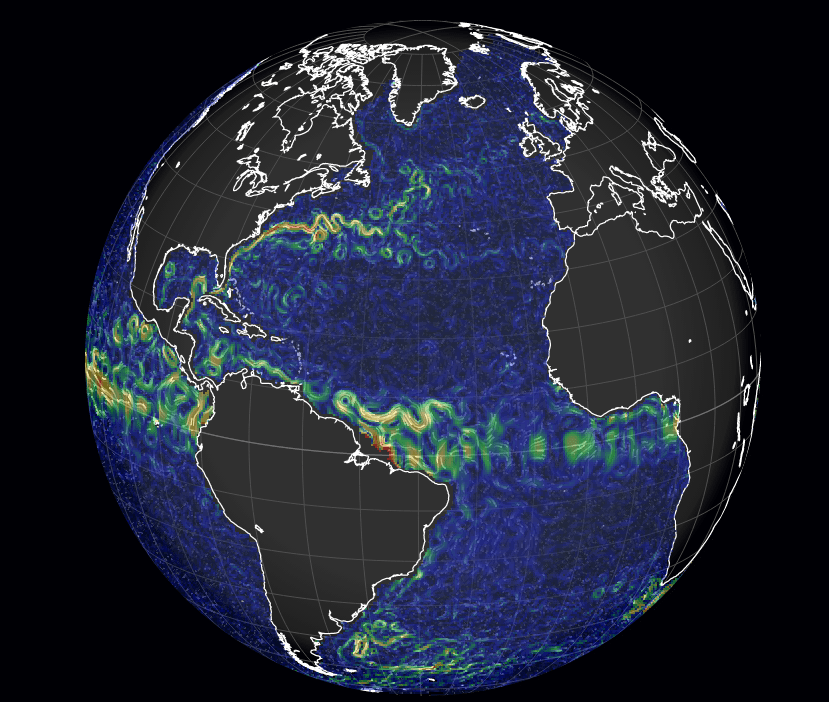
Much like the wind map we featured previously, designer Cameron Beccario’s visualizations of wind and ocean surface current data draw from near-real-time sources to create a stunning picture of fluid dynamics on a planetary scale. The number of options in terms of projections and data are really quite incredible, and you’ll want to play around to get a real sense for it. Want to see the wind and total precipitable water at 1000 hPa? Here you go. Maybe you prefer studying Pacific ocean currents. All the data are there to play with. People often wonder why weather forecasts aren’t always right, but, when you look at the scale and complexity of these flows, it’s almost a wonder that we can predict them at all. (Image credits:C. Beccario/earth; via skunkbear and io9)

Snow Rollers


Snow rollers are nature’s snowballs, formed when high winds roll a chunk of snow along the surface, allowing it to accumulate more and more material. They occur relatively rarely because their appearance is the culmination of several specific meteorological factors. To form rollers, the ground needs to be icy, with a layer of loose, wet snow above the ice. And, of course, it needs to be windy enough to move the snow without being so windy that snow breaks up. In the photos above, the snow roller got too large for the wind to continue moving it, but the wind didn’t stop blowing. Instead, the snow roller became an obstacle to the flow and a horseshoe vortex formed at its base. The spinning of the vortex dug out the trench in front of and along the sides of the snow roller. This same effect is often seen on the windward side of trees in winter. (Photo credit and submission: S. Benton)

Fluids Round-up – 11 January 2014
It’s a big fluids round-up today, so let’s get right to it.
- Over at txchnologist, there’s a great article on controlling combustion instabilities in rocket engines with sound.
- Quanta Magazine asks if knot theory can help unravel turbulence. (submitted by iamaponyrocket)
- SciAm takes a look at how FIFA finally got their aerodynamics right so that their video game football (soccer) balls fly correctly.
- The Smithsonian considers an important question: can you fry foods in space?
- The Navy unveiled a fantastic new facility for simulating ocean waves (via J. Ouellette)
- At SciAm, there’s a nice explanation of the polar vortex and its effects on recent freezing weather. For additional background, check out this excerpt from a presentation by meteorology professor Jennifer Francis. (via Nicholas Travers)
- Cold weather also brings a host of new viral videos; NatGeo explains some of the science behind instant snow, ice fog, and frozen bubbles. See also: our own explanation of the instant snow phenomenon.
- io9 looks at the physics of knuckleballs.
- Over at Wired, Rhett Allain questions whether dwarves should stand in floating barrels. Also on the subject of The Hobbit, here’s an analysis of fire-breathing in dragons.
- At SciAm, Kyle Hill explains how inertia lets one pour a drink toward the sky.
- SciAm reports on a manufacturing process for superhydrophobic paper.
- I don’t know what banking has to do with a pool of non-Newtonian fluids, but this Malaysian ad sure makes it look fun. (via physicsphysics and jmlinhart)
- Wired has a great write-up on the mantis shrimp, which kills its prey with cavitation.
- io9 tackles explaining one of the most vexing brain teasers in fluid dynamics, the Feynman sprinkler.
- Finally, today’s lead image comes from our friends at Think Elephants, who study elephant intelligence over in Thailand and occasionally capture the animals’ mastery of fluid dynamics. Be sure to check them out and follow them on Twitter and Facebook.
(Photo credit: Think Elephants International/R. Shoer)

Fluids Round-up – 7 December 2013
Fluids round-up time! I missed out last weekend because of the holidays, so this is a long list of links. There’s a lot of really great stuff here, including some neat fluidsy geophysics and astronomy.
- xkcd’s Randall Munroe explains why you can’t boil your tea by stirring it.
- LATimes describes a flying jellyfish robot.
- Wired takes a detailed look at archerfish physics, including some of the fluid dynamics we’ve discussed previously. (via iamaponyrocket)
- Several readers have also pointed out this ASCII CFD simulator, seen in action in this video.
- New models suggest that Europa’s chaotic terrain features may be due to turbulence in its lower latitudes.
- In a similar vein, nearby Jupiter’s Great Red Spot may owe its longevity to existing in three-dimensions.
- NASA revealed new movies and images of Saturn’s polar hexagon this week. For more, see some of the earlier photos and laboratory recreations of the hexagon and this summary from io9. (submitted by @AndrisPiebalgs)
- Continuing with the astronomical bent, check out Anders Sandberg’s musings on what a habitable planet twice the size of Earth would be like.
- Back here on Earth, NASA released some impressive images of global weather patterns as computed by their high-resolution models.
- PhysicsBuzz takes a look at the fluid dynamics of flying fish.
- I’ve seen plenty of videos of people doing crazy things with non-Newtonian fluids, but Hard Science adds an interesting new one: attempting to ride a bike across a pool of oobleck.
- PopSci reported from CES 2013 about a non-Newtonian fluid for protecting tech gadgets from impacts.
- Drummer Ali Siadat shows how to blow the perfect smoke rings using a bass drum. (via Jennifer Ouellette)
- Finally, this week’s lead image comes from the Grand Canyon where a strong temperature inversion created spectacular fog-filled vistas.
(Photo credit: E. Whittaker)

Lenticular Clouds Over Ice

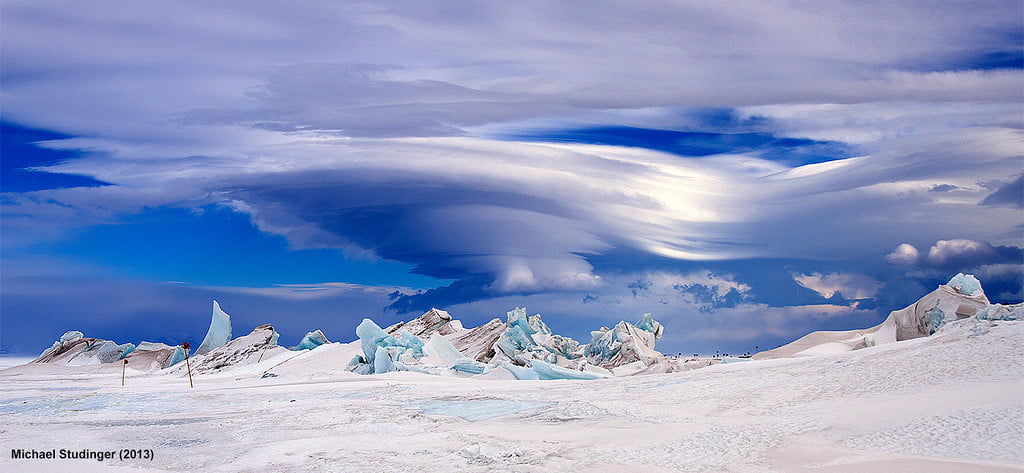
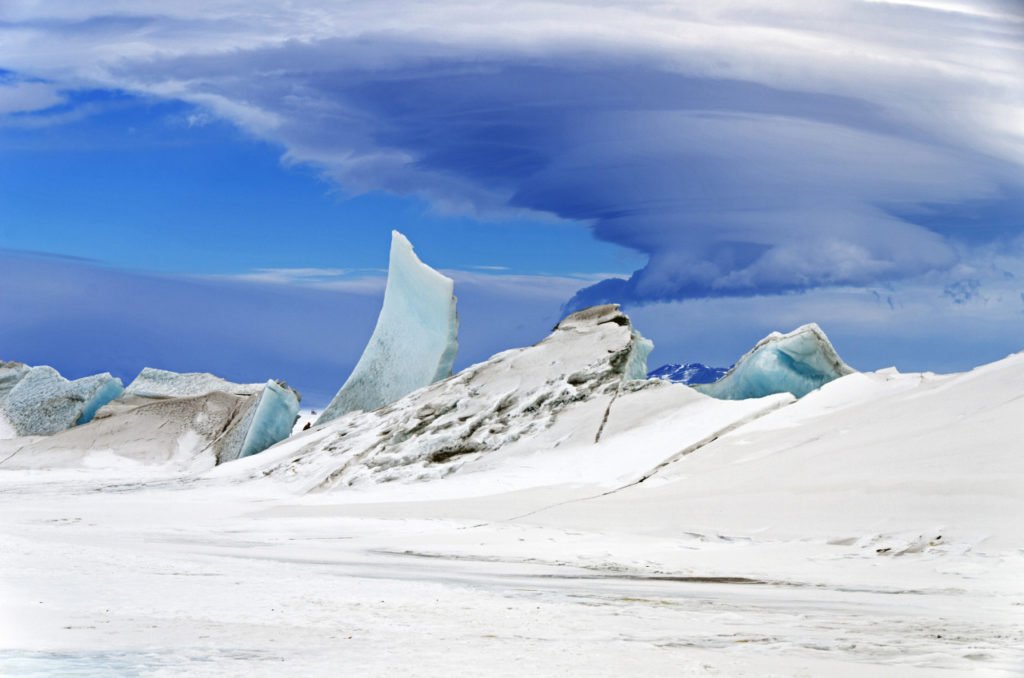
Lenticular clouds, like the one shown above, often attract attention due to their unusual shape. These stationary, lens-shaped clouds can form near mountains and other topography that force air to travel up and over an obstacle. This causes a series of atmospheric gravity waves, like ripples in the sky. If the temperature at the wave crest drops below the dew point, then moisture condenses into a cloud. As the air continues on into a warmer trough, the droplets can evaporate again, leaving a stationary lenticular cloud over the crest. This particular lenticular cloud was captured by Michael Studinger during Operation IceBridge in Antarctica. The line of ice in the foreground is a pressure ridge of sea ice formed when ice floes collided. (Photo credit: M. Studinger; via NASA Earth Observatory)

North Dakota Ice Disk
Cold weather can create some wild fluid dynamics, so pay attention to your local rivers and waterfalls during the next cold snap. The video above comes from North Dakota where a combination of cold dense air and a stable river eddy created a spinning ice disk, roughly 16 meters in diameter. The disk forms as a collection of ice chunks–not one solid, spinning piece–because the ice formed gradually. As ice pieces form, they get caught in the river eddy and begin to spin as part of the disk, rather like dust and ice do in the rings of Saturn. Such formations are rare but not unheard of; here’s a video showing a similar disk as it grows. (Video credit: G. Loegering; via Yahoo and io9; submitted by Simon H and John C)
The Glory of a Roll Cloud
Roll clouds stretch like a long horizontal tube, spinning as they process across the sky. This class of arcus cloud is relatively rare but occasionally forms in areas where cool air is sinking, along the downdraft of an oncoming storm or in coastal regions as a result of sea breezes. The cooler, sinking air displaces warmer, moist air to higher altitudes where the moisture condenses into a cloud. Winds then roll the cloud parallel to the horizon. Roll clouds are a form of soliton, a solitary wave with a single crest that moves without changing its shape or velocity; this is why the cloud appears so regular as it moves across the sky. These clouds are sometimes also called Morning Glory clouds and form regularly off the coast of Queensland, Australia around October. (Video credit: T. and B. Mask)
A reminder, for those attending the APS DFD conference this weekend: my FYFD talk will be Sunday evening at 5:37pm in Rm 306/307. I will be discussing, among other things, the results of July’s reader survey and science communication.
10 Years of Weather
This timelapse video captures the past 10 years’ worth of weather as seen by the GEOS-12 satellite during its service. It’s a mesmerizing look at the large-scale convective flow of Earth’s atmosphere. The prevailing winds for each region are clear from the motion of the clouds, but short-term effects are visible as well. June through November marks the Atlantic hurricane season, and you can see as storm after storm gets generated near western Africa and shoots westward toward North and Central America. You can also see the pattern tracks of these storms in these maps, which show 170 years’ worth of worldwide hurricane tracks. (Video credit: NOAA; via Scientific American)

Fluids Round-up – 13 July 2013
Prepare yourselves for lots of links in today’s fluids round-up!
- Longtime FYFD favorite Mark Stock (see here, here, and here) and his collaborator James Susinno have unveiled a new interactive art piece, “Everything is Made of Atoms” that utilizes some impressive real-time fluids simulation. NVIDIA’s blog has some details on the computing.
- ScarbsF1 takes a detailed look at the F-duct used to stall an F1 car’s rear wing to reduce drag. (submitted by Vinnie)
- Just in time for summer fun, National Geographic talks about the physics of water slides.
- SpaceX’s reusable Grasshopper rocket has set a new altitude test of over 1000 ft. Check out this feat of aerodynamic control over at io9.
- Stanford engineers are using high-speed video of birds in the wild to study the mechanics of flapping flight. If you check out their video, you’ll notice how the birds rotate their wings as they flap in order to maximize lift throughout the flapping cycle. (via io9)
- Speaking of io9, they highlighted a couple of great examples of meteorological fluid dynamics recently: roll clouds and water spouts.
- New research suggests that thresher sharks may whip their tails quickly enough to produce cavitation-induced shockwaves to stun their prey. If so, they join the pistol and mantis shrimp in utilizing this technique for hunting.
- If you’re looking for some casual games, Liquid Sketch is a fun fluids puzzle game for iOS (submitted by Keri B)
- Finally, congratulations to Toronoto’s AeroVelo for capturing the AHS Sikorsky Prize with their human-powered helicopter. Check out this video from their historic flight (submitted by Chris R).
(Photo credit: AeroVelo)