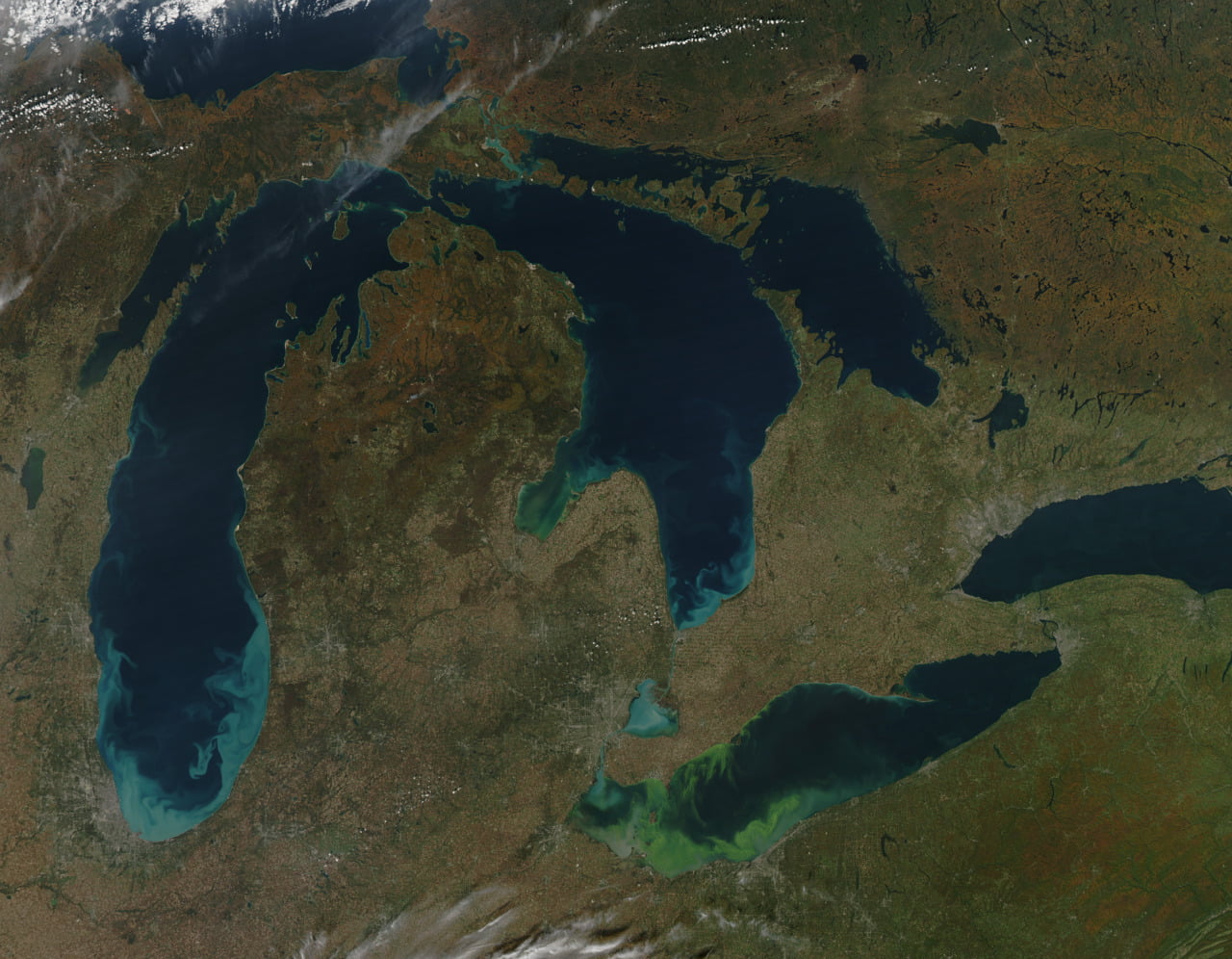
Swirls of blue in the Great Lakes mark locations of recent autumn storms whose winds have stirred up sediment in the lakes. The silt and quartz sand acts as a tracer particle, making visible the circulation patterns of the lakes. In contrast, the green streaks mark locations of calmer winds and warmer temperatures where algae blooms have grown. Note the fundamental dissimilarity in their structures. Blue eddies turn over and mix in a fashion reminiscent of convective instabilities while the green blooms are far more uniform in structure. #
Tag: meteorology

Cloud Streets
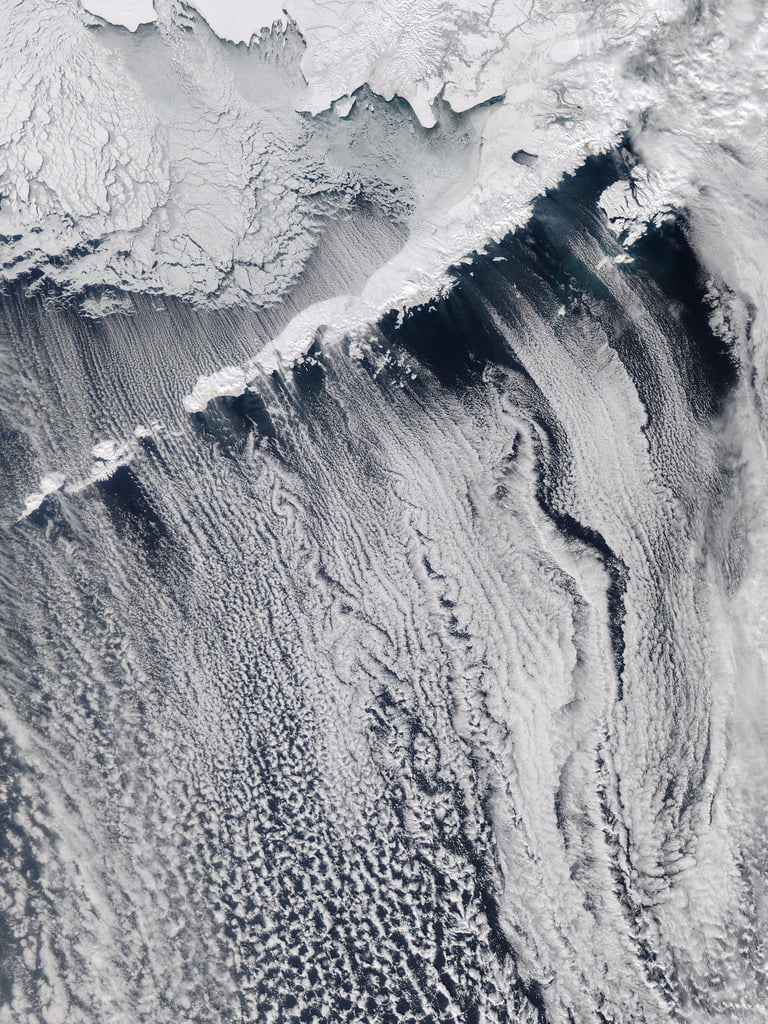
Cloud streets–long rows of counter-rotating air parallel to the ground in the planetary boundary layer–are thought to form as a result of cold air blowing over warm waters while caught beneath a warmer layer of air, a temperature inversion. As moisture evaporates from the warmer water, it creates thermal updrafts that rise through the atmosphere until they hit the temperature inversion. With nowhere to go, the warmer air tends to lose its heat to the surroundings and sink back down, creating a roll-like convective cell. (Photo credits: NASA Terra, NASA Aqua, and Tatiana Gerus)

Hurricane Irene
This August 25th satellite image shows Hurricane Irene over the Bahamas and Florida. Hurricanes are fueled largely by the release of heat as warm water vapor in the rising air condenses. The hurricane requires a body of warm water to sustain the process, which is why hurricanes weaken drastically after they make landfall. Over open water, the heat released by condensation fuels higher winds, which lowers the pressure at the center of the system and helps increase the rate of evaporation near the ocean surface, providing additional warm vapor for future condensation. See more photos of Irene from space, along with video from the ISS. #

Saturn’s Storm Stretches All the Way Around
This picture captured by Cassini in February shows a storm on Saturn stretching all the way around the planet. Unlike Earth and Jupiter, which have numerous storms virtually all the time, Saturn tends to store energy in its atmosphere for decades and then release it all at once in mega-storms like this one. #

Cloud Ocean
Time-lapse photography is great for capturing the fluid motion of clouds over the course of a day.