Search results for: “waves”

  • Strata of Starlings

    Strata of Starlings

    Starlings come together in groups of up to thousands of birds for the protection of numbers. These flocks form spellbinding, undulating masses known as murmurations, where the movement of individual starlings sends waves spreading from neighbor to neighbor through the group. One bird’s effort to dodge a hawk triggers a giant, spreading ripple in the flock.

    To capture the flowing nature of the murmuration, photographer and scientist Kathryn Cooper layers multiple images of the starlings atop one another. The birds themselves become pathlines marking the murmuration’s motion. The final images are surprisingly varied in form. Some flocks resemble a downpour of rain; others the dangling branches of a tree. (Image credit: K. Cooper; via Colossal)
    Fediverse Reactions
  • A New Mantle Viscosity Shift

    A New Mantle Viscosity Shift

    The rough picture of Earth’s interior — a crust, mantle, and core — is well-known, but the details of its inner structure are more difficult to pin down. A recent study analyzed seismic wave data with a machine learning algorithm to identify regions of the mantle where waves slowed down. These shifts in seismic wave speed occur in areas where the mantle’s viscosity changes; a higher viscosity makes waves travel slower.

    The team found seismic wave speed shifts at depths of 400 and 650 kilometers, corresponding to known viscosity changes. But they found shifts at 1050 and 1500 kilometers, as well — the first time anyone has shown a global viscosity shift at those depths. Their analysis suggests a higher viscosity in this mid-mantle transition zone, which could affect how tectonic plates, which rely on these slow mantle flows, move. (Image credit: NASA; research credit: K. O’Farrell and Y. Wang; via Eos)

  • The Best of FYFD 2024

    The Best of FYFD 2024

    Welcome to another year and another look back at FYFD’s most popular posts. (You can find previous editions, too, for 2023, 2022, 2021, 2020, 2019, 2018, 2017, 2016, 2015, and 2014. Whew, that’s a lot!) Here are some of 2024’s most popular topics:

    This year’s topics are a good mix: fundamental research, civil engineering applications, geophysics, astrophysics, art, and one good old-fashioned brain teaser. Interested in what 2025 will hold? There are lots of ways to follow along so that you don’t miss a post.

    And if you enjoy FYFD, please remember that it’s a reader-supported website. I don’t run ads, and it’s been years since my last sponsored post. You can help support the site by becoming a patronbuying some merch, or simply by sharing on social media. And if you find yourself struggling to remember to check the website, remember you can get FYFD in your inbox every two weeks with our newsletter. Happy New Year!

    (Image credits: dam – Practical Engineering, ants – C. Chen et al., supernova – NOIRLab, sprinkler – K. Wang et al., wave tank – L-P. Euvé et al., “Dew Point” – L. Clark, paint – M. Huisman et al., iceberg – D. Fox, flame trough – S. Mould, sign – B. Willen, comet – S. Li, light pillars – N. Liao, chair – MIT News, Faraday instability – G. Louis et al., prominence – A. Vanoni)

    Fediverse Reactions
  • Wave Clouds in the Atacama

    Wave Clouds in the Atacama

    Striped clouds appear to converge over a mountaintop in this photo, but that’s an illusion. In reality, these clouds are parallel and periodic; it’s only the camera’s wide-angle lens that makes them appear to converge.

    Wave clouds like these form when air gets pushed up and over topography, triggering an up-and-down oscillation (known as an internal wave) in the atmosphere. At the peak of the wave, cool moist air condenses water vapor into droplets that form clouds. As the air bobs back down and warms, the clouds evaporate, leaving behind a series of stripes. You can learn more about the physics behind these clouds here and here. (Image credit: Y. Beletsky; via APOD)

    Fediverse Reactions
  • A Dandelion-Like Supernova Remnant

    A Dandelion-Like Supernova Remnant

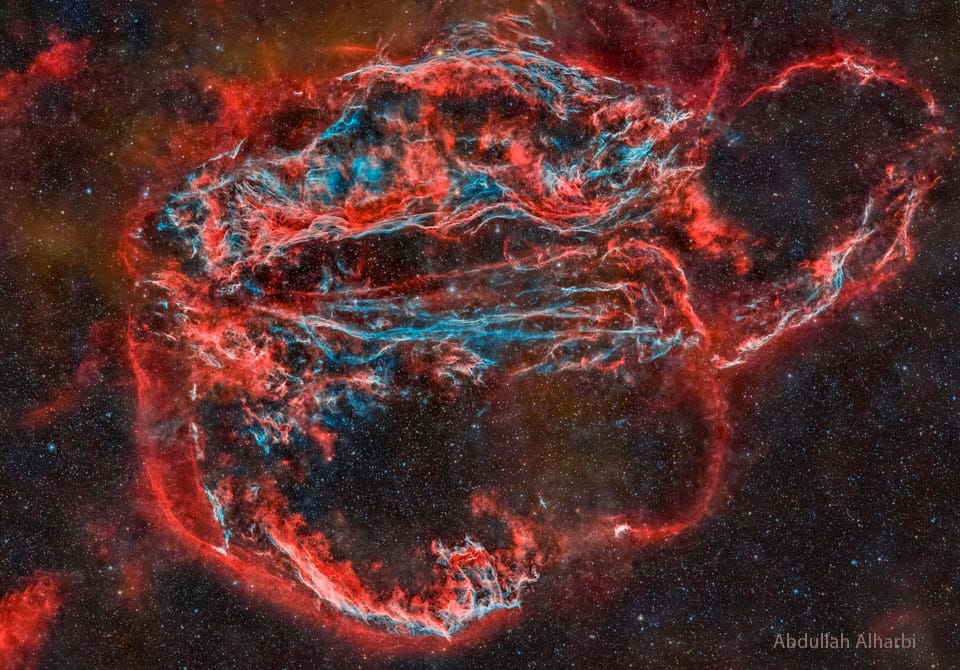
    In 1181 CE, astronomers in China and Japan recorded a new, short-lived star in the constellation Cassiopeia. After burning for nearly six months, this historic supernova disappeared from the naked eye. It was only in 2013 that an amateur astronomer identified a nebula in the vicinity of that supernova, and, in the years since, astronomers have collected evidence that identifies the object, known as Pa 30, as the remnants of that 1181 supernova. Now, astronomers have mapped the supernova remnant, revealing an unusual dandelion-like structure (shown in an artist’s conception above and below). Filaments of sulfur project outward from a dusty central region that houses the remains of the original star. Normally, a supernova destroys its original star, but this was a Type Iax supernova, a “failed” explosion that left behind a hot, inflated star that may eventually cool into a white dwarf star.

    Why the supernova remnant has this strange shape remains unclear. Scientists speculate that shock waves may have helped concentrate sulfur into these clumpy filaments. The material’s velocity suggests a ballistic trajectory (meaning, essentially, that it has neither sped up nor slowed down since the original explosion). Winding the trajectory backwards pegs their origin to 1181, helping confirm that Pa 30 is, indeed, the remains of that 1181 supernova. (Image and video credit: W.M. Keck Observatory/A. Makarenko; research credit: R. Fesen et al.; via Gizmodo)

  • Featured Video Play Icon

    “Colors of Glacial Rivers”

    As glaciers flow, they grind down rock, creating fine sediment that dyes waterways a milky color. In Jan Erik Waider’s aerial film, we get a bird’s eye view of the result, watching pockets of sediment move downstream in pulsating waves and swirls. Along the coast, ocean waves pass over the internal ones, creating a mesmerizing crisscrossed wavescape. You can also compare Waider’s aerial footage to Roman De Giuli’s tabletop-scale films and be amazed by their similarities. (Image and video credit: J. Waider; via Colossal)

  • Breaking in Rogue Seas

    Breaking in Rogue Seas

    Many models for forecasting ocean waves simplify the physics by assuming that waves are essentially two-dimensional, like a long breaker heading toward shore. But in the open ocean, waves often come from more than one direction; crossing seas are a good example. When waves from different directions combine, a recent study shows, the resulting wave can grow far larger and steeper than expected. These monstrous rogue waves are especially dangerous for offshore infrastructure like oil rigs and wind turbines, which must be built to withstand rare but extreme waves. (Image credit: O. Мороз; research credit: M. McAllister et al.; via Gizmodo)

  • Water Suspected Beneath Mars

    Water Suspected Beneath Mars

    The surface features of Mars — crossed by river deltas and sedimentary deposits — indicate a watery past. Where that water went after the planet lost its atmosphere 3 – 4 billion years ago is an open question. But a new study suggests that quite a bit of that water moved underground rather than escaping to space.

    The research team analyzed seismic data from the Mars InSight Lander. Marsquakes and meteor strikes on the Red Planet send seismic waves through the planet’s interior. The waves’ speed and other characteristics change as they pass through different materials, and by comparing different waves picked up from the same originating source, scientists can back out what the waves passed through on the way to the detector. In this case, the team concluded that the data best fit a layer of water-filled fractured igneous rock 11.5 – 20 kilometers below the surface. They estimate that the water trapped in this subsurface layer is enough to cover the surface of the planet in a 1 – 2 kilometer deep ocean. (Image credit: NASA/JPL-Caltech; research credit: V. Wright et al.; via Physics World)

  • Beneath the Surf

    Beneath the Surf

    A surfer duck-dives beneath a passing wave in this image from photographer John Barton. I always love seeing big waves from this underwater perspective. The turbulent surf looks like storm clouds, and sometimes you see features that are invisible from the surface. Barton’s shot captures the dichotomy of serenity and chaos in the breaking surf. (Image credit: J. Barton/OPOTY; via Colossal)

  • Paris 2024: Gunwale Bobbing

    Paris 2024: Gunwale Bobbing

    In the Olympics, you won’t see anyone win a rowing event without a paddle, but it turns out that you don’t really need one for a canoe or paddleboard. How can you get around when you’ve lost your paddle? You stand up on one end and start bobbing. This is known as gunwale (pronounced gunnel) bobbing, and it’s pretty impressively effective! With optimal parameters, scientists found that a canoe could move about 1 m/s with the technique.

    As the bobber pushes, it generates an asymmetric wave field on the water surface. The canoe or paddleboard then essentially surfs those waves, turning the vertical displacement into a horizontal thrust. The researchers expect that the effect matters for competitive rowing, too, where the athletes’ rowing motions cause some vertical displacement. Clearly, the biggest effect comes from the oars themselves, but optimal bobbing could provide enough of an edge to ensure the gold. (Image credit: top – R. Chisu; others – G. Benham et al.; research credit: G. Benham et al.; via APS Physics; submitted by Kam-Yung Soh)

    Related topics: Optimizing oar length, vorticity around an oar, and a vibration-propelled biorobot

    See more of our past and ongoing Olympic coverage here.