
When a space shuttle lands, a lucky few will hear twin sonic booms as it passes overhead. The double boom occurs due to the shock waves from in front of the shuttle and just behind it passing the observer on the ground. The colorized schlieren photograph above shows shock waves on a model of an early shuttle prototype. The fore and aft shocks that run from the craft to the ground are even clearer on this photo of a T-38 in flight. (Photo credit: Gary Settles)
Search results for: “waves”
Supersonic Bullet
[original media no longer available]
This video shows a CFD simulation of a bullet passing through a parallel channel at Mach 2. The simulation captures 3 milliseconds of real-time and shows the Mach number in the top view and the temperature in the bottom view. Note how the bow shock near the front of the bullet and the trailing shock behind it reflect off the walls of the channel and interact. Even though the calculation is inviscid, the shock waves cause intense heating (white) in front of and behind the bullet.

Liquid Acrobatics
Imagine blowing through a straw into a nearly empty glass–we probably all did this as children and sent water, milk, and soda flying everywhere! In essence, this video shows that same act, but filmed by a high-speed camera. The “straw” blows a steady stream of helium into a shallow pool of silicone oil and slowly moves so that the angle the straw makes with the pool changes. As the angle changes, different regimes are visible. First waves appear on the surface of the pool, then a bulge forms, which develops into a droplet stream, then on into the chaos of bubbles and jets. It’s good I couldn’t see this in slow motion as a child or I would have never used my straw for drinking!

Rocket Exhaust
This image of the Apollo 11 launch shows the Saturn V’s underexpanded nozzle (identifiable by the excessive width of the exhaust jet) shortly after liftoff. The faint diamond shape of the exhaust is a series of shock waves and expansion fans that equalize the exhaust pressure to the ambient. In general, a rocket nozzle is most efficient when it expands the exhaust to ambient pressure, but, since ambient pressure changes with altitude, designers have to choose a particular altitude for peak efficiency or design a nozzle capable of changing its shape with altitude.
Tsunami Simulation
This simulation shows how tsunami waves are expected to spread from the epicenter of the Japanese magnitude-8.9 earthquake. Note the complicated interference and reflection patterns. The main wavefront moved at a speed of about 230 m/s (830 km/h) between Japan and Hawaii.
Cornstarch Monsters
The patterns formed when vibrating a liquid on a speaker cone are standing waves known as Faraday waves. With a large enough amplitude, this produces some very cool effects with a shear-thickening non-Newtonian fluid like oobleck. (It would actually be interesting to see what happens when you vibrate a shear-thinning liquid like shampoo…) This video also details how you can set up this demonstration yourself at home.

Rocket Launch Phenomena
The launch of the Solar Dynamics Observatory (SDO) last year provided a rarely seen glimpse of how shock waves affect the atmosphere during launch, but only recently have researchers explained the white column that seemed to follow SDO toward orbit. Simulations indicate that the shock waves from the rocket aligned the ice crystals in the atmosphere into an array of spinning tops. Individual crystals precess as a result of the rocket passing; the column is part of a larger oval that would have been visible had the ice crystals covered a larger range. See Wired for more. #
Reader Question: Froude vs. Reynolds
@spooferbarnabas asks: I was wondering what the difference is between Froude’s number and Reynold’s number? they seem very similar
Fluid dynamicists often use nondimensional numbers to characterize different flows because it’s possible to find similarity in their behaviors this way. The Reynolds number is the most common of these dimensionless numbers and is equal to (fluid density)*(mean fluid velocity)*(characteristic length)/(fluid dynamic viscosity). The Reynolds number is considered a ratio of total momentum (or inertial forces) to the molecular momentum (or viscous forces). A small Reynolds number indicates a flow dominated by viscosity; whereas a flow with a large Reynolds number is considered one where viscous forces have little effect.
The Froude number, in contrast, focuses on resistance to flow caused by gravitational effects, not molecular effects. It is defined as (mean fluid velocity)/(characteristic wave propagation velocity). Initially, it was developed to describe the resistance of a model floating in water when towed at a given speed. As the boat’s hull moves through the water, it creates a wave that travels forward (and backward in the form of the wake), carrying information about the boat–much like pressure waves travel before and behind a subsonic aircraft. The speed of the wave created by the boat depends on gravity (see shallow water waves). The closer the boat’s speed comes to the water wave’s speed, the greater the resistance the boat experiences. In this respect, the Froude number is actually analogous to the Mach number in compressible fluids.
I hope that helps explain some of the differences!
Vibrating Fluid Interfaces
The Faraday instability forms when a fluid interface is vibrated. This high-speed video shows the differences in the shapes formed by a vibrated fluid interface when the two fluids are miscible–capable of mixing–and when they are immiscible–like oil and water. Note how the miscible interface breaks down quickly into turbulence, but the immiscible interface maintains a complex shape.
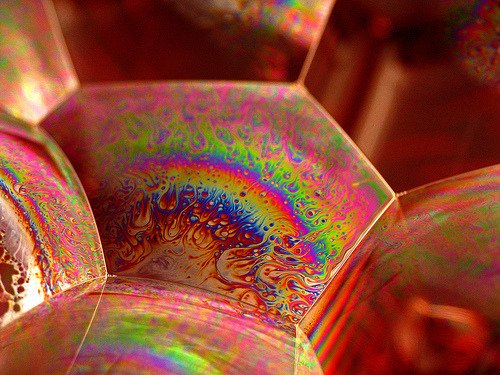
Soap Bubble Shapes
The shapes of soap bubbles are determined by surface tension, which ensures the smallest surface area for a given contained volume. (#) Their iridescent colors are created by the interference and refraction of light waves passing through the nonuniform thickness of the bubble, as well as to the motion of the soap mixture itself.
Photo credit: found via fuckyeaheyegasms, originally from teacupofmoons