Tag: seismic waves

  • Slipping Ice Streams

    Slipping Ice Streams

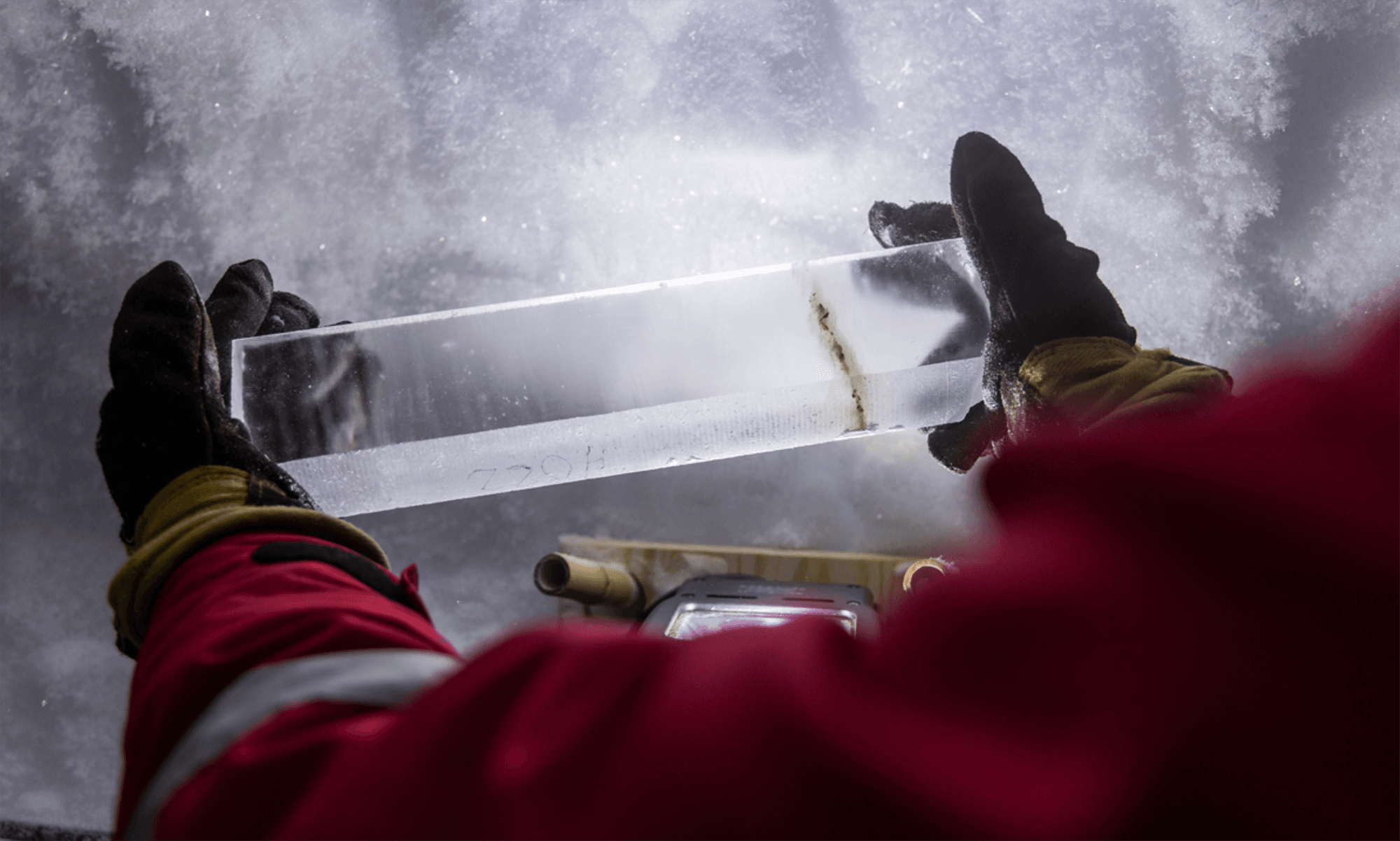
    The Northeast Greenland Ice Stream provides about 12% of the island’s annual ice discharge, and so far, models cannot accurately capture just how quickly the ice moves. Researchers deployed a fiber-optic cable into a borehole and set explosive charges on the ice to capture images of its interior through seismology. But in the process, they measured seismic events that didn’t correspond to the team’s charges.

    Instead, the researchers identified the signals as small, cascading icequakes that were undetectable from the surface. The quakes were signs of ice locally sticking and slipping — a failure mode that current models don’t capture. Moreover, the team was able to isolate each event to distinct layers of the ice, all of which corresponded to ice strata affected by volcanic ash (note the dark streak in the ice core image above). Whenever a volcanic eruption spread ash on the ice, it created a weaker layer. Even after hundreds more meters of ice have formed atop these weaker layers, the ice still breaks first in those layers, which may account for the ice stream’s higher-than-predicted flow. (Image credit: L. Warzecha/LWimages; research credit: A. Fichtner et al.; via Eos)

    Fediverse Reactions
  • A Seismic Warning for the Tongan Eruption

    A Seismic Warning for the Tongan Eruption

    In mid-January 2022, the Hunga Tonga-Hunga Ha’apai (HTHH) volcano had one of the most massive eruptions ever recorded, destroying an island, generating a tsunami, and blanketing Tonga in ash. Volcanologists are accustomed to monitoring nearby seismic equipment for signs of an imminent eruption, but researchers found that the HTHH eruption generated a surface-level seismic wave picked up by detectors 750 kilometers away about 15 minutes before the eruption began. They propose that the seismic wave occurred when the oceanic crust beneath the caldera fractured. That fracture could have allowed seawater and magma to mix above the volcano’s subsurface magma chamber, creating the explosive trigger for the eruption. Their finding suggests that real-time monitoring for these distant signals could provide valuable early warning of future eruptions. (Image credit: NASA Earth Observatory; research credit: T. Horiuchi et al.; via Gizmodo and AGU News)

    Fediverse Reactions
  • Water Suspected Beneath Mars

    Water Suspected Beneath Mars

    The surface features of Mars — crossed by river deltas and sedimentary deposits — indicate a watery past. Where that water went after the planet lost its atmosphere 3 – 4 billion years ago is an open question. But a new study suggests that quite a bit of that water moved underground rather than escaping to space.

    The research team analyzed seismic data from the Mars InSight Lander. Marsquakes and meteor strikes on the Red Planet send seismic waves through the planet’s interior. The waves’ speed and other characteristics change as they pass through different materials, and by comparing different waves picked up from the same originating source, scientists can back out what the waves passed through on the way to the detector. In this case, the team concluded that the data best fit a layer of water-filled fractured igneous rock 11.5 – 20 kilometers below the surface. They estimate that the water trapped in this subsurface layer is enough to cover the surface of the planet in a 1 – 2 kilometer deep ocean. (Image credit: NASA/JPL-Caltech; research credit: V. Wright et al.; via Physics World)

  • Reimagining Mars’ Interior

    Reimagining Mars’ Interior

    Older models of Mars assumed a liquid metal core beneath a solid mantle of silicates, but recent studies indicate that structure is missing at least one layer. Using data from the InSight lander’s seismometer, two teams independently calculated that a liquid silicate layer must surround the planet’s core. In September 2021, three meteorite pieces impacted Mars far from the InSight lander’s position. Since the Mars Reconnaissance Orbiter could exactly pinpoint the impact location, researchers were able to calculate just how long it took seismic waves from the impact to reach the lander.

    Like on Earth, Mars has two varieties of seismic wave: transverse S-waves that only travel through solids and longitudinal P-waves that travel through both liquid and solid layers. S-waves reflect off any liquid-solid boundary, following a different path to a seismometer than P-waves that refract across the boundary and travel through liquid. For more of the story behind this discovery, check out this article at Physics Today. (Image credit: Mars – NASA/JPL-Caltech/University of Arizona, illustration – J. Sieben/J. Keisling; research credit: H. Samuel et al. and A. Khan et al.; via Physics Today)

    An illustration of Mars' interior and the paths followed by seismic waves before InSight picked them up.
    An illustration of Mars’ interior and the paths followed by seismic waves before InSight picked them up.
  • Rocking From The Waves

    Rocking From The Waves

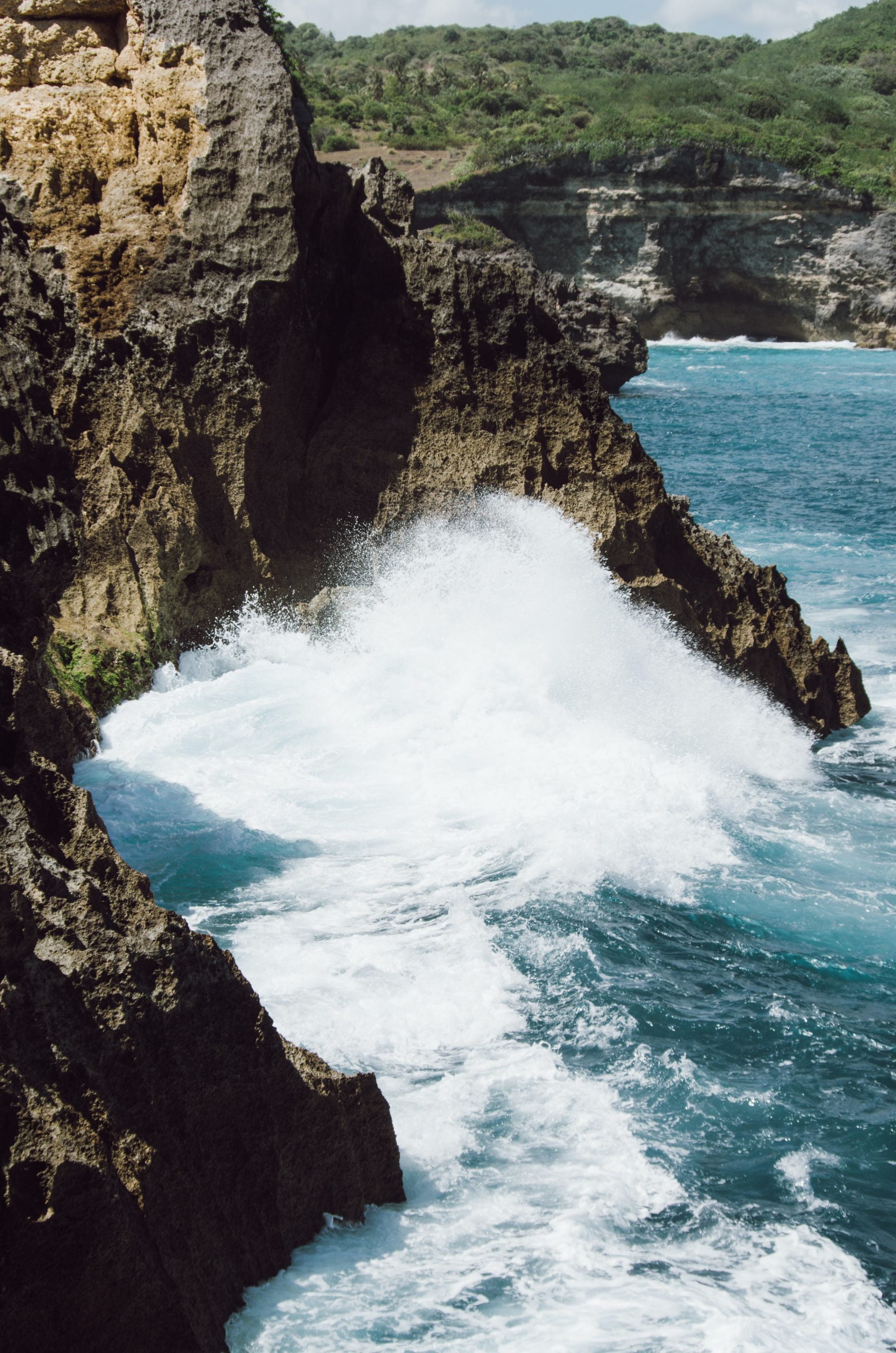
    Not all seismic activity stems from earthquakes. In fact, much of Earth’s measured seismic waves come from interactions of the ocean and atmosphere with solid ground. Some of the strongest vibrations come from interactions of ocean waves, which transmit pressure waves that don’t attenuate with depth before passing into the solid Earth.

    How those waves propagate and scatter inside the Earth has been a matter of contention for decades, but recent simulations are beginning to uncover the mechanisms that lead to the waves seismologists measure. (Image credit: I. Mingazova; via Physics Today)

  • Understanding Stars’ Seismology

    Understanding Stars’ Seismology

    Our understanding of Earth’s interior is based mostly on observations of seismic waves, which travel differently through our rocky crust and the molten core. Scientists similarly use seismic waves in stars to determine their interiors. But the pressure and temperature conditions in stars are far beyond anything we have here on Earth, which makes predicting how waves will travel in such exotic material difficult.

    To better understand these extreme temperatures and pressures, scientists are using Lawrence Livermore’s National Ignition Facility (NIF) to mimic conditions similar to the outer envelope of a white dwarf star, like the one shown in the center of the image above. NIF’s laser array – shown as the blue lines in the artist’s conception above – can generate spherical shock waves that, as they converge on a solid sample, create pressures as high as 450 Mbar, more than 400 million times sea level atmospheric pressure here on Earth. Although the shock wave takes only 9 ns to travel across the sample, it’s enough to give researchers a glimpse into star-like conditions. (Image credit: NASA/ESA/C. O’Dell/D. Thompson, Lawrence Livermore National Laboratory; via Physics Today)