Search results for: “waves”

  • Paris 2024: Triathlon Swimming

    Paris 2024: Triathlon Swimming

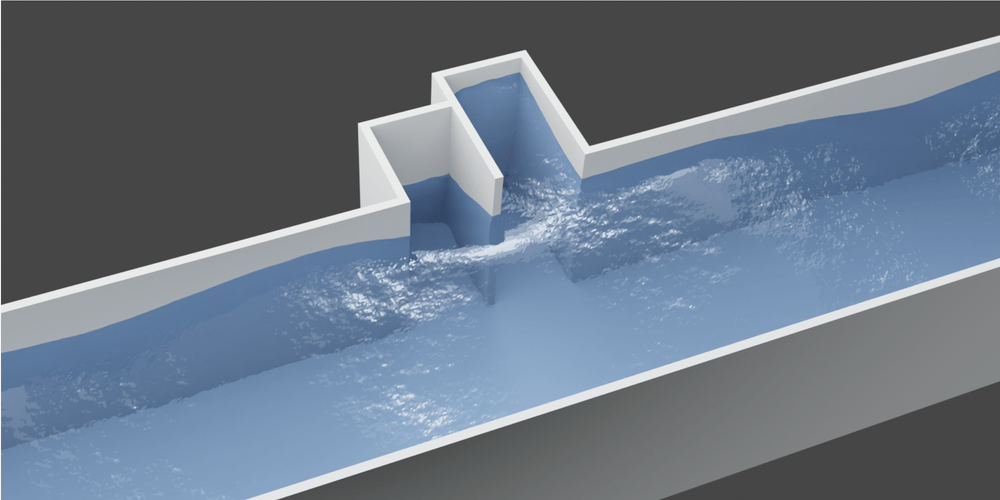
    Unlike the swimming competition, Olympic triathletes complete their swim legs in open waters. There are no lane dividers and no rules against drafting off a fellow athlete. Curious to see how draft positioning could affect swimmers, researchers experimented with swimmer-shaped models in a water channel and a numerical simulation. They found that the most advantageous position is directly behind a lead swimmer, where the follower could enjoy a 40% reduction in drag. Another good position is near the leader’s hip, where waves off the leader provide a 30% reduction in drag.

    The worst place to swim, interestingly, is immediately side-by-side. With both swimmers neck-in-neck, drag is maximized, and each swimmer feels more drag than they would swimming by themselves! (Image credit: J. Romero; research credit: B. Bolan et al.)

    Related topics: Drafting in each triathlon stage and drafting effects in nordic skiing

    Join us all this week and next for more Olympics-themed stories.

  • Searching for Stability in Cleaner Flames

    Searching for Stability in Cleaner Flames

    Spiking natural gas power plants with hydrogen could help them burn cleaner as we transition away from carbon power. But burners in power plants and jet engines can be extremely finicky, thanks to thermoacoustic instabilities. As a flame burns, it can sputter and fluctuate in its heat output. That creates pressure oscillations (which we sometimes hear as sound waves) that reflect off the burner’s walls and return toward the flame, causing further fluctuations. This feedback loop can be destructive enough to explode combustion chambers.

    Adding hydrogen to a burner designed purely for natural gas can trigger these instabilities (above image), but researchers hope that by exploring fuel-mixtures and their effect at lab-scale, they can help designers find safe ways to adapt industrial burners for the cleaner fuel mixture. (Image and research credit: B. Ahn et al.; via APS Physics)

  • Kelvin-Helmholtz and the Sun

    Kelvin-Helmholtz and the Sun

    Kelvin-Helmholtz instabilities (KHI) are a favorite among fluid dynamicists. They resemble the curls of a breaking ocean wave — not a coincidence, since KHI create those ocean waves to begin with — and show up in picturesque clouds, Martian lava coils, and Jovian cloud bands. The instability occurs when two layers of fluid move at different speeds and the friction between them causes wrinkles that grow into waves.

    Scientists have long suspected that KHI could occur in solar phenomena, too, like the coronal mass ejections that drive space weather. The Parker Solar Probe, a spacecraft designed to explore the sun, caught evidence of a series of turbulent eddies during a 2021 coronal mass ejection, and a recent study of those observations shows that the series of vortices are consistent with KHI. Put simply, the team found that the features are spaced and aligned as we’d expect for KHI and, during the probe’s measurements, the features grew at the rate Kelvin-Helmholtz eddies would. Although the instability itself may be common in the sun’s corona, it’s unlikely that we’ll see it often, simply because conditions need to be just right for them to be visible. (Image credit: NASA/Johns Hopkins APL/NRL/Guillermo Stenborg and Evangelos Paouris; research credit: E. Paouris et al.; via Gizmodo)

    Fediverse Reactions
  • Black Holes in a Blender

    Black Holes in a Blender

    Massive black holes drag and warp the spacetime around them in extreme ways. Observing these effects firsthand is practically impossible, so physicists look for laboratory-sized analogs that behave similarly. Fluids offer one such avenue, since fluid dynamics mimics gravity if the fluid viscosity is low enough. To chase that near-zero viscosity, experimentalists turned to superfluid helium, a version of liquid helium near absolute zero that flows with virtually no viscosity. At these temperatures, vorticity in the helium shows up as quantized vortices. Normally, these tiny individual vortices repel one another, but a spinning propeller — much like the blades of a blender — draws tens of thousands of these vortices together into a giant quantum vortex.

    Here superfluid helium whirls in a quantum vortex.
    Here superfluid helium whirls in a quantum vortex.

    With that much concentrated vorticity, the team saw interactions between waves and the vortex surface that directly mirrored those seen in black holes. In particular, they detail bound states and black-hole-like ringdown phenomena. Now that the apparatus is up and running, they hope to delve deeper into the mechanics of their faux-black holes. (Image credit: L. Solidoro; research credit: P. Švančara et al.; via Physics World)

  • Seeking Rogue Wave Origins

    Seeking Rogue Wave Origins

    Rogue waves — rare waves much larger than any surrounding waves — have long been a part of sailors’ tales, but their existence has only been confirmed relatively recently. The exact mechanisms behind them are still a matter of debate. Laboratory experiments with mechanically-produced waves have created miniature rogue waves, but we still lack real-world observations of their formation.

    To that end, researchers sailed the Southern Ocean, known for its rough waves, during austral winter and observed the state of the wind and waves nearby using stereo cameras. They found that young wind-driven waves tend to be steeper, and they move slower than the wind, as they’re still drawing energy from it. Older waves, in contrast, were shorter, less steep, and less likely have white caps from breaking. Overall, they found that strong winds could more easily drive young waves into the nonlinear growth that leads to rogue waves. (Image credit: S. Baisch; research credit: A. Toffoli et al.; via APS Physics)

  • Featured Video Play Icon

    Floating in Sync

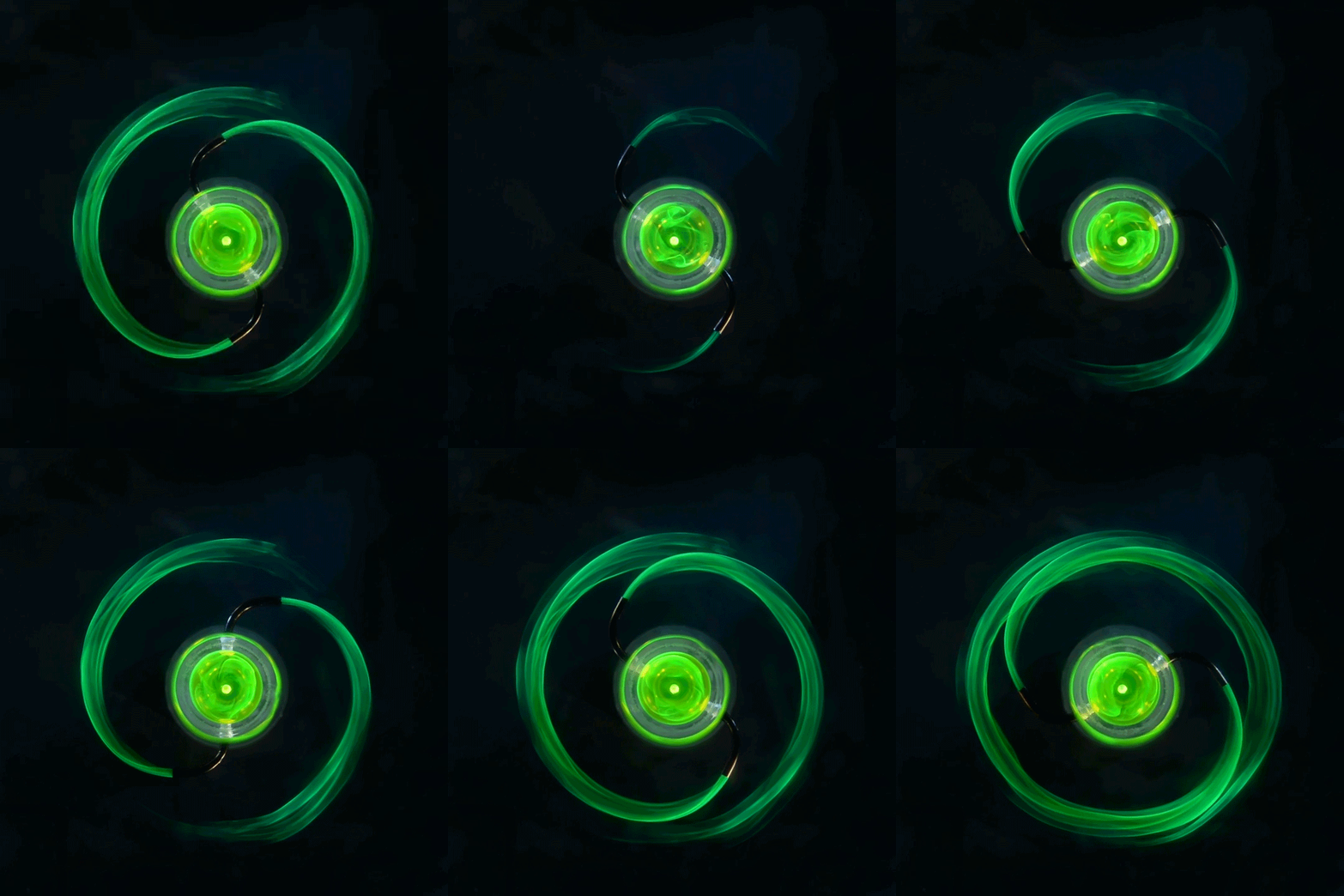
    Objects on a vibrating liquid bath can interact with each other through the waves they make as they bounce. Here, researchers look at three-armed spinners interacting in pairs and in larger groups. A pair of spinners can synchronize so that they spin together or so that they spin in opposing phases. With more spinners, more complex patterns are possible. The spinners can even “freeze” one another by forming a pattern of standing waves that keep them locked in their orientation. (Video and image credit: J. Barotta et al.; via GoSM)

  • Reapproaching Supersonic Air Travel

    Reapproaching Supersonic Air Travel

    Before the Concorde even began regular flights, protests over its sound levels caused the U.S. and many other countries to ban overland commercial supersonic flight. Those restrictions have stood for fifty years. But NASA and Lockheed Martin Aeronautics are hoping to make supersonic air travel a possibility again with their experimental X-59 aircraft, designed to have a much quieter sonic boom.

    In supersonic flight, every curve, bolt, and bump generates a shock wave, and these waves tend to coalesce at the front and back of the aircraft, creating strong leading and trailing shocks. It’s these shock waves that are responsible for the double sonic boom that rattles windows and startles those of us on the ground. The X-59 reduces its noise by spreading out those shock waves, a feat designers managed with heavy reliance on computational fluid dynamics. They used wind tunnel studies mainly for validation, since iterating designs in the wind tunnel was far slower than working computationally. With the initial aircraft built, the team will now do test flights and, starting in 2026, will fly over the public and solicit feedback on whether the aircraft is acceptably quiet. (Image credit: NASA; via Physics Today)

    The sound of the X-59's sonic boom compared to other familiar sound levels.
    The sound of the X-59’s sonic boom compared to other familiar sound levels.
  • Simeis 147

    Simeis 147

    Sometimes known as the Spaghetti Nebula, Simeis 147 is the remnant of a supernova that occurred 40,000 years ago. The glowing filaments of this composite image show hydrogen and oxygen in red and blue, respectively. These are the outlines of the shock waves that blew off the outer layers of the one-time star within. What remains of that star’s core is now a pulsar, a fast-spinning neutron star with a solar wind that continues to push on the dust and gas we see here. (Image credit: S. Vetter; via APOD)

  • Lasers and Soap Films

    Lasers and Soap Films

    Soap films are a great system for visualizing fluid flows. Researchers use them to look at flags, fish schooling and drafting, and even wind turbines. In this work, researchers explore the soap film’s reaction to lasers. When surfactant concentrations in the soap film are low, laser pulses create shock waves (above) in the film that resemble those seen in aerodynamics. The laser raises the temperature at its point of impact, lowering the local surface tension. That temperature difference triggers a Marangoni flow that draws the heated fluid outward. The low surfactant concentration gives the soap film relatively high elasticity, and that allows the shock waves to form.

    In contrast, a soap film with a high concentration of surfactants has relatively little elasticity. In these films (below), the laser creates a mark that stays visible on the flowing soap film. This “engraving” technique could be used to visualize flow in the soap film without using tracer particles. (Image and research credit: Y. Zhao and H. Xu)

    When surfactant concentrations are high, a laser pulse "engraves" spots onto a flowing soap film. Shown in terms of interference (left) and Schlieren (right) imaging.
    When surfactant concentrations are high, a laser pulse “engraves” spots onto a flowing soap film. Shown in terms of interference (left) and Schlieren (right) imaging.
  • Seeding Clouds

    Seeding Clouds

    In the remote South Atlantic, north of the Antarctic Circle, sit the volcanic Zavodovski and Visokoi islands. Though only roughly 500 and 1000 meters tall, respectively, each island disrupts the atmosphere nearby, often generating cloudy wakes. In today’s pair of images, the northerly Zavodovski has a particularly bright cloud wake, thanks to sulfate aerosols degassing from its volcano, Mount Curry. Though it’s hard to pick out the effect in the natural-color image above, the false-color version below shows the bright wake clearly. The filtering on this image turns snow and ice — like that on Visokoi’s peak — red and makes the water vapor of clouds white. The sulfates from Mount Curry act as nucleii for water droplets, forming many small, reflective drops that stand out against the rest of the sky. (Image credit: W. Liang; via NASA Earth Observatory)

    This false-color satellite image highlights the volcanic seeding by filtering snow and ice as red and water vapor in clouds as white.
    This false-color satellite image highlights the volcanic seeding by filtering snow and ice as red and water vapor in clouds as white.