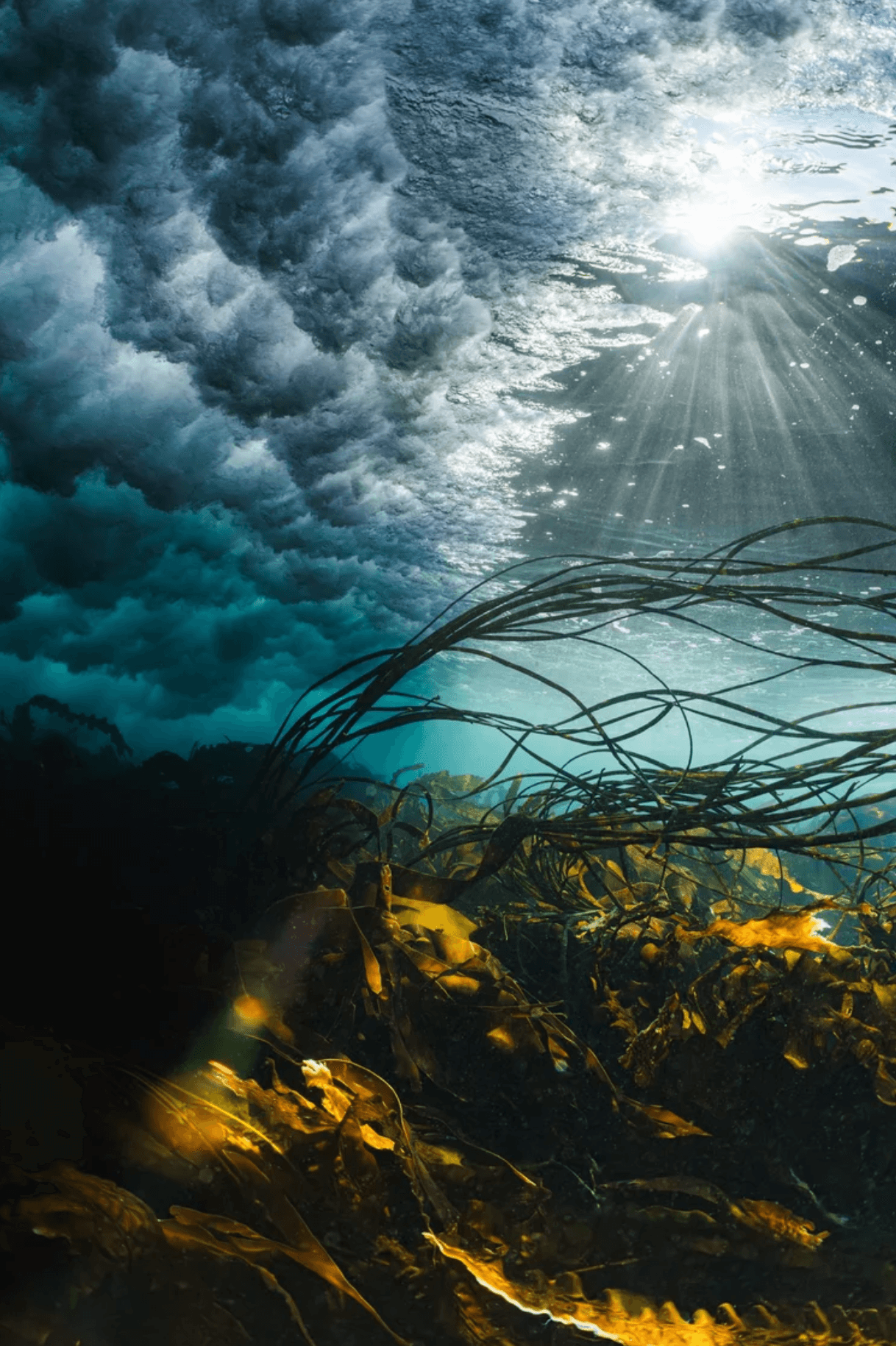
Seaweed sways in the surf in this photograph by Billy Arthur. I always love how waves look like a stormy sky when viewed from below. This image is extra neat because of the contrast with the sunbeams shining through the still surface on the right side of the image. Sun and storm on the verge of colliding. (Image credit: B. Arthur/BWPA; via Colossal)
Our ears, like those of many other animals, convert mechanical signals to electrical ones, through a Rube-Goldberg-esque series of transformations. External sound waves make their way down the soft tube of the ear canal, which funnels them to a thin-walled cone, the eardrum, that’s about half as large as a dime. Here, the vibrating air pushes against the cone’s membrane, and those vibrations travel onward through a linked trio of small bones that amplify the vibration’s amplitude.
The last of these bones presses against an even smaller, oval-shaped membrane. As the bone moves, it shakes the membrane, sending waves through the liquid on its other side. Those waves travel down the spirals of the tiny, pea-sized cochlea, named for a snail shell’s shape. As the waves move through the liquid, they bend bundles of hair-like strands back and forth, like tall grass waving in a breeze. The bending triggers a chemical that binds to nerves at the base of the bundles, sending an electrical signal through the nerve and into the brain.
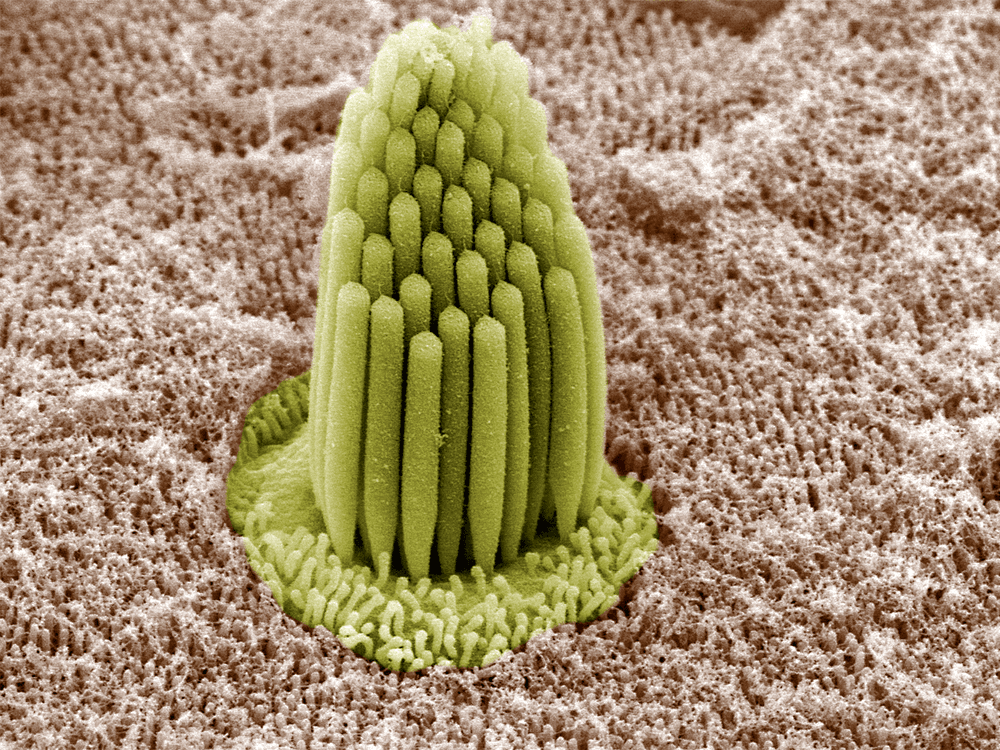
But the hair-like bundles, known as stereocilia, are also able to amplify incoming vibrations. In this case, the bundles in the outer portion of the cochlea expend energy to bend more than the incoming vibrations naturally make them move. This bending amplifies the fluid motion that gets transmitted to stereocilia further down the line; it’s those bundles that will make the final conversion to an electrical signal the brain receives. (Image credit: B. Kachar; research credit: Y. Thipmaungprom et al.; via APS)
Scanning electron microscope view of the stereocilia “hair bundles” inside a frog’s inner ear.
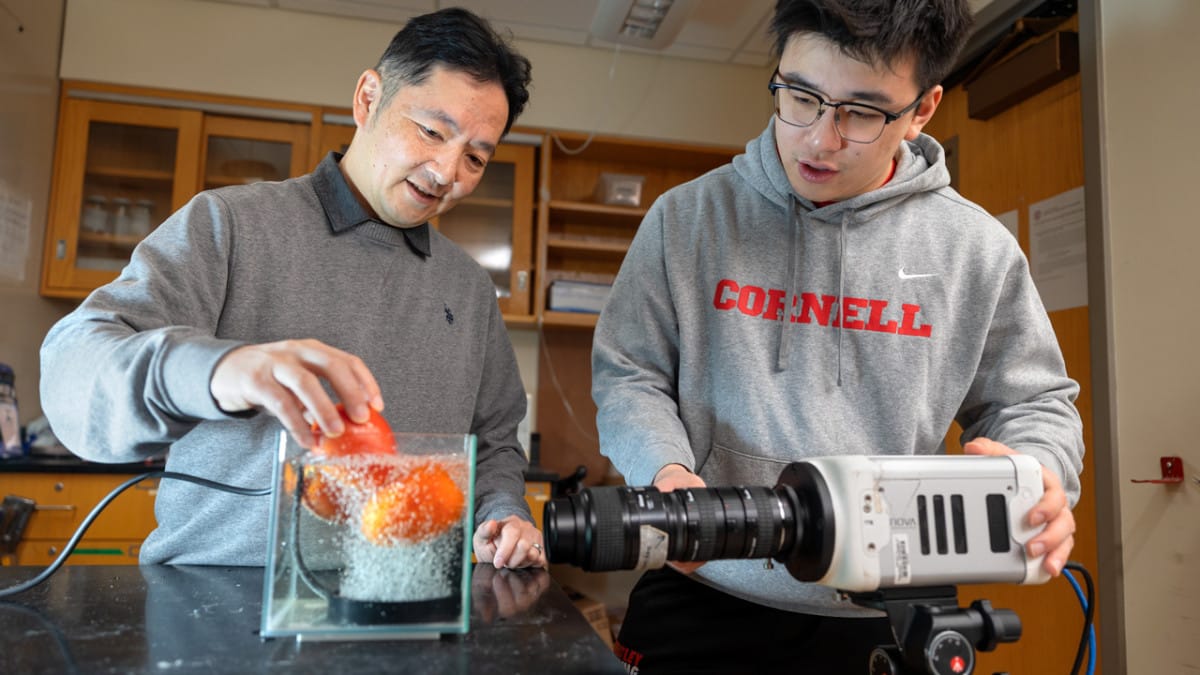
Cleaning produce helps fruits and vegetables last longer and reduces the chances for foodborne illness. But it can be a difficult feat with soft, delicate foods like tomatoes, berries, or greens. Current methods often combine ultrasonic cleaning and chemicals like chlorine. Instead, researchers are looking to boost the cleaning power of bubbles themselves by giving them an acoustic pick-me-up.
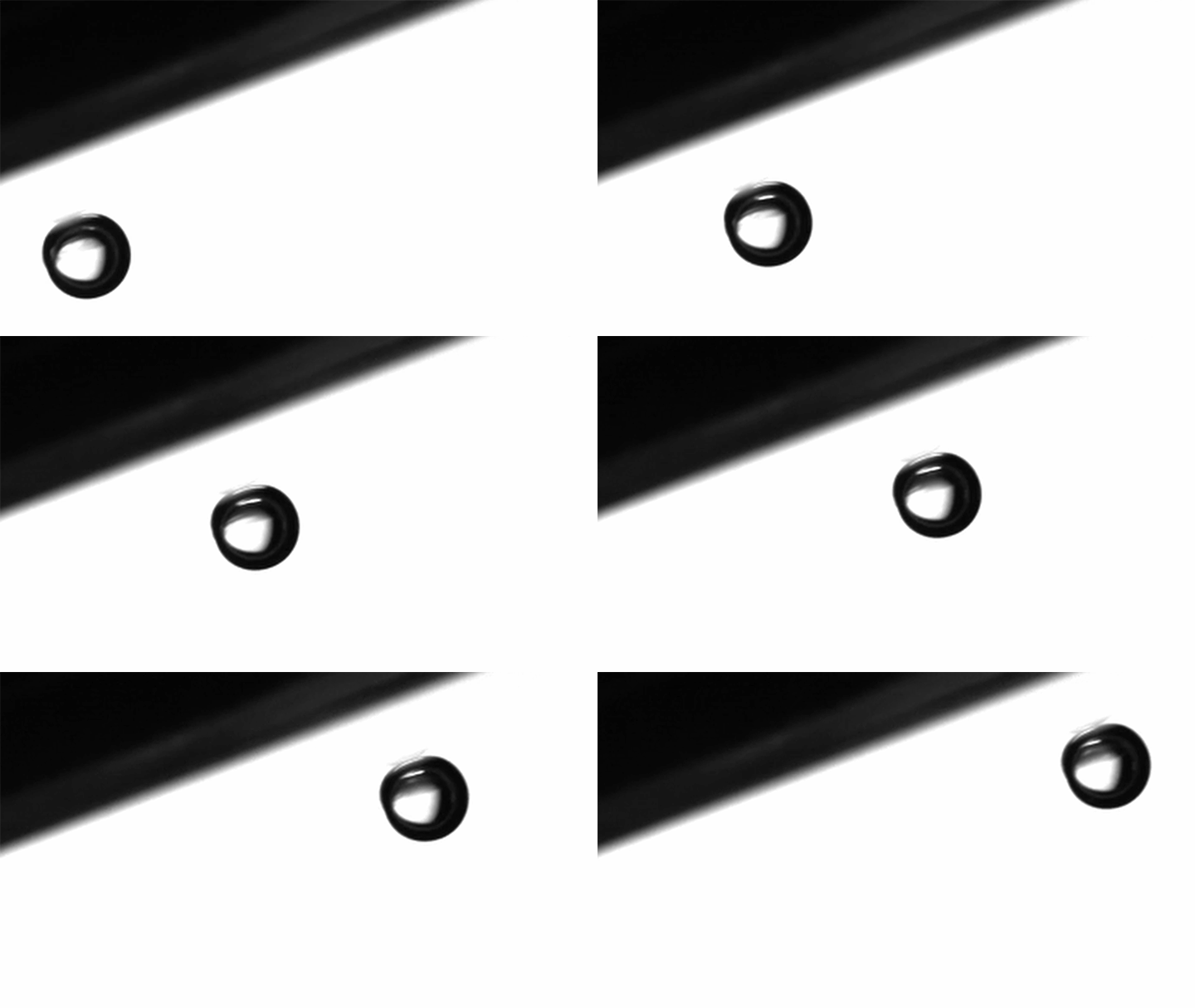
Stop-and-go. A bubble slides along an inclined surface in a pronounced stop-and-go motion when vibrated near its frequency for translational resonance.
The team combined a bubble-filled bath with sound at low (sub-cavitation) frequencies. They found that driving sound waves at the right frequency could vibrate the bubbles in a way that made them slide in a stop-and-go motion along inclined surfaces. This swaying significantly boosted their cleaning power; getting surfaces 90% cleaner than non-resonating bubbles did. (Image credit: S. Hok/Cornell University; video and research credit: Y. Lin et al.; via Gizmodo)
If you’ve ever seen crashing waves glowing blue, you’ve been treated to bioluminescence. Although many creatures can bioluminesce, tiny dinoflagellates–a type of marine phytoplankton–are one of the easiest to spot. These microscopic organisms create a flash of light in response to viscous stresses. Their response to flow-induced stresses is so robust that they can be used to visualize stress fields.
In a new study, researchers explored how turbulence affects the dinoflagellate’s luminescence. They mathematically modeled the dinoflagellate as an elastic dumbbell that emitted light based on its extent and rate of deformation. Then they explored how this model dinoflagellate behaved in different types of turbulent flows. They found that the fluctuations and intermittency of turbulent flows both encouraged the radiant displays. (Image credit: T. McKinnon; research credit: P. Kumar and J. Picardo)
Sound is not something we can typically see, though there are ways to visualize it, including cymatics and special acoustic cameras. This video pursues a different tactic: using schlieren photography and stroboscopic lighting to show how sound waves reflect and deflect. It’s no easy feat, but one worth enjoying–especially when others have already done the hard part for you! (Video and image credit: All Things Physics; submitted by David J.)
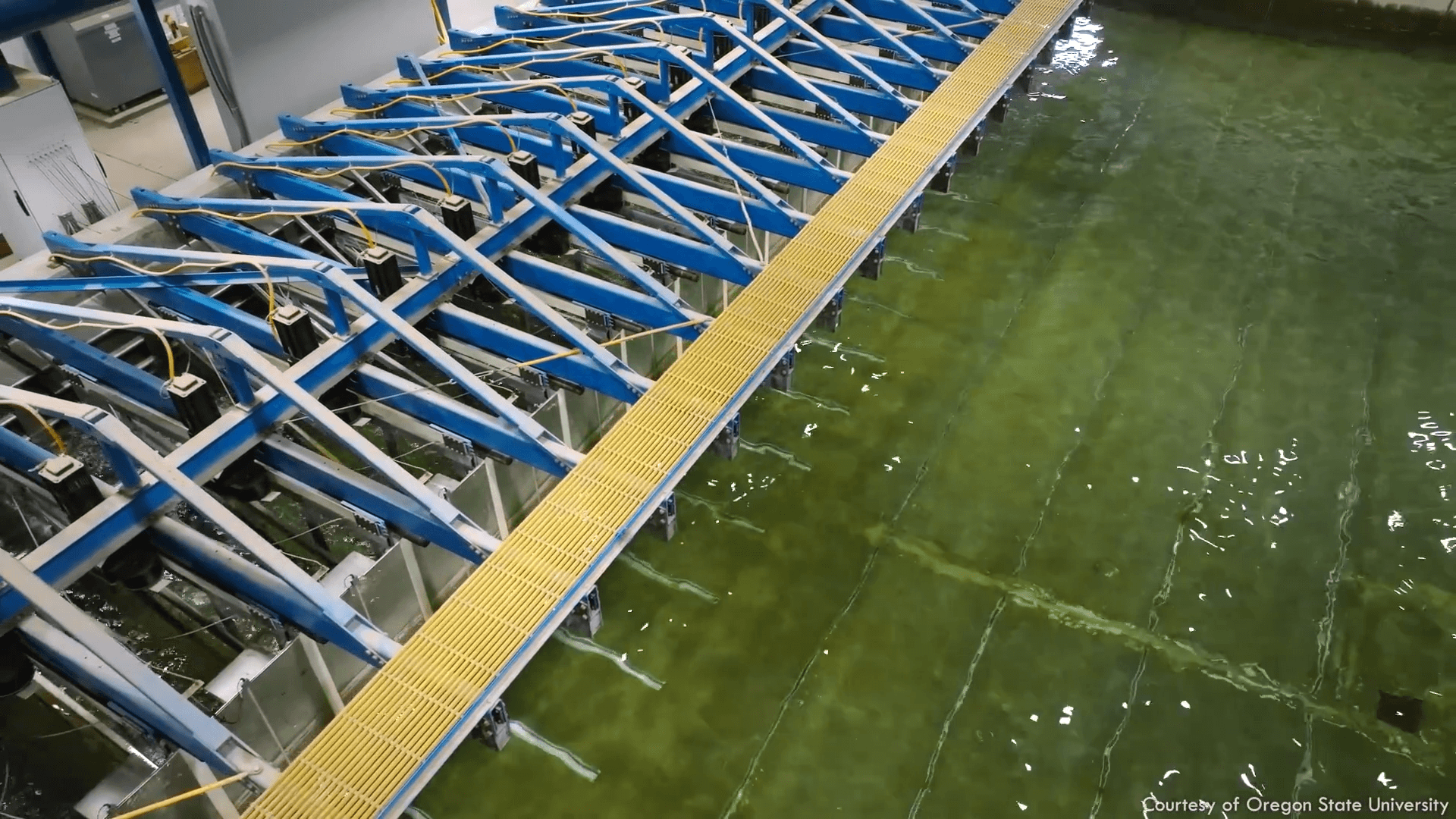
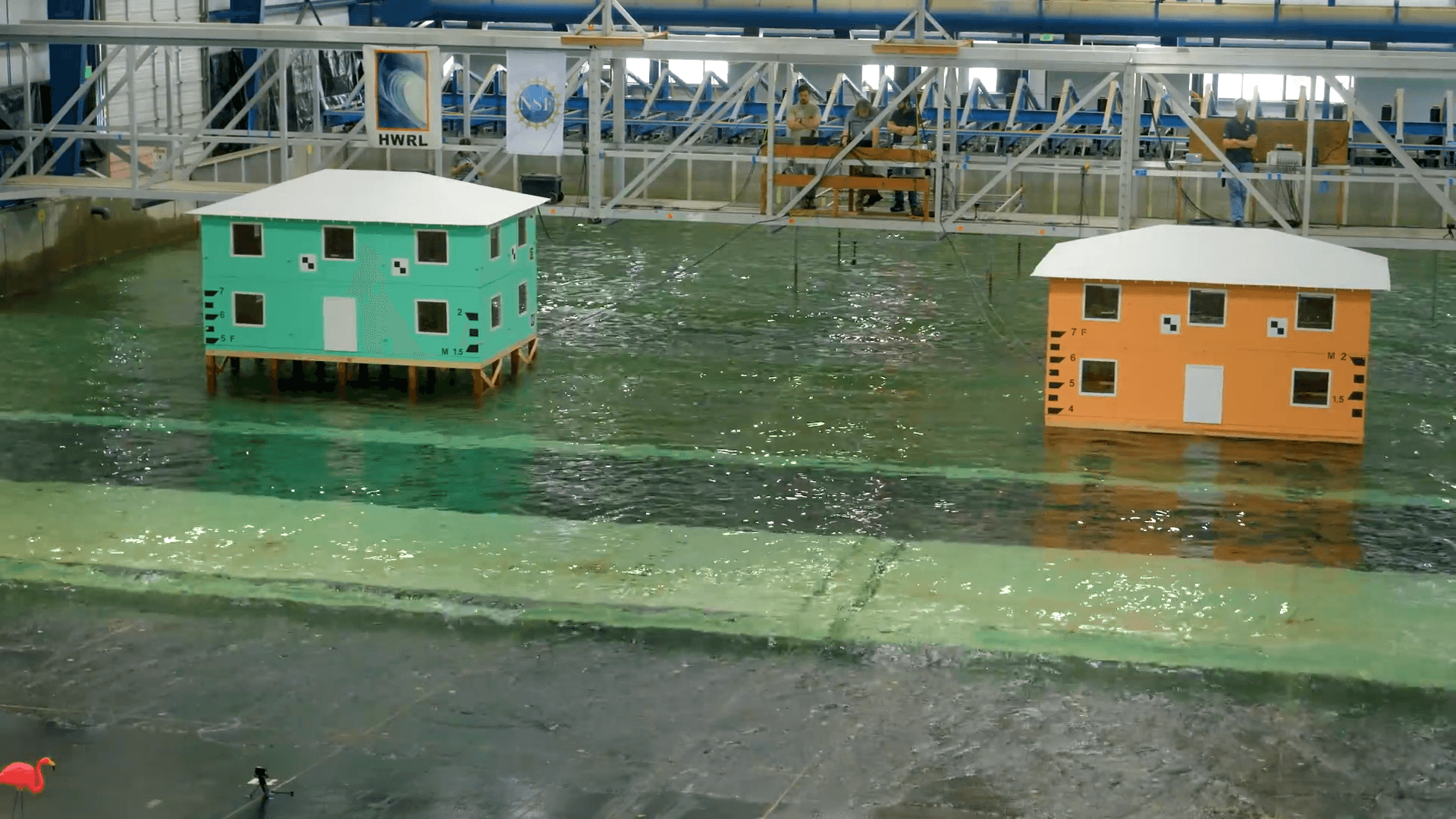
When hurricanes hit coasts, they bring with them incredible storm surge, which puts buildings right in the middle of ocean waves. To understand how to better protect against those conditions, engineers use facilities like the Directional Wave Basin to create smaller-scale versions of hurricanes. In this Practical Engineering video, Grady visited during a test that compared two identical one-third-scale houses subjected to the same storm conditions–except that one house had an additional foot (3ft at real-scale) of elevation. The results are pretty spectacular.
This isn’t a short video, but it’s well-worth a watch. I think Grady does a great job of explaining why engineers need (admittedly) expensive facilities like this one to help guide both engineering and regulatory decisions. (Video and image credit: Practical Engineering)
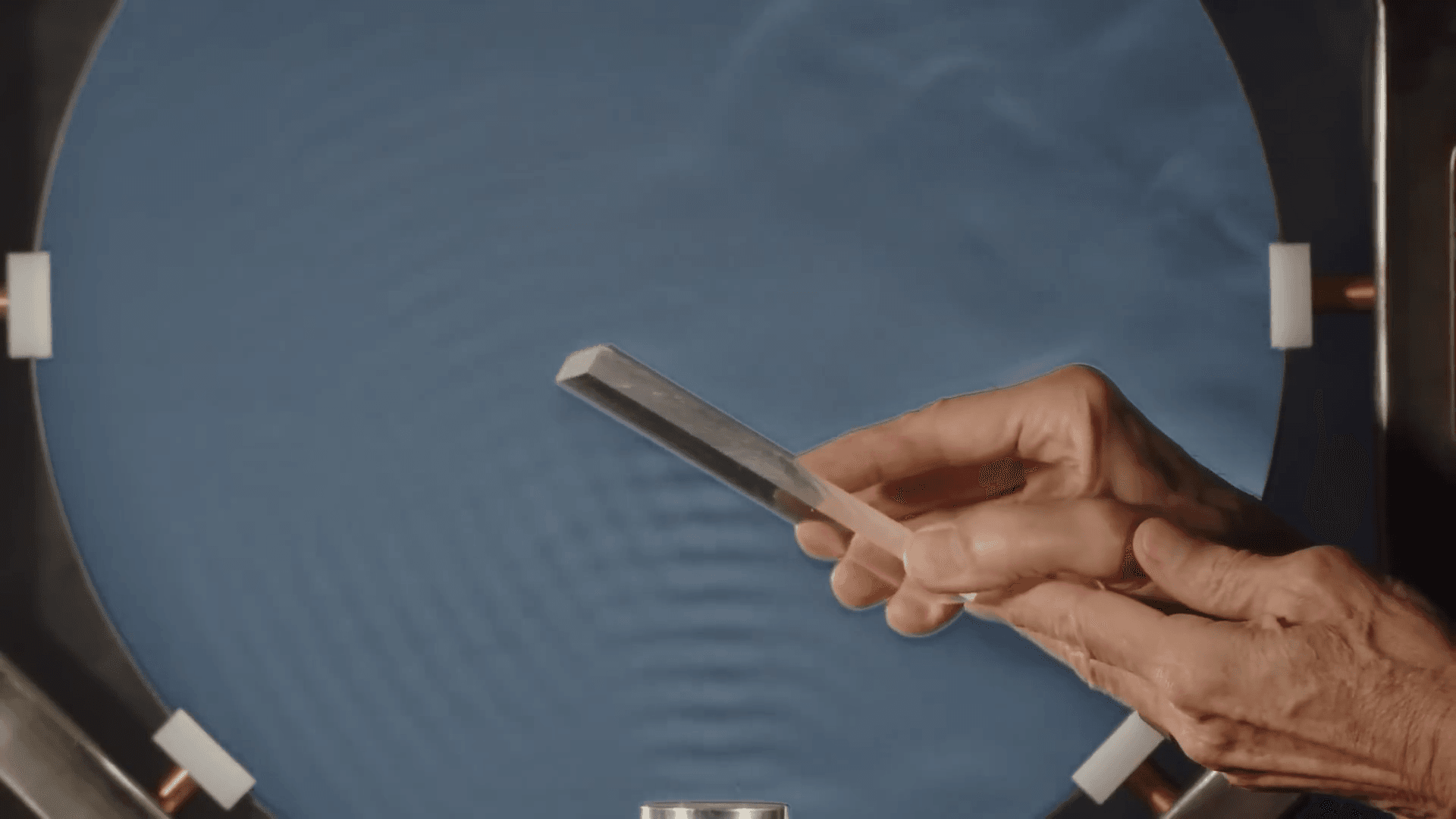
Over the last 15 years or so, researchers have been exploring pilot-wave theory–originally proposed by De Broglie in the 1920s as a way to understand quantum mechanics–using hydrodynamic quantum analogs. In these experiments, researchers vibrate pools of silicone oil, which allows oil drops to bounce–and in some conditions, walk–indefinitely on the pool. By mixing in obstacles that mimic classic quantum mechanical experiments, they reproduce effects like the double-slit experiment in a macroscopic system.
In this video and the accompanying papers, a team recreates the Kapitsa-Dirac effect where a standing electromagnetic wave diffracts electrons. Here, the standing wave is instead a Faraday wave in the surface of the pool. Yet the droplets, too, diffract in a manner resembling the quantum version. (Video credit: B. Primkulov et al.; research credit: B. Primkulov et al. 1, 2)
Schlieren techniques are one of my favorite forms of flow visualization. They cleverly make the invisible visible through an optical set-up that’s sensitive to changes in density. They’re great–as seen in the examples here–for seeing local buoyant flows like the plumes that rise from a candle, or for making gases like carbon dioxide visible. They’re also excellent for visualizing shock waves.
In this video, physicist David Jackson explains how one particular flavor of schlieren–one using a spherical mirror–works. There are lots of other possible schlieren set-ups, too, though each one has its quirks. (Video and image credit: All Things Physics; submitted by David J.)
Light shining through misty spray creates a liquid rainbow in this photo by Ronja Linssen. Although mists and sprays–from waterfalls, waves, and more–seem insubstantial, they can be a major source of material transfer between the water and atmosphere. Teratons of salt, biomass, and even microplastics make their way yearly from the ocean into the sky through droplets launched from popping bubbles. (Image credit: R. Linssen/CUPOTY; via Colossal)
Even though particles are not (strictly speaking) a fluid, they often behave like one. Here, researchers investigate what happens when two layers of particles–with different size and density–slide down an incline together. The video is tilted so that the flow instead appears from left to right.
When the larger, denser particles sit atop a layer of smaller, lighter particles, shear between the two layers causes a Kelvin-Helmholtz instability that runs in the direction of the flow. This creates a wavy interface that lets some small particles work upward while large particles shift downward.
At the same time, a slice across the flow shows that plumes of small particles are pushing up toward the surface, driven by a Rayleigh-Taylor instability. The researchers also look at what happens when the particles are fluidized by injecting a gas able to lift the particles. (Video and image credit: M. Ibrahim et al.; via GFM)














































![Composite image of bed layers for 4 different particle density ratios. Text reads, "The wave amplitude and growth rate increase with particle density ratio but only if [the density of large particles is greater than the smaller particle density]."](https://fyfluiddynamics.com/wp-content/uploads/KHbed3.png "Composite image of bed layers for 4 different particle density ratios. Text reads, \"The wave amplitude and growth rate increase with particle density ratio but only if [the density of large particles is greater than the smaller particle density].\"")