
A liquid drop can fold itself up in a thin sheet. The animation above shows a drop of water with an ultra-thin (79nm) circular sheet of polystyrene atop it. As a needle removes water from the underside of the droplet, the shrinking droplet causes wrinkles and folds to form in the sheet. What’s going on here is a competition between the energy required to change the droplet’s shape and the energy needed to bend the sheet. Eventually, the droplet’s volume is small enough that the bending of the sheet overrules surface tension in dictating the droplet’s shape. The result is a tiny empanada-shaped droplet completely encapsulated by the sheet. (Image credit: J. Paulsen et al., source; research paper)
Search results for: “water droplet”

Popping
Popcorn’s explosive pop looks pretty cool in high-speed video, but just watching it with a regular camera doesn’t show everything that’s going on. If we take a look at it through schlieren optics, the kernel’s pop looks even more extraordinary:
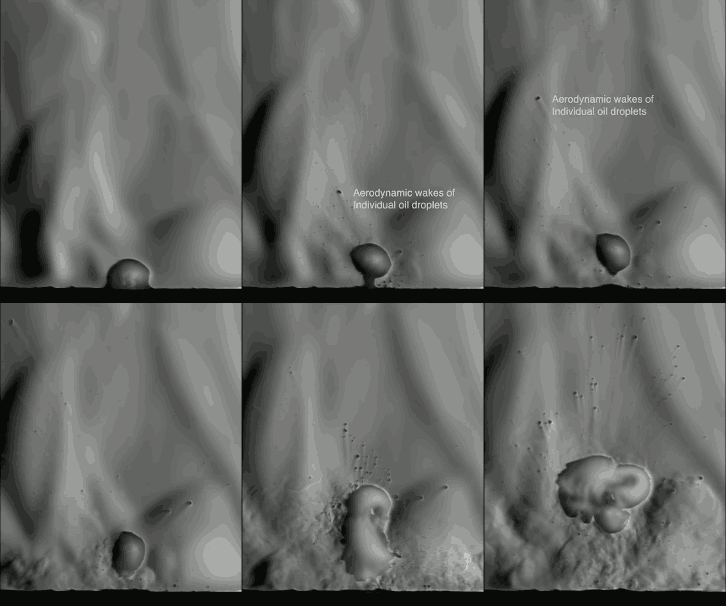
The schlieren technique reveals density differences in the gases around the corn–effectively allowing us to see what is invisible to the naked eye. The popcorn kernel acts like a pressure vessel until the expansion of steam inside causes its shell to rupture. The first hints of escaping steam send droplets of oil shooting upward. The kernel may hop as steam pours out the rupture point, causing the turbulent billowing seen in the animation above. As the heat causes legs of starch to expand out of the kernel, they can push off the ground and propel the popcorn higher. As for the eponymous popping sound, that is the result of escaping water vapor, not the actual rupture or rebound of the kernel! See more of the invisible world surrounding a popping kernel in the video below. (Image credits: Warped Perception, source; Bell Labs Ireland, source; WP video via Gizmodo; BLI video submitted by Kevin)

Vibrated to Bits
Sound and vibration can be powerful tools for controlling liquids. In this animation, a water/glycerin drop violently bursts into a cloud of droplets when it is vibrated vertically 1000 times per second by a piezoelectric actuator. This vibration shakes the drop with accelerations of 150 g. Initially, the amplitude is small enough to simply create ripples around the drop’s circumference. As it increases, the drop deforms more at the edges and starts to eject droplets there. When the vibration hits a critical amplitude, the entire drop explodes into droplets. The technique is called vibration-induced droplet bursting, and its near-instantaneous ability to atomize drops makes it a candidate for applications like spray cooling microprocessors or spray coating a solid surface. (Video credit: B. Vukasinovic, source)
Dissolving
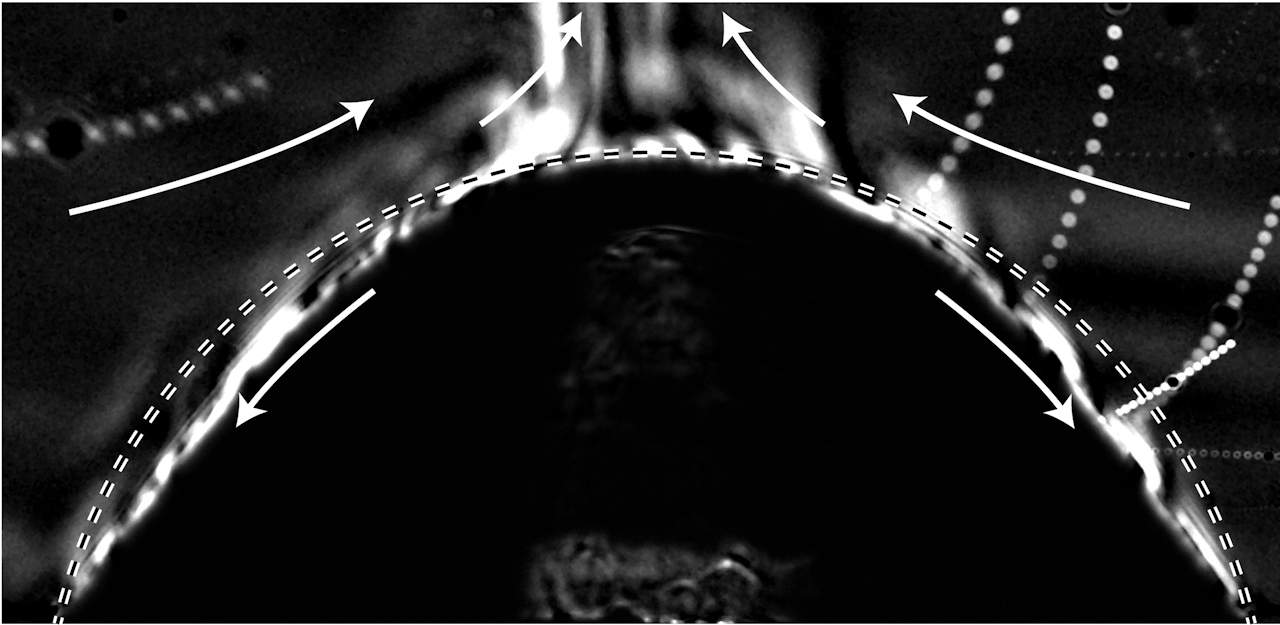
It looks like the fiery edge of a star’s corona, but this photo actually shows a dissolving droplet. The droplet, shown as the lower dark region in this shadowgraph image, is a mixture of pentanol and decanol sitting in a bath of water. Pentanol is a type of alcohol that is fully miscible with decanol and is water soluble, so that it will dissolve into the surrounding water over time. Decanol, on the other hand, is immiscible with water, so that part of the droplet won’t mix with the surrounding water.
The bright swirls along the droplet’s edge show areas with more pentanol. As the alcohol dissolves into the water, it forms a buoyant plume at the top of the droplet that rises due to pentanol’s lower density. That rising plume draws fresh water in from the sides, shown by the upper white arrows. Inside the droplet, flow moves in the opposite direction, from the top toward the outer edges. This is a result of uneven surface tension within the droplet. Scientists are interested in understanding the dynamics of these multiple component drops for applications like printing, where it’s desirable for pigments in an ink drop to be distributed evenly as the drop dries. (Image credit: E. Dietrich et al.)

Erie Waves


Photographer Dave Sandford braved the cold and turbulent waters of Lake Erie in late fall to capture some remarkable wave action. Like on the ocean, waves in the Great Lakes are largely driven by winds, but lakes don’t develop the constant set of rolling waves that oceans do. Instead their waves are more erratic and unpredictable. Sandford focused on capturing the moment when wind-driven waves coming into shore collided with waves rebounding from piers or rocks along the shore. The results are waves that, through Sandford’s lens, look like exploding mountainsides. Such energetic waves mix sediment and nutrients in the lake, and the spray of droplets can even loft aerosols and pollutants from the water into the atmosphere. (Photo credit: D. Sandford; via Flow Vis)
Liquid Fragmentation
From spilling coffee to driving through puddles, our daily lives are full of examples of liquids fragmenting into drops. A recently published study describes how this break-up occurs and predicts what the distribution of droplet sizes will be for a given fluid. Viscoelasticity is the property that governs this droplet size distribution. Viscoelasticity describes two aspects of a fluid–its viscosity, which acts like internal friction, resisting motion–and its elasticity, the fluid’s ability to return to its original shape after stretching. Most fluids have a little bit of each of these properties, which makes them somewhat sticky, both in the sense of not-flowing-easily and in the sense of sticking-to-itself. These same properties cause viscoelastic fluids to wind up with a broader droplet size distribution, ultimately creating both more small droplets and more large droplets than a Newtonian liquid like water. (Video credit: MIT News; research credit: B. Keshavarz et al.; submitted by mrvmt)

A Particle-Filled Splash


A drop of water that impacts a flat post will form a liquid sheet that eventually breaks apart into droplets when surface tension can no longer hold the water together against the power of momentum flinging the water outward. But what happens if that initial drop of water is filled with particles? Initially, the particle-laden drop’s impact is similar to the water’s – it strikes the post and expands radially in a sheet that is uniformly filled with particles. But then the particles begin to cluster due to capillary attraction, which causes particles at a fluid interface to clump up. You’ve seen the same effect in a bowl of Cheerios, when the floating O’s start to group up in little rafts. The clumping creates holes in the sheet which rapidly expand until the liquid breaks apart into many particle-filled droplets. To see more great high-speed footage and comparisons, check out the full video. (Image credit and submission: A. Sauret et al., source)

Surfing on Vapor
Place a drop of liquid on a surface much, much hotter than the liquid’s boiling point, and the portion of the drop that impacts will vaporize immediately. This leaves the droplet hovering on a thin layer of vapor. With a fluid like water, the vapor state is a much more efficient insulator than the liquid state. Thus, the vapor layer actually protects the liquid droplet, enabling it to boil off at a much slower rate than if the drop were touching the heated surface. This is known as the Leidenfrost effect, and it can be used to create self-propelled droplets. (Image credit: R. Thévenin and D. Soto)
Colors in Macro
Milk, acrylic paints, soap, and oil – all relatively common fluids, but together they form beautiful mixtures worth leaning in to enjoy. Variations in surface tension between the liquids cause much of the motion we see. Soap, in particular, has a low surface tension, which causes nearby colors to get pulled away by areas with higher surface tension, behavior also known as the Marangoni effect. Adding oil creates some immiscibility and lets you appreciate both the coalescence and fragmentation of the fluids. And finally, there’s one of my favorite sequences, where bubbles start popping in slow motion. As the bubble film ruptures, fluid pulls away, breaking into ligaments and then a spray of droplets as the bubble disintegrates. (Video credit: Macro Room; via Gizmodo)

Dripping, Frozen
The simple drip of a faucet is more complicated when frozen in time. Any elongated strand of water tends to break up into droplets due to surface tension and the Plateau-Rayleigh instability. Whenever the radius of the water column shrinks, surface tension tends to drive water away from the narrow region and toward a wider point. This exaggerates the profile, making narrow regions skinnier and wider regions fatter. Eventually, the neck connecting the droplets becomes so thin that it pinches off completely, leaving a string of falling droplets. (Image credit: N. Sharp)