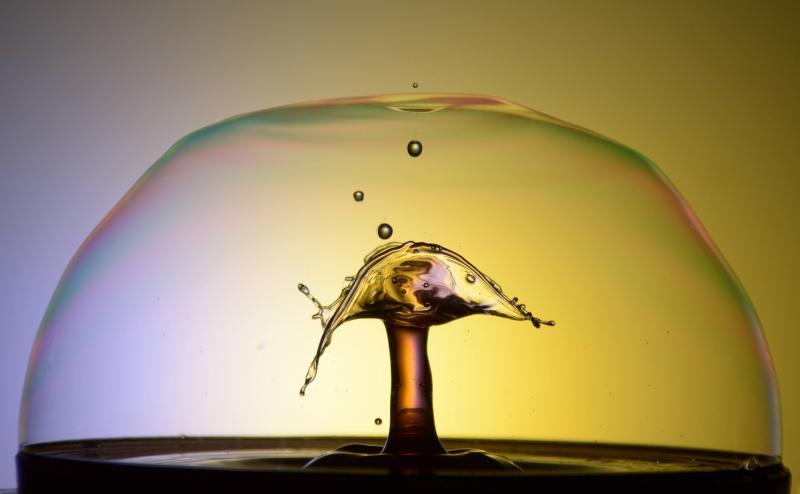
With patience and timing, one can create remarkable sculptures with fluids. To capture this shot, Moussi Ouissem used two droplets, perfectly timed. The first fell through the soap bubble (which stayed intact thanks to its powers of self-healing) and hit the pool of water. The impact caused a cavity, which then inverted into a Worthington jet. The second drop was timed to impact the column of the jet, creating the saddle-shaped splash seen here. Ripples in the bubble are still visible from the passage of the second drop, and several satellite droplets are signs of the violence of the impacts. (Image credit: M. Ouissem)
Search results for: “water droplet”
Emulsions By Condensation
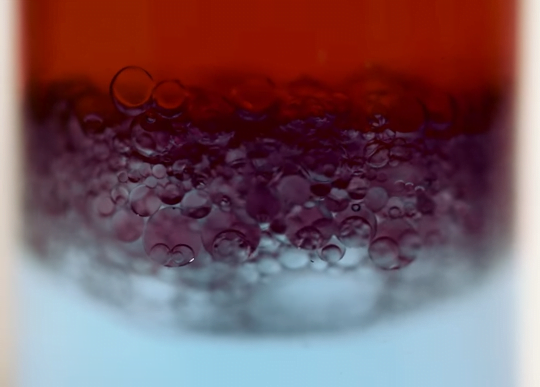
Oil and water are hard to mix, as any salad dressing aficionado will attest. Technically, the two fluids are immiscible – they won’t mix with one another – but one way around this is to emulsify them by distributing droplets of one in the other. This is usually accomplished by shaking or using sound waves to vibrate the mixture, but the results are typically short-lived. The larger a droplet is, the more gravity affects it, causing the buoyant oil to rise and separate from the water.
The key to making an emulsion last is creating tiny droplets, which a new study accomplishes energy efficiently through condensation. Instead of mixing the oil and water immediately, the researchers used a surface covered in a mixture of oil and surfactant and cooled it in a humid chamber. As the temperature dropped, water condensed onto the oil and became encapsulated, creating nanoscale emulsion droplets. At such a tiny scale, buoyant forces are unable to overcome surface tension, so the emulsion remains stable for months. (Image credit: MIT, source; research credit: I. Guha et al.; via MIT News)

Oil Splatters
Most cooks have experienced the unpleasantness of getting splattered with hot oil while cooking. Here’s a closer look at what’s actually going on. The pan is covered by a thin layer of hot olive oil. Whenever a water drop gets added – from, say, those freshly washed greens you’re trying to saute – it sinks through the oil due to its greater density. Surrounded by hot oil and/or pan, the water heats up and vaporizes with a sudden expansion. This throws the overlying oil upward, creating long jets of hot oil that break into flying droplets. These are what actually hit you. This is a small-scale demonstration, but it gets at the heart of why you don’t throw water on an oil fire. (Image credit: C. Kalelkar and S. Paul, source)

Detergency


Have you ever wondered just how detergents are able to get grease and oil off a surface? This simple example demonstrates one method. In the top image, a drop of oil sits attached to a solid surface; both are immersed in water. An eyedropper injects a surfactant chemical near the oil drop. This lowers the surface tension of the surrounding water and allows the mixture to better wet the solid. That eats away at the oil drop’s contact with the surface. It takes awhile – the middle animation is drastically sped up – but the oil droplet maintains less and less contact with the surface as the surfactant works. Eventually, in the bottom image, most of the oil drop detaches from the surface and floats away. (Image credits: C. Kalelkar and A. Sahni, source)

Controlling Leidenfrost Drops

On a surface much hotter than their boiling point, droplets can surf on a layer of their own vapor due to the Leidenfrost effect. Recent research has shown that textured surfaces like ratchets can create corrals, traps, and mazes for such droplets. Here, researchers manipulate the propulsion of Leidenfrost drops using non-parallel grooves instead. When placed between two non-parallel plates, the droplet is squeezed by side forces perpendicular to the walls, with the resultant force in the direction where the gap widens. In most states, friction forms an opposition to this squeeze, but for Leidenfrost droplets that frictional force is negligible. Instead, the squeezing from the plates launches droplets toward the wider end of the groove, allowing researchers to design repellers (top) and traps (bottom) for the fast-moving drops. (Image credits: C. Luo et al., source)

Creating Clouds
Despite their ubiquity and importance, we know surprisingly little about how clouds form. The broad strokes of the process are known, but the details remain somewhat fuzzy. One challenge is understanding how nucleation – the formation of droplets that become clouds or rain – works. A recent laboratory experiment in an analog cloud chamber suggests that falling rain drops may help spawn more rain drops.
The experiment takes place in a chamber filled with sulfur hexafluoride and helium. The former acts like water in our atmosphere, appearing in both liquid and vapor forms, while the latter takes the place of dry components of our atmosphere, like nitrogen. The bottom of the chamber is heated, forming a liquid layer of sulfur hexafluoride, seen at the bottom of the animation above. The top of the chamber is cooled, encouraging sulfur hexafluoride vapor to condense and form droplets that fall like rain. A top view of the same apparatus during a different experiment is shown in this previous post.
When droplets fall through the chamber, their wakes mix cold vapor from near the drop with warmer, ambient vapor. This changes the temperature and saturation conditions nearby and kicks off the formation of microdroplets. These are the cloud of tiny black dots seen above. Under the right conditions, these microdroplets grow swiftly as more vapor condenses onto them. In time, they grow heavy enough to fall as rain drops of their own. (Image credits: P. Prabhakaran et al.; via APS Physics; submitted by Kam-Yung Soh)

Fluid Black Holes

Fluid systems can sometimes serve as analogs for other physical phenomena. For example, bouncing droplets can recreate quantum effects and a hydraulic jump can act like a white hole. In this work, a bathtub vortex serves as an analog for a rotating black hole, a system that’s extremely difficult to study under normal circumstances. In theory, the property of superradiance makes it possible for gravitational waves to extract energy from a rotating black hole, but this has not yet been observed. A recent study has, however, observed superradiance for the first time in this fluid analog.
To do this, the researchers set up a vortex draining in the center of a tank. (Water was added back at the edges to keep the depth constant.) This served as their rotating black hole. Then they generated waves from one side of the tank and observed how those waves scattered off the vortex. The pattern you see on the water surface in the top image is part of a technique used to measure the 3D surface of the water in detail, which allowed the researchers to measure incoming and scattered waves around the vortex. For superradiance to occur, scattered waves had to be more energetic after interacting with the vortex than they were before, which is exactly what the researchers found. Now that they’ve observed superradiance in the laboratory, scientists hope to probe the process in greater detail, which will hopefully help them observe it in nature as well. For more on the experimental set-up, see Sixty Symbols, Tech Insider UK, and the original paper. (Image credit: Sixty Symbols, source; research credit: T. Torres et al., pdf; via Tech Insider UK)

Chinese Spouting Bowl Physics


In their newest video, the Slow Mo Guys recreated one of my favorite effects: vibration-driven droplet ejection. For this, they use a Chinese spouting bowl, which has handles that the player rubs after partially filling the bowl with water. By rubbing, a user excites a vibrational mode in the bowl. Watch the GIFs above and you can actually see the bowl deforming steadily back and forth. This is the fundamental mode, and it’s the same kind of vibration you’d get from, say, ringing a bell.
Without a high-speed camera, the bowl’s vibration is pretty hard to see, but it’s readily apparent from the water’s behavior in the bowl. In the video, Gav and Dan comment that the ripples (actually Faraday waves) on the water always start from the same four spots. That’s a direct result of the bowl’s movement; we see the waves starting from the points where the bowl is moving the most, the antinodes. In theory, at least, you could see different generation points if you manage to excite one of the bowl’s higher harmonics. The best part, of course, is that, once the vibration has reached a high enough amplitude, the droplets spontaneously start jumping from the water surface! (Video and image credits: The Slow Mo Guys; submitted by effyeah-artandfilm)
The Elastic Leidenfrost Effect


Drop some hydrogel beads in a hot frying pan and they’ll bounce, hiss, and screech. Normally, if you drop a ball, it bounces to ever smaller heights until it comes to rest. In contrast, on a hot surface the hydrogel can bounce to a steady height for minutes at a time, raising a question: where does it get the energy for its incessant bounce?
Upon close examination of the impact, researchers found the hydrogel beads are actually slapping the surface over and over on each bounce. The frequency of the slapping exactly matches that of the audible screech, so what you’re actually hearing is this bounce-slap. Now what causes the slapping?
Contact with the hot surface vaporizes some of the water inside the hydrogel. If it were a droplet, this vapor would form a thin, almost frictionless layer the droplet could glide on; that’s the classic Leidenfrost effect. Here the shell of the bead prevents that until the pressure really builds up. When the pressure gets high enough, the vapor finally escapes, opening up a gap. As the gap reaches its largest point, the bead rebounds elastically, bringing it back in contact with the surface and starting the process again. Each of these cycles acts like a tiny engine, harvesting energy that drives the larger bounce. This elastic Leidenfrost effect may be particularly helpful in soft robotics, providing robots with a new mechanism for movement. (Image and video credit: S. Waitukaitis et al.,arXiv)

A Drip’s Vortex


Drip food coloring into water and you can often see a torus-shaped vortex ring after the drop’s impact. That vortex rings form during droplet impact has been well known for over a century, but only recently have we begun to understand the process that leads to that vortex ring. Part of the challenge is that the vortex formation is very small and very fast, but recent work with x-ray imaging has allowed experimentalists to finally capture this event.
When a drop impacts a pool, surface tension draws some of the pool liquid up the sides of the drop. At the same time, the impact causes ripple-like capillary waves down the sides of the drop. This causes pool liquid to penetrate sharply into the drop, triggering the spirals that mark the forming vortex ring. When drops impact with even higher momentum, multiple vortex spirals can form, as seen on the lower right image. The authors observed as many as four rings during an impact. For more, check out the (open access) article. (Image and research credit: J. Lee et al., source)