
Frost typically forms when supercooled droplets of water scattered across a surface freeze together. The freezing spreads via tiny ice bridges that link droplets together into a frozen network. The animation above shows this process in action. Freezing starts in a droplet off-screen on the right and quickly spreads. Watch carefully, and you can see the ice bridges growing toward the unfrozen droplets. This is because the ice bridges are fed by water vapor evaporating from the droplets. If one can spread the droplets far enough from one another, it’s possible for a droplet to evaporate completely before the ice bridge reaches it, thereby disrupting the spread of frost. (Video credit: J. Boreyko et al.; research paper)
Search results for: “water droplet”

Fish, Feathers, and Phlegm
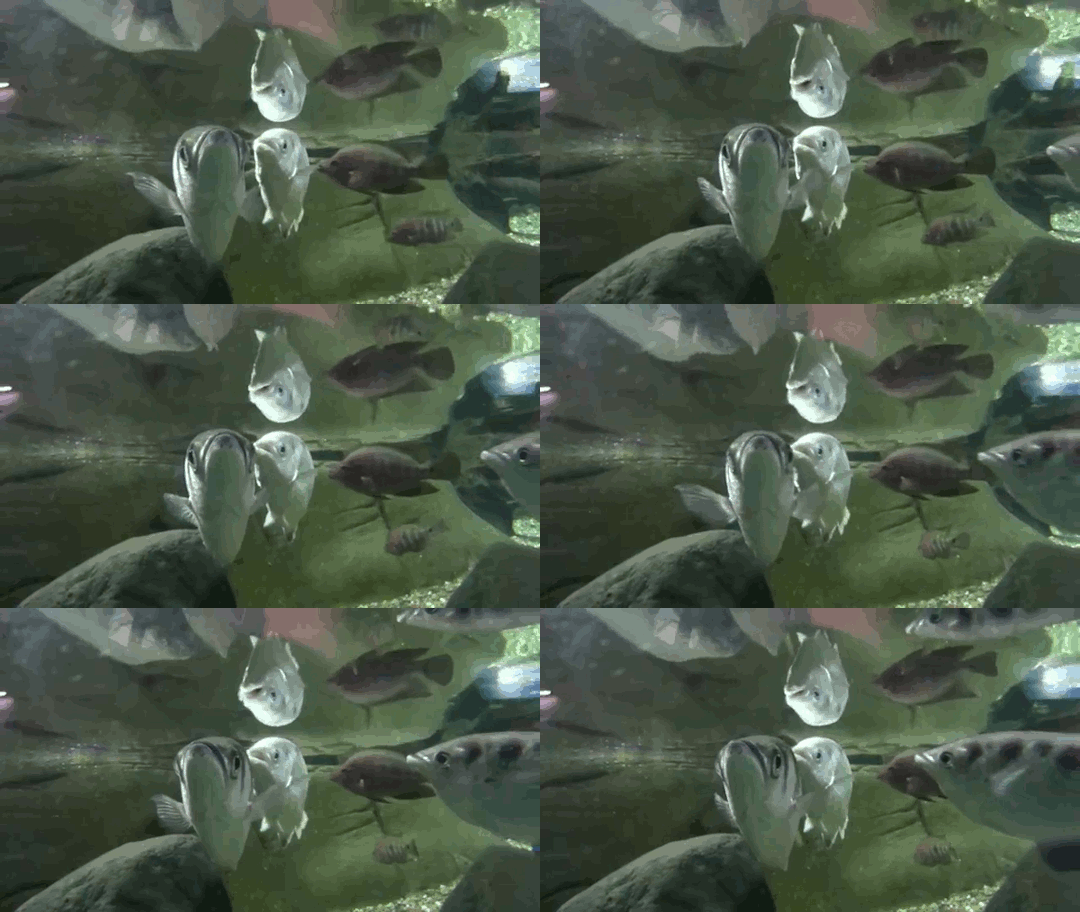
Inside Science has a new documentary all about fluid dynamics! It features interviews with five researchers about current work ranging from the physics of surfing to the spreading of diseases. Penguins, sharks, archer fish, 3D printing, and influenza all make an appearance (seriously, fluid dynamics has everything, guys). If you’d like to learn more about some of these topics, I’ve touched on several of them before, including icing, penguin physics, shark skin, archer fish, and disease transmission via droplets. (Video credit: Inside Science/AIP)

Inside a Humidifier
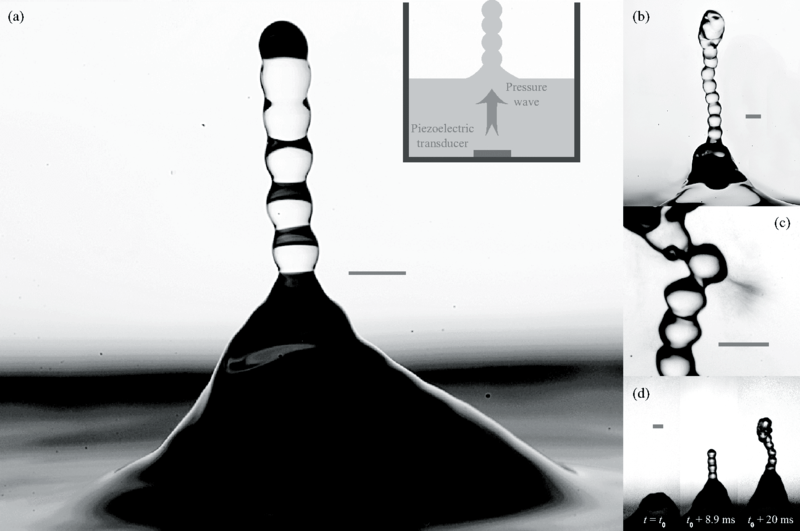
After this, you may never look at a humidifier the same way again. Ultrasonic humidifiers generate tiny droplets using piezoelectric transducers. When the humidifier is on, the ultrasonic vibrations of the piezoelectric transducer create a pressure wave that forces the water above into a hill with a string of liquid droplets extending upward. For a sense of the scale, the gray bars shown in each image above represent 1mm. The super-fine droplets the humidifier produces come from cavitation of these larger drops, as shown in image c). Image d) shows snapshots of the formation of the droplet string over a matter of milliseconds. (Image credit: S. J. Kim et al., original poster)

The Evaporation of Ouzo


Ouzo is an aperitif made up of ethanol (alcohol), water, and anise oil. This three-part, or ternary, mixture undergoes an intriguing evaporation process thanks to the characteristics of its components. An ouzo drop’s evaporation can be divided into four phases, each shown above. Initially, the drop is well-mixed and transparent (upper left).
Since ethanol is the most volatile of ouzo’s components, it evaporates the most quickly. As the ethanol evaporates, the drop becomes oversaturated with oil (upper right). Oil droplets form, giving the ouzo a milky appearance. At the same time, the ethanol evaporating causes gradients in surface tension, which drive a vigorous Marangoni flow inside the drop.
Eventually, the ethanol finishes evaporating and the oil drops collect in a ring around the outside of the drop (lower left). Slowly, the water inside the drop evaporates. Eventually, a tiny microdroplet of water is left to dissolve in the anise oil (lower right). (Image and research credit: H. Tan et al., source; via Inkfish)

Reader Question: Splashes
Reader effjoebiden asks:
So is the crown splash the curving wave of water on either side of the tire, the spikes of water in the middle behind the tire, or both? And is the Worthington jet also the same phenomenon that can happen with a massive meteorite impact?
Here the term “crown splash” refers to the curving sheets of water spreading on either side of the tire. Those liquid sheets (or lamella) break down at the edges into spikes and droplets just like the ones seen when a drop falls into a pool, which is the traditional source of the term “crown splash” because it resembles a crown.

And, yes, enormous meteor impacts can create Worthington jets (that column of fluid that pops up after a droplet impacts)! This is why some craters have peaks in the middle. There are actually some surprising similarities between meteor impacts and fluid dynamics.
(Image credits: S. Reckinger et al., original post)

Daily Fluids, Part 3
A lot of the fluid dynamics in our daily lives centers around the preparation and consumption of food. (And in its digestion afterward, but that’s another story!) Here are a few examples of fluid dynamics you might not have realized you’re an expert on:
Low Reynolds Number Flows
This is a fancy way of discussing the motion of syrup, honey, and other thick and viscous fluids we interact with in our lives. These flows are typically slow moving and exhibit some neat properties like coiling or being possible to unstir.
Immiscible Fluids
Oil and water don’t mix, a fact anyone familiar with salad dressings or marinades is well aware of. The way around this is to shake them up! This disperses droplets of the oil within the water (or vinegar or whatever) to create an emulsion. While not truly mixed, it does make for more pleasant eating.
Multiphase Flows
Multiphase flows are ones containing both liquid and gaseous states. Boiling is an example we often see in our daily lives, though carbonated beverages, water sprayers, and sneezes are other common ones.
Leidenfrost Effect
The Leidenfrost effect occurs when liquid is introduced to a surface that is much, much hotter than its boiling point. Part of the liquid instantly vaporizes, leaving droplets to skitter around on a thin vapor layer. This is most often seen around the stove and in skillets. (And, yes, it does qualify as a multiphase flow!)Tune in all week for more examples of fluid dynamics in daily life. (Image credit: S. Reckinger et al., source)
P.S. – I’m at VidCon (@vidconblr) this year! If you are, too, come say hi and get an FYFD sticker 😀
Reader Question: Shower Curtains
Reader thansy asks:
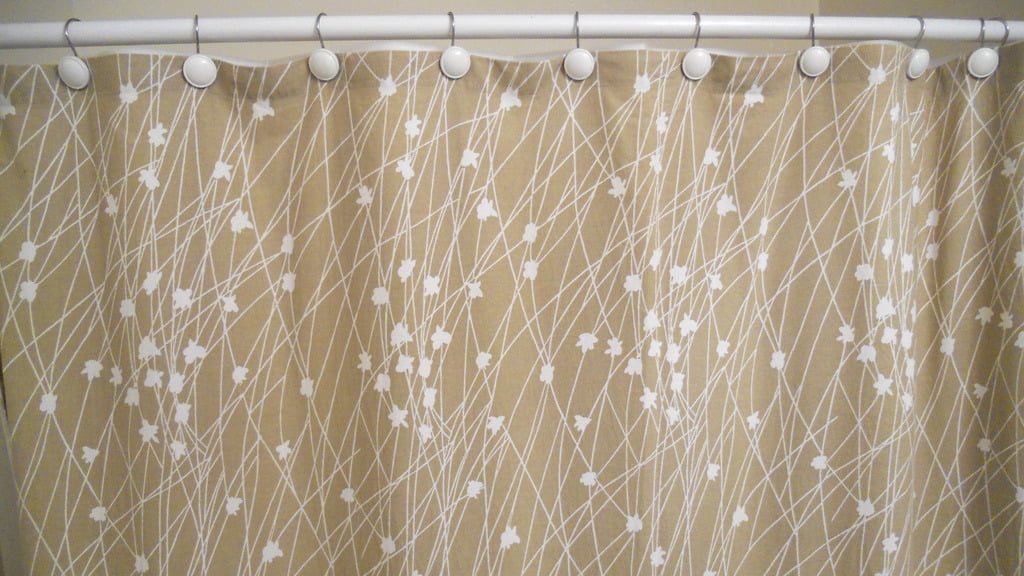
Why do the bottoms of shower curtains drift in toward the water coming from the shower head?
We all know that moment. You’re minding your own business, scrubbing away, and all of a sudden, the shower curtain billows up and grabs you. Scientists have debated the cause of this behavior for years. Some argued that the curtain billowed due to hot air rising from the shower. Others claimed the fast-moving spray caused lift that pulled the curtain up. But fifteen years ago, one scientist tackled the problem computationally. He performed a numerical simulation of a shower head spraying into a bath and found that this spray of droplets creates a weak horizontal vortex in the shower.

This shower vortex has a low-pressure core at the middle, which is thought to provide the suction that causes the shower curtain to billow. The scientist, David Schmidt, was awarded the 2001 Ig Nobel Prize for his work. (Image credits: N. Paix, D. Schmidt; research credit: D. Schmidt)

Drawing Up Dew


Desert plants have evolved to efficiently collect and capture whatever water they can. Each leaf of the moss Syntrichia caninervis ends in a hairlike fiber called an awn (seen in white in the top image). Tiny as they are, awns are vital to the moss’s water collection, correlating to more than 20% of their dew collection. Extremely tiny grooves on the surface of the awn provide nucleation sites where dew condensed from fog collects. Once a droplet forms on the awn, it grows larger as more fog condenses (middle image). When the droplet grows large enough, the conical shape of the awn will cause surface tension to draw the droplets along the awn and toward the leaf (bottom image).
(Credits: Syntrichia caninervis moss image – M. Lüth; videos and research – Z. Pan et al., Supplementary Videos 3 and 4; h/t to T. Truscott)
When Lasers Strike
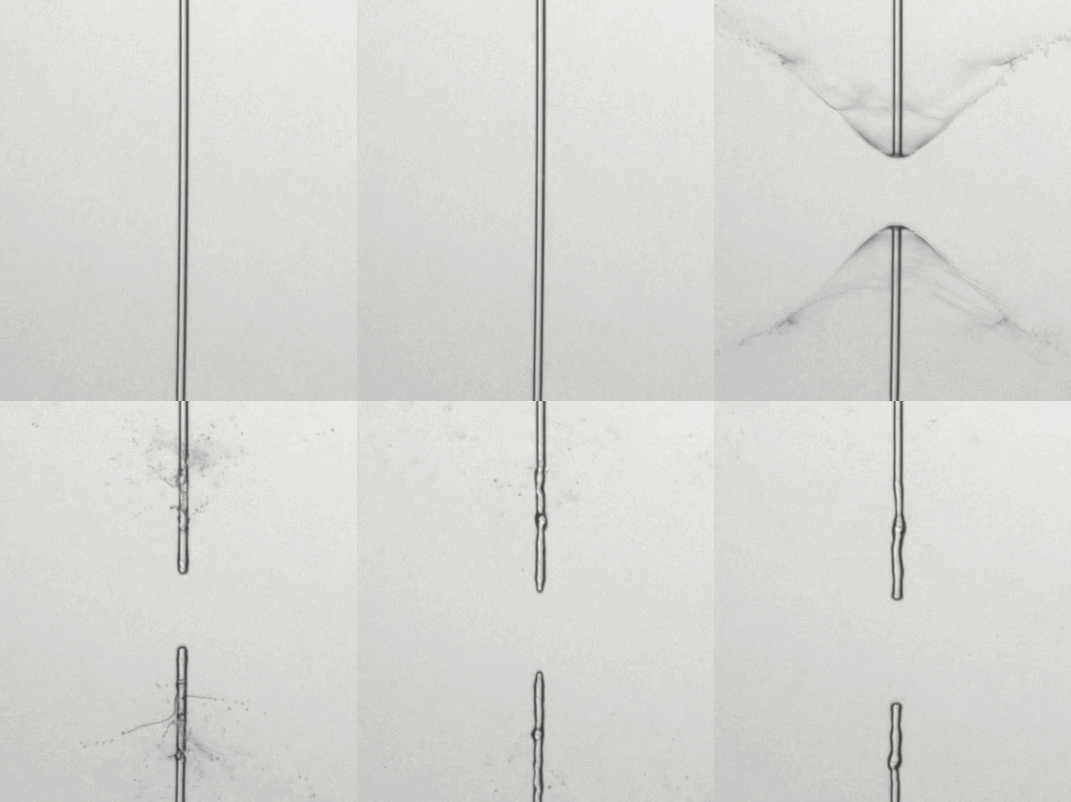
Lasers are a great way to deliver a lot of energy very quickly. In this animation, you see a jet of water get struck by a pulse from a powerful X-ray laser. The energy from that laser pulse gets absorbed by the water in a matter of picoseconds – that’s trillionths of a second. All that energy in so little time makes the water vaporize explosively. It’s this vapor explosion that breaks the jet in two. As the vapor expands outward, it forces water from the jet into a thin film that forms a cone. The conical film bends back on itself until it strikes the jet and coalesces. For more, check out this video of a similar experiment that looked at laser impacts on droplets. (Image credit: C. Stan et al., from Supplementary Movie 5; via Gizmodo)

Striking Oobleck
Mixing cornstarch and water creates a fluid called oobleck that has some pretty bizarre properties. Oobleck is a shear-thickening, non-Newtonian fluid, which means its viscosity increases when you try to deform it with a shearing, or sliding, force. But as the Backyard Scientist demonstrates above, striking oobleck with a solid object produces some spectacular and very non-fluid-like results. The golf ball’s impact blows the oobleck into pieces that look more like solid chunks than liquid droplets. This solid-like behavior occurs because the impact jams the suspended cornstarch particles together, creating a solidification front that travels ahead of the golf ball. Imagine how a snow plow pushes a denser region of snow ahead of it as it drives; the cornstarch behaves similarly but only in a region near the impact. Once that impact force dissipates, the particles unjam and the mixture responds fluidly again. (Image credit: The Backyard Scientist, source; research credit: S. Waitukaitis and H. Jaeger, pdf)