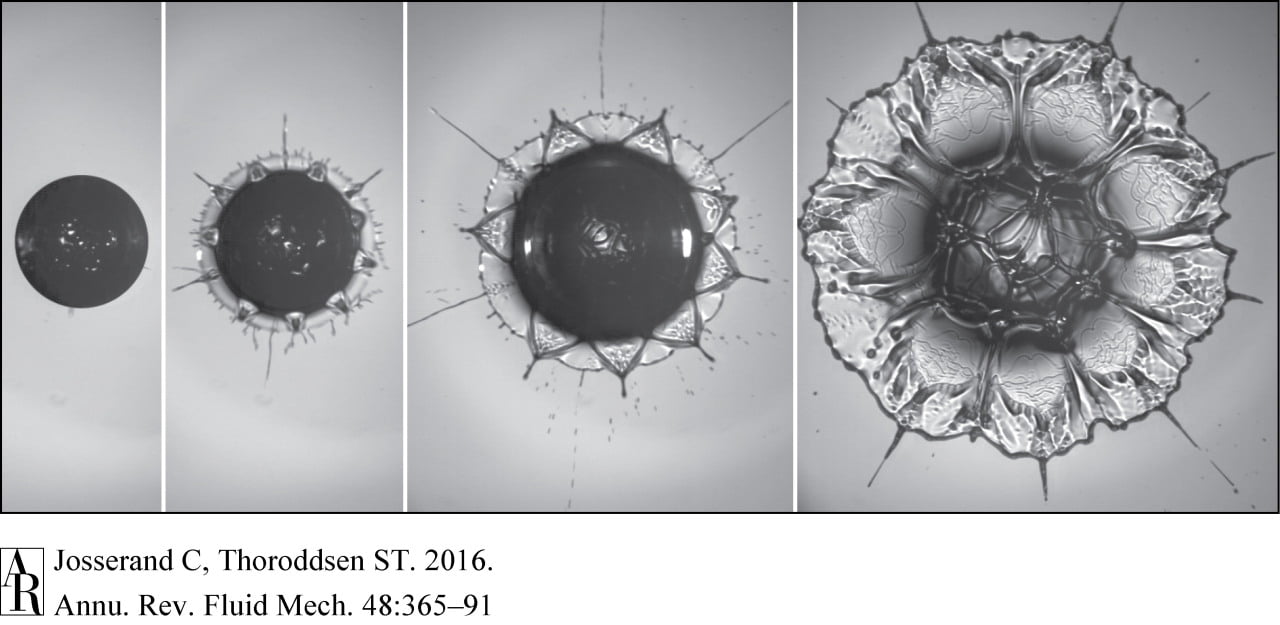
Emulsions – mixtures of two immiscible fluids – are quite common; the oil and vinegar combination used in many salad dressings is one. The image sequence above shows the first 800 microseconds of the impact of a similarly emulsified droplet. The outer drop, seen on the left, consists of a water/glycerin mixture, and inside the drop are 20 smaller perfluorohexane droplets. These smaller droplets are denser and tend to settle toward the bottom of the outer drop. When the compound droplet hits a solid surface, it spreads in a spectacular starburst pattern that depends on the number and location of interior droplets. You can see a similar impact in motion here. (Image credit: J. Zhang and E. Li; source: C. Josserand and S. Thoroddsen)
Search results for: “water droplet”
Fluids Round-up
Last week was supposed to have a fluids round-up, but we were having too much fun walking on water instead. So here it is now!
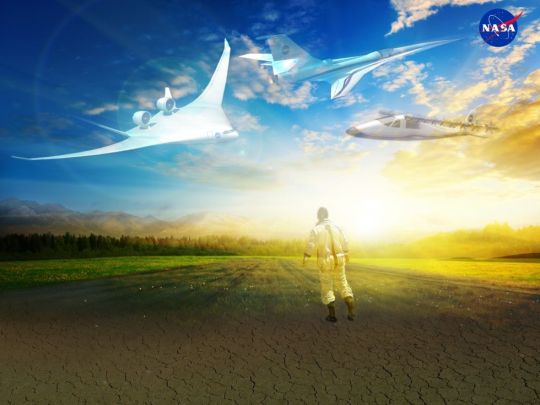
– NASA has asked Congress for funding for new X-plane programs to explore solutions for greener airliners and quieter sonic booms to enable next-generation air travel. Popular Science, Gizmodo, and Ars Technica take a closer look at the proposed projects. I won’t lie – as an aerospace engineer I am hugely in favor of this. The first ‘A’ in NASA has been neglected for quite a while and projects like these are needed if we want to advance the state-of-the-art in aeronautics.
– The New York Times’ ScienceTake video series took a look back at their most popular videos, and 3 of the top 5 videos are fluid dynamics-related. Because we are just that awesome. (via Rebecca M)
– I made a guest appearance on last week’s Improbable Research podcast, where we talked about bizarre experiments trying to unravel swimming.
– Physics Girl shows us 5 weird ways to blow out a candle. There’s some neat and potentially non-intuitive fluid dynamics involved!
– SciShow offers an explanation of why we sneeze. Spoiler alert: it’s more than just to get rid of irritants.
– Fluid dynamics made the short list for NPR’s Golden Mole awards with the discovery of dancing droplets. Here’s Skunkbear’s take on it.
– Ernst Mach, of Mach number fame, was also a bit of an artist and philosopher. (via @JenLucPiquant)
– It’s not quite fluid dynamics, but this Slow Mo Guys video of spinning burning steel wool might be their most beautiful video yet. Check it out!
(Image credit: NASA)

Watching a Sneeze
What does a sneeze look like? You might imagine it as a violent burst of air and a cloud of tiny droplets. But this high-speed video shows, that’s only part of the story. The liquid leaving a sneezer’s mouth and nose is a mixture of saliva and mucus, and in the few hundred milliseconds it takes to expel this air/mucosaliva mixture, there’s not enough time for the liquid to break into droplets. Instead, liquid leaves the mouth as a fluid sheet that breaks into long ligaments.
Because mucosaliva is viscoelastic and non-Newtonian, it does not break down into droplets as quickly as water. Instead, when stretched, the proteins inside the fluid tend to pull back, causing large droplets to form with skinny strands between them – the beads-on-a-string instability. The end result when the ligaments do finally break is more large droplets than one would expect from a fluid like water. Understanding this break-up process and the final distribution of droplet sizes is vital for better understanding the spread of diseases and pathogens. (Video credit: Bourouiba Research Group; research paper: B. Scharfman et al., PDF)
The Leidenfrost Dunk
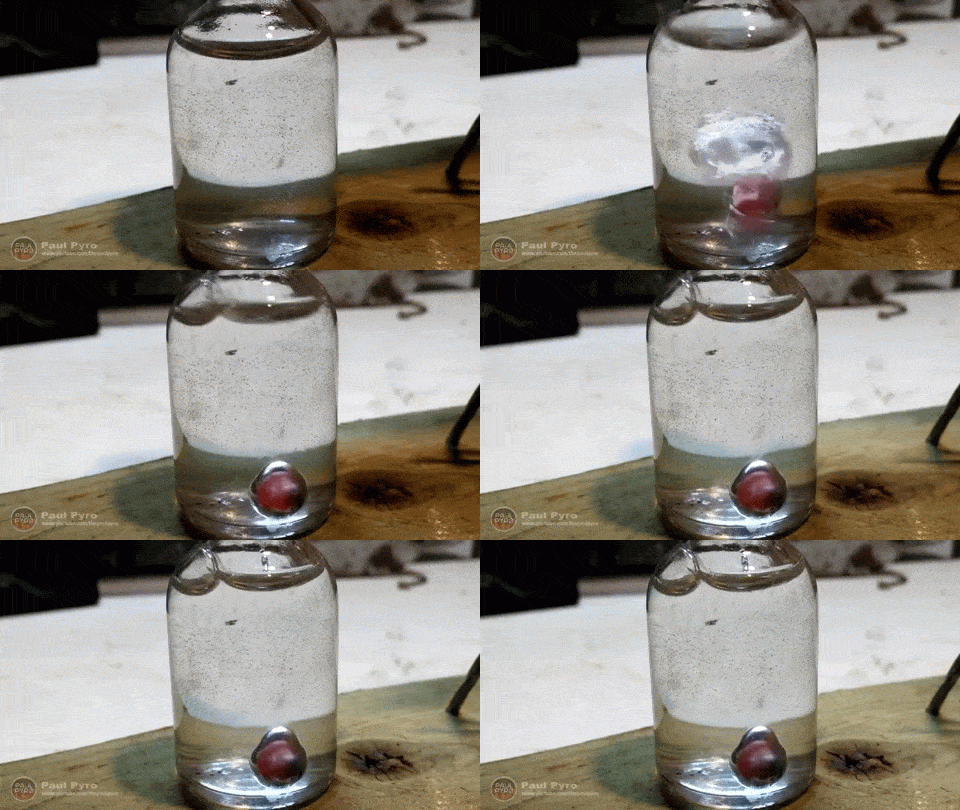
The Leidenfrost effect occurs when a liquid is exposed to a surface so hot that it instantly vaporizes part of the liquid. It’s typically seen with a drop of water on a very hot pan; the drop will slide around, nearly frictionless, upon a cushion of its own vapor. You can see the effect when plunging a hot object into a bath of liquid, too. This is what happens when you quickly dunk a hand in liquid nitrogen (not recommended, incidentally) or when you drop a red hot steel ball into water like above. In this case, the object is so hot that it gets encased in a layer of water vapor. If you could maintain the temperature difference necessary to keep the vapor layer intact, you could move underwater at high speeds with low drag, similar to the effects of supercavitation. (Image credit: Paul Pyro, source)
If you enjoy FYFD, please consider supporting the site by becoming a patron!
Tears of Wine
Give your wine glass a swirl and afterward you may notice little rivulets of wine along the side of your glass. These so-called “tears of wine” or “wine legs” are caused by a combination of evaporation, surface tension, and gravity. After the glass has been swirled, alcohol from the thin layer of wine on the glass wall quickly evaporates, leaving behind a fluid that is more watery than the wine in the glass. Since water has a higher surface tension than alcohol or wine, it pulls more fluid up the wall via the Marangoni effect. This carries on until enough wine is pulled up to form a droplet that’s heavy enough to slide down the glass. This up-and-down exchange of fluid is nicely illustrated in the video above, where the tiny particles in the wine help show how flow gets drawn up even as your eye follows the drops sliding down. (Video credit: A. Athanassiadis and K. Khalil; submitted by Thanasi A.)
Special thanks to our Patreon patrons, who help keep FYFD up and running.

The Best of FYFD 2015


2015 was a pretty good year. FYFD turned five, we had a great reader survey response, and Tumblr gave us a Tumblr Lifetime Achievement! Guess that means I’ve got more in common with Wil Wheaton and the New York Public Library than my lifelong obsession with books.
Without further ado, I give you the top 10 FYFD posts of 2015:
1. The secret of the dancing droplets
2. The open siphon and self-pouring liquids
3. Fingers of sea foam
4. The physics of rain drops falling on a puddle
5. Fin-like Kelvin-Helmholtz clouds in the Galapagos
6. A fish swimming in microgravity
7. Hawaiian lava waterspouts
8. Colorado’s Kelvin-Helmholtz clouds
9. Delicious fluid dynamics in the kitchen
10. Inside of a fluidic oscillatorThanks for a great year, readers, and stay tuned. There are exciting developments afoot for 2016!
(Image credits: N. Cira et al., Ewoldt Research Group, L. Meudell, K. Weiner, C.Miller, IRPI LLC, B. Omori, Breckenridge Resort, Buttery Planet, M. Sieber et al.)
Freezing From Below
Watch closely as a droplet freezes on a cold surface, and you’ll observe something surprising. First, a freeze front will appear, traveling upward from the substrate. It curves slightly near the edges, leaving a liquid cap atop the frozen drop. But, as we’ve all discovered, water expands as it freezes. We can watch the drop freezing and see that the water isn’t expanding radially. Instead, the water expands vertically, forming a sharp tip or cusp just as the drop freezes completely. Remarkably, the geometry of the final tip doesn’t depend on the temperature of the substrate or on the wetting contact angle. (Video credit: L. Posada)

From Dripping to Beading

When water drips, it quickly breaks up into a string of smaller droplets due to a surface-tension-driven instability called the Plateau-Rayleigh instability. But adding just a tiny bit of polymer to the fluid changes the behavior entirely. Instead of breaking into droplets, a narrow filament dotted with tiny satellite droplets forms between the larger drops. This is known as the beads-on-a-string instability. The viscoelasticity the polymers add is one key to seeing this behavior. Polymers consist of large molecule chains that, when stretched, act a little like rubber bands–they pull back against the stretch, providing an elastic effect. Without this elasticity, the tiny filament connecting the drops would break up immediately. (Image credit: M. Berman, source; research credit: P. Bhat et al.)
Carbonation in Space
Astronauts don’t typically drink soda or other carbonated beverages while in space. The reason is probably apparent if you watch this new video of an effervescent tablet in water on the space station (or, you could watch the older classic one from Don Pettit). Unlike on Earth, where the carbon dioxide bubbles are buoyant and rise to the surface, the bubbles in a fluid in microgravity are randomly distributed. Those few bubbles that happen to be located along the edge of the water sphere will sometimes burst, creating the halo of tiny droplets you see in the video. In the case of sodas, though, the bubbles’ behavior creates a foamy mess, and, after ingestion, the bubbles are stuck travelling through the astronaut’s digestive system instead of getting burped out. Sounds rather unpleasant to me. (Video credit: NASA; submitted by entropy-perturbation and buckitdrop)
——————
LAST CALL: Help us do some science! I’ve teamed up with researcher Paige Brown Jarreau to create a survey of FYFD readers. By participating, you’ll be helping me improve FYFD and contributing to novel academic research on the readers of science blogs. It should only take 10-15 minutes to complete. You can find the survey here.

Raindrops in Puddles
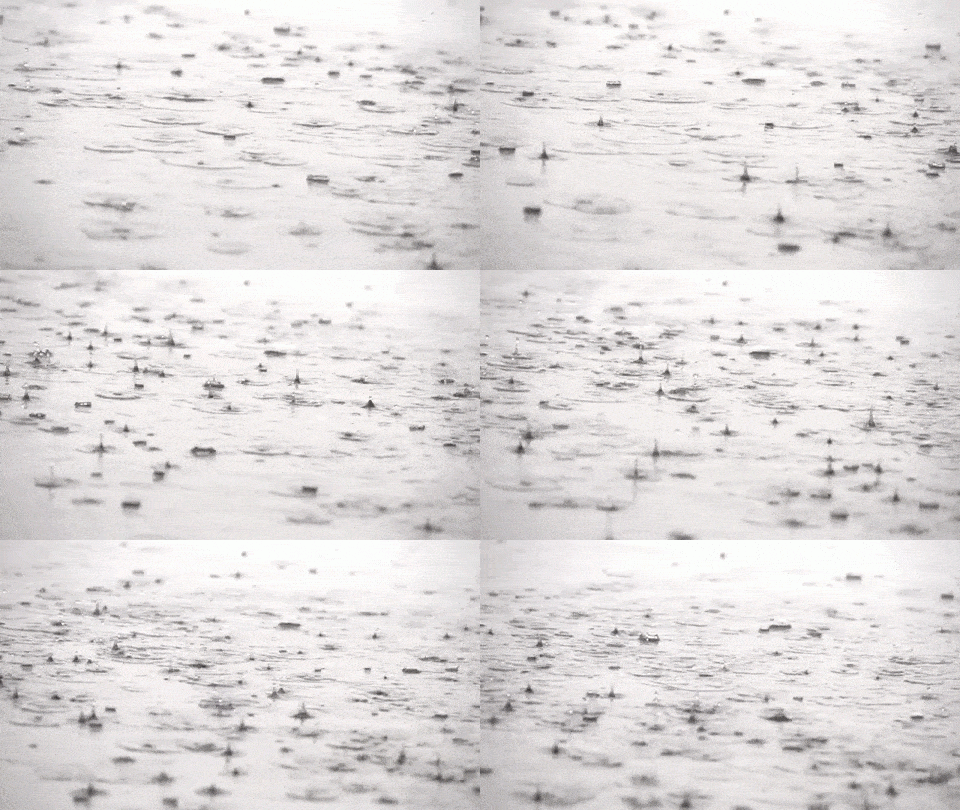
Watching rain drops hit a puddle or lake is remarkably fascinating. Each drop creates a little cavity in the water surface when it impacts. Large, energetic drops will create a crown-shaped splash, like the ones in the upper animation. When the cavity below the surface collapses, the water rebounds into a pillar known as a Worthington jet. Look carefully and you’ll see some of those jets are energetic enough to produce a little satellite droplet that falls back and coalesces. Altogether it’s a beautifully complex process to watch happen over and over again. (Image credit: K. Weiner, source)
——————
Help us do some science! I’ve teamed up with researcher Paige Brown Jarreau to create a survey of FYFD readers. By participating, you’ll be helping me improve FYFD and contributing to novel academic research on the readers of science blogs. It should only take 10-15 minutes to complete. You can find the survey here.