Ever tried to mix oil and vinegar? Anyone who has ever dealt with salad dressings knows the difficulty of evenly distributing immiscible fluids; the key is to shake them and create an emulsion, where droplets of one fluid are distributed throughout another. In this video, researchers create a double emulsion–oil in water in oil–without touching the two fluids. First they suspend a drop of water on a wire and then coat it with oil. Below, they place a bath of silicone oil, which they vibrate. When the oil-coated droplet falls onto the bath, it bounces on the surface rather than coalescing because a thin layer of air–constantly refreshed due to the vibration of the surface–separates the droplet from the bath. When the amplitude of the vibration is large enough, the oil coating penetrates the water during the bounce, leaving behind a tiny droplet and creating the emulsion. (Video credit: D. Terwange et al; Research paper)
Search results for: “water droplet”

Fragmenting Raindrops
This numerical simulation demonstrates the fragmentation of droplets of water falling through a quiescent medium–essentially how a raindrop behaves. As the initial droplet falls, drag forces deform the droplet, contorting it until surface tension causes it to break into smaller droplets, which can themselves be broken up by the same mechanisms.
Cavity Collapse
When a solid object is driven into a quiescent liquid, a cavity is formed. As the cavity collapses jets–a type of singularity–form. In this video, researchers explore the effect of the geometry of a disk being driven into water on the shape of the cavity formed and how it collapses. As in this video of droplet impacts on posts of different geometries, there’s a lovely symmetry in the results. (Video credit: O. Enriquez et al)
Freezing Drops
[original media no longer available]
The physics of droplets freezing is important for understanding applications like ice formation on airplane wings. Here we see how a warm droplet deposited on a cold plate freezes. A freezing front advances through the drop, which expands vertically as it freezes. Ultimately, the expansion of the ice and the surface tension of the water create a pointed singular tip.
Vibration-Induced Atomization
Atomization–breaking a liquid into a fine spay of droplets–is common in engines, printers, and in the shower. Here a droplet of water is placed on a thin metal diaphragm that is vibrated at 1 kHz with increasing vibrational amplitude. Capillary waves form on the droplet, and once a critical vibrational amplitude is achieved, tiny droplets are ejected. Full atomization of the original droplet is achieved in about 0.3 seconds real-time. #
The Coalescence Cascade
When a droplet impacts a pool at low speed, a layer of air trapped beneath the droplet can often prevent it from immediately coalescing into the pool. As that air layer drains away, surface tension pulls some of the droplet’s mass into the pool while a smaller droplet is ejected. When it bounces off the surface of the water, the process is repeated and the droplet grows smaller and smaller until surface tension is able to completely absorb it into the pool. This process is called the coalescence cascade.
Disrupting the Coalescence Cascade
When a droplet contacts a pool, a thin layer of air can get trapped beneath the droplet, delaying the instant when the liquids contact and surface tension pulls the droplet into the pool. If the pool is being vibrated, air flows more easily into the gap, keeping droplets intact longer. It’s even possible to make them dance.
Atomization
Atomization–breaking a flowing liquid into a fine spray–is important for fuel injection in a variety of engines, including automobiles, jet engines, ramjets, scramjets, and rockets. The more effectively a liquid fuel can be dispersed as a spray in an engine, the more efficient and stable the combustion will be. The apparatus in this high-speed video injects an annular water sheet with concentric jets of air on either side of the water. The video series shows the effects of increasing the outer and inner air velocities relative to the water on the breakup of the liquid. What to the naked eye looks like a deluge, high-speed video reveals as a complex undulating structure.
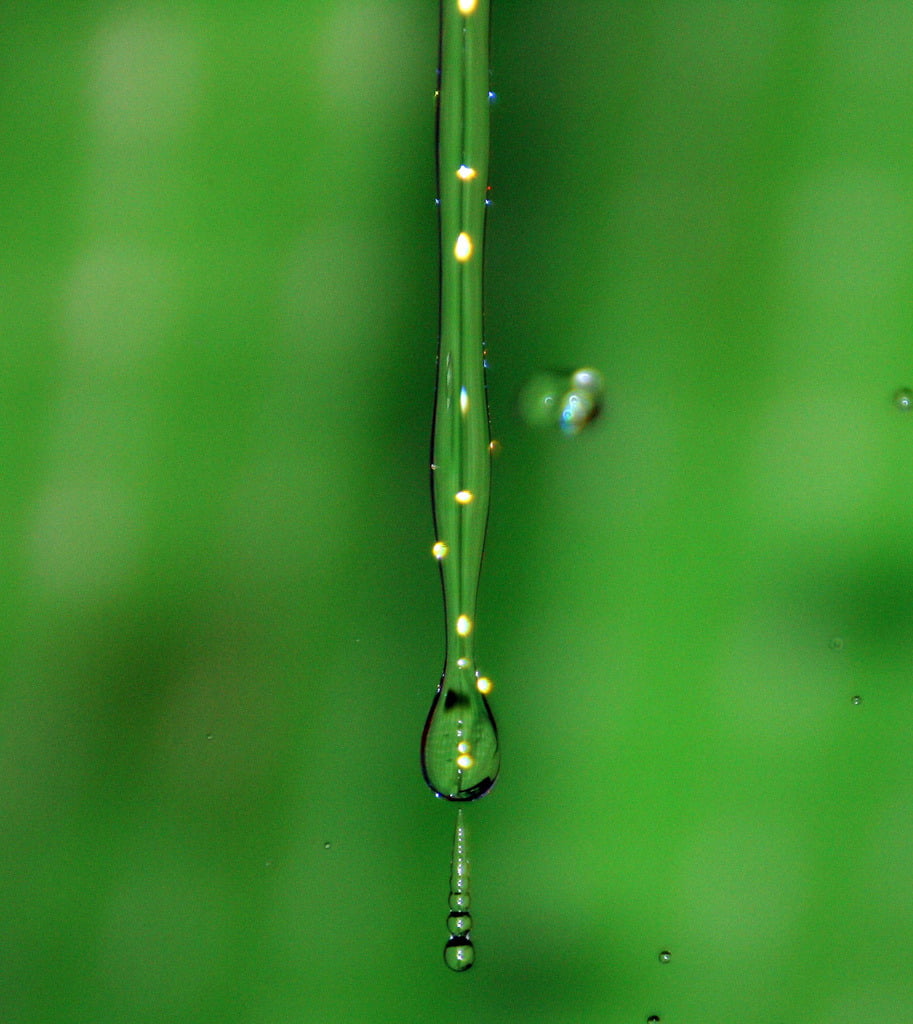
Jet Breakup
As a laminar column of water falls, slight perturbations cause waviness in the stream. Whenever the radius of the stream decreases, the pressure due to surface tension increases, causing fluid to flow away from the area of smaller radius. This outflow decreases the radius further and drives the stream to break into droplets. The mechanism is called the Plateau-Rayleigh instability. (Photo credit: Mahmoudreza Shirinsokhan)
The Tibetan Singing Bowl
The vibration caused by rubbing a Tibetan singing bowl excites standing waves in a Faraday instability on the surface of water in the bowl. As the amplitude of excitation increases, jets roil across the surface, creating a spray of droplets, some of which actually bounce on the surface as it vibrates. For more see the BBC and SciAm articles.