Tag: shark

  • Spiral Shark Intestines

    Spiral Shark Intestines

    We’ve seen previously just how fluid dynamically impressive sharks are on the outside, but today’s study demonstrates that they’re just as incredible on the inside. Researchers used CT scans of more than 20 shark species to examine the structure of their intestines. Sharks have spiral intestines that come in four different varieties; two of those types look like a stacked series of funnels (either pointing upstream or downstream). These funnel-filled spirals, the researchers found, are incredibly good at creating uni-directional flow without any moving parts, much like a Tesla valve does. The spiral structure also seems to slow down digestion, which may factor into the shark’s ability to go long periods between meals. Incredibly, the fossil record indicates that spiral intestines — in some form — evolved in sharks about 450 million years ago — before mammals even existed! Clearly we engineers are way behind sharks when it comes to controlling flows!

    Animation of a 3D scan of a shark's intestine, showing the spiral internal structure.

    (Image credit: top – D. Torobekov, scan – S. Leigh; research credit: S. Leigh et al.; via NYTimes; submitted by Kam-Yung Soh)

  • Hammerhead Hydrodynamics

    Hammerhead Hydrodynamics

    Hammerhead sharks have some of the most distinctive craniums in the ocean, which begs the question: how do they swim with that head? New computational fluid dynamics studies suggest that their long foil-shaped heads help the sharks maneuver swiftly, but they come at the cost of substantially higher drag. The researchers found that drag on the hammerhead’s cranium required energy expenditures more than 10 times higher than other sharks, but since the study looked at heads only, it’s possible that the rest of the shark’s positioning helps mitigate that cost. (Image credit: shark – J. Allert, CFD – M. Gaylord et al.; research credit: M. Gaylord et al.; via NYTimes; submitted by Kam-Yung Soh)
    Pressure contours and streamlines around a hammerhead shark head.
  • Bristling Sharkskin Fights Separation

    Bristling Sharkskin Fights Separation

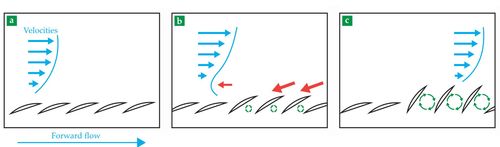
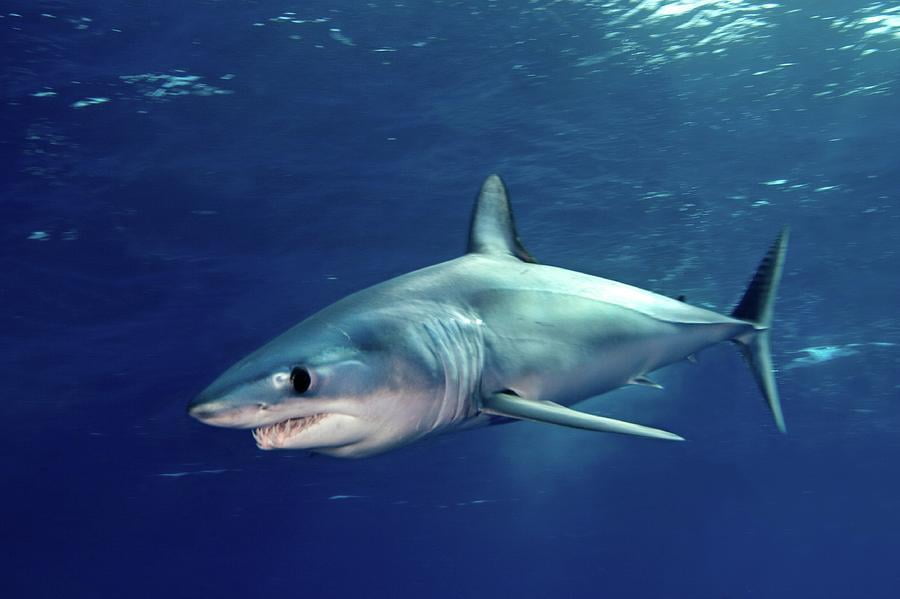
    The speedy shortfin mako shark has a secret weapon to fight drag: bristling denticles that line its fins and tail. Denticles are tiny, anvil-shaped enamel scales on the mako’s skin. In the photo above, each one is about 100 microns across. Under normal conditions, with flow moving over the shark from nose to tail, the denticles lie flat, providing no interference.

    But when sudden changes in flow near the shark’s skin cause water to begin moving in the opposite direction, the denticles flare up. Their rise interferes with the reversed flow, trapping it in small eddies beneath each denticle. Since that flow reversal is a precursor to the flow separating from the shark’s body, the bristling effectively cuts off flow separation before it can begin. The result is much less separation and much lower drag. Once the flow stops trying to move upstream, the denticles settle back into their original place. (Image credit: mako shark – jidanchaomian, denticles – J. Oeffner and G. Lauder, illustration – A. Lang, bristling – A. Lang et al.; research credit: A. Lang and A. Lang et al.; submitted by Kam-Yung Soh)

  • Review: “How to Walk on Water and Climb Up Walls”

    Review: “How to Walk on Water and Climb Up Walls”

    “An eight-year-old girl kicked her feet back and forth on the seat of a Long Island Railroad train. I beckoned her to cover over and pointed to the top of my winter jacket, which I slowly unzipped. Inside, nestling against me for warmth, were ten snakes, their forked tongues waving back and forth. The child shrieked and ran back over to her mother, who was napping. ‘That man has a coat full of snakes,’ she shouted.”

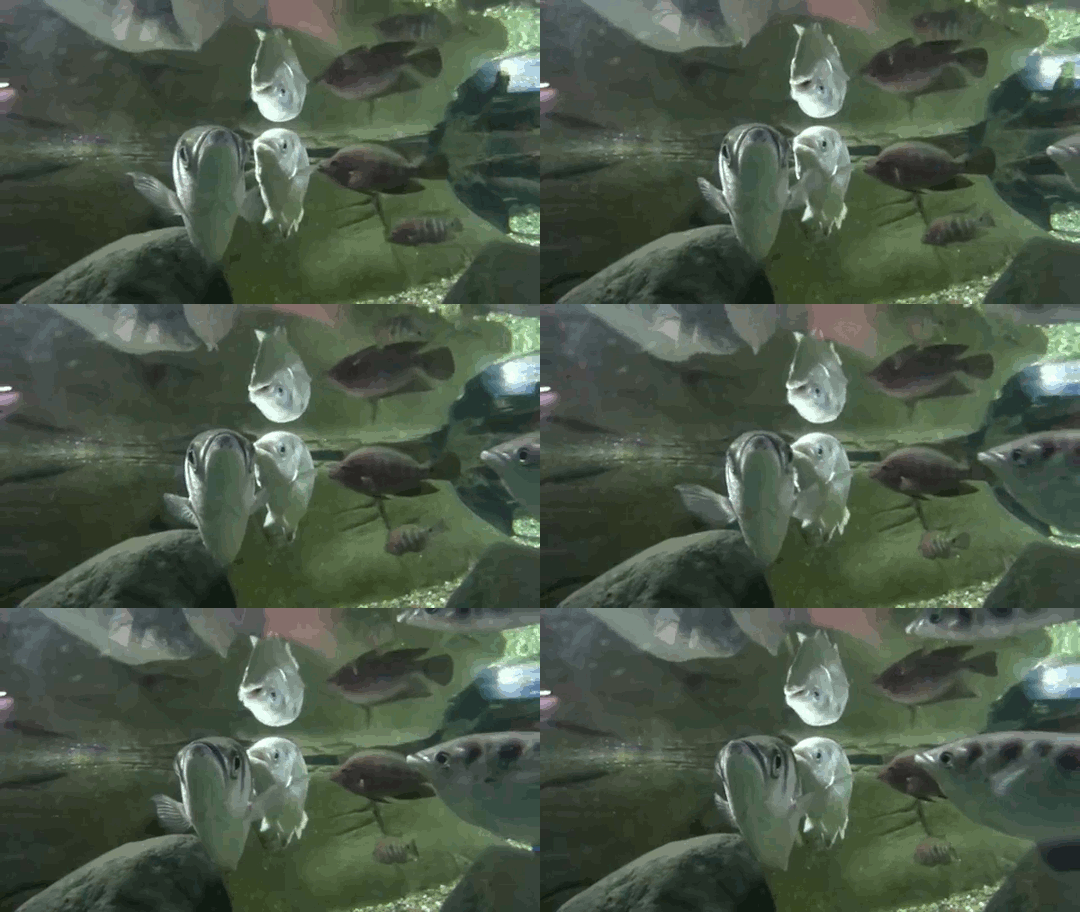
    So begins Chapter 2 of Dr. David Hu’s new book, How to Walk on Water and Climb Up Walls (*), a captivating and funny journey through animal locomotion and biorobotics. Don’t let that fool you, though; this book has plenty of fluid dynamics to it. Long-time FYFD readers will recognize some of the topics, such as the fluid-like behavior of fire ants, how eyelashes keep our eyes clean and moist, and why swimming behind an obstacle is so easy even a dead fish (like the one shown above) can do it.

    There are plenty of exciting, new stories as well, like how sandfish – a type of lizard – can swim under sand and why a lamprey’s nervous system may lead to better robots. The explanation of how cockroaches are virtually unsquishable and able to squeeze themselves into crevices a quarter of their height absolutely floored me. 

    Hu’s book offers a front-row seat to research at the cutting edge of biology, engineering, and physics, with anecdotes, explanations, and applications that will stick with you long after you put the book down. If you’re looking for a holiday gift for yourself or another science-lover, check this one out for certain (*).

    *Disclosures: I purchased my copy of this book using my own funds, and this review is not sponsored in any way. This post contains affiliate links – marked with (*); if you click on one of these links and purchase something, FYFD may receive a small commission at no additional cost to you.

    (Image credits: book – Princeton University Press; fish – D. Beal et al.; ants – Vox/Georgia Tech; eyelashes –  G. Diaz Fornaro; shark denticles – J. Oeffner and G. Lauder)

  • Featured Video Play Icon

    Fish, Feathers, and Phlegm

    Inside Science has a new documentary all about fluid dynamics! It features interviews with five researchers about current work ranging from the physics of surfing to the spreading of diseases. Penguins, sharks, archer fish, 3D printing, and influenza all make an appearance (seriously, fluid dynamics has everything, guys). If you’d like to learn more about some of these topics, I’ve touched on several of them before, including icing, penguin physics, shark skin, archer fish, and disease transmission via droplets.  (Video credit: Inside Science/AIP)

  • Sharks Swimming Sideways

    Sharks Swimming Sideways

    Like many sharks, the great hammerhead shark is negatively buoyant, meaning that, absent other forces, it would sink in water. To compensate, sharks generate lift with their pectoral (side) fins to offset their weight. Their dorsal (top) fin is used to generate the horizontal forces needed for control and turning. However, both captive and wild great hammerhead sharks tend to swim rolled partway onto their sides. The reason for this unusual behavior is hydrodynamic – it is more efficient for the shark. Unlike other species, the great hammerhead has a dorsal fin that is longer than its pectoral fins. By tipping sideways, the shark effectively creates a larger lifting span and is able to induce less drag than when it swims upright. Models show that swimming on their sides requires ~8% less energy than swimming upright! (Image credit: N. Payne et al., source)

  • Denticles and Sharkskin

    Denticles and Sharkskin

    Look closely enough at a shark’s skin, and you will find it is covered in tiny, anvil-shaped denticles (lower left). To try and discover how and why these denticles help sharks, researchers are 3D printing denticles in different patterns onto flexible sheets to create biomimetic shark skin (lower right). 

    They test the artificial shark skin in a water tunnel by moving it with prescribed motions and measuring different characteristics, like the swimming speed attained and the power required. When compared to a smooth but flexible control surface, one pattern came out ahead. The staggered-overlapped denticle pattern (shown in C of the lower right figure) achieved swimming speeds 20% higher than the smooth control despite having far more surface area due to the denticles. The cost of that speed was only 13% greater than the smooth case on average, and was about equal to the smooth case for small amplitude motion. This suggests that the patterning of a shark’s skin may help it swim faster with little to no additional cost in effort.

    For more on shark hydrodynamics, check out my previous posts on the topic, and if you want even more shark science, check out these great videos. (Image credit: R. Espanto; J. Oeffner and G. Lauder; L. Wen et al.; research credit: L. Wen et al., 1, 2)

  • Sharkskin Fluid Dynamics

    Sharkskin Fluid Dynamics

    Sharks have evolved some incredible fluid dynamical abilities. Instead of scales, their skin is covered in microscopic structures called denticles. To give you a sense of size, each denticle in the black and white image above is about 100 microns across. Denticles are asymmetric and overlap one another, creating a preferential flow direction along the shark. When water tries to move opposite the preferred direction, the denticles will bristle, like in the animation above. The bristled denticles form an obstacle for the reversed flow without any effort on the shark’s part. Since local flow reversal is an early sign of separation, researchers theorize that this bristling tendency prevents flow along the shark’s skin from separating. Keeping flow attached, especially along the shark’s tail, is vital not only to the shark’s agility but to keeping its drag low. Researchers have even begun 3D printing artificial shark skin to try and harness the animal’s hydrodynamic prowess. For much more shark-themed science, be sure to check out this week’s “Several Consecutive Calendar Days Dedicated to Predatory Cartilaginous Fishes” video series by SciShow, It’s Okay to be Smart, The Brain Scoop, Smarter Every Day, and Minute Physics. (Image credits: J. Oeffner and G. Lauder; A. Lang et al.; original video; jidanchaomian)

  • Fluids Round-up – 13 July 2013

    Fluids Round-up – 13 July 2013

    Prepare yourselves for lots of links in today’s fluids round-up!

    (Photo credit: AeroVelo)

  • Sharkskin’s Secrets

    Sharkskin’s Secrets

    Sharks are known as extremely fast and agile swimmers, due in part to the surface of their skin. Sharks are covered in very tiny tooth-shaped scales called denticles which are streamlined in the direction of flow over the shark. If you were to run a hand over a shark’s skin from head to tail, it would feel silky smooth, but rub against the grain and it’s like running your hand on sandpaper.  Water encounters a similar resistance, which, according to new research, provides the shark with a passive flow control mechanism, requiring no effort on the part of the shark. When water near the shark’s denticles tries to reverse direction, an early stage in flow separation, the denticles naturally bristle, slowing and trapping the reversed flow. This prevents local flow separation which would otherwise increase the shark’s drag and hinder its agility. (Photo credit: James R. D. Scott; Research by A. Lang et al.)