Search results for: “kelvin-helmholtz instability”

  • How Are Sea Waves Created?

    How Are Sea Waves Created?

    There are many different kinds of sea waves, some of which have fluid dynamical origins and some of which don’t. For example, tsunamis are caused by the sudden displacement of the ocean floor caused by earthquakes and the tides are caused by the pull of the moon on Earth’s oceans. But many of the waves we are accustomed to seeing are caused by the wind moving across open water, whether in the ocean, in a lake or a sea, or even a river or pond. When the wind blows across the free surface of the water, the difference in velocity between the two fluids causes shearing and the development of surface waves as a result of the Kelvin-Helmholtz instability. (Incidentally, this is why other examples of the K-H instability look so much like ocean waves.)

    These wind-generated waves can take several forms. Ripples–or capillary waves–remain visible only as long as the wind is blowing. But under steady conditions, or after the wind has affected a large enough area, waves can form that will persist at the surface even if the wind stops blowing. At that point, even though the wind generated the waves, it is gravity that allows them to persist. This is the source of most of the waves we see on large bodies of water. (Photo credit: Travis Weins)

  • Where Jupiter Got Its Swirls

    Where Jupiter Got Its Swirls

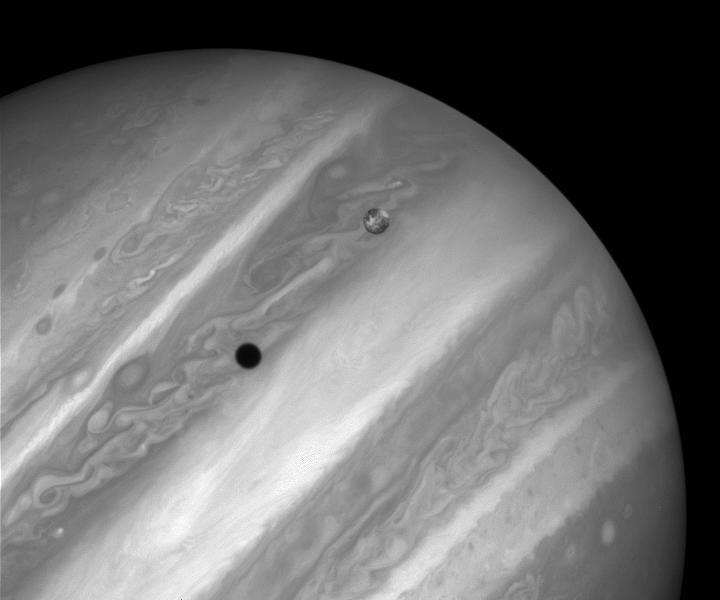
    When layers of a fluid are moving at different relative velocities, they shear against one another. This shear can trigger the Kelvin-Helmholtz instability, which develops as a waves along the interface. Here Hubble captures Kelvin-Helmholtz waves along the cloud bands of Jupiter, but such clouds are also not uncommon here on Earth. (Photo credit: J. Spencer and NASA)

  • Featured Video Play Icon

    Smoke Flow Viz

    Smoke visualization, illuminated by a laser sheet, shows a 2D slice from an axisymmetric jet as it breaks down to turbulence. The flow is laminar upon exiting the nozzle, but the high velocity at the edge of the jet and low velocity of the surrounding air causes shear that leads to the Kelvin-Helmholtz instability. This instability leads to the formation of small vortices that grow as they are advected downstream until they are large enough to interrupt the jet and it breaks down into fully turbulent flow. (Video credit: B. O. Anderson and J. H. Jensen)

  • Featured Video Play Icon

    Smoke Transition

    Smoke issuing from a round jet undergoes transition from laminar to turbulent flow. As the smoke moves past the unmoving ambient air, the friction between these two layers creates shear and triggers a Kelvin-Helmholtz instability, recognizable by the formation and roll up of vortices along the edges of the jet. Those vortices then roll together in pairs, detach, and devolve into a generally turbulent flow. Because turbulence is far more efficient at mixing than a laminar flow is, the smoke seems to disappear.

  • Featured Video Play Icon

    “Glacial River Blues”

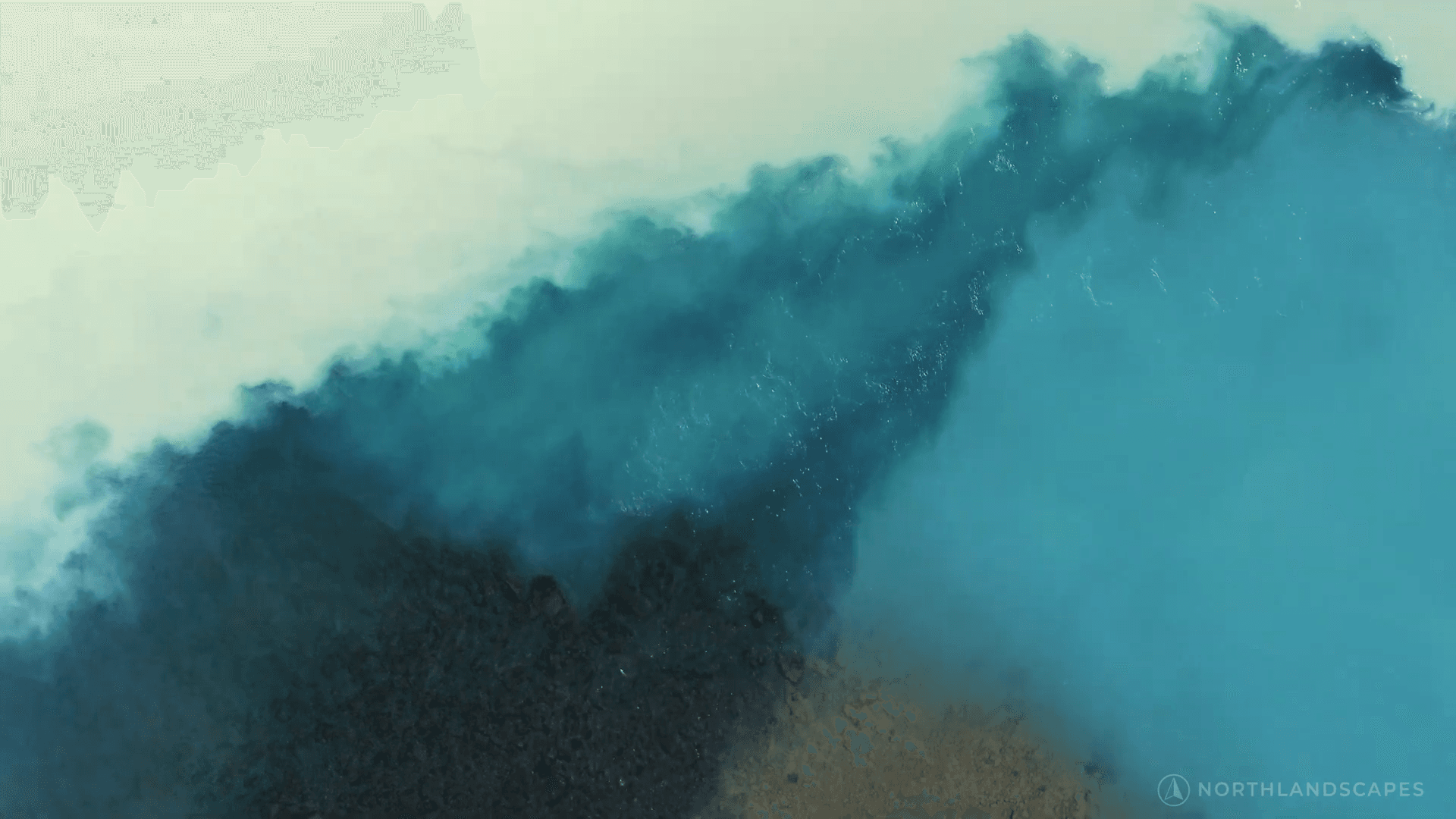
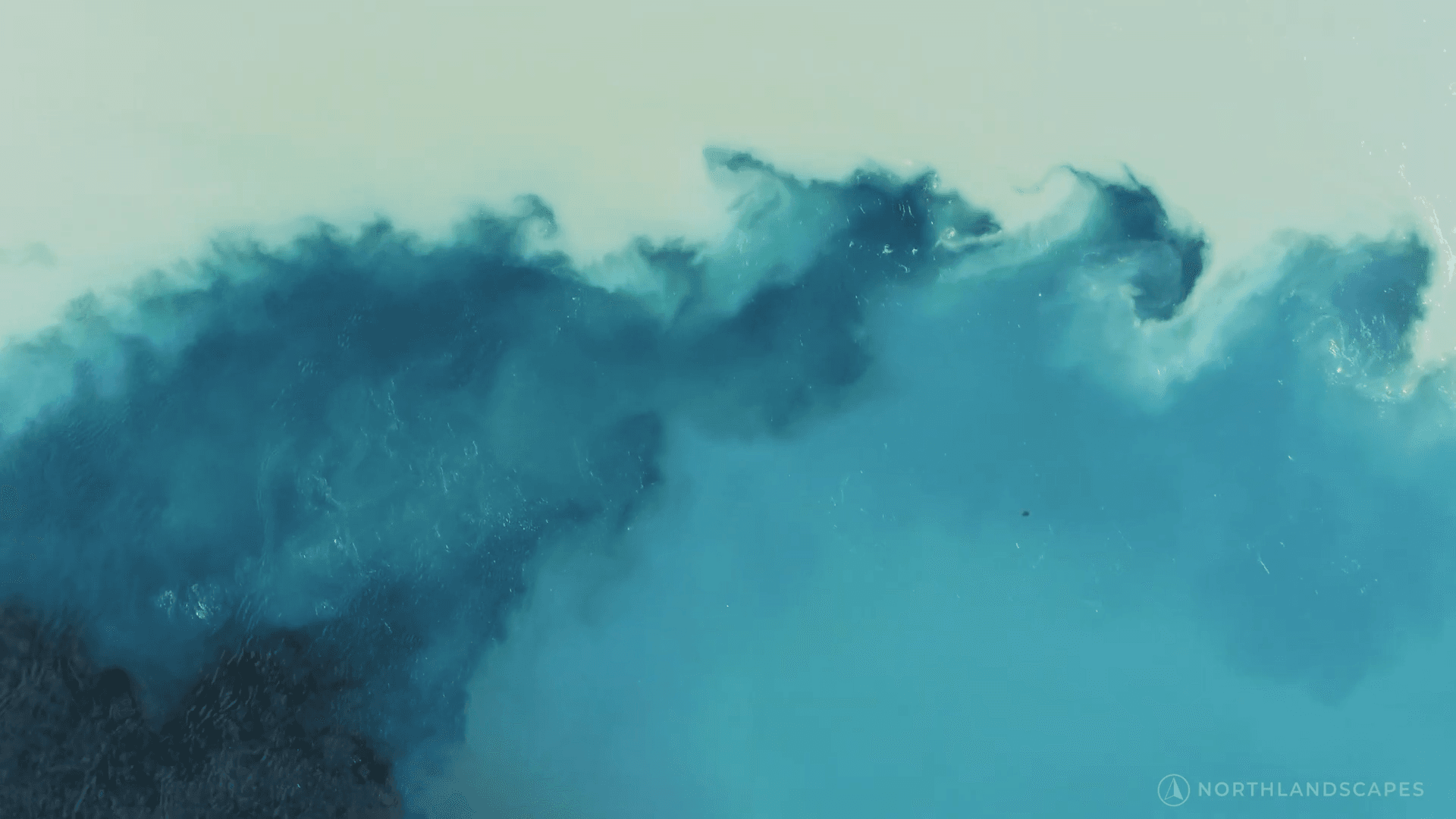
    Glacier-fed rivers are often rich in colorful sediments. Here, photographer Jan Erik Waider shows us Iceland’s glacial rivers flowing primarily in shades of blue. While the wave action and diffraction in these videos is great, the real star is the turbulent mixing where turbid and clearer waters meet. Watch those boundaries, and you’ll see shear from flows moving at different speeds which feeds the ragged, Kelvin-Helmholtz-unstable edge between colors. (Video and image credit: J. Waider; via Laughing Squid)

    Fediverse Reactions
  • Featured Video Play Icon

    “A Sense of Scale – Reminiscence”

    In so much of fluid dynamics, size does not matter. We see the same patterns mirrored across nature from a fuel injection nozzle to galactic clusters. And no one plays with that sense of scale better than artist Roman De Giuli, whose microscale practical effects give the impression of flying above glittering alien coastlines. Ink and paint squeeze around craggy islands, leaving perfect streamlines to mark their passage. Fractal fingers expand like river deltas seeking the path to the sea. Enjoy more of De Giuli’s work on his website and Instagram. (Image and video credit: R. De Giuli; via Colossal)

  • Breaking Up Is(n’t) Hard to Do

    Breaking Up Is(n’t) Hard to Do

    Engineers often need to break a liquid jet up into droplets. To do so quickly, they surround the jet with a ring of fast-moving air in a set-up known as a coaxial jet. Shear between the gas and liquid creates instabilities that quickly distort the jet’s initial cylinder into sheets and ligaments. Those formations then undergo their own instabilities to break up into drops. The method is, as you can see in the high-speed images above, quite effective, though the breakup mechanism itself is tough to quantify. (Image credit: G. Ricard et al.)

  • Jovian Auroras

    Jovian Auroras

    Like Earth, Jupiter is home to polar auroras that light the sky as charged particles interact with the planet’s magnetosphere. A recent paper identifies interesting features in the aurora that appear similar to expanding vortex rings (see inset below). Although the researchers cannot yet identify the origin of the rings, they hypothesize that the process begins at the far edges of Jupiter’s magnetosphere where it interacts with the incoming solar wind. One theory posits that shear flows and Kelvin-Helmholtz instabilities where the magnetosphere and solar wind meet drive the phenomenon. (Image credit: Jupiter – NASA, ESA, and J. Nichols, aurora features – NASA/SWRI/JPL-Caltech/SwRI/V. Hue/G. R. Gladstone/B. Bonfond; research credit: V. Hue et al.; via Gizmodo)

    Diagram showing an inset of Jupiter's northern aurora, with further insets showing the expanding ring features.
  • Waves on a Supercell

    Waves on a Supercell

    This Colorado supercell thunderstorm features an unusual twist. Notice the sawtooth-like protrusions along the outer cloud wall. These are Kelvin-Helmholtz waveslike these fair-weather clouds we’ve seen before, but instead of occurring vertically, they project horizontally! That implies that the invisible layer of air just outside the cloud wall is moving faster than the wall itself. That creates shear along the outer edge of the cloud wall and causes these waves to form. This is the first time I’ve ever seen this sort of thing. What an awesome photo! (Image credit: M. Charnick; submitted by jpshoer)

  • Waves in the Sky

    Waves in the Sky

    Even when the sky is mostly blue, there’s a lot going on at different altitudes. The winds do not move in a consistent direction or at the same speed, something which becomes apparent when watching clouds move relative to one another. When different layers of air move past one another, there is shear between them, not unlike the friction you feel when running your hand along a table. Under the right circumstances, this shear creates Kelvin-Helmholtz waves like the ones in this image over Helena Valley, Montana. Fast-moving winds (blowing right to left in the image) above a layer of clouds created these breaking wave-like curls. The same phenomenon creates many of the ocean’s waves from the shear caused by wind blowing across water. (Image credit: H. Martin, via EPOD)