Tag: atomization

  • Predicting Droplet Sizes

    Predicting Droplet Sizes

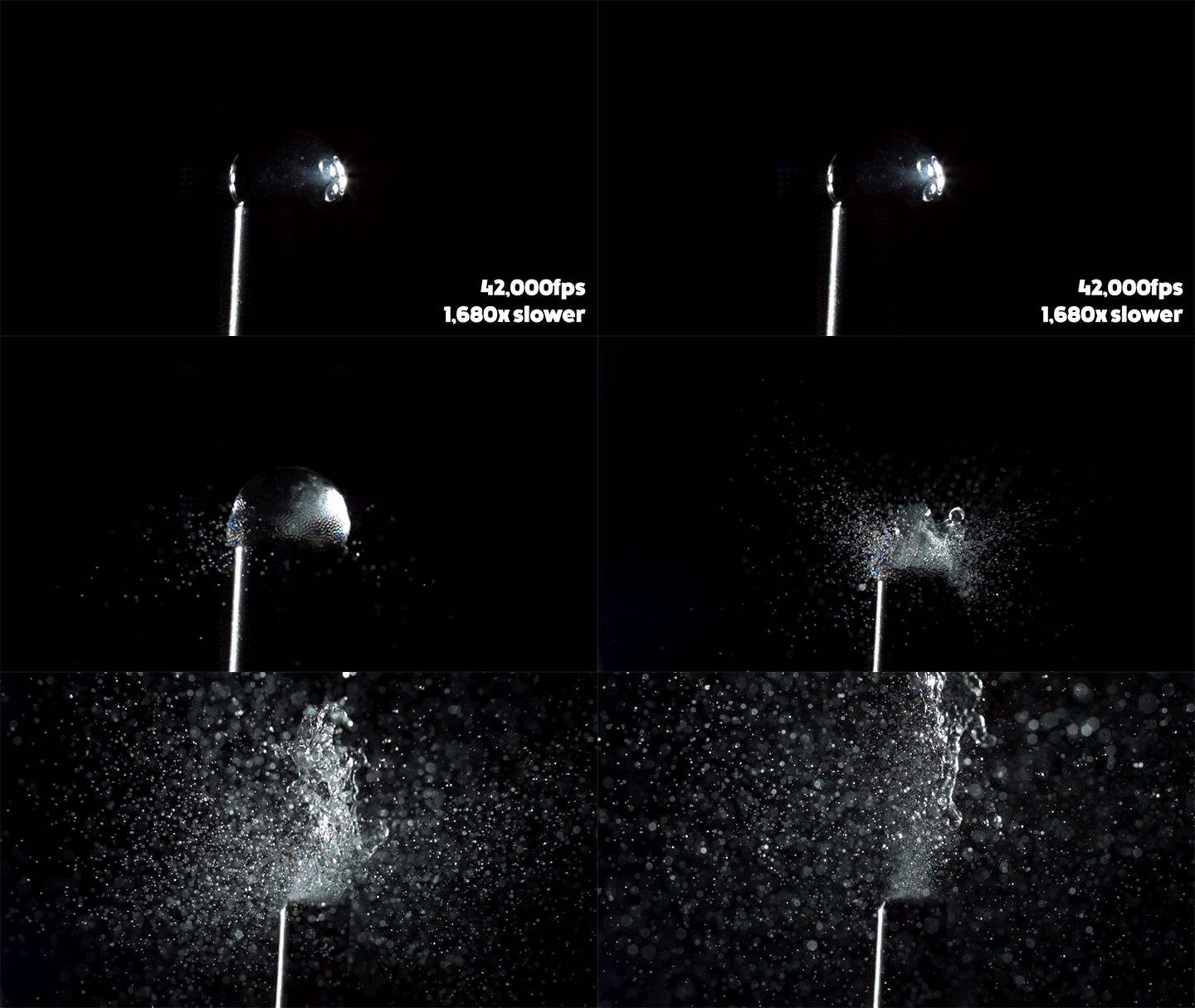
    Squeeze a bottle of cleaning spray, and the nozzle transforms a liquid jet into a spray of droplets. These droplets come in many sizes, and predicting them is difficult because the droplets’ size distribution depends on the details of how their parent liquid broke up. Shown above is a simplified experimental version of this, beginning with a jet of air striking a spherical water droplet on the far left. In less than 3 milliseconds, the droplet has flattened into a pancake shape. In another 4 milliseconds, the pancake has ballooned into a shape called a bag, made up of a thin, curved water sheet surrounded by a thicker rim. A mere 10 milliseconds after the jet and drop first meet, the liquid is now a spray of smaller droplets.

    Researchers have found that the sizes of these final droplets depend on the balance between the airflow and the drop’s surface tension; these two factors determine how the drop breaks up, whether that’s rim first, bag first, or due to a collision between the bag and rim. (Image credit: I. Jackiw et al.; via APS Physics)

  • Miniature Ice Stupas

    Miniature Ice Stupas

    Ice stupas are conical artificial glaciers built with snow cannons; they’re used to store water for spring irrigation. Here, researchers explore a miniaturized lab-grown version made from atomized water droplets. The growing drop breaks and spills, forming frozen fingers in all directions. Further drops flow and freeze as rivulets atop the stupa — or they destabilize and rotate toward another finger, leaving behind a wrinkling shape. Although the formation works very differently (and the scales are completely different) these tiny ice stupas remind me of volcanic flows. (Image credit: D. Papa et al.)

  • Droplet Medusa

    Droplet Medusa

    Vibration is one method for breaking a drop into smaller droplets, a process known as atomization. Here, researchers simulate this break-up process for a drop in microgravity. Waves crisscrossing the surface create localized craters and jets, making the drop resemble the Greek mythological figure of Medusa. With enough vibrational amplitude, the jets stretch to point of breaking, releasing daughter droplets. (Image and research credit: D. Panda et al.)

  • Featured Video Play Icon

    Leidenfrost Explosion

    When a water drop hits a surface that’s much hotter than its boiling point, part of it will vaporize immediately. Depending on the temperature, this Leidenfrost effect can be a relatively gentle process — or not. Here, the surface is so hot that the entire drop is boiling before it’s even finished spreading from impact. The vapor in contact with the surface is trying to escape, bubbling up so violently that it rips the original droplet into a spray of tiny droplets. (Video and image credit: L. Gledhill)

  • Breaking Up Is(n’t) Hard to Do

    Breaking Up Is(n’t) Hard to Do

    Engineers often need to break a liquid jet up into droplets. To do so quickly, they surround the jet with a ring of fast-moving air in a set-up known as a coaxial jet. Shear between the gas and liquid creates instabilities that quickly distort the jet’s initial cylinder into sheets and ligaments. Those formations then undergo their own instabilities to break up into drops. The method is, as you can see in the high-speed images above, quite effective, though the breakup mechanism itself is tough to quantify. (Image credit: G. Ricard et al.)

  • Featured Video Play Icon

    Shattering With Resonance

    Resonance is a phenomenon that is both familiar and somewhat mysterious. It takes place when a system is excited near its natural frequency. In this case, we’re seeing a mechanical resonance that’s driven by sound waves near the glass’s natural frequency. Once excited, the glass vibrates by flexing side-to-side along one axis and then again in a perpendicular direction. Eventually, the amplitude of this flexing is large enough to break the glass. When the glass is filled with water, its flexing instead generates a cloud of tiny droplets in a process known as vibration-induced atomization. The inverse problem — an empty glass resonating within a pool of liquid — is also an extremely cool problem. (Image and video credit: The Slow Mo Guys)

  • Featured Video Play Icon

    Ultrasonic Vibrations

    Ultrafast vibrations can break up droplets, mix fluids, and even tear voids in a liquid. Here, the Slow Mo Guys demonstrate each of these using an ultrasonic homogenizer, a piece of lab equipment capable of vibrating 30,000 times a second. At that speed generating cavitation bubbles is trivial, and the flow induced by that cavitation is well-suited to emulsifying otherwise immiscible liquids like oil and water. They also show how a lone droplet gets torn into many microdroplets, a process formally known as atomization. (Image and video credit: The Slow Mo Guys)

  • Spin Cycle

    Spin Cycle

    Rotational motion is a great way to break up liquids, as anyone who’s watched a dog shake itself dry can attest. That same centrifugal force is what allows this rotary atomizer to break liquids into droplets. Relative to the photos above, the atomizer spins in a counter-clockwise direction. This motion stretches the fluid flowing off it into skinny, equally-spaced ligaments, which eventually break down into droplets.

    Just how and when that break-up occurs depends on the fluid, as well as the characteristics of the spin. For Newtonian fluids like silicone oil — shown in the first two pictures — the break-up is driven by surface tension and happens relatively quickly. But with a viscoelastic fluid — shown in the last image — the elasticity of polymers in the fluid allow it to resist break-up for much longer. Instead, the ligaments form the beads-on-a-string instability. See more flows in action in the video below. (Video, image, and research credit: B. Keshavarz et al., video)

  • Featured Video Play Icon

    Streaming Fire

    I’m just going to start this one with a blanket statement: DO NOT TRY THIS. Instead, enjoy the fact that the Internet enables us to enjoy the sight of burning gasoline in slow mo without any danger to ourselves.

    In this video, Gav and Dan capture a burning bucket of gasoline as it’s thrown against glass. One thing this stunt really highlights is that it’s not the liquid gasoline that burns, it’s the vapor. However, since gasoline is volatile – in other words, it evaporates easily – the fire is quick to spread, especially as the toss atomizes droplets near the edge of the fluid. That’s why you see distinct streaks near the edge of the spreading flame and a non-burning liquid in the center. (Image and video credit: The Slow Mo Guys)

    Flaming gasoline flies toward the viewer and spreads against glass in slow motion
  • Breaking Up Drops

    Breaking Up Drops

    Lots of applications – from rocket engines to ink jet printing – require breaking large droplets into smaller ones, so there are many methods to do this. Some techniques rely on fluid instabilities, others use ultrasonic vibration. But one of the most effective methods may also be the simplest: placing a mesh between large drops and their target.

    That’s the idea at the heart of this new study, which uses a wire mesh to break large droplets into a spray of finer ones 1000 times smaller. The target application is agricultural spraying, and the researchers argue that their method would allow farmers to treat their crops effectively with fewer chemicals and less run-off. Drops impacting the mesh form a narrow cone over the plant, and the smaller, slower droplets are better at sticking to the plant instead of bouncing away. They’re also less likely to injure crops, since they don’t disturb the leaves the way larger drops do. (Image and research credit: D. Soto et al.; via MIT News; submitted by Omar M.)