Search results for: “kelvin-helmholtz instability”

  • Breaking With a Wave

    Breaking With a Wave

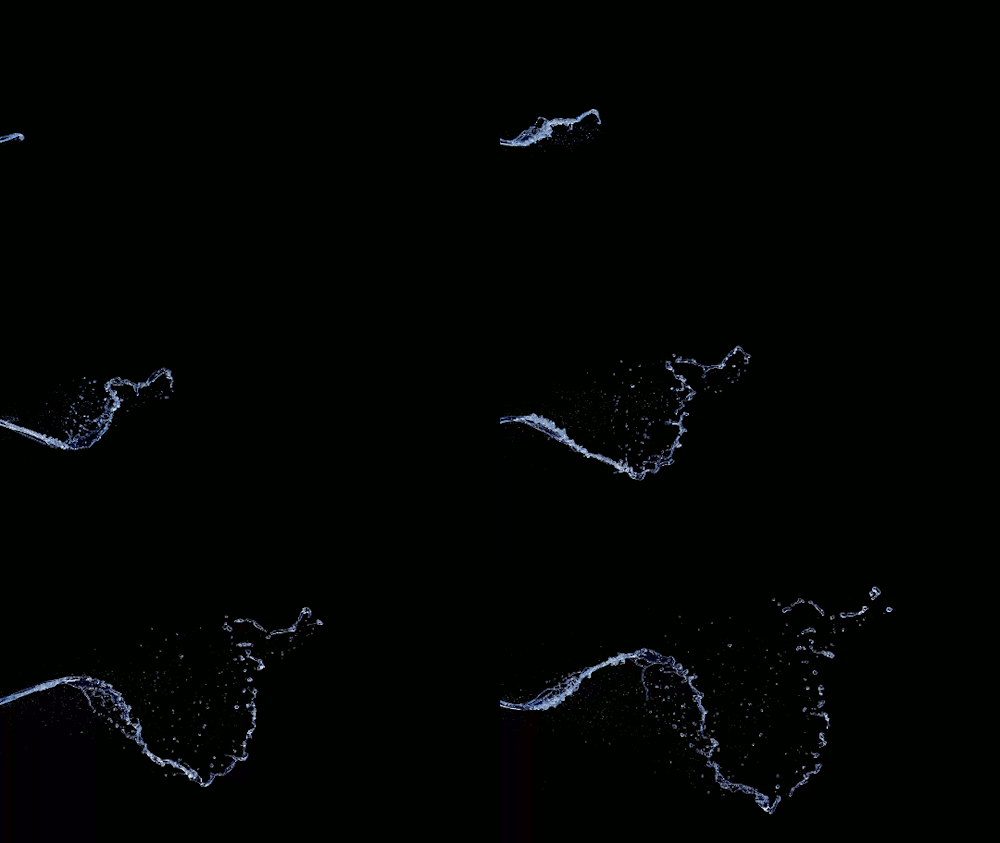
    For rocket combustion and other applications, like watering your lawn with a hose, a stream of fluid may need to be broken up into droplets. While simply spraying a liquid jet will make it break up, waving that jet back and forth will break it up faster. A recent study simulated this problem numerically to determine the exact mechanisms driving that break-up. The researchers found two major culprits.

    The first is a Kelvin-Helmholtz, or shear-based, instability. When a jet leaves the nozzle, there’s friction between it and the comparatively still air surrounding it. This creates tiny ripples in the surface that eventually grow into the distortions we can see, and it’s found in all jets, regardless of their side-to-side motion.

    The second culprit, which is only found in the oscillating jet, is a Rayleigh-Taylor instability. By moving the jet side-to-side, you’re driving the dense liquid into less dense air, which creates a different set of disturbances that also help break up the jet. The final result: swinging the jet side-to-side breaks it into smaller droplets faster. (Image and research credit: S. Schmidt et al.)

  • Featured Video Play Icon

    Perijove

    The Juno spacecraft continues to send back incredible photos of Jupiter’s atmosphere. This video animates images from the sixth close pass of Jupiter to give you a sense of what Juno sees as it swoops by our system’s largest planet. The trajectory passes from the north pole to the south, showing Jupiter’s whitish zones, dark belts, and massive storms. Up close Jupiter looks like an Impressionist painting, all vortices and shear instabilities. The large white spots you see are enormous counterclockwise rotating vortices known as anticyclones – many of them larger than our entire planet. (Video credit: NASA / SwRI / MSSS / G. Eichstädt / S. Doran)

  • Breaking Waves in the Sky

    Breaking Waves in the Sky

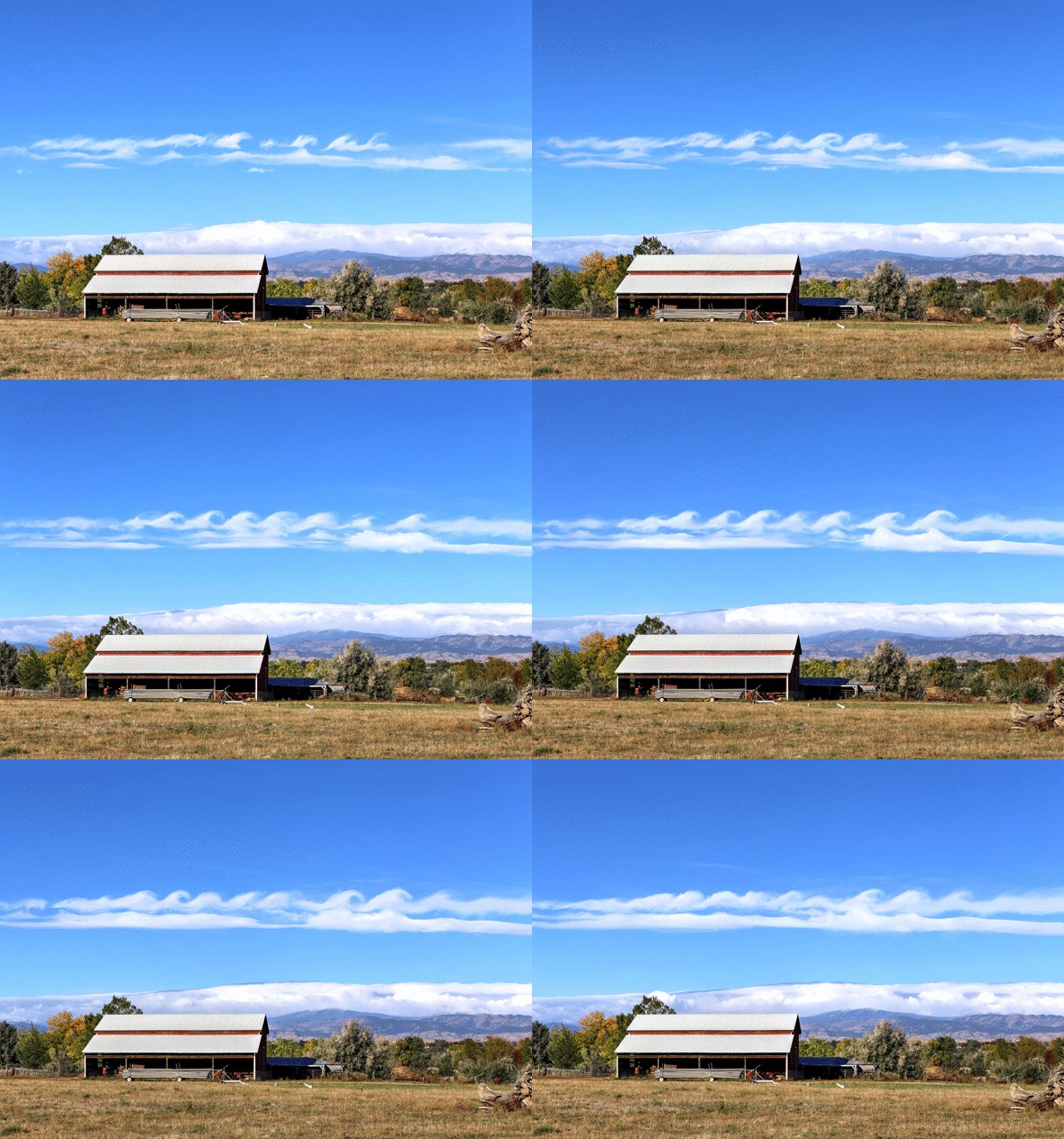
    Under the right atmospheric conditions, clouds can form in a distinctive but short-lived breaking wave pattern known as a Kelvin-Helmholtz cloud. The animation above shows the formation and breakdown of such a cloud over the course of 9 minutes early one morning in Colorado’s Front Range region. Kelvin-Helmholtz instabilities occur when fluid layers with different velocities and/or densities move past one another. Friction between the two layers moving past creates shear and causes the curling rolls seen above.

    In the background, you can also see a foehn wall cloud low to the horizon. This type of cloud forms downwind of the Rocky Mountains after warm, moist Chinook winds are forced up over the mountains, cool, and then condense and sink in the mountains’ wake. (Image credit and submission: J. Straccia, more info)

  • The Perseus Cluster’s Bay

    The Perseus Cluster’s Bay

    The Perseus cluster is a group of galaxies in the constellation Perseus. When viewed in x-ray, the cluster includes a concave feature known as the “bay”, shown in the white oval of the upper left image. A recent study uses x-ray and radio observations and computer simulations to argue that this feature is, in fact, a Kelvin-Helmholtz wave, like the breaking wave clouds that appear here on Earth.

    The simulations start with a cluster similar to Perseus, with a “cold” core of gas about 30 million degrees Celsius and an outer gas region about three times hotter. A second galaxy cluster moves by, just grazing Perseus, and sets its cold gas to sloshing in an expanding spiral. After about 2.5 billion years, the difference in velocity between the cold and hot gases results in a Kelvin-Helmholtz wave near the outer arm of the spiral. One such simulation is shown in the upper right. The Kelvin-Helmholtz wave forms near the end of the cycle at a roughly 2 o’clock position. 

    If the bay is, in fact, a Kelvin-Helmholtz roll, then this is fluid dynamics on an almost unimaginable scale. That wave is about 160 thousand light-years across! (Image credits: Perseus cluster and movie – Chandra X-Ray Observatory; simulation – John ZuHone/Harvard-Smithsonian Center for Astrophysics; research credit: S. Walker et al.; via Vince D.)

  • Wrinkling Winds

    Wrinkling Winds

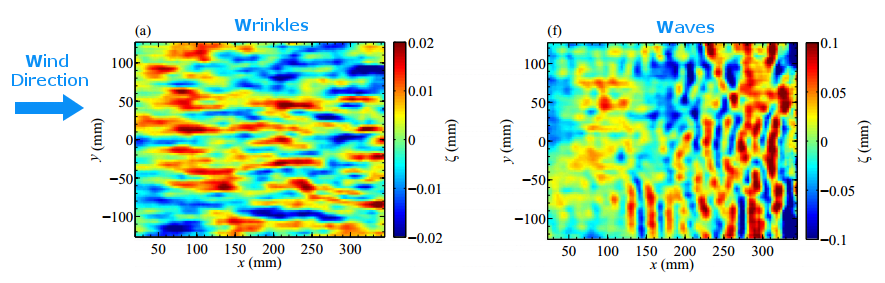
    If you’ve ever sat out on a lake and just watched the water’s surface, you’ve probably noticed how complex and variable it looks. There may be waves that rock your kayak but there are smaller variations, too, like little ripples or even tiny wrinkles that appear on the surface. Much of this activity comes from wind blowing across the water. When the wind exceeds a critical speed, waves form. They generally travel in lines that are aligned perpendicular to the wind (lower right). But what happens when the wind is below the critical speed?

    A recent study looked at just this question. By blowing air across the surface of different liquids and observing variations in the surface height as small as 2 micrometers, the researchers were able to measure tiny wrinkles on the water’s surface (lower left) when the wind speed was small. The size and shape of the wrinkles actually corresponds to structures in the turbulent air flow over the water! For fluids like water, there’s a smooth transition from wrinkles to waves as the wind speed increases, so both may be visible at the same time. For higher viscosity fluids, the switch from one to the other is more abrupt. (Image credits: water – M. Soveran; figure – A. Paquier et al. w/ annotations added in blue; research credit: A. Paquier et al.)

  • Vortex Impact

    Vortex Impact

    When a vortex ring impacts a solid wall (or a mirrored vortex ring), it expands and quickly breaks up. The animations above show something a little different: what happens when a vortex ring hits a water-air interface. As seen in the side view (top image), the vortex starts to expand, but its shear at the interface generates a stream of smaller vortices that disrupt the larger vortex. (They even look like a little string of Kelvin-Helmholtz vortices!) When viewed from above (bottom image), the vortex ring impact and breakdown look even more complicated. Mushroom-like structures get spat out the sides as those secondary vortices form, and the entire structure quickly breaks up into utter turbulence. There’s some remarkable visual similarities between this situation and some we’ve seen before, like a sphere meeting a wall and drop hitting a pool. (Image credit: A. Benusiglio et al., source)

  • Jovian Belts and Zones

    Jovian Belts and Zones

    Jupiter’s colorful cloud bands alternate between dark belts and light zones. The bands mark convection cells in Jupiter’s atmosphere, and, like on Earth, powerful jet streams form due to this atmospheric heating and the planet’s rotation. The jet winds can even move in opposite directions, creating strong shear forces between neighboring cloud bands. The shear helps drive Kelvin-Helmholtz instabilities in the clouds, resulting in the regularly spaced waves and vortices seen along the edges of some bands. (Image credit: NASA/ESA; via APOD)

  • Phytoplankton Flow Viz

    Phytoplankton Flow Viz

    Nutrient-rich waters off Patagonia in South America blossom with phytoplankton in this satellite image. When present in large quantities, these microscopic photosynthesizers lend a green hue to the water. They act as seed particles in the flow, highlighting the currents and flow that carry them. If you check out the full resolution version of the photo, you can admire the rich detail in the whorls of ocean mixing. There even seem to be Kelvin-Helmholtz-like instabilities creating trains of vortices along the interface between separate bands. (Photo credit: NASA/ASU; via SpaceRef; submitted by jshoer)

  • Undulatus Asperatus

    Undulatus Asperatus

    This surrealistic timelapse doesn’t show an ocean in the sky. These are undulatus asperatus clouds rolling over Lincoln, Nebraska. Also known simply as asperatus, this cloud formation has been proposed as but not yet recognized as a distinctive cloud type. Their speed is much slower than shown in the animation, but the wave-like motion is accurate and is the source of the cloud’s name, which comes from the Latin word aspero, meaning to make rough. Though they appear stormy, asperatus clouds do not usually produce storms. They form under conditions similar to those of mammatus clouds, but wind shear at the cloud level causes the undulations to form. (Maybe some Kelvin-Helmholtz instabilities going on there?) You can check out many more images of asperatus clouds at the Cloud Appreciation Society’s gallery. (Image credit: A. Schueth, source video; submitted by leftcoastjunkies)

  • Featured Video Play Icon

    Jupiter Timelapse

    This timelapse video shows Jupiter as seen by Voyager 1. In it, each second corresponds to approximately 1 Jupiter day, or 10 Earth hours. Be sure to fullscreen it so that you can appreciate the details. The timelapse highlights the differences in velocity (and even flow direction!) between Jupiter’s cloud bands. It is these velocity differences that create the shear forces which cause Kelvin-Helmholtz instabilities–the series of overturning eddies–seen between the bands. Earth also has bands of winds moving in opposite directions, but there are fewer of them and the composition of our atmosphere is such that they do not make for such a dramatic naked eye view of large-scale fluid dynamics. (Video credit: NASA/JPL/B. Jónsson/I. Regan)