This timelapse video shows Jupiter as seen by Voyager 1. In it, each second corresponds to approximately 1 Jupiter day, or 10 Earth hours. Be sure to fullscreen it so that you can appreciate the details. The timelapse highlights the differences in velocity (and even flow direction!) between Jupiter’s cloud bands. It is these velocity differences that create the shear forces which cause Kelvin-Helmholtz instabilities–the series of overturning eddies–seen between the bands. Earth also has bands of winds moving in opposite directions, but there are fewer of them and the composition of our atmosphere is such that they do not make for such a dramatic naked eye view of large-scale fluid dynamics. (Video credit: NASA/JPL/B. Jónsson/I. Regan)
Search results for: “kelvin-helmholtz instability”
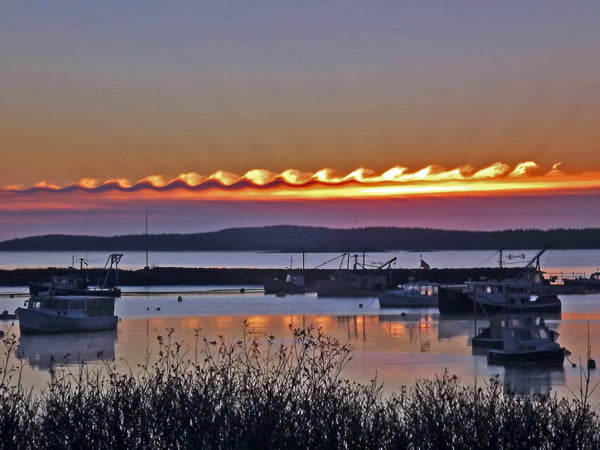
Ocean Waves in the Sky
These wave-like Kelvin-Helmholtz clouds can form due to shear between different layers of air in the atmosphere. When one region of air has a higher velocity than the other, their interface forms a shear layer, which can break down in this wavy pattern. In this case, the lower layer of air was moist enough to form condensation and clouds, making the pattern visible to the naked eye. (Photo credit: Gene Hart; via Flow Visualization)

Atomizing
High-speed video reveals the complexity of fluid instabilities leading to atomization–the breakup of a liquid sheet into droplets. A thin annular liquid sheet is sandwiched between concentric air streams. As the velocity of the air on either side of the liquid sheet varies, shear forces cause the sheet to develop waves that result in mushroom-like shapes that break down into ligaments and droplets. Quick breakup into droplets is important in many applications, most notably combustion, where the size and dispersal of fuel droplets affects the efficiency of an engine. (Video credit: D. Duke, D. Honnery, and J. Soria)

Fractal Fluids
These images from a numerical simulation of a mixing layer between fluids of different density show the development and breakdown to Kelvin-Helmholtz waves. The black fluid is 3 times denser than the white fluid, and, as the two layers shear past one another, billow-like waves form (Fig 1(a)). Inside those billows, secondary and even tertiary billows form (Fig 1(a) and (b)). Fig 1 (c)-(e) show successive closeups on these waves, showing their beautiful fractal-like structure. (Photo credit: J. Fontane et al, 2008 Gallery of Fluid Motion) #

Martian Lava Coils

NASA’s HiRISE spacecraft has sent back images of lava coils left on the surface of Mars. These features form when lava flows of different speeds move past one another; they’re essentially Kelvin-Helmholtz waves–like the ones often seen in clouds–in the lava flow that have solidified into solid rock! On Earth these coils appear about a foot wide; the Martian versions are 100 feet across. (Photo credit: NASA/JPL/University of Arizona; via Wired; submitted by Brian L)
Portrait of Gas Giants
[original media no longer available]
Here raw footage from NASA’s Cassini and Voyager missions has been combined in a stunning portrait of Saturn and Jupiter. Watch as tiny moons create gravity waves in the rings of Saturn and observe the complicated relative motion between the cloud bands on Jupiter and the swirls and vortices that result. Fluid dynamics are truly everywhere. (Video credit: Sander van den Berg; submitted by Daniel B)
Breakup of an Annular Sheet
A thin annular sheet of water is sandwiched between two concentric air streams. This airflow on either side of the water causes shearing and Kelvin-Helmholtz-type instabilities develop, causing the sinuous waves along the water surface. Periodic behavior of the sort observed here is frequently observed in fluid mechanical instabilities. #

Wave Clouds Over Alabama
Last week, Birmingham, Alabama got treated to a special cloudy day, thanks to some Kelvin-Helmholtz waves, shown above. When a layer of faster moving fluid shears a slower moving fluid, this instability can form and cause some spectacular mixing. In this case, the lower, slower fluid was cool and moist enough to contain clouds, enabling us to see the effect with the naked eye. The same mechanism is responsible for the shape of breaking ocean waves and can even be seen in the atmospheres of gas giants like Saturn and Jupiter. (submitted by David B)
Coronal Waves
NASA’s Solar Dynamics Observatory has found evidence of Kelvin-Helmholtz waves in the sun’s corona. These waves, which occur between two fluids of different densities or moving at different speeds, are similar to the iconic waves surfers ride. Researchers suspect that this turbulent motion may help explain why the corona is 1,000 times hotter than the surface of the sun. #

Upside-Down Umbrellas
When a heavier fluid is suspended over a lighter fluid (as with ink or food coloring in water), the interface between fluids is subject to the Rayleigh-Taylor instability. As the heavier fluid starts to sink, it forms “fingers”, which develop into mushroom-cap shapes as the fluid continues falling. Sometimes the shear stress between the heavier fluid and lighter fluid causes secondary Kelvin-Helmholtz instabilities as well. (Photo by Leonardo Aguiar)

