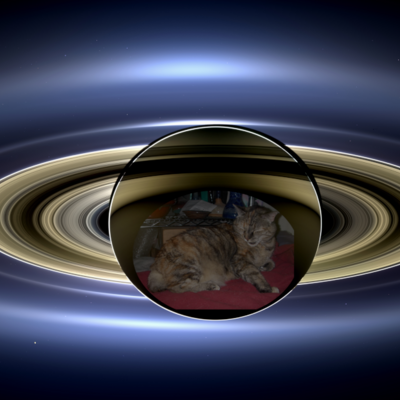
By spinning a gas of ultracold atoms, the team observed a spontaneous transition from a needle-like configuration to a crystal made up of spirals. It’s a quantum Kelvin-Helmholtz instability! The authors found that wave’s phase is random; it arises purely from quantum interactions between the atoms. (Image, research, and submission credit: B. Mukherjee et al.; see also MIT News)
The spinning cloud of ultracold atoms breaks up into a series of spirals.
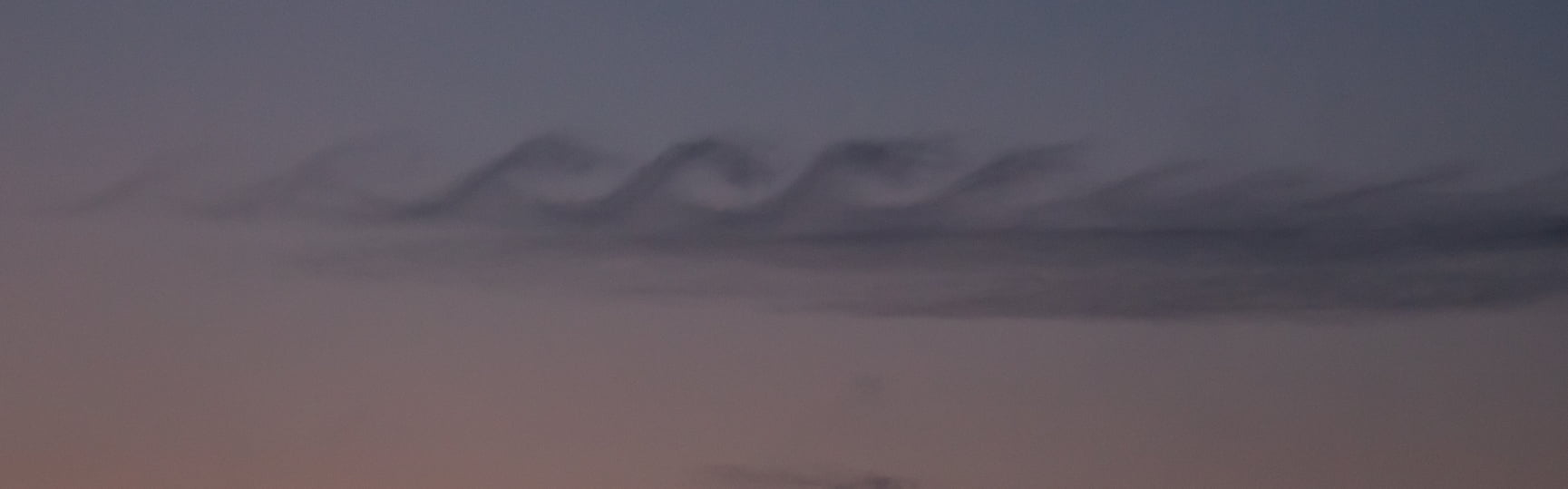
Like breaking waves at the beach, these wavy clouds curl but only for a moment. The photo was captured near sunset on a late August evening in Arlington, MA. This short-lived cloud shape forms due to the Kelvin-Helmholtz instability, which is driven by shear forces between two layers of air moving at different speeds. The situation is a common one in the atmosphere, where air layers at altitude move in different directions and at different speeds. Most of the time we cannot see the curls that form between these air layers because of air’s transparency. But occasionally the mismatch happens right at a cloud layer and the condensation of the cloud gets pulled into these distinctive curls. (Image credit: B. Bray; submitted by Mark S.)
When differing layers of fluid move past one another, friction between them causes shear. This shear quickly transforms a simple flat interface between fluid layers into a wavy unstable boundary that resembles a series of breaking ocean waves. This effect is known as the Kelvin-Helmholtz (KH) instability. In the atmosphere, this instability causes air layers with differing temperatures and moisture content to form wave-like clouds where the two layers meet. Other examples of the effect are widespread. On earth, many ocean waves are generated by wind shearing the water; elsewhere in our solar system, the cloud bands of Jupiter are lined with spinning eddies from the KH instability. (Photo credit: H. Bondo)
The Kelvin-Helmholtz instability looks like a series of overturning ocean waves and occurs between layers of fluids undergoing shear. This video has a great lab demo of the phenomenon, including the set-up prior to execution. When the tank is tilted, the denser dyed salt water flows left while the fresh water flows to the right. These opposing flow directions shear the interface between the two fluids, which, once a certain velocity is surpassed, generates an instability in the interface. Initially, this disturbance is much too small to be seen, but it grows at an exponential rate. This is why nothing appears to happen for many seconds after the tilt before the interface suddenly deforms, overturns, and mixes. In actuality, the unstable perturbation is present almost immediately after the tilt, but it takes time for the tiny disturbance to grow. The Kelvin-Helmholtz instability is often seen in clouds, both on Earth and on other planets, and it is also responsible for the shape of ocean waves. (Video credit: M. Hallworth and G. Worster)
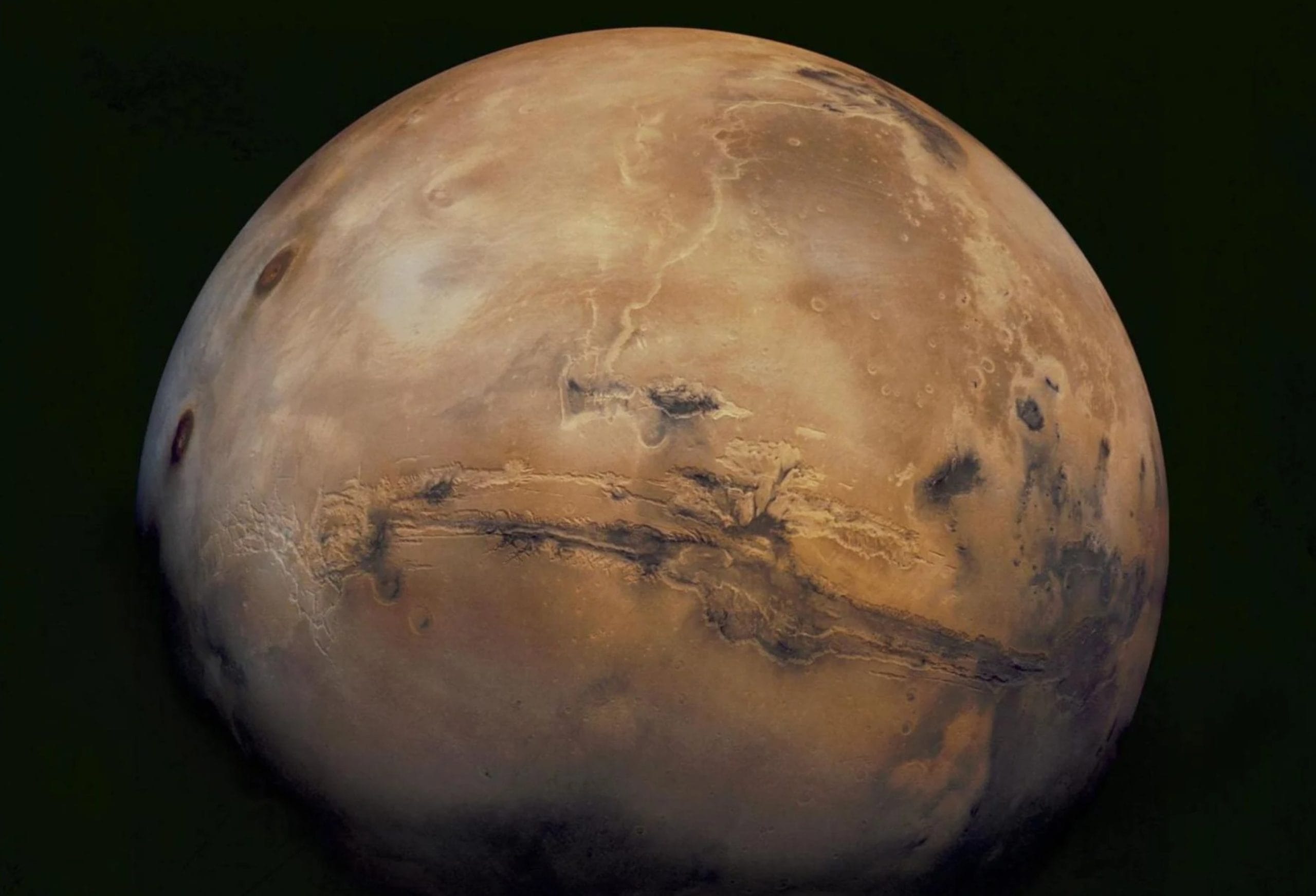
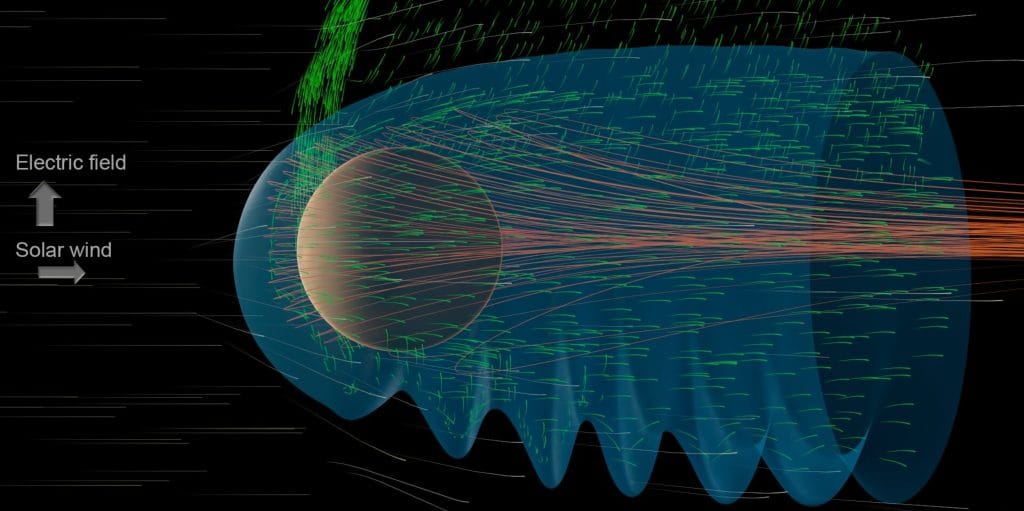
Mars was once a warmer, wetter place, swathed in a thick and protective atmosphere. Unlike Earth, Mars lacks a strong global magnetic field, which allows the solar wind to strip its atmosphere, but the exact mechanisms of that process have been unclear. But a new study has caught the process in action.
Illustration of the Kelvin-Helmholtz instability occurring as the solar wind and Mars’ electric field interact.
By combining simultaneous measurements from two spacecraft–NASA’s MAVEN and China’s Tianwen-1–the team was able to monitor the upstream solar wind conditions and the atmospheric ions escaping. They found that previously-observed “plasma clouds” in the Martian atmosphere result from a Kelvin-Helmholtz instability between the solar wind and Mars’ electric field. Within these clouds, the ion flux is ten to a hundred times greater than at steady-state conditions.
This mechanism directly couples ion escape from Mars’ atmosphere to the solar wind, and it’s likely that this process plays out for other unmagnetized planets as well. (Image credit: Mars – NASA, illustration – C. Zhang et al.; research credit: C. Zhang et al.; via Gizmodo)
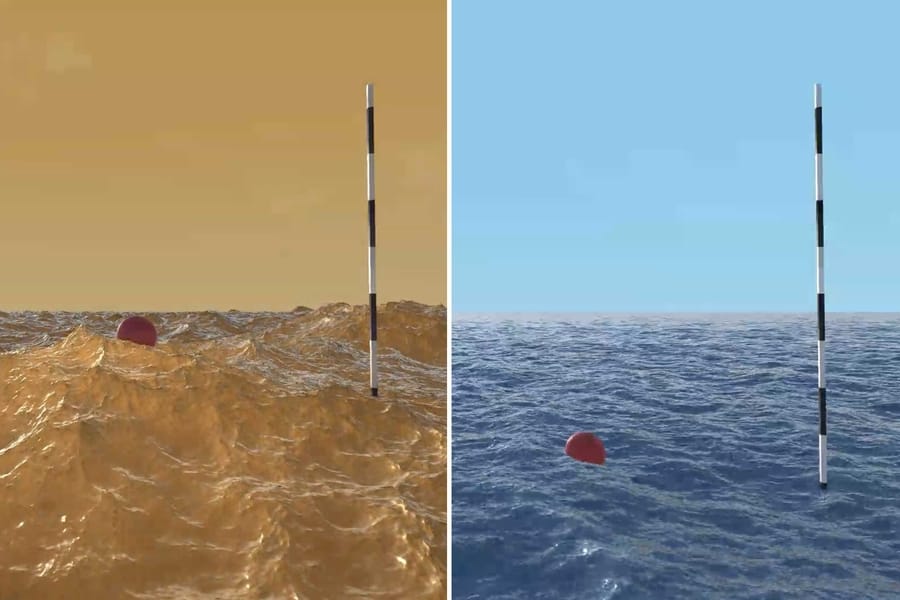
On Earth, most waves form when wind blows across the water. The shear and added energy from the wind ripples the surface, eventually building up waves (through the Kelvin-Helmholtz instability). The same process should happen anywhere else where wind and open liquid surfaces meet–even on other planets. To explore this, researchers built a new model, PlanetWaves, that predicts the waves based on a planet’s gravity, atmospheric conditions, and the density, viscosity, and surface tension of its surface liquid.
After validating the model with conditions on Earth, the team explored wave conditions for Titan, ancient Mars, and several exoplanets. They found that Titan’s lighter gravity and liquid ethane (which is less dense than water) combined to make waves on Titan much taller than those generated at the same wind speed on Earth (top image). You can watch them in action in the video below. Standing in a light breeze on Titan, you’d watch giant 3-meter waves rolling in.
The team also found that waves on Mars would have gotten shorter as Mars lost its atmosphere and the air pressure dropped. Over time, the same wind speed would have elicited smaller and smaller waves. Wave action has a big effect on a landscape’s erosion, so understanding how waves look on other planets will help us parse their geography. (Video, image, and research credit: U. Schneck et al.; via MIT News; submitted by Joseph S.)
Even though particles are not (strictly speaking) a fluid, they often behave like one. Here, researchers investigate what happens when two layers of particles–with different size and density–slide down an incline together. The video is tilted so that the flow instead appears from left to right.
When the larger, denser particles sit atop a layer of smaller, lighter particles, shear between the two layers causes a Kelvin-Helmholtz instability that runs in the direction of the flow. This creates a wavy interface that lets some small particles work upward while large particles shift downward.
At the same time, a slice across the flow shows that plumes of small particles are pushing up toward the surface, driven by a Rayleigh-Taylor instability. The researchers also look at what happens when the particles are fluidized by injecting a gas able to lift the particles. (Video and image credit: M. Ibrahim et al.; via GFM)
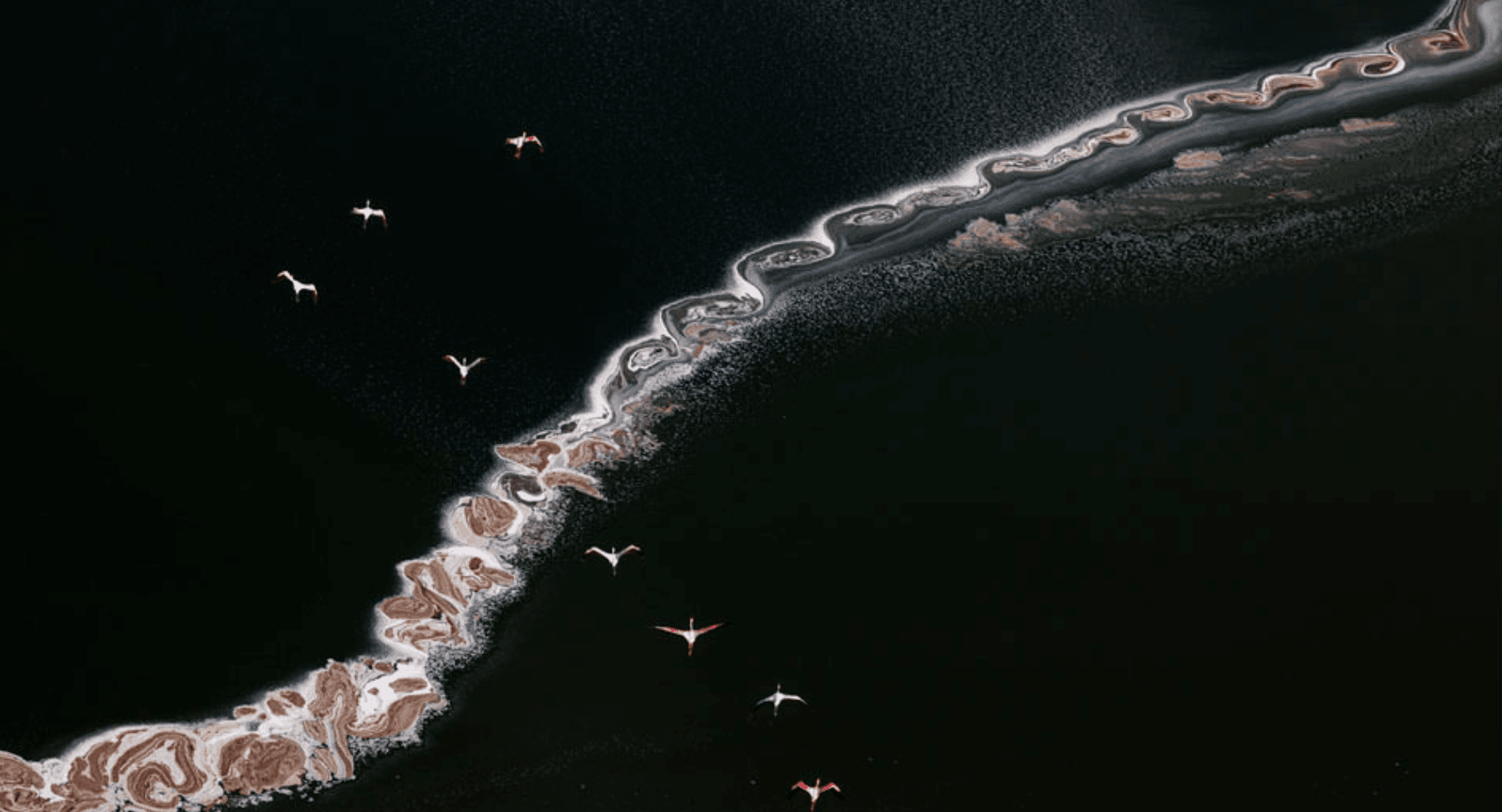
Flamingos soar over swirls of salt and algae in a lake in Kenya’s Rift Valley. Shaped by winds, currents, physics, and chemistry these eddies reflect the motion of the water, evaporation patterns, and more. Without more information, it’s hard to say exactly what shapes the pattern, but it does appear reminiscent of a Kelvin-Helmholtz instability in places. (Image credit: B. Hayden/IAPOTY; via Colossal)
Rotating drums are a popular way to explore granular dynamics. Here, researchers fill a cylinder (seen below) with heavy grains and a low-viscosity fluid, then rotate the mixture about a horizontal axis. This sets up a contest between centrifugal forces and gravitational forces on the grains. At the right rotation rates, the grains form annular rings around the outside of the cylinder, where they rotate at a different speed than the fluid. This difference in speed between the two layers can trigger a Kelvin-Helmholtz instability and cause waves along the interface between the grains and the fluid, as seen in the examples above. (Image and research credit: V. Dyakova and D. Polezhaev; top image adapted by N. Sharp)
That the wind causes ocean waves is obvious to anyone who has spent time near the water, but the details of that process remain fuzzy. Many of the explanations — like the Kelvin-Helmholtz instability — only explain part of the process, usually the beginning when the waves are very small. As the waves get larger, they affect the wind in turn, complicating matters.
As messy as the theory gets, our ability to measure the wind and water in situ is limited, too. Just look at this wild research platform oceanographers designed to study wind and waves. It’s part of a 355-ft vessel that’s towed out to sea horizontally and then flipped so that 300 feet of it remain underwater to stabilize the remainder for measurements. Even with equipment like this, measuring the turbulent air and water near the ocean-sky interface is incredibly difficult.
This review article gives a nice overview of different historical efforts to explain how wind makes waves and provides a snapshot of the latest research in the area. (Image credit: R. Bilcliff; see also N. Pizzo et al.)
















![Composite image of bed layers for 4 different particle density ratios. Text reads, "The wave amplitude and growth rate increase with particle density ratio but only if [the density of large particles is greater than the smaller particle density]."](https://fyfluiddynamics.com/wp-content/uploads/KHbed3.png "Composite image of bed layers for 4 different particle density ratios. Text reads, \"The wave amplitude and growth rate increase with particle density ratio but only if [the density of large particles is greater than the smaller particle density].\"")