Tag: science

  • Featured Video Play Icon

    Liquid Pearls

    Researchers create liquid pearls–a liquid droplet surrounded by a gel-like exterior–by dropping the fluid through a special bath. The initial droplet contains a mixture of the liquid core and an alginate solution. When the drop falls through a bath containing calcium ions, the alginate turns into a hydrogel shell around the liquid core. In order to prevent mixing during the droplet impact, researchers use a surfactant that helps the thin alginate layer persist while gelling takes place. The resulting liquid pearl is permeable to chemicals; researchers hope this may allow them to be used to contain microorganisms or cells in a three-dimensional environment during testing. (Video credit: New Scientist, N. Bremond et al.; see also Gallery of Fluid Motion)

  • Titan’s Vortex

    Titan’s Vortex

    The timelapse animation above shows a swirling vortex above the south pole of Saturn’s moon Titan. It completes a full rotation in about nine hours, significantly quicker than the 16-day rotation of the moon. The vortex appears to demonstrate open cell convection, in which air sinks at the center of the cell and and rises at the edges to form clouds along the cell edges.  For the most part the dense haze of Titan’s atmosphere prevents scientists from seeing what goes on beneath the clouds, but Titan is thought to have weather cycles similar to Earth’s, except featuring methane rather than water. (Photo credit: NASA, Cassini; submitted by Adam L)

    ETA: This theme sometimes dislikes displaying .GIF images. If you don’t see the animation, click here.

  • Paper Marbling

    [original media no longer available]

    Suminagashi, the Japanese art of “floating ink”, is one of many methods historically used for paper marbling. In it, a shallow layer of water or other viscous fluid serve as a medium for drops of ink that diffuse across the fluid surface and are manipulated with straws, brushes, or other tools. Once a design is complete, an absorbent surface like paper or fabric is carefully placed on top to preserve the art.  Among other applications, the technique has historically been used for calligraphy and book bindings.

  • Flapping Wakes

    Flapping Wakes

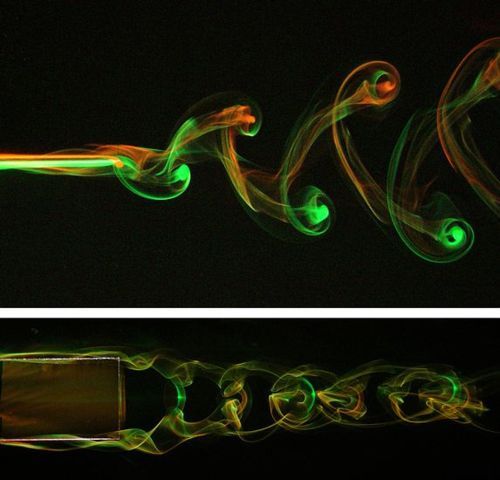
    As a flapping object moves through a fluid, many patterns of vortices can form in its wake. The familiar von Karman vortex street, so often seen in clouds or behind cylinders, is only the beginning. In the photo above, a symmetric foil flaps in a vertical soap film; as the amplitude and frequency of the oscillation varies, the wake patterns it produces change dramatically.  From left to right, a) a von Karman wake; b) an inverted von Karman wake; c) a 2P wake, in which two vortex pairs are shed with each cycle; d) a 2P+2S wake, in which two vortex pairs and two single vortices are shed per cycle; e) a 4P wake; and f) a 4P+2S wake. See some of these flows in action in these videos. (Photo credit: T. Schnipper et al.)

  • Featured Video Play Icon

    Hydraulic Jumps

    This student video outlines the principles and mathematics behind the hydraulic jump, a commonly occurring phenomenon that occurs when a high velocity liquid flows into a low velocity zone. In order to slow down, the liquid’s kinetic energy converts to potential energy, resulting in an increase in height. Though often seen in kitchen sinks or rivers, the principle is also commonly used in dams and other manmade structures to control erosion of surrounding features. (Video credit: T. Price, D. Alexander, A. Rodabough, and D. Jensen)

  • Featured Video Play Icon

    Atmospheric Dynamics in the Lab

    One way to explore some of the large-scale atmospheric dynamics we observe here on earth is through table-top demonstrations such as this one. Here a platform with a water tank is rotating at a constant velocity. The camera rotates with the tank; this is why the hand in the video seems to spin. At the center of the tank, ice in a can cools the water, while the warmer air along the periphery provides heating. The green dye marks initially cooler fluid while the red dye marks the warmer fluid from the outside of the tank. The dense cooler fluid sinks and moves outward while warmer water moves in to replace it. This creates radial circulation; the thermal gradients and rotation cause the eddies and jets seen from this top view, in much the same way that they form in the mid-latitudes of earth’s atmosphere.  (Video credit: Marshall Lab, MIT)

  • The Cloud Bands of Jupiter

    The Cloud Bands of Jupiter

    The cloud bands of Jupiter stripe the planet with turbulence. Throughout its upper atmosphere, Jupiter shows signs of gravity waves and complicated wave patterns. Near the equator, the cloud bands are driven by planetary winds that reach speeds of 500 kph, whereas near the poles, the clouds show greater evidence of mottling and convection. At present, the reasons for this patterning are undetermined. (Image Credit: NASA; via APOD)

  • Featured Video Play Icon

    Fire Tornado

    An artificial fire tornado makes for fascinating viewing. The box fans are positioned around a central firepit such that they impart the angular velocity needed to create a vortex. I’ve actually seen an even bigger live demonstration than this one at a fluid dynamics conference.  Do not try this yourself. Fire tornadoes occur in nature, too: take a look at how they form. (submitted by acervant)

  • The Fluid Dynamical Sewing Machine

    The Fluid Dynamical Sewing Machine

    Anyone who has poured a viscous fluid like honey or syrup will have noticed its tendency to coil like rope. A similar effect is observed when a viscous fluid stream falls onto a moving belt. The photos above show some of the patterns seen in these “fluid-mechanical sewing machines” depending on the height of the thread and the speed of the moving belt. Notice how some of the patterns are doubles of another (i.e. two coils per side instead of one). This period doubling behavior is often seen in systems on their way to chaos.  (Photo credits: S. Chiu-Webster and J. Lister)

  • Featured Video Play Icon

    Sea Surface Temperatures

    This video shows sea surface temperature results and their seasonal variation from a numerical simulation modeling circulation in the atmosphere and oceans. Modeling such enormous problems requires the development of reasonable models of the turbulent physics, clever algorithms to quickly progress the solutions, relatively low-fidelity (a single grid node may cover tens of kilometers), and enormous computing power. (Video credit: NOAA; via Gizmodo)