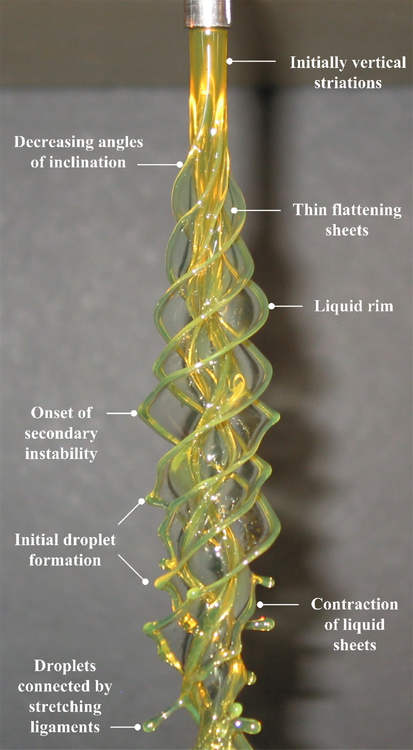
In fluid dynamics, we like to classify flows as laminar–smooth and orderly–or turbulent–chaotic and seemingly random–but rarely is any given flow one or the other. Many flows start out laminar and then transition to turbulence. Often this is due to the introduction of a tiny perturbation which grows due to the flow’s instability and ultimately provokes transition. An instability can typically take more than one form in a given flow, based on the characteristic lengths, velocities, etc. of the flow, and we classify these as instability modes. In the case of the vertical rotating viscous liquid jet shown above, the rotation rate separates one mode (n) from another. As the mode and rotation rate increase, the shape assumed by the rotating liquid becomes more complicated. Within each of these columns, though, we can also observe the transition process. Key features are labeled in the still photograph of the n=4 mode shown below. Initially, the column is smooth and uniform, then small vertical striations appear, developing into sheets that wrap around the jet. But this shape is also unstable and a secondary instability forms on the liquid rim, which causes the formation of droplets that stretch outward on ligaments. Ultimately, these droplets will overcome the surface tension holding them to the jet and the flow will atomize. (Video and photo credits: J. P. Kubitschek and P. D. Weidman)
Tag: science

Saturn’s Polar Vortex

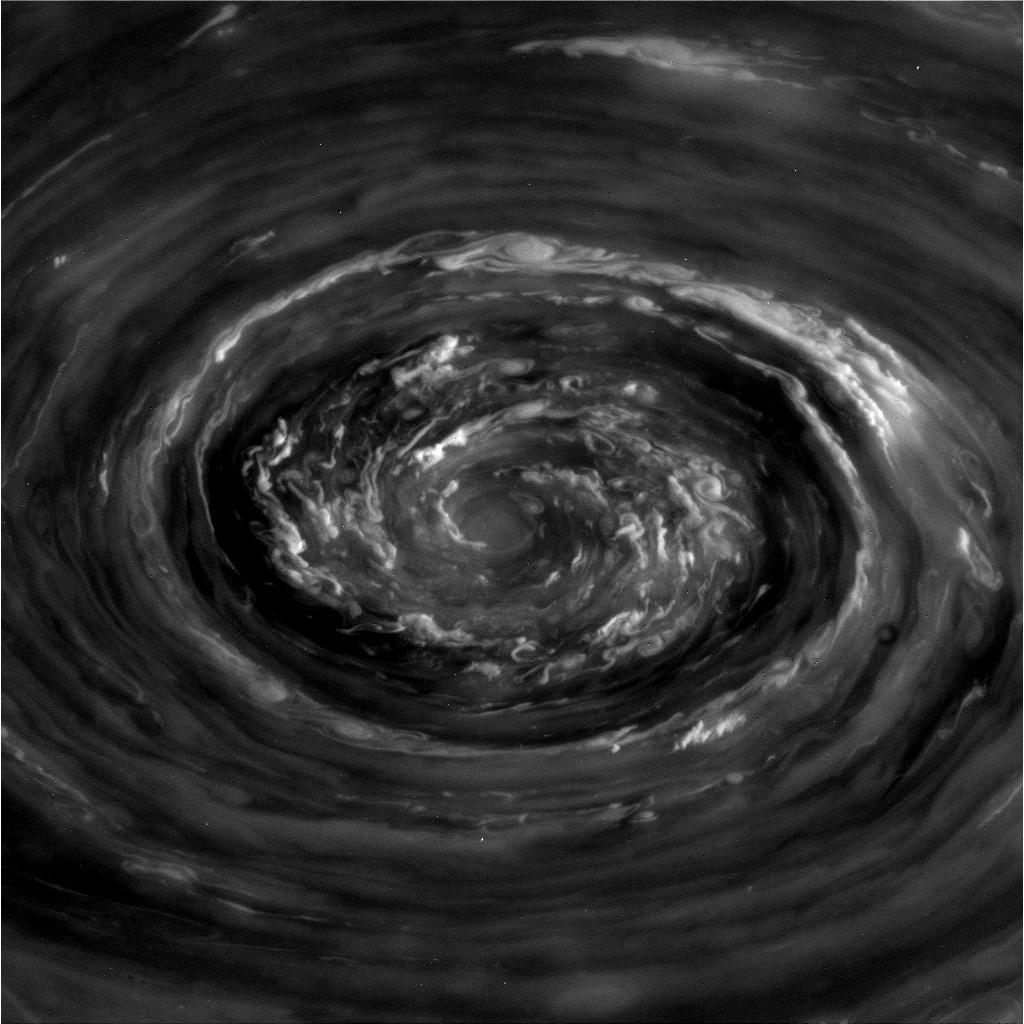
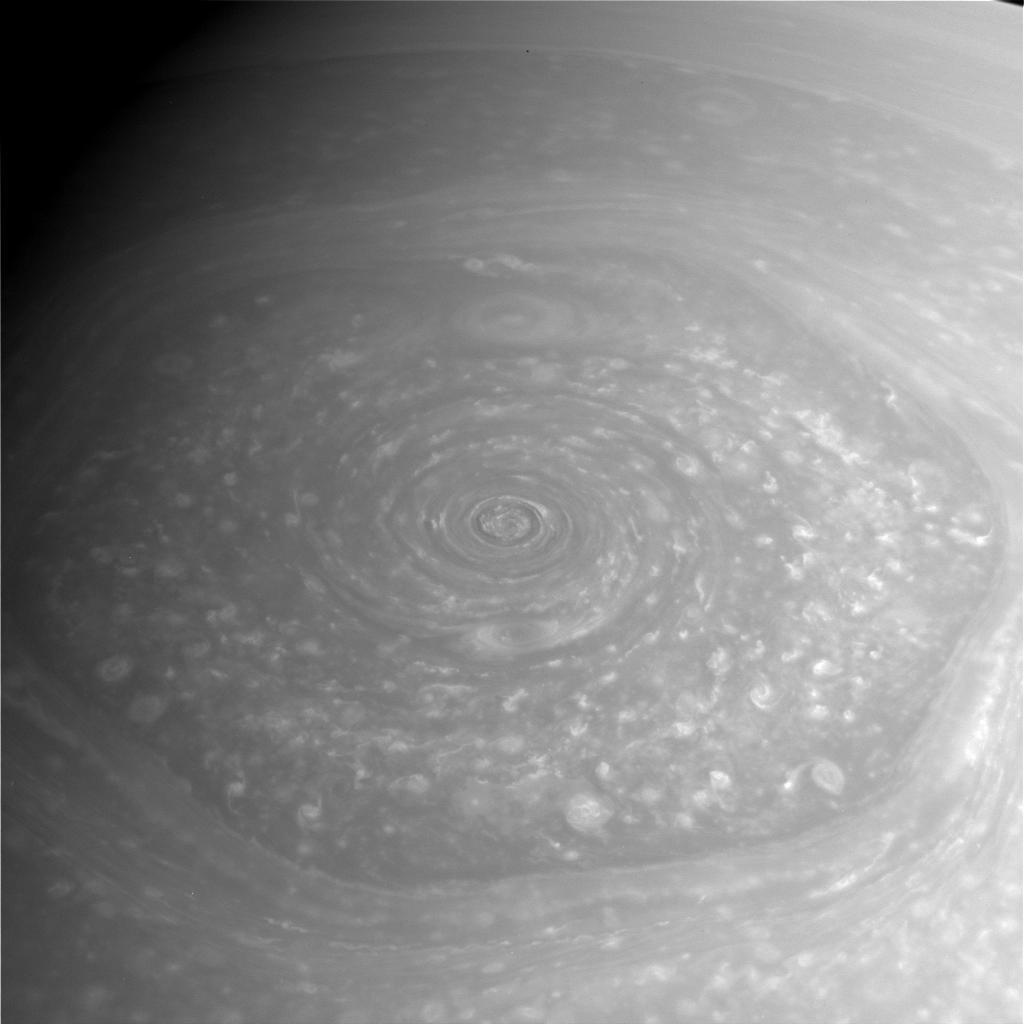

Nothing quite compares to the beauty of fluid dynamics on astronomical scales. What you see here are raw photographs of recent storms at Saturn’s north pole. The recent change in Saturnian seasons has afforded Cassini a sunlit view of the northern pole, which had previously lain in darkness. A roiling vortex filled with clouds being twisted and sheared was revealed near the center of its famed polar hexagon. (Photo credit: NASA/JPL-Caltech/Space Science Institute; submitted by J. Shoer)

Supersonic Bubble Shock Waves
Supercomputing has been an enormous boon to fluid dynamics over the past few decades. Many problems, like the interaction between a supersonic shock wave and a bubble, are too complicated for analytical solutions and difficult to measure experimentally. Numerical simulation of the problem, combined with visualization of key variables, adds invaluable understanding. Here a shock wave strikes a helium bubble at Mach 3, and the subsequent interactions in terms of density and vorticity are shown. This situation is relevant to a number of applications, such as supersonic combustion and shockwave lithotripsy–a medical technique in which kidney stones are broken up inside the body using shock waves. After impact, an air jet forms and penetrates the center of the structure while the outer regions mix and form a persistent vortex ring. (Video credit: B. Hejazialhosseini et al.; via Physics Buzz)
Sandy Jets
When a fluid is vibrated, instabilities can form along its surface. With a sufficient amplitude, voids form inside the fluid and their collapse leads to a jet that shoots out from the fluid. A very different process leads to air cavities forming in a vibrated granular medium, but the jets produced are remarkably similar, as seen in this video. (Video credit: M. Sandtke et al.)
Frozen Powder Drops
Droplet impacts on granular surfaces and water interactions with superhydrophobic surfaces are not unfamiliar topics for FYFD. But this behavior of water droplets falling on a superhydrophobic powder is unusual, to say the least. When the droplets impact in powder, they rebound with a partial coating of powder. In the case of the superhydrophobic powder, the shape of the droplet is “frozen” by the powder. A satellite droplet is ejected from the region not coated in powder and the resultant main drop falls back to the surface and comes to rest with little to no deformation. The researchers report a critical velocity at which the behavior is observed. (Video credit: J. Marston et al.; via Physics Buzz)

Reader Question: Dry Rear Windshields in the Rain
Reader sheepnamedpig asks:
I was driving through the rain down the highway when I noticed something strange: though the rain was heavy enough to reduce visibility to a quarter mile, the rear windshield of my Corolla was bone dry except for the streams of water flowing off the roof. There was no wind so far as I could tell, but I had to slow down all the way to ~20-25 mph for rain to start falling on the rear windshield. Why is that?
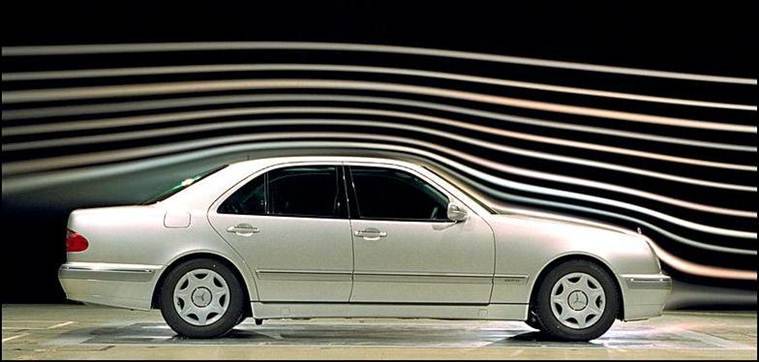
That’s a wonderful observation! Like many sedans, your Corolla has a long, sloped rear window that acts much like a backward-facing step with respect to the airflow while the car is moving. Note the smoke lines in the photo above. At the front of the car, we see closely spaced intact lines near the hood and windshield, indicating relatively fast, smooth airflow over the front of the vehicle. At the back, though, there is a big gap over the rear windshield. This is because flow over the car has separated at the rear windshield and a pocket of recirculating air. This recirculation zone is, for the most part, isolated from the rest of the air moving over the car; that’s why the smoke lines continue relatively unaffected a little ways above the surface. This same pocket of recirculating air is protecting your rear windshield from rainfall. It’s an area of low-speed, high-pressure fluid, and the raindrops are preferentially carried by the high-speed, low-pressure air over the recirculation zone. This is one reason why many sedans don’t have rear windshield wipers. (Photo credit: F-BDA)
ETA: Reposted by request to make it rebloggable.

Simulating Floods
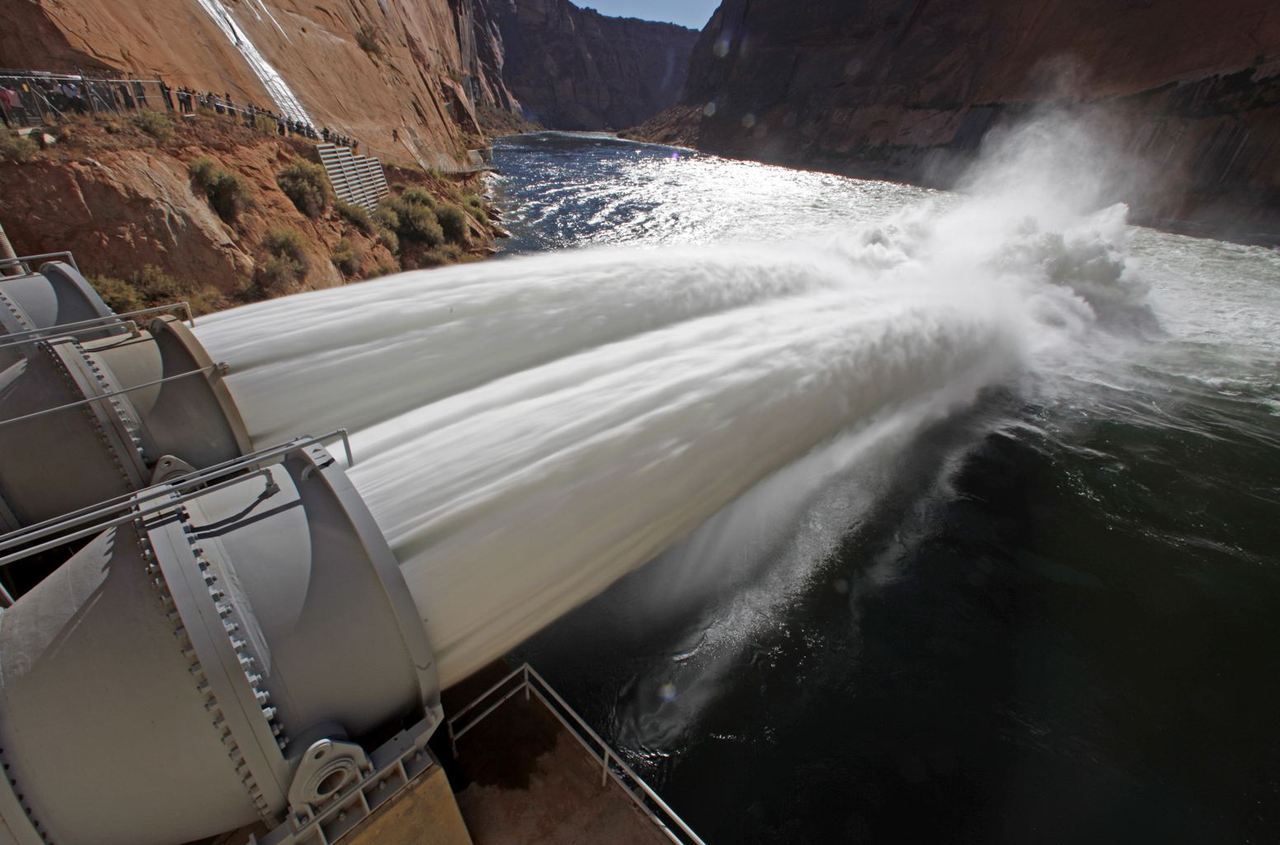
Last week officials opened the Glen Canyon Dam’s bypass tubes to release a simulated flood on the Colorado River, which runs through the Grand Canyon. This is the first of several planned “high-flows” intended to imitate the positive effects of natural floods on the area. Officials hope the increased water flow will help deposit sediment along the Grand Canyon’s walls at heights unreachable at the lower water levels. This sediment transport should help restore the natural sandbars and beaches that serve as breeding grounds for native fish. The floods will also clear vegetation from the riverside camping spots utilized by tourists. (Photo credit: Reuters/Bob Strong; submitted by Bobby E.)
Superfluid Vortices
Cooling helium to a few degrees Kelvin above absolute zero produces superfluid helium, a substance with some very bizarre behaviors caused by a lack of viscosity. Superfluids exhibit quantum mechanical properties on a macroscopic scale; for example, when rotated, a superfluid’s vorticity is quantized into distinct vortex lines, known as quantum vortices. These vortices can be visualized in a superfluid by introducing solid tracer particles, which congregate inside the vortex line, making it appear as a dotted line, as shown in the video above. When these vortex lines approach one another, they can break and reconnect into new vortices. These reconnections provoke helical Kelvin waves, a phenomenon that had not been directly observed until the present work by E. Fonda and colleagues. They are even able to show that the waves they observe match several proposed models for the behavior. (Video credit: E. Fonda et al.)

Sharkskin’s Secrets

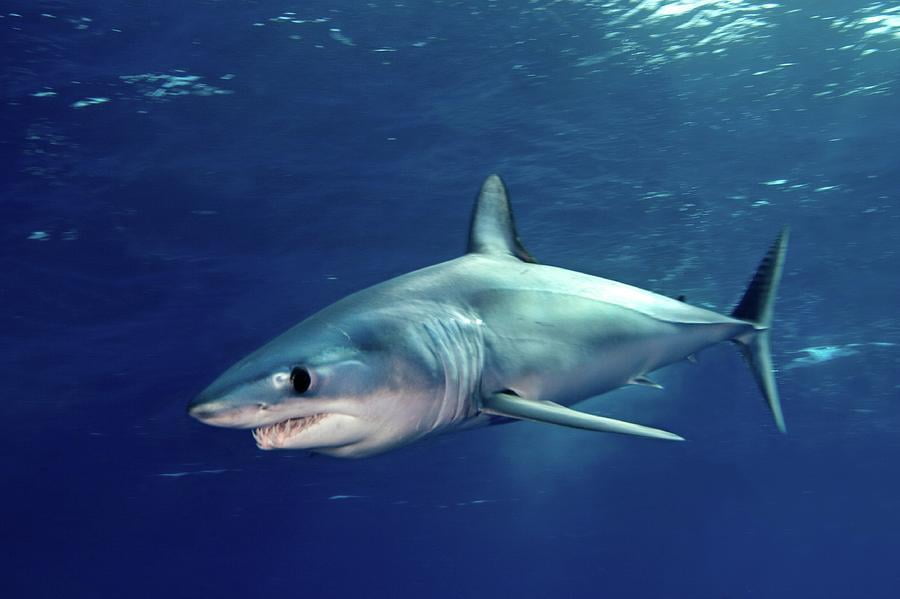
Sharks are known as extremely fast and agile swimmers, due in part to the surface of their skin. Sharks are covered in very tiny tooth-shaped scales called denticles which are streamlined in the direction of flow over the shark. If you were to run a hand over a shark’s skin from head to tail, it would feel silky smooth, but rub against the grain and it’s like running your hand on sandpaper. Water encounters a similar resistance, which, according to new research, provides the shark with a passive flow control mechanism, requiring no effort on the part of the shark. When water near the shark’s denticles tries to reverse direction, an early stage in flow separation, the denticles naturally bristle, slowing and trapping the reversed flow. This prevents local flow separation which would otherwise increase the shark’s drag and hinder its agility. (Photo credit: James R. D. Scott; Research by A. Lang et al.)
Self-Healing Soap Films
Some soap films are capable of self-healing after a solid object passes through them, as shown in the video above. The behavior is primarily dependent on Weber number–a nondimensional ratio of the film’s inertia to its surface tension. Although demonstrated for positive curvature in the video, the same behavior is observed in negatively curved soap films as well. For a look at how the behavior varies with projectile velocity and size, check out this video. (Video credit: J. Bryson, BYU Splash Lab)