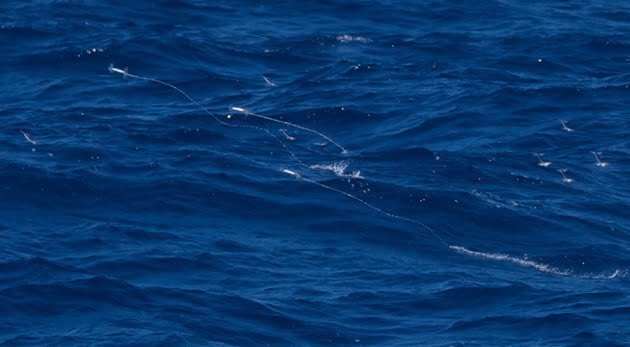
Ever seen a squid fly? Not many have, but the behavior may be more common than you think. Thanks to a set of photos from an amateur photographer, scientists have managed to estimate the velocity and acceleration of squid as they propel themselves out of the water by squirting a jet behind them. Researchers found that their speeds in air are roughly five times that in water, thanks to decreased drag. Previously it was thought that the flying behavior might be linked to escaping predators, but some now suggest that it enables migration over long distances by saving energy.
Tag: science

Where Jupiter Got Its Swirls
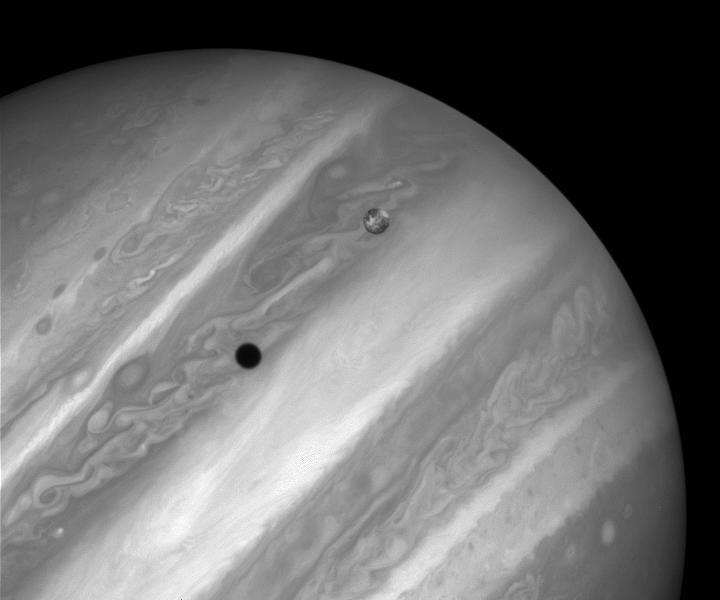
When layers of a fluid are moving at different relative velocities, they shear against one another. This shear can trigger the Kelvin-Helmholtz instability, which develops as a waves along the interface. Here Hubble captures Kelvin-Helmholtz waves along the cloud bands of Jupiter, but such clouds are also not uncommon here on Earth. (Photo credit: J. Spencer and NASA)

The Gobbling Drop
A little polymer goes a long way when it comes to changing a fluid’s behavior. Normally, a falling jet of fluid will develop waviness and be driven by surface tension and the Plateau-Rayleigh instability to break up into a stream of droplets. We see this at our water faucets all the time. But when traces of a polymer are dissolved in water, the behavior is much different. The viscoelasticity of the polymer chains creates a force that opposes the thinning effects caused by surface tension. So, instead of thinning to the point of breaking into droplets, a drop is able to climb back up the jet until it reaches a critical mass where it reverses direction, accelerates downward due to gravity and eventually breaks off the jet. Then the whole process begins again with a new terminal drop. (Video credit: C. Clasen et al)
Solar Tornadoes
NASA’s Solar Dynamics Observatory captured this video of swirls of darker, cooler plasma caught between competing magnetic forces over the course of 30 hours. The plasma strands rotate like tornadoes caught on magnetic field lines. It sometimes feels incredible to observe such familiar-looking fluid behavior in such unfamiliar places, but it’s just a reminder that physics works no matter where you are.
Making Mixed Emulsions
Ever tried to mix oil and vinegar? Anyone who has ever dealt with salad dressings knows the difficulty of evenly distributing immiscible fluids; the key is to shake them and create an emulsion, where droplets of one fluid are distributed throughout another. In this video, researchers create a double emulsion–oil in water in oil–without touching the two fluids. First they suspend a drop of water on a wire and then coat it with oil. Below, they place a bath of silicone oil, which they vibrate. When the oil-coated droplet falls onto the bath, it bounces on the surface rather than coalescing because a thin layer of air–constantly refreshed due to the vibration of the surface–separates the droplet from the bath. When the amplitude of the vibration is large enough, the oil coating penetrates the water during the bounce, leaving behind a tiny droplet and creating the emulsion. (Video credit: D. Terwange et al; Research paper)
Water Drops on Sand
This high-speed video captures the impact of liquid droplets onto a granular surface. While there is some similarity to liquid-solid and liquid-liquid impacts, the permeability of the granular surface helps to “freeze” the splash rather quickly. Energy is dissipated in the initial impact, causing a splash of grains. Then the surface tension, viscosity and inertia of the droplet compete in causing the deformations seen in the video. The deformation appears strongly dependent on the kinetic energy with which the droplet hits the surface (i.e. proportional to the height from which it is dropped). (Video credit: G. Delan et al)

Flow Around Traffic
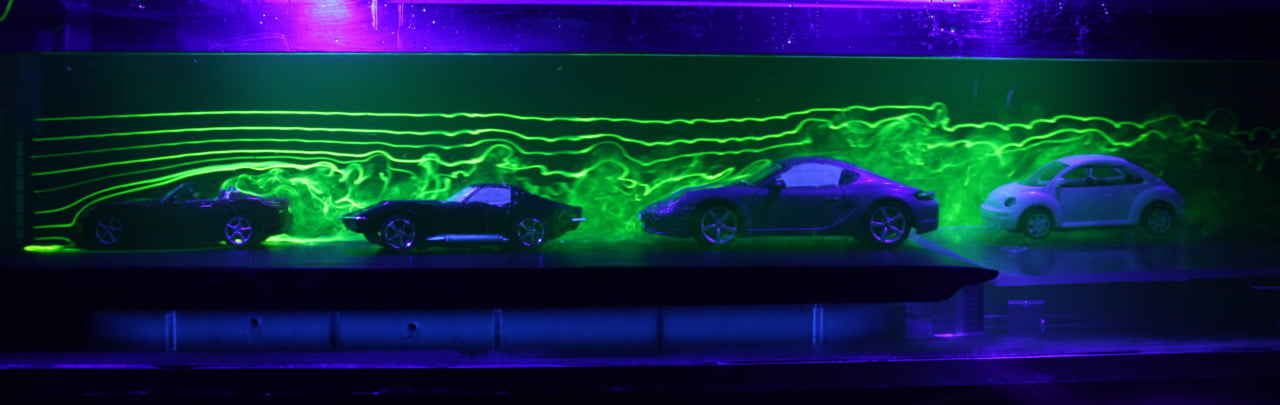
Flow visualization in a water tunnel shows what the flow around a line of traffic looks like. Note the progressively more turbulent flow around each car as it sits in the wake of the car before it. Turbulent flow is usually associated with increased drag forces, but because turbulence can actually help prevent flow separation it is sometimes desirable as a method for decreasing drag. In the case of these cars drafting on one another, it is clear that the cars further back in the line cause less effect on the fluid–and thus have less drag to overcome–than the front car. (Photo credit: Rob Bulmahn)
Wind Tunneling Testing for BASE Jumpers
While we usually think of wind tunnel testing airplane models, the truth is that wind tunnels today test a much wider array of subjects. From oil rigs and skyscrapers to athletes and police sirens, if you can imagine it, it’s probably been stuck in a wind tunnel. This video shows some wind tunnel testing of a tracking suit used for BASE jumping. The primary focus seems to be on lift and drag at angle of attack–which can be used to determine glide ratios for the pilot–but there is also some study of localized turbulence generation, as evidenced by the use of smoke generators and the streamers attached to the suit’s arms and legs. (submitted by Jason C)
Pāhoehoe Lava
Lava flows come in many varieties but one of the most captivating is the pāhoehoe flow, meaning “smooth, unbroken lava” in the native Hawaiian. This type of basaltic lava features a smooth or undulating surface formed by the fluid lava beneath a cooler, congealing surface crust. They often feature low viscosity (by the standards of lava) and very high temperatures between 1100 and 1200 degrees Celsius. Here the flow shows features of viscous fluids like honey, including rope-coiling motions.
Smoke Flow Viz
Smoke visualization, illuminated by a laser sheet, shows a 2D slice from an axisymmetric jet as it breaks down to turbulence. The flow is laminar upon exiting the nozzle, but the high velocity at the edge of the jet and low velocity of the surrounding air causes shear that leads to the Kelvin-Helmholtz instability. This instability leads to the formation of small vortices that grow as they are advected downstream until they are large enough to interrupt the jet and it breaks down into fully turbulent flow. (Video credit: B. O. Anderson and J. H. Jensen)