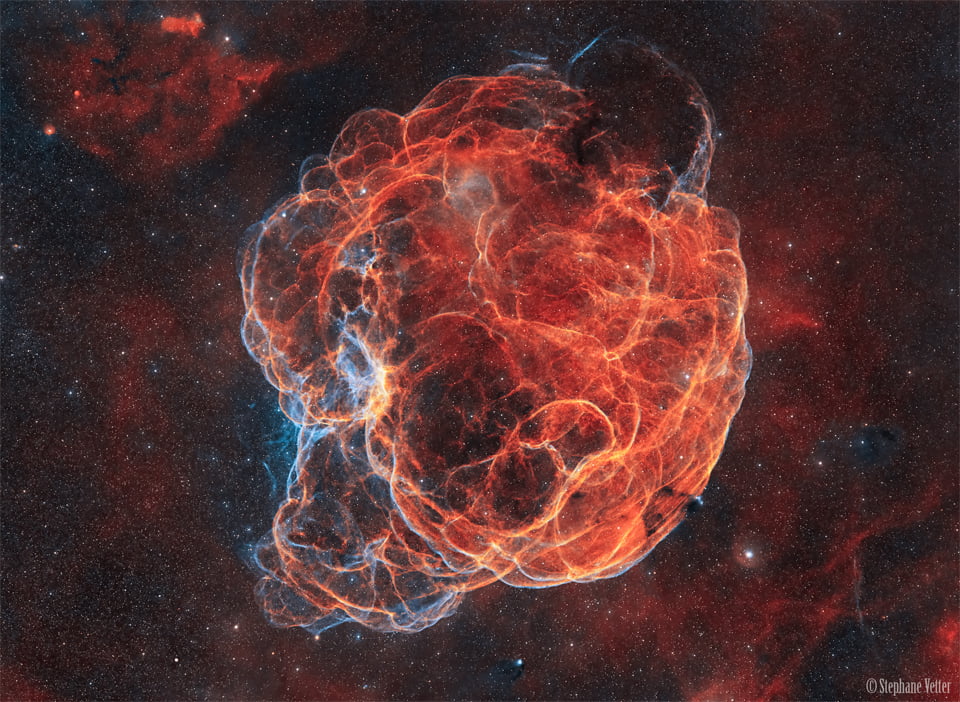
Sometimes known as the Spaghetti Nebula, Simeis 147 is the remnant of a supernova that occurred 40,000 years ago. The glowing filaments of this composite image show hydrogen and oxygen in red and blue, respectively. These are the outlines of the shock waves that blew off the outer layers of the one-time star within. What remains of that star’s core is now a pulsar, a fast-spinning neutron star with a solar wind that continues to push on the dust and gas we see here. (Image credit: S. Vetter; via APOD)
Simeis 147
Comments
2 responses to “Simeis 147”

Hi, some ‘space’ phenomena like this look remarkably ‘terrestrial’. This resembles a deflagration type of explosion. Is this a reasonable comparison, or are the conditions very different and it’s just a coincidence? I suspect a similarity, as this is gas expanding into the space around it. What’s the influence of the density of the surrounding medium?
Love the website, btw!Well-spotted, Nigel! Yes, there are overlaps in the physics there. I don’t happen to know what the density of the surrounding medium is there, but it’s definitely a factor in the physical similarities. This likely falls into the category of a Richtmyer-Meshkov instability, which itself is a kind of Rayleigh-Taylor instability. https://en.wikipedia.org/wiki/Richtmyer%E2%80%93Meshkov_instability


Leave a Reply