Search results for: “waves”

  • An August Arc

    An August Arc

    In summer, the fjords of Greenland are littered with ice, but in August 2023, satellites caught an odd interloper. See the thin white arc spanning the fjord in the photo above? Scientists suspect this ephemeral feature was a wave caused by a large iceberg calving off the glacier on the right. When large chunks of ice fall into the water, they can cause distinctive waves that travel out from the point of impact.

    Another possible mechanism is an underwater plume. In Greenland’s fjords, such plumes are sometimes formed from freshwater melting below the glacier. When that water rises to the surface, it can push ice. (Image credit: W. Liang; via NASA Earth Observatory)

  • Featured Video Play Icon

    Withstanding Rocket Launches

    It takes a lot of power to lift a giant rocket‘s payload all the way to orbit, and in the first moments of a rocket launch, all that energy is directed downward at a concrete pad. How do engineers design and protect launch pads? In this Practical Engineering video, Grady tackles just that question through a comparison of SpaceX’s Stage Zero and NASA’s Launch Pad 39A.

    SpaceX notoriously chose to build Stage Zero without a trench or water sprayer system like the ones NASA use. Trenches deflect the rocket exhaust to reduce the impact on infrastructure beneath the engines. And water sprayers reduce the temperatures the pad experiences and disrupt shock waves that otherwise hammer the pad. Without those precautions, even special heavy-duty concretes have a hard time holding together against a launch. (Video and image credit: Practical Engineering)

  • Viscoelasticity and Bubbles

    Viscoelasticity and Bubbles

    Bursting bubbles enhance our drinks, seed our clouds, and affect our health. Because these bubbles are so small, they’re easily affected by changes at the interface, like surfactants, Marangoni effects, or, as a recent study shows, viscoelasticity.

    A bubble released in pure water pops at the surface, creating a rebounding jet and a daughter droplet.
    A bubble released in pure water pops at the surface, creating a rebounding jet and a daughter droplet.

    In clean water, a bubble’s burst generates a rebounding jet that shoots off one or more daughter droplets, as seen in the animation above. But when researchers added proteins that modify only the water’s surface, they found something very different. As seen below, the bursting bubble no longer generated a jet, and, instead of forming droplets, it made a single, tiny daughter bubble. The difference, they found, comes from the added viscoelasticity of the surface. The long protein molecules resist getting stretched, which damps out the tiny waves that surface tension usually produces on the collapsing bubble cavity. (Image and research credit: B. Ji et al.; submission by Jie F.)

    When the surface of water is viscoelastic, a bursting bubble creates no jet and a daughter bubble instead of a drop.
    When the surface of water is viscoelastic, a bursting bubble creates no jet and a daughter bubble instead of a drop.
  • Black Hole Signature

    Black Hole Signature

    240 million years ago, pressure waves emanated from a black hole inside the Perseus Galaxy Cluster. Much later, NASA’s Chandra X-Ray Observatory intercepted those waves. Scientists raised the frequency of the signal until it fell within the range of human hearing. And then photographer John White played that sound through a petri dish of water sitting on a speaker. The result is above: a watery glimpse of a long ago black hole’s signature. Within these Faraday waves is the echo of a stellar phenomenon that took place when the very first dinosaurs walked our planet. (Image credit: J. White; via the 2023 Astronomy POTY)

  • Star YY Hya

    Star YY Hya

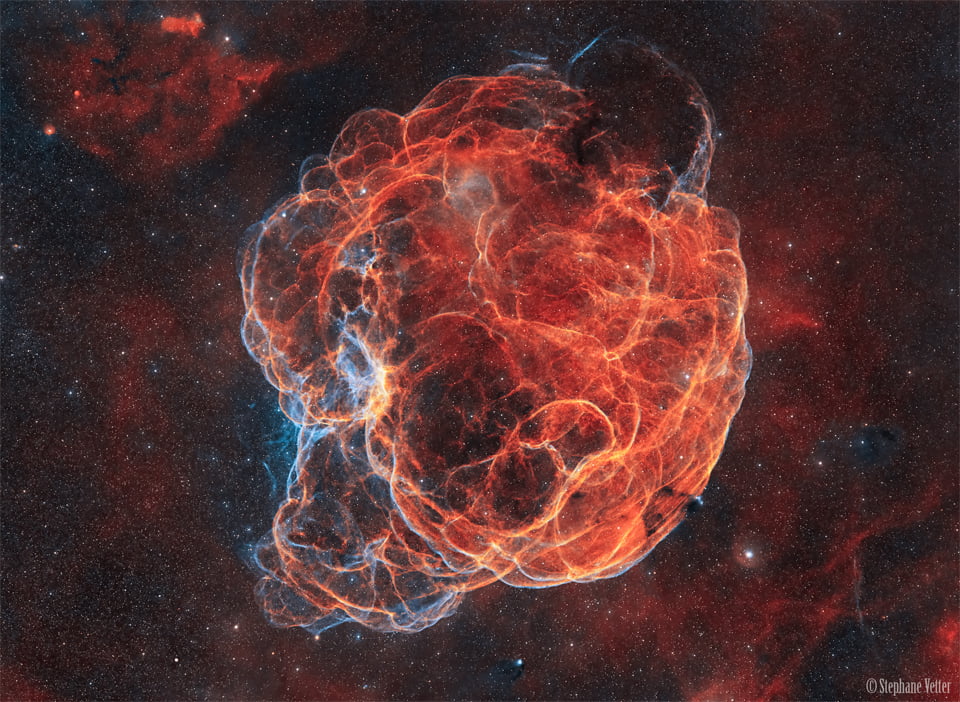
    A team of professional and amateur astronomers discovered and then imaged this previously undiscovered galactic nebula. At the heart of the stellar remnant is a binary star pair. Shock waves of the gas and dust twist and spread in the surrounding space, the remains of an earlier star’s violent eruption. (Image credit: M. Drechsler et al.; via 2023 Astronomy POTY)

  • Scooting Droplets

    Scooting Droplets

    As a child, I always loved watching rain on the windows as I rode in the car. Hemispherical droplets got stretched by the wind flowing over them. But they never stretched smoothly; instead they seemed to shiver and shake unevenly. A recent study looks at a similar situation: drops of glycerin forced to slide along a horizontal surface under the force of the wind. Like the drops on my parents’ car, the glycerin gets stretched out into an elongated oval. Surface waves develop atop the drop and move downstream. The drops, the authors observe, move a bit like a crawling caterpillar, pilling up and smoothing out as they move. (Image credit: rain – A. Alves, experiment – A. Chahine et al.; research credit: A. Chahine et al.; via APS Physics)

    This series of images shows an elongated droplet subjected to airflow moving from left to right. Waves form on the drop and move downstream in a fashion similar to a caterpillar crawling.
    This series of images shows an elongated droplet subjected to airflow moving from left to right. Waves form on the drop and move downstream in a fashion similar to a caterpillar crawling.
  • Clouds Down Under

    Clouds Down Under

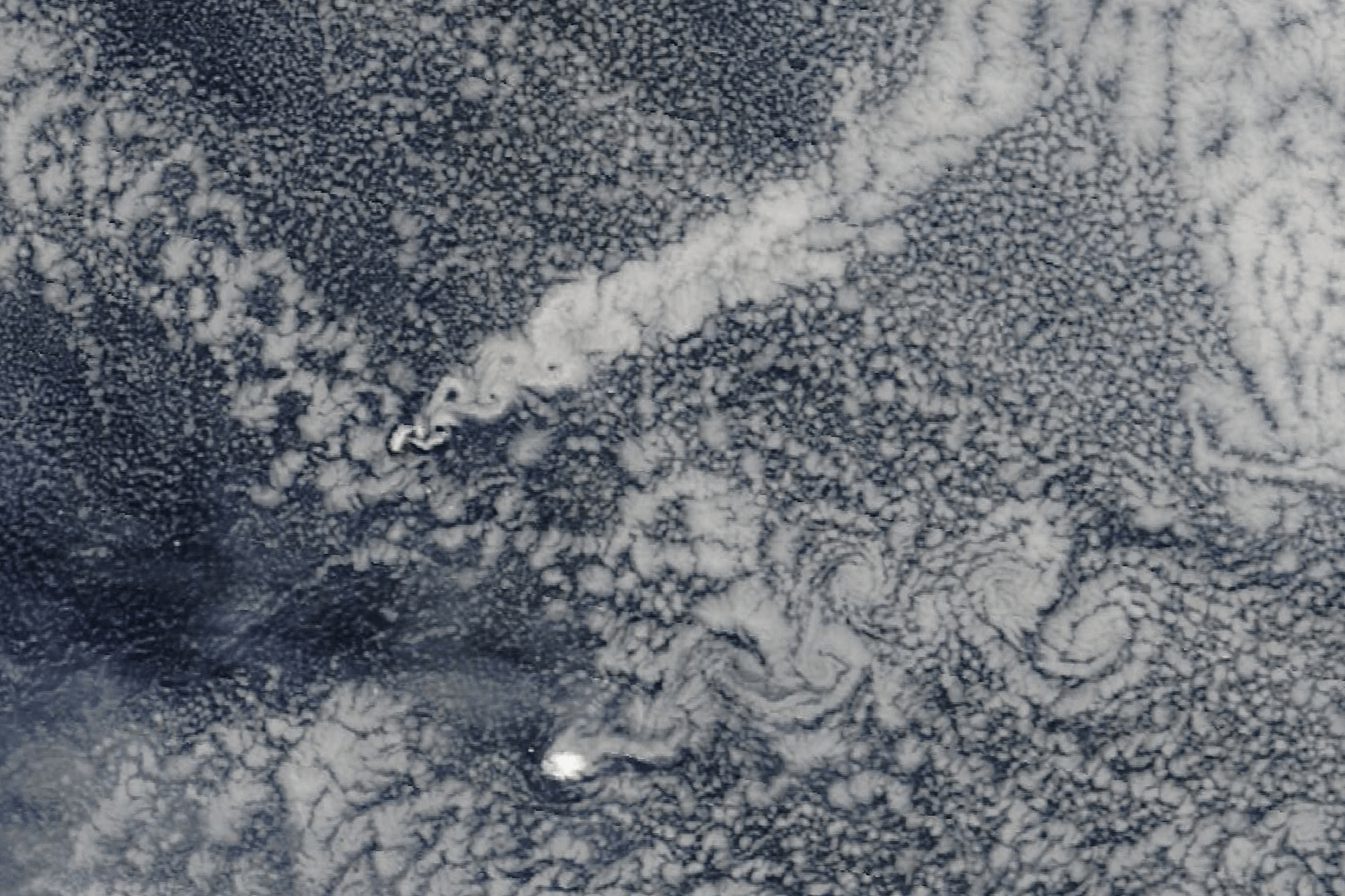
    This large and unusual cloud formation was captured one July morning over western Australia. Stretching over 1,000 kilometers, the clouds have interesting features at both the large and small scale. The small-scale ripples within the clouds are gravity waves triggered by the terrain below. The larger, arced features are tougher to explain, though they may also be related to gravity waves and terrain, just on a much larger scale. They also resemble fallstreak clouds where supercooled droplets evaporate from the inside of the cloud out. (Image credit: W. Liang; via NASA Earth Observatory)

  • Painting in Sediment

    Painting in Sediment

    Pale plumes of sediment flow off these islands in the Gulf of Mannar between India and Sri Lanka. As waves erode the land, currents and tides carry the sediment outward, shaping it into swirls and eddies. I rarely tire of satellite images like these because there are always subtle new details of flow to notice. The photos are much like paintings, with layer after layer to decipher the closer you look. (Image credit: A. Nussbaum; via NASA Earth Observatory)

  • Featured Video Play Icon

    Tongan Eruption

    In January 2022, the Hunga Tonga-Hunga Ha’apai volcano erupted spectacularly, sending waves around the world through the air, water, and ground. In many ways, it was unlike any eruption scientists have observed, though they think it bears similarities to the 1883 eruption at Krakatoa. This video summarizes some of the research to come out of the eruption, looking at how waves propagated, what aerosols the volcano pushed high into the atmosphere, and what the long-term effects of the eruption may be. (Video credit: Science)

  • Featured Video Play Icon

    Studying Earth’s Interior

    The Earth’s interior is almost entirely inaccessible to humanity, so how do we know what it consists of? As explained in this video, our knowledge of the planet’s interior is based on measuring waves sent out by earthquakes and nuclear blasts. Both produce two kinds of waves — pressure waves (P-waves) and shear waves (S-waves) that travel through the earth and get picked up by seismometers. Scientists noticed that pressure waves travel through the center of the planet while shear waves — which get dissipated in liquids — do not. This led them to conclude that part of Earth’s interior is a liquid. The idea of a solid inner core came from observations of pressure waves scattering in a way that only made sense if they’d hit something solid. (Video and image credit: Science)