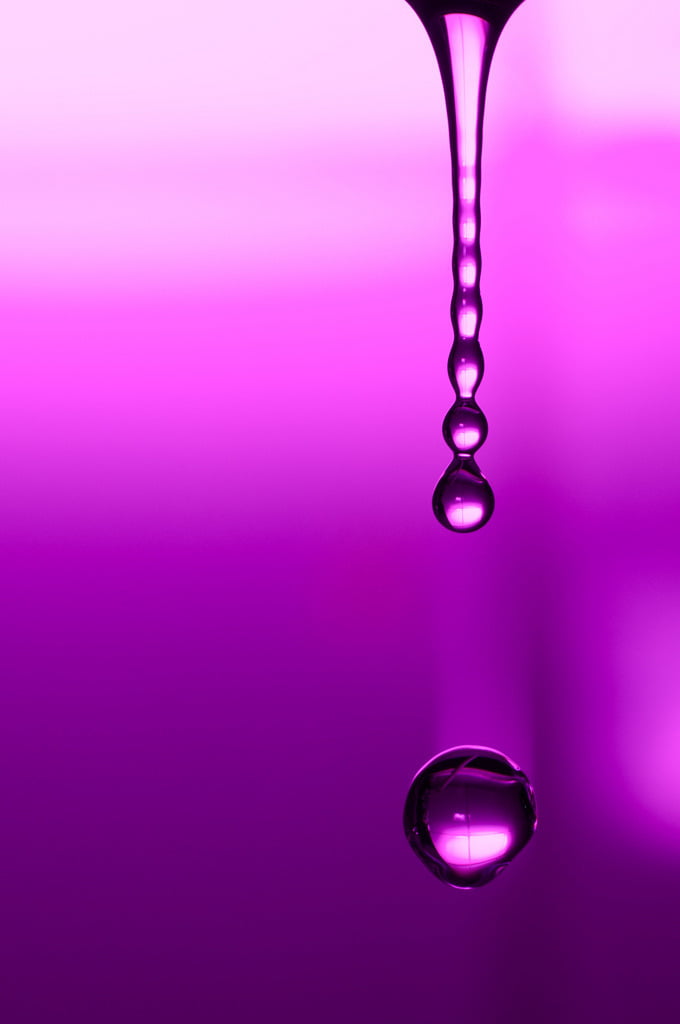
A falling stream of water will break into droplets due to the Plateau-Rayleigh instability. Small disturbances can create a wavy perturbation in the falling jet. Under the right conditions, the pressure caused by surface tension will be larger in the narrower regions and smaller in the wider ones. This imbalance will drive flow toward the wider regions and away from the narrower ones, thereby increasing the waviness in the jet. Eventually, the wavy jet breaks into droplets, which enclose the same volume of water with less surface area than the perturbed jet did. The instability is named for Joseph Plateau and Lord Rayleigh, who studied it in the late 19th century and showed that a falling jet of a non-viscous fluid would break into droplets if the wavelength of its disturbance was larger than the jet’s circumference. (Image credit: N. Morberg)
Search results for: “water droplet”
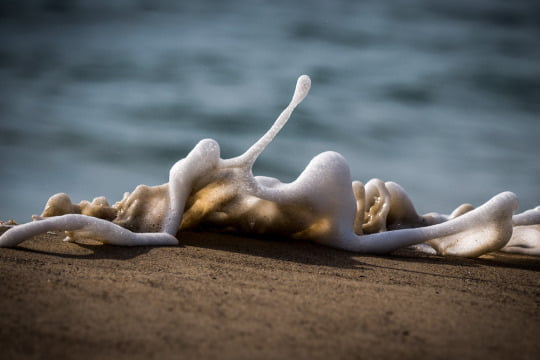
Sea Foam

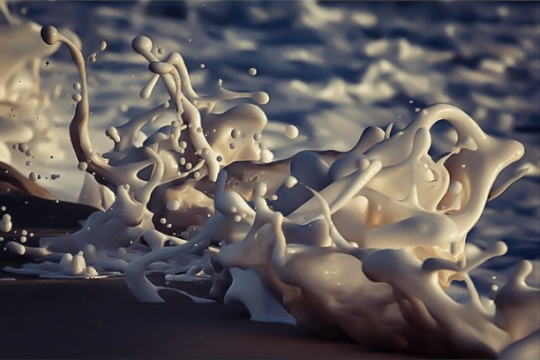
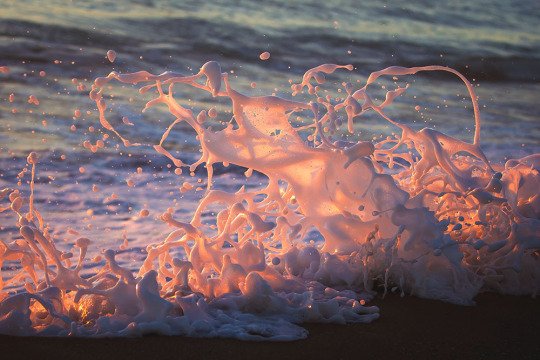
Photographer Lloyd Meudell captures surrealistic images of breaking sea foam.
Interestingly, the sea foam is essentially a three-phase fluid made up of air, water, and sand. Yet despite the surrealism of its forms, the foam bears strong resemblance to other flows. The shapes the foam forms are reminiscent of vibrated non-Newtonian fluids like paint or oobleck. Momentum deforms the foam into sheets and ligaments smoothed and held together by surface tension until droplets snap free. You can find more of Meudell’s work at his site. (Image credits: L. Meudell; via freakingmindblowing; submitted by molecular-freedom)
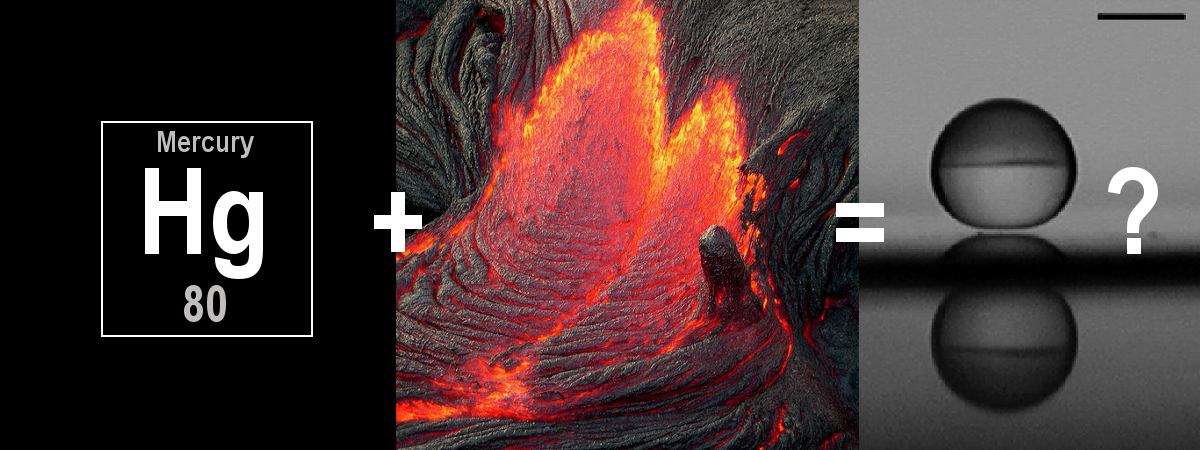
Reader Question: When Mercury Meets Lava
Reader lucondri asks:
What happens when mercury touches lava?
That’s an interesting thought experiment, but hopefully no one tries it any time soon given mercury’s toxicity. So, what might happen? Mercury has a boiling point just under 630 Kelvin, and, although the temperature of molten lava varies, it’s between 970 and 1470 Kelvin when it first erupts. So mercury would definitely vaporize (i.e. boil) on contact with lava. (Again, this is very bad for anyone nearby.) If you’re curious what boiling liquid mercury looks like, wonder no further.
Molten lava is much, much hotter than the boiling point of mercury, though, so there’s a possibility that the mercury won’t boil away instantly. This is because of the Leidenfrost effect, where a thin layer of vapor forms between a liquid and an extremely hot surface. The vapor has such low friction that the liquid can essentially skate across a surface, and it doesn’t boil away instantly because the vapor insulates it from the extreme heat. After some digging, I found a paper that placed the Leidenfrost temperature of mercury between about 850 and 950 Kelvin, meaning that fresh lava is probably hot enough to generate mercury Leidenfrost drops.
So pouring a lot of mercury on lava will probably result in some boiling, but there’s also a good chance that it will form a bunch of skittering mercury droplets that will stick around awhile before they evaporate into toxic mercury gas. That said, it’s a lot easier and safer to watch awesome Leidenfrost drop videos with other liquids. (Collage credit: N.Sharp; images sources: Z. T. Jackson, and A.Biance)

Asteroid Impact
I often receive questions about how fluids react to extremely hard and fast impacts. Some people wonder if there’s a regime where a fluid like water will react like a solid. In reality, nature works the opposite way. Striking a solid hard enough and fast enough makes it behave like a fluid. The video above shows a simulated impact of a 500-km asteroid in the Pacific Ocean. (Be sure to watch with captions on.) The impact rips 10 km off the crust of the Earth and sends a hypersonic shock wave of destruction around the entire Earth. There’s a strong resemblance in the asteroid impact to droplet impacts and splashes. Much of this has to do with the energy of impact. The asteroid’s kinetic (and, indeed, potential) energy prior to impact is enormous, and conservation of energy means that energy has to go somewhere. It’s that energy that vaporizes the oceans and fluidizes part of the Earth’s surface. That kinetic energy rips the orderly structure of solids apart and turns it effectively into a granular fluid. (Video credit: Discovery Channel; via J. Hertzberg)

Laser-Made Superhydrophobics
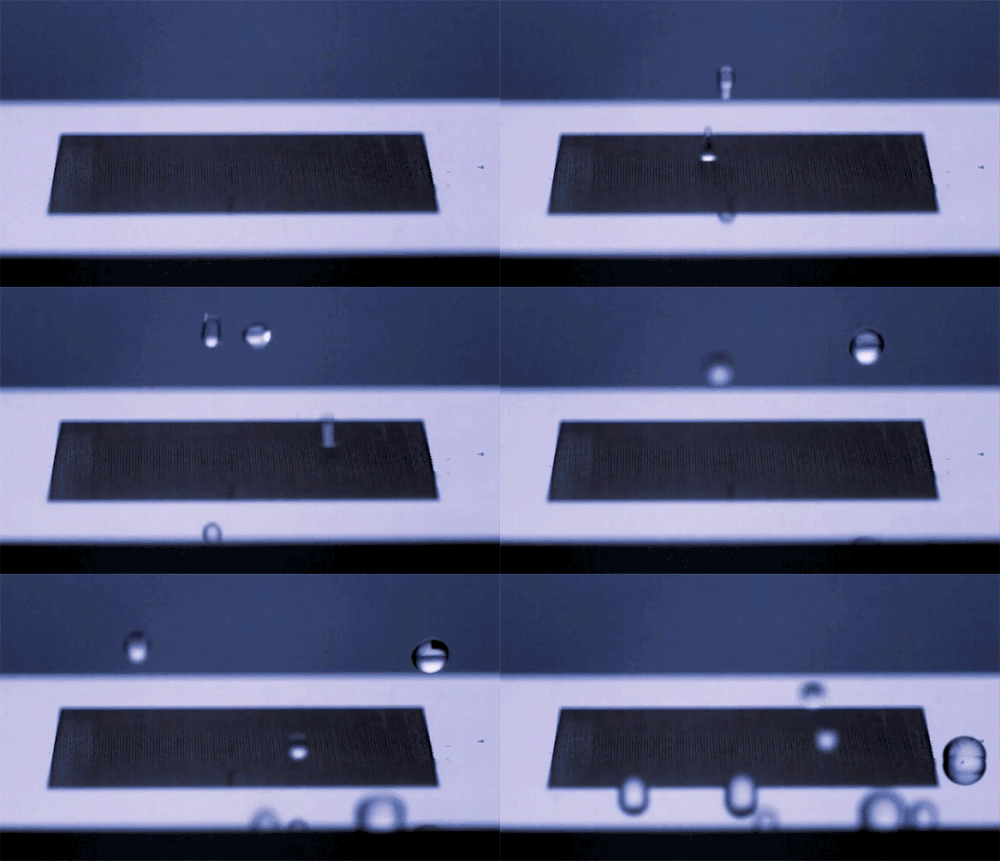
Superhydrophobic surfaces are so repellent to water that liquids often cannot wet them. Today these surfaces are usually created with chemical coatings or deliberate manufacturing to create micro- and nanoscale structures that trap air between the drop and the surface in order to prevent adhesion. Researchers recently announced they’ve made metals superhydrophobic with laser treatments. The process is still time-consuming, but they hope it can be scaled up for wider applications. Because drops bounce so readily off the treated surfaces, it takes very little water to clean them, which may be especially useful for sanitation purposes in the developing world. Superhydrophobic materials are also good for preventing icing on aircraft wings. To learn more about the research, check out the University of Rochester’s video explanations. (Image credit: C. Guo et al., source videos 1,2; submitted by entropy-perturbation and buckitdrop)
How Rain Gets Its Smell
Light rain after a dry spell often produces a distinctive earthy scent called petrichor that is associated with plant oils and bacteria products. How these chemicals get into the air has been unclear, but new research suggests that the mechanism may come from the rain itself. When water falls on a porous surface like soil, tiny air bubbles get trapped beneath the drop. These bubbles rise rapidly due to buoyancy and, upon reaching the surface, burst and release tiny droplets known as aerosols. Depending on the surface properties and the drop’s impact speed, a single drop can produce a cloud of aerosol droplets. The research team is now investigating how readily bacteria or pathogens in the soil can spread through this mechanism. Other human-focused research has already shown that these tiny aerosol droplets can persist in the air for remarkably long periods and may help spread diseases. (Video credit: Massachusetts Institute of Technology; research credit: Y. Joung and C. Buie; submitted by Daniel B and entropy-perturbation)

Hand Dryers and Atomization
Some newer electric hand dryers, like the Dyson Airblade, use jets of high-speed air to dry hands faster than traditional models. Much of their effectiveness comes from the rapid atomization–or break-up into tiny droplets–of water on one’s hands. This is demonstrated in the animation above, which comes from a high-speed video of a water drop falling through the jets of a homemade dryer. Breaking up the water quickly disperses the microdroplets but it also speeds up evaporation by greatly increasing the exposed surface area of the water. This is similar to how you can get instant snow from throwing boiling water if it’s cold enough outside. (Image credit: tesla500, source video; submitted by Nick)

Manipulating Fluids
Combining water-repelling superhydrophobic surfaces with water-loving hydrophilic surfaces allows scientists and engineers to manipulate common fluids. Here a hydrophilic track surrounded by a superhydrophobic background collects and distributes drops of dyed water. The wetting characteristics of the surface combined with surface tension in the liquid drives the flow. No pumping or power input is necessary. This kind of manipulation of droplets can be especially useful in biomedical applications where fast-acting, low-cost devices could be used to diagnose diseases or measure blood glucose levels. (Image credit: A. Ghosh et al., via NSF; see also source video)
Coalescence in Microgravity
Microgravity is a wonderful playground for fluid dynamics. Here astronaut Reid Wiseman demonstrates the interplay of forces involved in coalescence. When smaller droplets hit with insufficient force, they bounce off the water sphere. But if they hit hard enough to overcome surface tension, they coalesce with the sphere. I think the space station needs a high-speed video camera; I’d like to see this behavior at a few thousand frames per second! (Video credit: R. Wiseman/NASA)

Plume Stratification
Clean-up of accidents like the 2010 Deepwater Horizon oil spill can be complicated by what goes on beneath the ocean surface. Variations in temperature and salinity in seawater create stratification, stacked layers of water with differing densities. When less dense layers are on top, the fluid is said to be stably stratified. Since oil is less dense than water, one might assume that buoyancy should make an oil plume should rise straight to the ocean surface. But the presence of additives or surfactants in the oil mixture plume can prevent that. With surfactants present, an oil mixture tends to emulsify, breaking into tiny droplets like a well-mixed salad dressing. Even if the density of the emulsion is smaller than the surrounding fluids, such a plume can get trapped at a density boundary, as seen in the photo above. Researchers report a critical escape height, which depending on the plume’s characteristics and stratification boundary, determines whether a plume escapes or becomes trapped. (Image credit: R. Camassa et al.)