
Atmospheric re-entry subjects vehicles to extreme conditions. At high Mach numbers, the leading shock wave compresses the air so strongly that it reaches temperatures hotter than the surface of the sun. At these temperatures, oxygen and nitrogen molecules in the air dissociate, bathing a vehicle in a plasma of ionized gas molecules. Often these atoms chemically react with the surface materials of a vehicle causing ablation that removes mass from the vehicle while helping protect the vehicle substructure from re-entry heating. Tests in specialized ground facilities like arc-jet plasma tunnels are necessary to develop thermal protection systems capable of shielding a vehicle during hypersonic flight. (Image credit: D. Ponseggi/NASA)
Search results for: “lift”

Visualizing Vortices
Flow visualization can be a valuable tool for understanding fluid dynamics. In this video, we see how it can help elucidate the mechanisms of flapping flight. By dyeing vortices from the leading edge in red rhodamine and vortices from the trailing edge in green fluorescein, it’s possible to distinguish their competing effects for wings of different size. The speed and efficiency of a flapping wing depends on the vortices it sheds–these provide its lift and thrust. On a short wing, the leading edge vortex is significant and spins in a counter-clockwise (positive) direction. When it reaches the trailing edge, it meets a vortex spinning clockwise (negative). The interference of the two vortices weakens the shed vortex, thereby slowing the wing. Lengthening the wing weakens the leading edge vortex, which reduces its interference at the trailing edge and makes the longer wings more efficient. (Video credit: T. Mitchel et al.; via @AlbanSauret)
The Challenges of Micro Air Vehicles
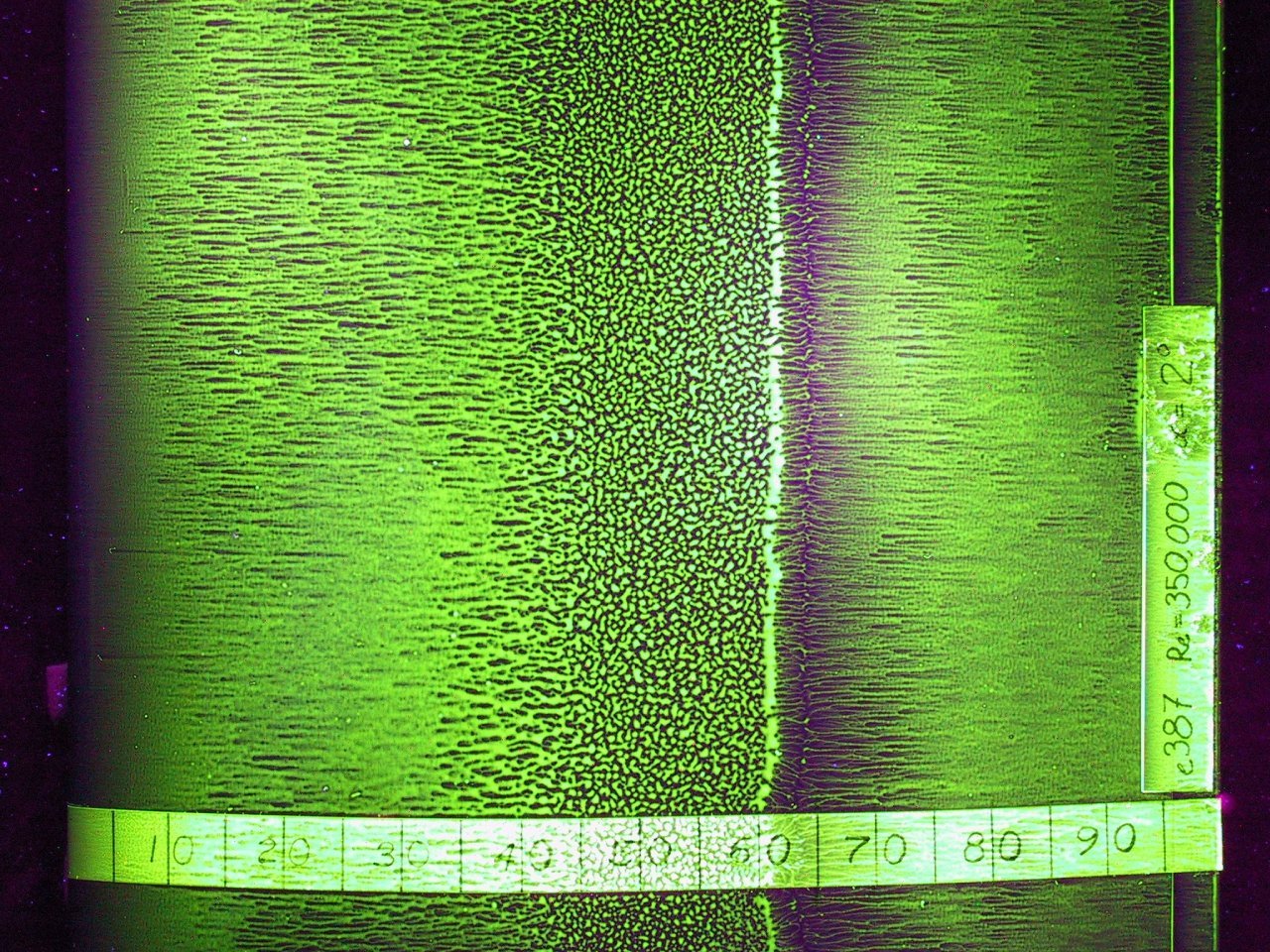
Interest in micro-aerial vehicles (MAVs) has proliferated in the last decade. But making these aircraft fly is more complicated than simply shrinking airplane designs. At smaller sizes and lower speeds, an airplane’s Reynolds number is smaller, too, and it behaves aerodynamically differently. The photo above shows the upper surface of a low Reynolds number airfoil that’s been treated with oil for flow visualization. The flow in the photo is from left to right. On the left side, the air has flowed in a smooth and laminar fashion over the first 35% of the wing, as seen from the long streaks of oil. In the middle, though, the oil is speckled, which indicates that air hasn’t been flowing over it–the flow has separated from the surface, leaving a bubble of slowly recirculating air next to the airfoil. Further to the right, about 65% of the way down the wing, the flow has reattached to the airfoil, driving the oil to either side and creating the dark line seen in the image. Such flow separation and reattachment is common for airfoils at these scales, and the loss of lift (and of control) this sudden change can cause is a major challenge for MAV designers. (Image credit: M. Selig et al.)

Vapor Cones
Vapor cones typically appear around aircraft flying in the transonic regime–near, but still below, the speed of sound. Air moving over the vehicle accelerates and decelerates as it moves around different parts of the plane; if it didn’t, the plane couldn’t generate lift and wouldn’t fly. When the local flow accelerates past the speed of sound, the accompanying drop in pressure and temperature can be enough to for conditions to fall below the dew point, causing the condensation we see. At the back of the airplane, a shock wave decelerates the airflow back to subsonic speeds and raises local conditions back above the dew point, thereby truncating the cone. (Image credit: C. Caine)

Flow Around a Delta Wing
Colorful streaks of dye wrap like ribbons along the leading edge of a delta wing. At an angle of attack, this triangular wing forms a set of vortices that run along its edge, providing much of the low pressure–and therefore lift–on the upper surface of the wing. In contrast, the red streaks of dye in the middle of the wing demonstrate clean, laminar flow. Highly swept delta wings are popular for aircraft traveling at supersonic speeds, but they can also work well subsonically, as shown here. For more incredible and beautiful examples of flow visualizations by Henri Werlé, check out his 1974 film Courants et couleurs. (Photo credit: H. Werlé; via eFluids)
Hummingbird Hovering
Hummingbirds have a unique way of flying among birds. By flapping in a figure-8 motion, they generate lift on both the upstroke and the downstroke, which enables them to fly forward, backward, and even hover for extended periods. Such mid-air acrobatics are necessary for a species that feeds on flower nectar. What is especially impressive about the birds, though, is how they hold up even in adverse conditions like wind or rain. By placing birds in a wind tunnel and filming with high-speed video, researchers can see how hummingbirds maintain their feeding position even in 20 mph (32 kph) winds. By fanning out their tail feathers like a rudder, they can control their body orientation despite turbulent gusts. Not even rain stops them. The birds will periodically shake themselves dry, much like a dog if a dog could manage to fly while shaking itself. (Video credit: Deep Look; submitted by entropy-perturbation)
Cloud Formation
Clouds are so ubiquitous here on Earth that it’s easy to take them for granted. But there’s remarkable complexity in the mechanics of their formation. This great video from Minute Earth steps through the processes of evaporation and condensation that drive basic cloud formation. After evaporation, buoyancy lifts warm, moist air upward. That warm air expands and cools until it reaches an altitude where water droplets can condense onto dust particles in the atmosphere. These droplets form the wispy cloud we see. Turbulence mixes these droplets and helps them collide and grow. Interestingly, although we understand the basic process of cloud formation, relatively little is understood about the details, and the subject is still very much an area of active research. (Video credit: Minute Earth; via io9)

Snowy Deserts
Windblown snow bears a certain resemblance to desert sands or a Martian landscape. Many of the same aeolian processes–like erosion, transport, and deposition–take place in each. The animation above shows an example of suspension, where fine snowflakes are lifted and carried along near the ground. Larger snowflakes may bounce or skip along the surface in a process called saltation. For more, check out some of the crazy things snow does or learn about how dunes form. (Image credit: Redemption Designs, source video)

A Toast!
When you lift a glass of champagne or sparkling wine at midnight tonight, your nose and mouth will be greeted by a plethora of aromas, flavors, and sensations propagated by the tiny bubbles in the drink. Carbon dioxide dissolved in the wine gathers in a stream of tiny bubbles that rise at the center of the glass. (The bubbles form at the center because champagne glasses are often etched in a ring there to provide nucleation points where the bubbles can grow.) This stream of rising bubbles generates vortical motion in the glass that helps carry the carbon dioxide to the surface, where it is released when the bubbles burst. In the tall, thin champagne flute these vortices mix the entire contents of the glass, but, in a wider coupe, the vortices are confined to the center, leaving a stiller region along the glass’s edges. For those who find that a freshly poured flute of champagne stings their noses–a side effect of the high gaseous carbon dioxide concentration just after decanting–the wider coupe lowers the concentration at the glass’s lip and may provide a more pleasant experience for toasting the new year. (Image credit: F. Beaumont et al.)

Transonic Flow
In the transonic speed regime the overall speed of an airplane is less than Mach 1 but some parts of the flow around the aircraft break the speed of sound. The photo above shows a schlieren photograph of flow over an airfoil at transonic speeds. The nearly vertical lines are shock waves on the upper and lower surfaces of the airfoil. Although the freestream speed in the tunnel is less than Mach 1 upstream of the airfoil, air accelerates over the curved surface of airfoil and locally exceeds the speed of sound. When that supersonic flow cannot be sustained, a shock wave occurs; flow to the right of the shock wave is once again subsonic. It’s also worth noting the bright white turbulent flow along the upper surface of the airfoil after the shock. This is the boundary layer, which can often separate from the wing in transonic flows, causing a marked increase in drag and decrease in lift. Most commercial airliners operate at transonic Mach numbers and their geometry is specifically designed to mitigate some of the challenges of this speed regime. (Image credit: NASA; via D. Baals and W. Corliss)