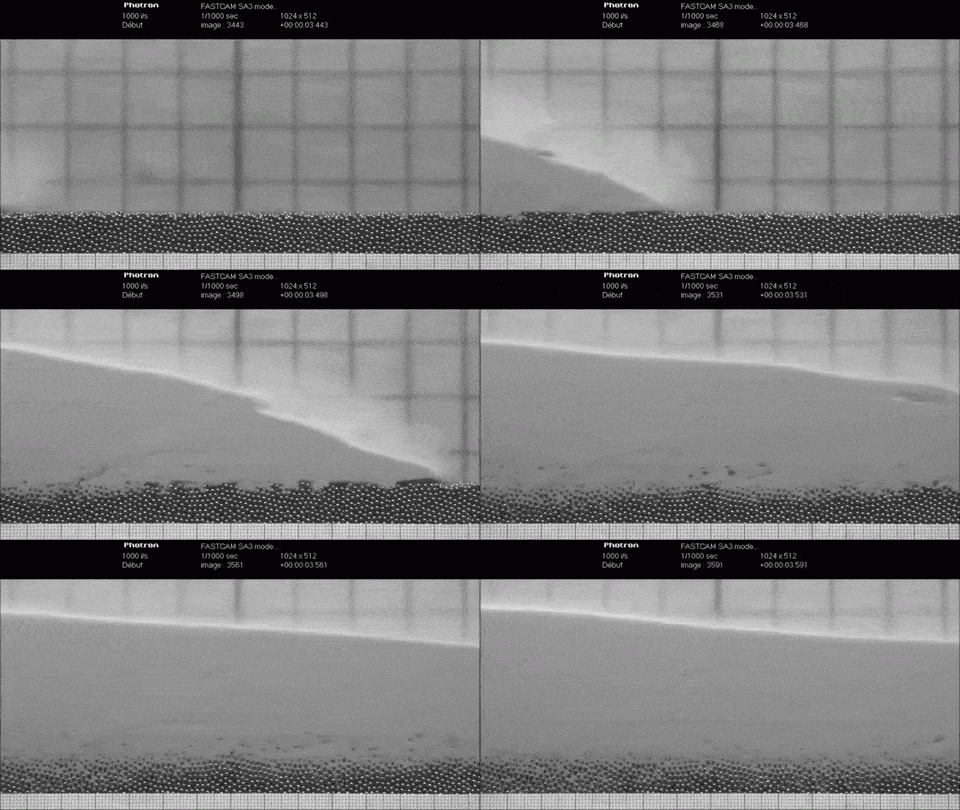
Major volcanic eruptions can be accompanied by pyroclastic flows, a mixture of rock and hot gases capable of burying entire cities, as happened in Pompeii when Mt. Vesuvius erupted in 79 C.E. For even larger eruptions, such as the one at Peach Spring Caldera some 18.8 million years ago, the pyroclastic flow can be powerful enough to move half-meter-sized blocks of rock more than 150 km from the epicenter. Through observations of these deposits, experiments like the one above, and modeling, researchers were able to deduce that the Peach Spring pyroclastic flow must have been quite dense and flowed at speeds between 5 – 20 m/s for 2.5 – 10 hours! Dense, relatively slow-moving pyroclastic flows can pick up large rocks (simulated in the experiment with large metal beads) both through shear and because their speed generates low pressure that lifts the rocks so that they get swept along by the current. (Image credit: O. Roche et al., source)
Search results for: “lift”

Humans Running on Water
How fast does a speedster like The Flash or Dash Parr from The Incredibles have to go to run on water? As we saw from other water-walkers like the basilisk lizard and the western and Clark’s grebes, any large creature wanting to run on water needs to generate the necessary vertical impulse by hitting the water hard, pushing off against the cavity that creates, and pulling their foot up before the cavity collapses around it.
Using basilisk lizards as our guide, we can build a simplified hydrodynamic model (following Glasheen and McMahon and Minetti et al.) to describe this process and predict a speedster’s necessary speed. If we assume our runner removes their foot before the cavity collapses, we have a relatively simple relation to satisfy, namely: the vertical impulse from the slap combined with the vertical impulse from the push, or stroke, must equal or exceed the impulse from the runner’s weight:
(Impulse from slap) + (Impulse from stroke) >= Impulse from runner’s weight
The impulse from the runner’s weight is relatively straightforward. It depends on the runner’s mass, gravity, and the time it takes the runner to complete a step. The other two terms are a bit more complicated and require some approximations. One is that we’ll treat the runner’s foot like a circular disk – this makes it easier to figure out the drag while the runner pushes against the water. Ultimately, the model requires five variables (four, if we assume that we’re on Earth):
– the runner’s mass
– the area of the runner’s foot
– the depth the runner’s foot reaches underwater
– the time it takes the runner to take one step
– the acceleration due to gravityI will spare you the math, but I’ve created an online calculator (now with English or metric versions) with the model, so you can follow along with my math or play around with your own numbers.
Click through to see how fast a human has to go to run on water.
So how fast would The Flash have to run? Barry Allen is grown man, roughly 75 kg in mass, with a foot area of about 314 cm^2. We can assume that he pushes his leg about 0.15 m into the water with each step. The best human sprinters run with a step time of 0.2 – 0.26 seconds, but Barry’s a metahuman, so we’ll give him the benefit of the doubt and say that he can take a step in 0.15 seconds. (Let’s be honest, he’s probably capable of faster than that!)
To keep from sinking, The Flash would have to strike his feet against the water at about 37 m/s. It’s a little tough to say exactly how that would translate into forward speed. Both basilisks and grebes strike the water at a higher speed than their forward velocity. Since their feet are parallel to the surface when they strike, the slap phase only gives them vertical impulse. Their forward velocity comes from the stroke phase where they can push off against the water. This suggests that a runner who generates a lot of their vertical impulse during the slap phase will be able to get more forward velocity out of the stroke phase because they can afford to push forward off the cavity instead of mostly up. That’s consistent with what we observe in the lizards and grebes; the grebe gets more of its impulse from the slap and its forward velocity is a larger percentage of its foot impact velocity compared to the basilisk.
Using the lizards and birds as our guide, we can estimate that The Flash, who gets about 45% of his necessary vertical impulse from slapping, will have a forward velocity of about 27 m/s or 98 kph. That’s a lot faster than any human has ever run – Usain Bolt has managed about 44.7 kph – but it’s not that fast. In CW’s The Flash TV show, his team estimates that he must run 650 miles per hour, or 1050 kph, to run on water. That is way faster than necessary!
How about Dash Parr, though? Dash is about 10 years old, so he’s a lot smaller than Barry. That means he has less mass to keep afloat (about 32 kg), but it also means that he has smaller feet (154 cm^2) and shorter legs (0.1 m foot depth). For the same stride rate, that means that Dash has to hit the water at 47 m/s, about 25% faster than Barry. It also means that Dash gets a tad more oomph from his slap (~46%) and runs across the water at 128 kph, about 30% faster than Barry has to go.
That’s totally doable for a superhero, but what about us regular humans? Sadly, our large mass and small feet won’t let us run on water like The Flash or Dash, but there are ways to bend the rules. One is to reduce gravity – this was the subject of an Ig Nobel prize-winning study by Minetti et al. The researchers put fins on volunteers, suspended them from a harness to reduce their effective weight, and got them to run in place in a pool. They found that fin-augmented humans could run on water in gravity about 20% of Earth’s.
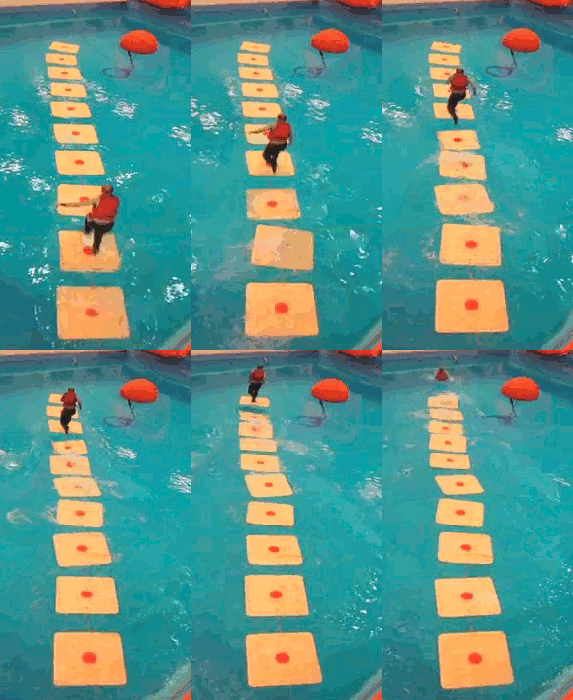
Another technique is to increase a runner’s effective foot area without making them bother to lift the foot out of the water. In essence, a human can run on water across over-sized lily pads. In their study, Lothman and Ruina accomplished this with plywood pads laid out in a pool. The pads were buoyant enough to stay afloat at the water surface but would sink if a person stood still on them. But by running quickly from one to the next, their test subject was able to successfully run across water.
So, there you have it: speedsters can run on water without breaking autobahn speed limits and the rest of us can cheat. Be sure to check out the online calculator and play with the model yourself. And join me tomorrow for my special webcast with Professor Tadd Truscott and Randy Hurd, who inspired this foray into water-walking!
ETA: I updated the calculator so that there is now an English unit version as well as a metric unit version.

Research credits:
– Glasheen and McMahon, “A hydrodynamic model of locomotion in the basilisk lizard”, 1996.
– Minetti et al., “Humans running in place on water at simulated reduced gravity,” 2012.
– Lothman and Ruina, “Humans can run on water using big instantly-changable shoes,” 2012.
(Image credits: Disney, CW/DC Comics, Lothman and Ruina, source, and The Splash Lab)
Grebe Rushing Physics
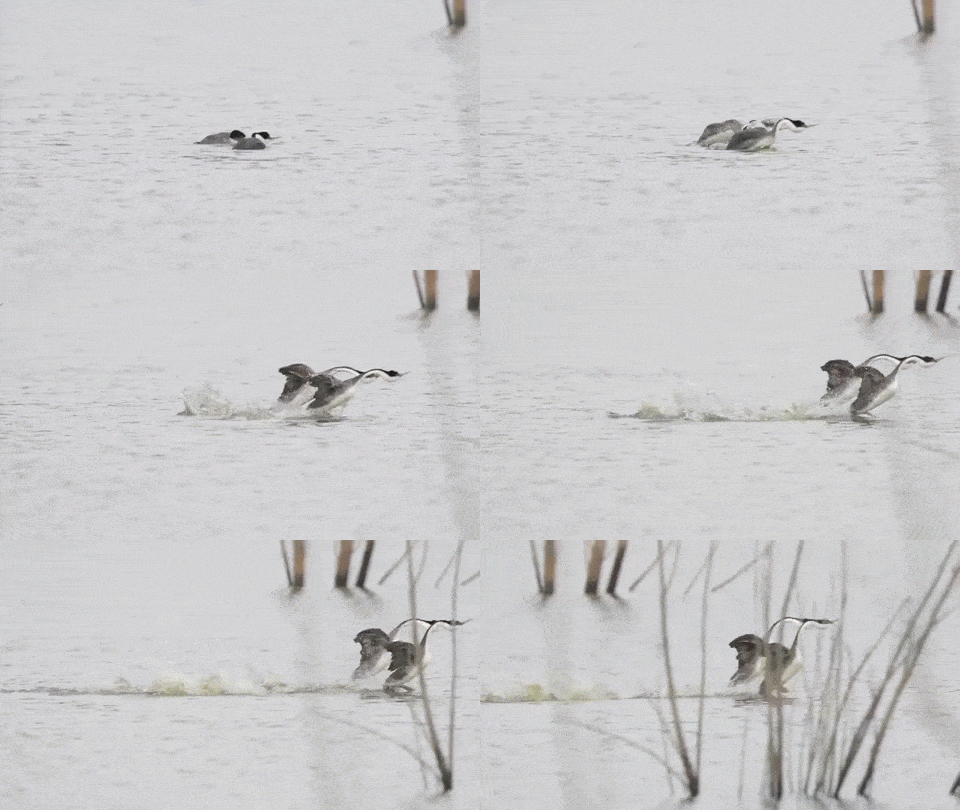
As capable a water-runner as the common basilisk is, the western and Clark’s grebe is even more impressive. Not only do these birds weigh up to three times as much as an adult basilisk, but they start their water-walking from inside the water, which requires overcoming much more hydrodynamic force.
Like the lizards, grebes must slap the water with their feet to generate upward forces capable of supporting their weight above water. The birds take as many as 20 steps a second – an incredible and unmatched stride rate for a creature their size. Their feet impact the water at up at 4.5 m/s, which generates an impulse equivalent to 30-55% of the grebe’s weight. The rest of the necessary impulse comes from the stroke phase, where the bird pushes its foot down against the water.
When retracting its foot, the grebe extracts the foot with a sideways motion through the water – unlike the basilisk which pulls its foot out through the air cavity its stroke created. In order to reduce drag, the grebe’s foot collapses into a more streamlined shape as it gets pulled from the water, letting the bird set up for the next step. (Image/video credit: B. Struck, source; research credit: G. Clifton et al.)
This week FYFD is exploring the physics of walking on water, all leading up to a special webcast on March 5th with guests from The Splash Lab. The live webcast will be open to all FYFD patrons, so be sure to sign up if you want to tune in.

The Basilisk Lizard
One of the most famous water-walking creatures is the common basilisk lizard. These South American reptiles are far too large to be kept aloft by surface tension and other interfacial effects. They generate the vertical force necessary to stay above water by slapping the water hard and fast. There are three phases to a basilisk’s water running gait: the slap, the stroke, and the retraction.
In the slap phase, the lizard slams its foot flat against the water surface at a peak velocity of about 3.75 m/s. The impact pushes water down and generates an upward force on the lizard that accounts for between 15-30% of the lizard’s body weight, depending on the size of the lizard. The rest of the upward force comes from the stroke phase, where the lizard pushes its foot downward in the water, causing an air cavity to form.
The air cavity is vital for the last phase of the lizard’s step. The basilisk must pull its foot out and prepare for the next slap, ideally doing so without generating too much drag. The lizard does this by pulling its foot through the air cavity before it seals. Doing so through air is much easier than through water.
Water-walking this way requires fast reflexes. Basilisks take up to 20 steps per second when running across water and reach speeds of about 1.6 m/s. Although both juvenile and adult basilisks can run on water, the smaller lizards do better because they can generate more than enough impulse to overcome their weight. (Image credit: T. Hsieh/Lauder Laboratory, source; video credit: BBC; research credits: J. Glasheen and T. McMahon, G. Clifton et al.)
This week FYFD is exploring the physics of walking on water, all leading up a special webcast March 5th with guests from The Splash Lab.

Sand Ripples in Tidal Flats


Sand, winds, and waves can interact to form remarkable and complex patterns. These sand ripples from the tidal flats of Cape Cod are a testament to such interactions. When a fluid like air or water flows over a flat bed of sand, it can shear and lift grains of sand, moving them to a new location. Very quickly, turbulence within the flow disturbs the initially smooth surface and begins to form the wavelike crests we see. Because the change in surface shape alters the nearby air or water flow, there is a trend toward self-organization and persistence. In other words, once the ripples form, they’re reinforced by their effect on the wind or water that formed them. Once rippled, the surface does not tend to smooth back out. (Image credit: N. Sharp; research credit: F. Sotiropoulos and A. Khosronejad)
Skipping Squishy Spheres

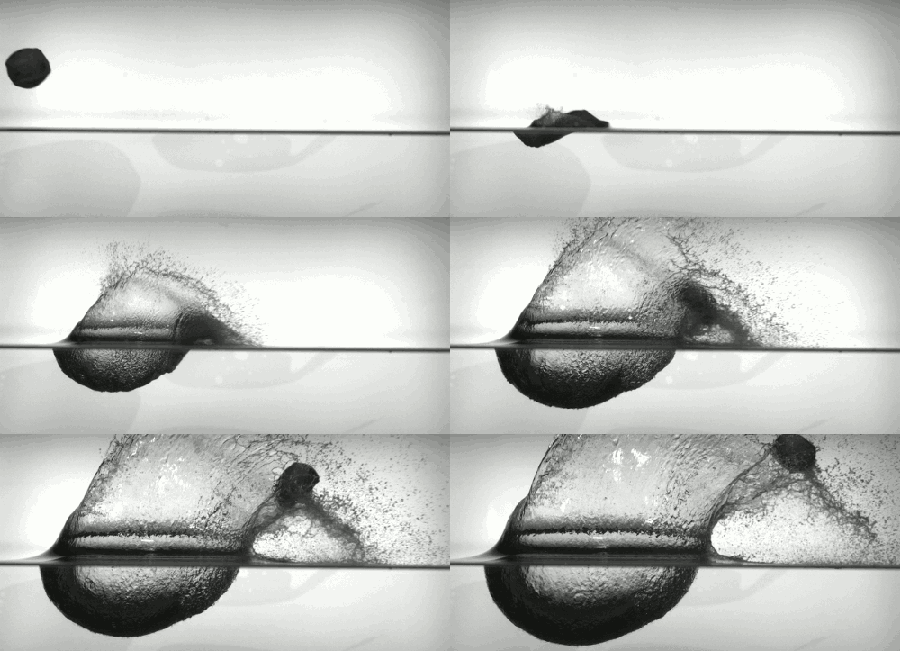
Skipping a stone on water requires a flat, disk-like stone thrown at a shallow angle, but elastic spheres are remarkable skippers, too, even at higher impact angles. Researchers at the Splash Lab have just published their work on why these balls skip so well. As seen in the top animation, the elastic spheres deform on impact, flattening to a more disk-like shape that rides at an angle of attack relative to the air-water interface. Both features are important to the spheres’ enhanced skipping. By flattening, the sphere comes into greater contact with the water and by orienting at a larger angle of attack, the sphere increases the vertical component of force the water generates on the sphere. It’s this vertical force that lifts the sphere up and lets it keep bouncing.
Because the ball is soft, it keeps deforming after its impact and bounce (see top animation). For some skips, the timescale of the sphere’s elastic waves is smaller than the length of time the sphere is in contact with the water. When this is the case, the sphere’s elastic waves will affect the impact cavity in the water, forming what the researchers call a
matryoshka cavity, after the Russian nesting dolls. An example is shown in the second animation. For more, check out the USU press release, the original paper, or the award-winning video they made a few years ago. (Image credits: J. Belden et al./The Splash Lab)
If you enjoy FYFD and want to help support it, please consider becoming a patron!

Perching Physics
Compared to birds, manmade aircraft tend to be quite limited and inelegant. Fixed-wing aircraft, for example, require long, flat areas for take-off and landing, whereas birds of all sizes are adept at maneuvers like perching. This video examines the perching behaviors of large birds and extends the physics to a small unmanned aerial vehicle (UAV). As a bird approaches a perching location, it pitches its body and wings upward. This places the bird in what’s known as deep stall, where air flowing over the upper surface of the wing separates just after the leading edge. This move dramatically increases drag on the bird, slowing it for landing. At the same time, the speed of the pitch maneuver generates a vortex on the wing that helps the bird maintain lift despite the drop in speed. With the help of both forces, the bird can make a graceful, controlled landing in only a short distance. (Video credit: J. Mitchell et. al.)

Helicopter Tip Vortices
Airplanes and other fixed-wing aircraft produce wingtip vortices as a result of their finite length. Rotor blades, like those on helicopters, produce the effect as well. Both wings and rotors generate lift by trapping low-pressure air on their top surface and high-pressure air below. At their tips, though, the high-pressure air can sneak around the wing or rotor, creating vortices like the ones visualized above. Here smoke from a wire is entrained by the rotors’ inflow and twisted into a tip vortex. The line of vortices drifts downward due to the rotor’s downwash. (Image credit: M. Giuni et al., source)
The Tightrope Dancers
Boiling is a process most of us don’t pay much attention to. But it can be remarkably entertaining and beautiful. This award-winning video shows boiling on and around a heated wire immersed in oil. Depending on the diameter of the wire and the power used to heat it, the researchers observe several different regimes of behavior. In one, vapor bubbles form on the wire and interact with one another: bouncing, merging, and dancing back and forth. When the bubbles become large enough, their buoyancy lifts them upward. In another regime, the wire is hot enough for film boiling. Like the Leidenfrost effect, film boiling occurs when a surface is so hot that it instantly vaporizes any liquid near it. The vapor layer then acts like coating, insulating the remaining liquid from the hot surface. The bubbles formed on the wire in this regime are mesmerizing, rising in periodic patterns or shifting back and forth gobbling up lesser bubbles. (Video credit: A. Duchesne et al.)
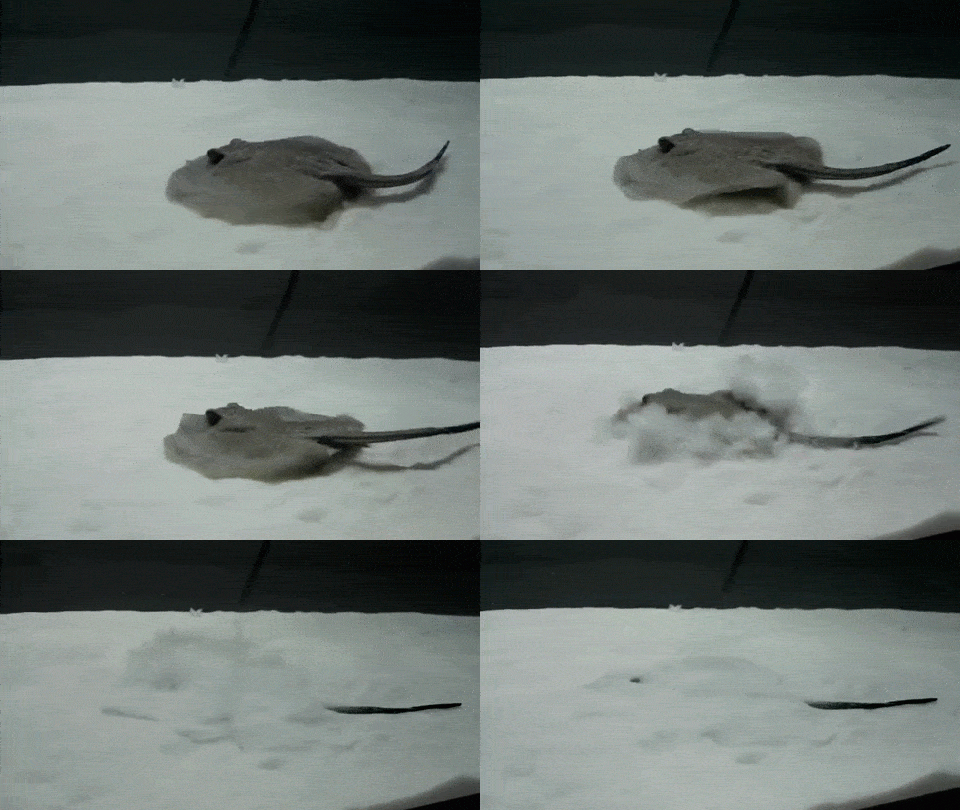
Hiding in the Sand


Flounders, stingrays, and other flat, bottom-dwelling fish often hide under sand for protection. These fish move by oscillating their fins or the edge of their bodies. They use a similar mechanism to bury themselves–quickly flapping to resuspend a cloud of particles, then hitting the ground so that the sand settles down to cover them. Researchers have been investigating this process by oscillating rigid and flexible plates and observing the resulting flow. When the flapping motion exceeds a critical velocity, the vortex that forms at the plate’s edge is strong enough to pick up sand particles. Understanding and controlling how and when these vortex motions kick up particles is useful beyond the ocean floor, too. Helicopters are often unable to land safely in sandy environments because of the particles their rotors lift up, and this work could help mitigate that problem. (Image credits: TylersAquariums, source; Richmondreefer, source; A. Sauret, source; research credit: A. Sauret et al.)