Anthony Hall’s “Perpetual Puddle Vortex Experiment” is an intriguing display of several physical mechanisms. What looks like a puddle is actually a vortex constantly sucking fluid down a hole in the table. The liquid is re-circulated into the puddle so it never disappears. The table itself is treated to be hydrophobic, causing the distinctive curvature and large contact angle of the puddle’s rim. The oils mixed in float on top, creating patterns of foam that visualize the swirling motions of the fluid as the vortex pulls it in. (Video credit and submission by: A. Hall)
Tag: vortex

Mercedes-Benz Tornado


The world’s most powerful artificial tornado is part of the Mercedes-Benz Museum in Stuttgart, Germany. Though popular enough with visitors that the staff will bring out smoke generators to make it visible, the tornado was not built as an attraction – It’s actually part of the building’s fire protection system. The modern open design of the museum meant that conventional smoke removal systems were inadequate. Instead vorticity is generated in the central lobby with 144 wall-mounted jets. The angular velocity created by the jets is strongest at the middle, in the vortex core, due to conservation of angular momentum – exactly the way a spinning ice skater speeds up by pulling his arms in. The core of the vortex is a low pressure area, which draws outside air toward it – this is how the tornado pulls in smoke when there is a fire. The fan on the ceiling provides the pressure draw necessary for the smoke to be pulled up and out of the building at a supposed rate of 4 tons per minute. See the tornado in action here. (Photo credit: Mercedes-Benz Passion; submitted by Ivan)

Real-Life Whirlpools
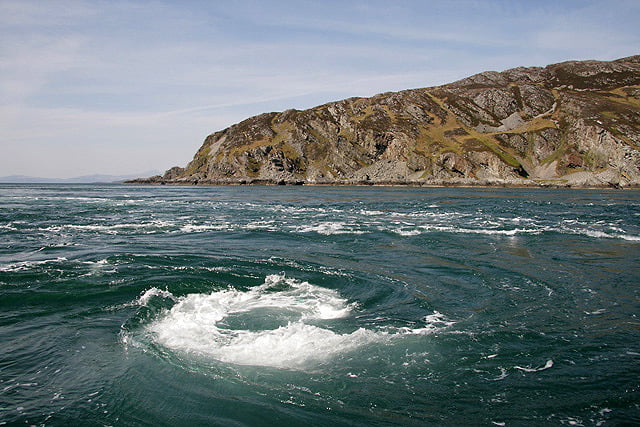
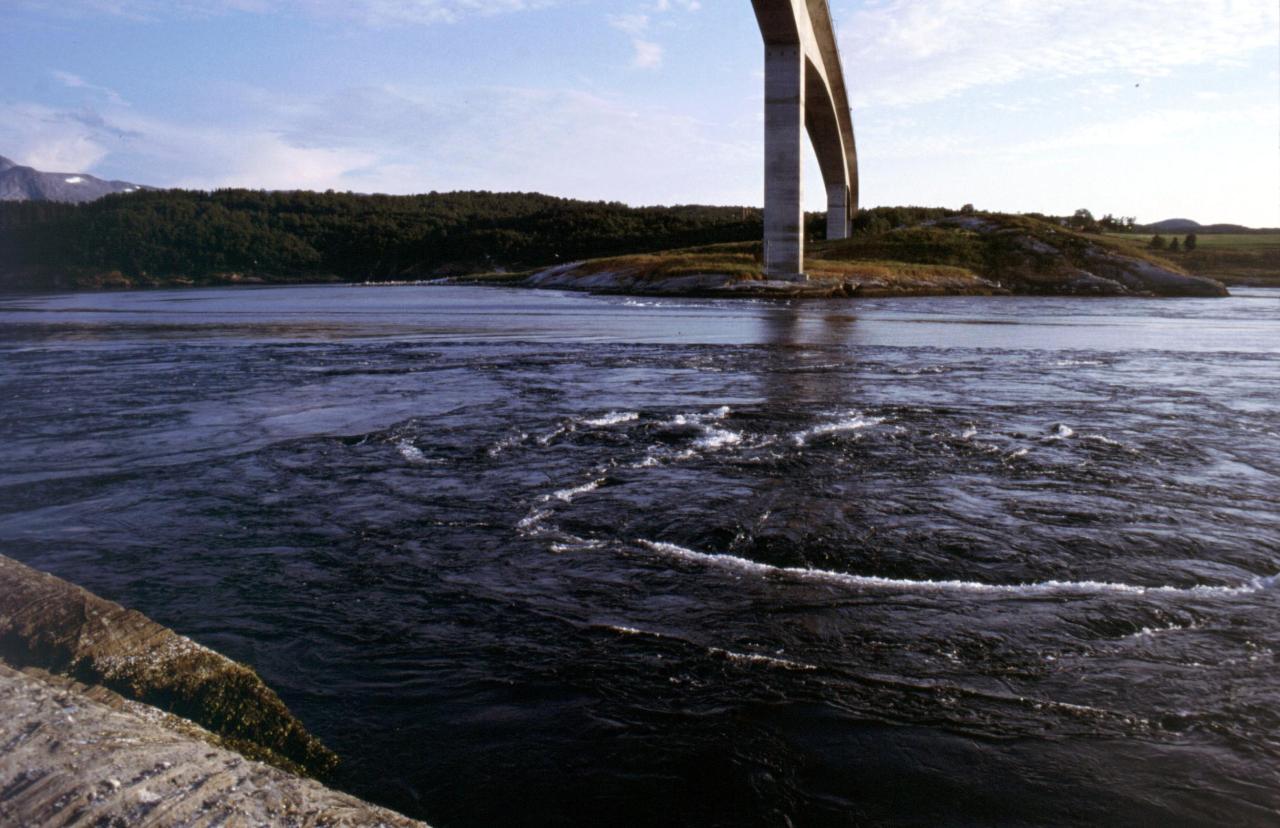
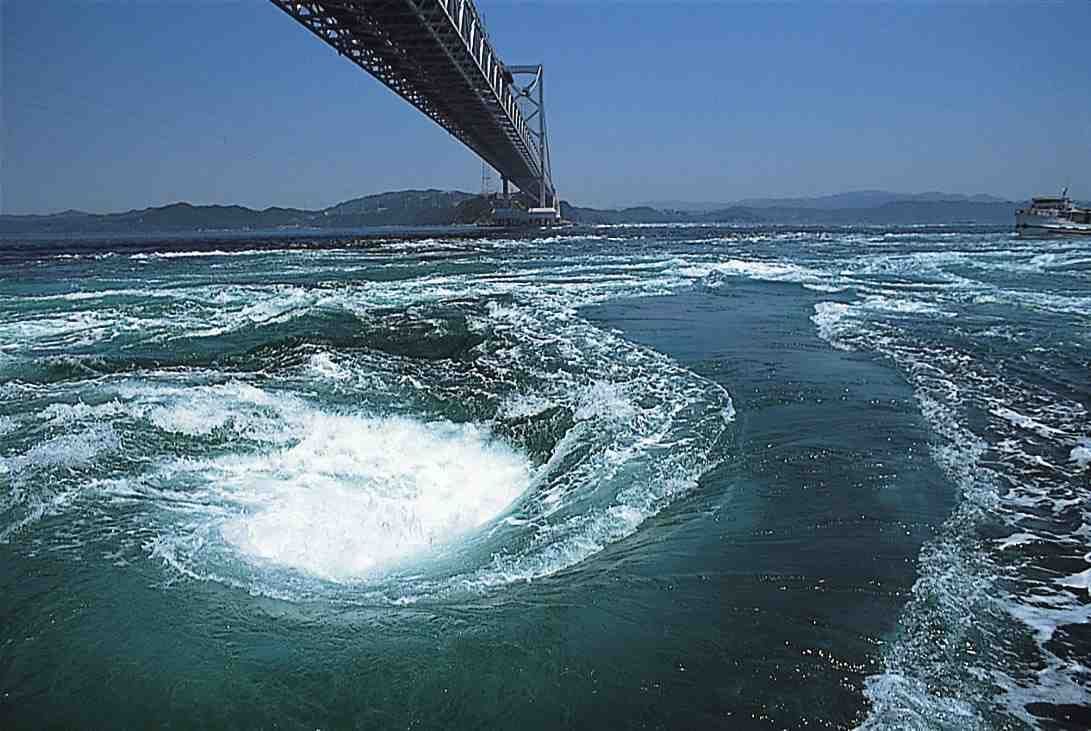
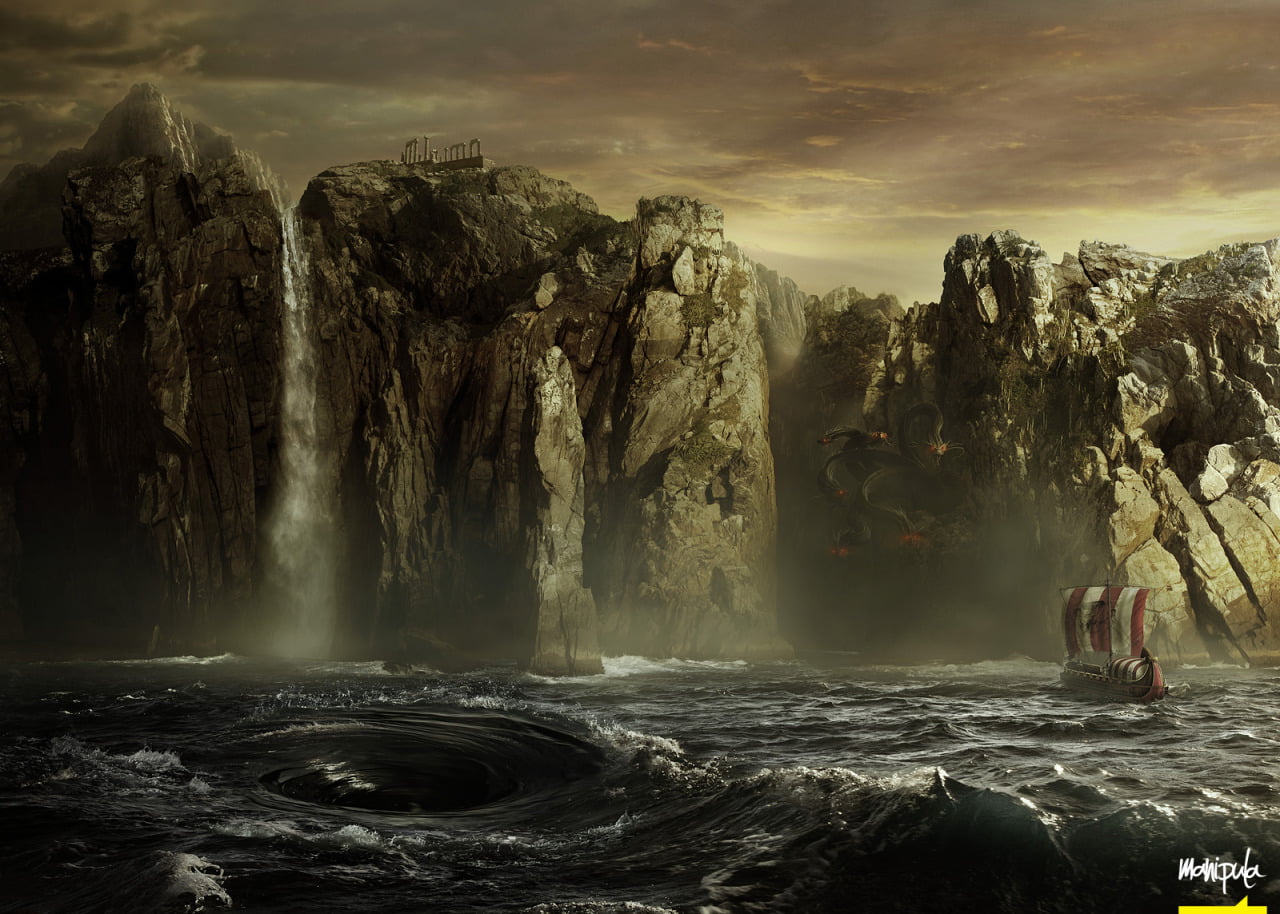
Literature is full of descriptions of monstrous whirlpools like Charybdis, which threatens Homer’s Odysseus. While it’s not unusual to see a small free vortex in bodies of water, most people would chalk boat-swallowing maelstroms up to literary device. But it turns out that, while there may not be permanent Hollywood-style whirlpools, there are several places in the world where the local tides, currents, and topology combine to produce turbulence, dangerously vortical waters, and even standing vortices on a regular basis.
One example is the Corryvreckan, between the islands of Jura and Scarba off Scotland. In this narrow strait, Atlantic currents are funneled down a deep hole and then thrust upward by a pinnacle of rock that rises some 170 m to only 30 m below the surface. The swift waters and unusual topology produce strong turbulence near the surface and whirlpools pop up throughout the strait. Other “permanent” maelstroms, such as those in Norway and Japan, arise from tidal interactions with similar structures rising from the sea floor.
For more, check out this Smithsonian article, Gjevik et al., Moe et al., and the videos linked above! (Photo credits: Manipula, Tokushima Gov’t, Wikimedia, and W. Baxter; requested by @kb8s)

Lift on a Paper Plane
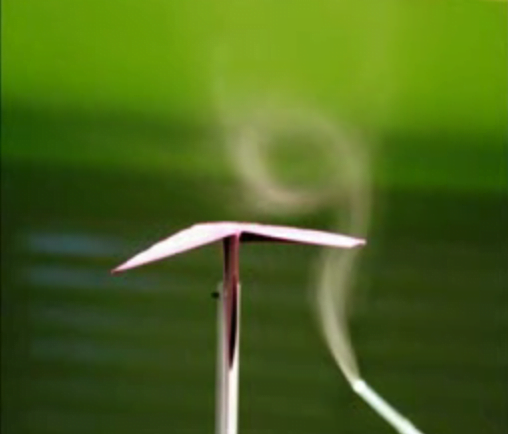
In this still image from a student experiment, smoke visualization shows the formation of a vortex over the wing of a paper airplane during a wind tunnel test. This wing vortex is mirrored on the opposite wing, though there is no smoke to show it. At high angle of attack, the delta-wing shape of the traditional paper air plane creates these vortices on the upper surface, which helps generate the lift necessary to keep the plane aloft. (Photo credit: A. Lindholdt, R. Frausing, C. Rechter, and S. Rytman)

Pancake Vortex
In large-scale geophysical flows, rotation and density gradients often play major roles in the structures that form. Here the UCLA SPINLab demonstrates how large, essentially flat vortices–pancake vortices–form in rotating, stratified fluids. The stratification, in this case, is due to the density difference between salt water and fresh water; salt water is denser and therefore less buoyant, so it sinks toward the bottom of the tank. Note how the pancake vortex only forms when the fluid is both stratified and rotating. If it lacks one of the two, the structures will be very different. (Video credit: O. Aubert et al./SPINLab UCLA)

Saturn’s Polar Vortex
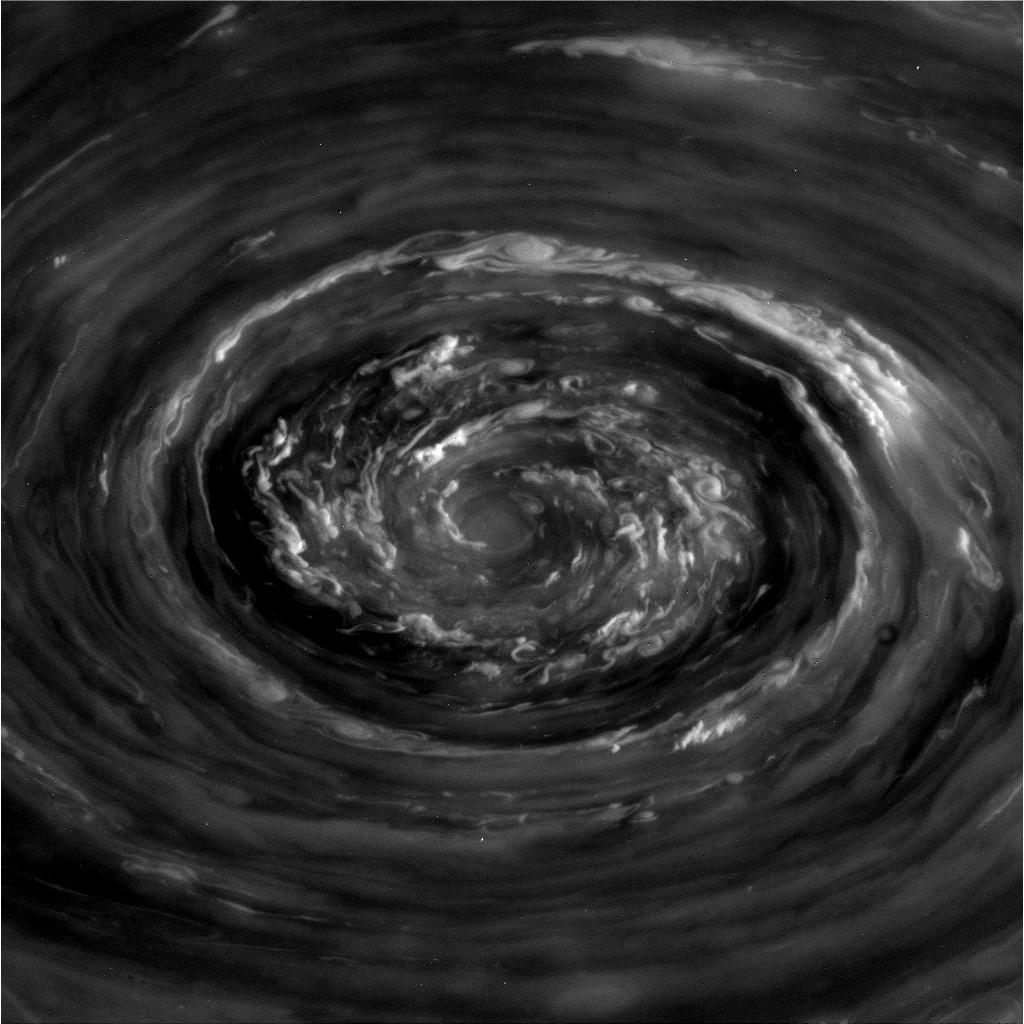
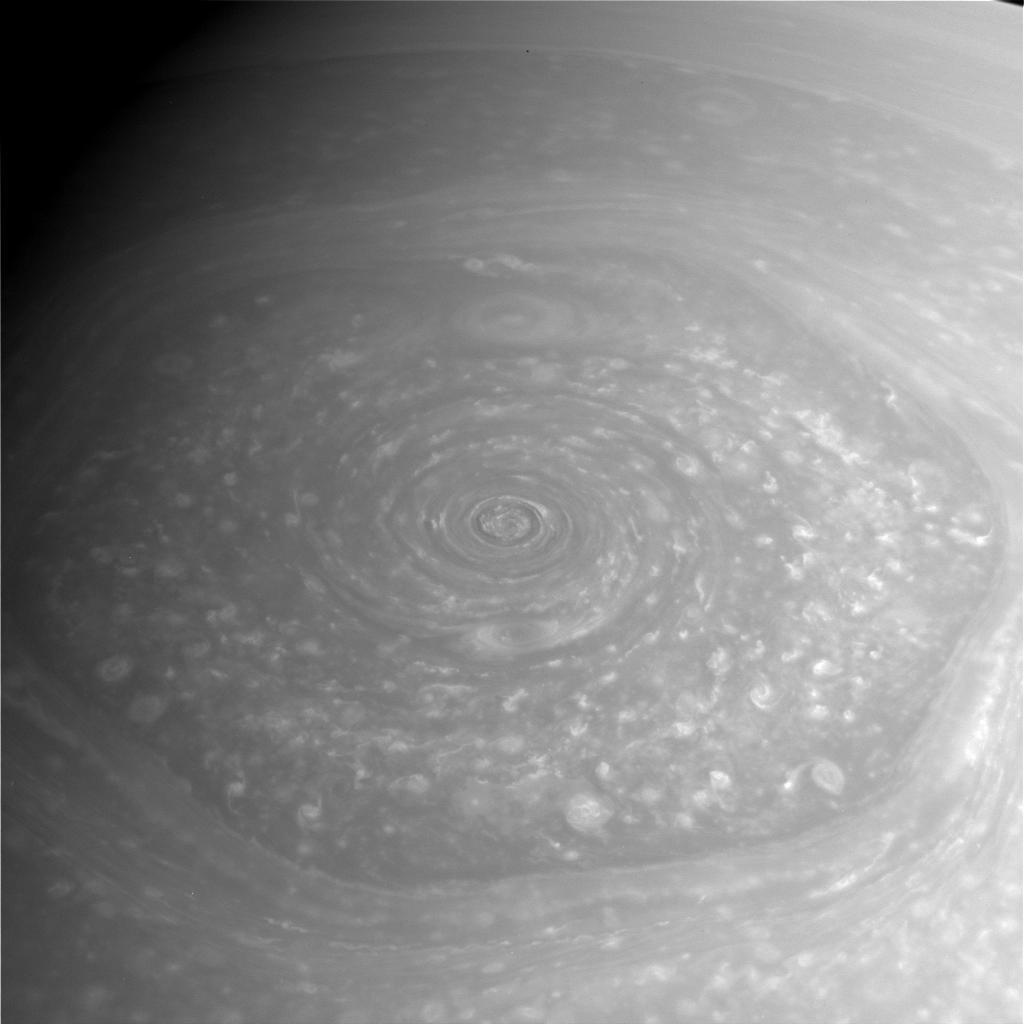

Nothing quite compares to the beauty of fluid dynamics on astronomical scales. What you see here are raw photographs of recent storms at Saturn’s north pole. The recent change in Saturnian seasons has afforded Cassini a sunlit view of the northern pole, which had previously lain in darkness. A roiling vortex filled with clouds being twisted and sheared was revealed near the center of its famed polar hexagon. (Photo credit: NASA/JPL-Caltech/Space Science Institute; submitted by J. Shoer)
Superfluid Vortices
Cooling helium to a few degrees Kelvin above absolute zero produces superfluid helium, a substance with some very bizarre behaviors caused by a lack of viscosity. Superfluids exhibit quantum mechanical properties on a macroscopic scale; for example, when rotated, a superfluid’s vorticity is quantized into distinct vortex lines, known as quantum vortices. These vortices can be visualized in a superfluid by introducing solid tracer particles, which congregate inside the vortex line, making it appear as a dotted line, as shown in the video above. When these vortex lines approach one another, they can break and reconnect into new vortices. These reconnections provoke helical Kelvin waves, a phenomenon that had not been directly observed until the present work by E. Fonda and colleagues. They are even able to show that the waves they observe match several proposed models for the behavior. (Video credit: E. Fonda et al.)

Those Funny Fins on Airplane Wings
Ever look out an airplane’s window and wondered why a row of little fins runs along the upper side of the wing? These vortex generators help prevent a wing from stalling at high angle of attack by keeping flow attached to the surface. Airflow over the vanes creates a tip vortex that transports the higher-momentum fluid from the freestream closer to the wing’s surface, increasing the momentum in the boundary layer. As a result of this momentum exchange, the boundary layer remains attached over a greater chordwise distance. This also increases the effectiveness of trailing-edge control surfaces, like ailerons, on the wing. (Photo credit: Mark Jones Jr.)

The Backward-Facing Step
This photo collage shows vortices shed off a backward-facing step. The flow is left to right. Here the flow is visualized using dye released in water. Initially, the vortex forms near the bottom of the step in the recirculation zone. Because flow over the top of the vortex is much faster than the flow beneath the vortex, a low pressure zone forms over the vortex and gradually draws it up toward the top of the step. Eventually the vortex will rise to the point where the upstream flow pushes it downstream and the process begins anew. (Photo credit: Andrew Carter, University of Colorado)
Wingtip Vortices
Any finite length wing produces wingtip vortices–potentially intense regions of rotational flow downstream of the wing’s ends. These vortices are associated both with the production of lift on the wing and with unavoidable induced drag. The tabletop demonstration above shows the region of the vortices’ influence and how strong the rotation is there. Note also that the two vortices have opposite rotational senses–the left side induces a clockwise rotation, whereas the right side induces an anti-clockwise rotation. The larger an aircraft, the stronger and longer lasting its vortices; this can be a source of danger for smaller aircraft passing through the wake. If a pilot crosses one wingtip vortex and overreacts to compensate, crossing the second counter-rotating vortex can cause even greater damage.