Tag: vortex

  • Reader Question: Wave Vortex

    Reader Question: Wave Vortex

    Reader unquietcode asks:

    I saw this post recently and it made me wonder what’s going on. If you look in the upper right of the frame as the camera submerges, you can see a little vortex of water whirring about. Even with the awesome power of the wave rolling forward a little tornado of water seems able to stably form. Any idea what causes this phenomenon?

    This awesome clip was taken from John John Florence’s “& Again” surf video. What you’re seeing is the vortex motion of a plunging breaking wave. As ocean waves approach the shore, the water depth decreases, which amplifies the wave’s height. When the wave reaches a critical height, it breaks and begins to lose its energy to turbulence. There are multiple kinds of breaking waves, but plungers are the classic surfer’s wave. These waves become steep enough that the top of the wave  overturns and plunges into the water ahead of the wave. This generates the vortex-like tube you see in the animation. Such waves can produce complicated three-dimensional vortex structures like those seen in this video by Clark Little. Any initial variation in the main vortex gets stretched as the wave rolls on, and this spins up and strengthens the rib vortices seen wrapped around the primary vortex. (Source video: B. Kueny and J. Florence)

  • Featured Video Play Icon

    Stirring Up

    When a viscoelastic non-Newtonian fluid is stirred, it climbs up the stirring rod. This behavior is known as the Weissenberg effect and results from the polymers in the fluid getting tangled and bunched due to the stirring. You may have noticed this effect in the kitchen when beating egg whites. In this video, researchers explore the effect using rodless stirring. The first example in the video shows a viscous Newtonian fluid being stirred. The stirring action creates a concave shape in the glycerin-air interface, and dye injection shows a toroidal vortex formed over the stirrer. Fluid near the center of the vortex is pulled downward and circulates out to the sides. In contrast, the viscoelastic fluid bulges outward when stirred. Dye visualization reveals fluid being pulled up the center into the bulge. It then travels outward, forming a mushroom-cap-like shape before sinking down the outside. This is also a toroidal vortex, but it rotates opposite the direction of the Newtonian one. Exactly how the polymers create this change in flow behavior is a matter of active research. (Video credit: E. Soto et al.)

  • Featured Video Play Icon

    Australian Fire Tornado

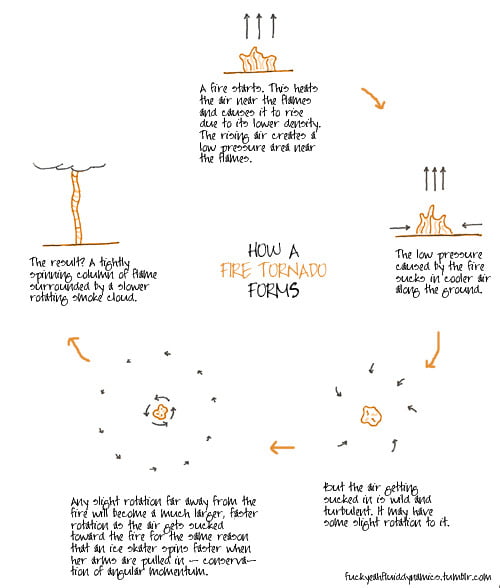
    The fire tornado is one of nature’s most impressive and terrifying examples of fluid dynamics. Although they are relatively common phenomena, it’s rare to get such a clear glimpse of them since they usually occur in the midst of giant wildfires. The fire tornado is driven by a combination of updraft from the fire and rotation from the surrounding flow. Take a look at how they form:

    There are artificial fire tornadoes as well, including homemade ones. That said, please do not try this at home without full safety measures and extreme caution. In general, watching YouTube videos is a much safer way to enjoy this phenomenon. (Video credit: C. Tangey; h/t to Flow Visualization)

  • Snow Rollers

    Snow Rollers

    Snow rollers are nature’s snowballs, formed when high winds roll a chunk of snow along the surface, allowing it to accumulate more and more material. They occur relatively rarely because their appearance is the culmination of several specific meteorological factors. To form rollers, the ground needs to be icy, with a layer of loose, wet snow above the ice. And, of course, it needs to be windy enough to move the snow without being so windy that snow breaks up. In the photos above, the snow roller got too large for the wind to continue moving it, but the wind didn’t stop blowing. Instead, the snow roller became an obstacle to the flow and a horseshoe vortex formed at its base. The spinning of the vortex dug out the trench in front of and along the sides of the snow roller. This same effect is often seen on the windward side of trees in winter. (Photo credit and submission: S. Benton) 

  • Featured Video Play Icon

    North Dakota Ice Disk

    Cold weather can create some wild fluid dynamics, so pay attention to your local rivers and waterfalls during the next cold snap. The video above comes from North Dakota where a combination of cold dense air and a stable river eddy created a spinning ice disk, roughly 16 meters in diameter. The disk forms as a collection of ice chunks–not one solid, spinning piece–because the ice formed gradually. As ice pieces form, they get caught in the river eddy and begin to spin as part of the disk, rather like dust and ice do in the rings of Saturn. Such formations are rare but not unheard of; here’s a video showing a similar disk as it grows. (Video credit: G. Loegering; via Yahoo and io9; submitted by Simon H and John C)

  • Dynamic Stall

    Dynamic Stall

    In nature, birds and other flying animals often use unsteady flow effects to enhance the lift their wings generate. When a wing sits at a high angle of attack, it stalls; the flow separates from the upper surface, and its lift force is suddenly lost. If, on the other hand, that wing is in motion and pitching upward, lift is maintained to a much higher angle of attack. The reason for this is shown in the flow visualization above. This montage shows a rectangular plate pitching upwards. Flow is left to right. Each row represents a specific angle of attack and each column shows a different spanwise location on the plate. As the plate pitches upward, a vortex forms and grows on the leading edge of the plate. Eventually, the leading-edge vortex separates, but not until a much higher angle of attack than the plate could sustain statically. This effect allows birds to maintain lift during perching maneuvers and is also key to helicopter rotor dynamics. (Image credit: K. Granlund et al.)

  • Hydraulic Bumps

    Hydraulic Bumps

    If you’ve ever noticed the circular jump in your kitchen sink when you turn on the faucet, you’re familiar with what a jet does when it plunges into a horizontal layer of liquid. If the liquid is deep enough, the jet will perturb the surface into a circular depression, as in Figure (a) above. As the flow rate increases, a recirculating vortex ring and hydraulic bump forms (Figure b photo and flow schematic). At a critical flow rate, the bump will become unstable and form polygons instead of circles. At even larger flow rates, the system will shift toward a hydraulic jump, with a larger change in fluid elevation. Like bumps, these jumps can also appear in a variety of shapes. (Image credit: M. Labousse and J. W. M. Bush)

  • The Bathtub Vortex

    The Bathtub Vortex

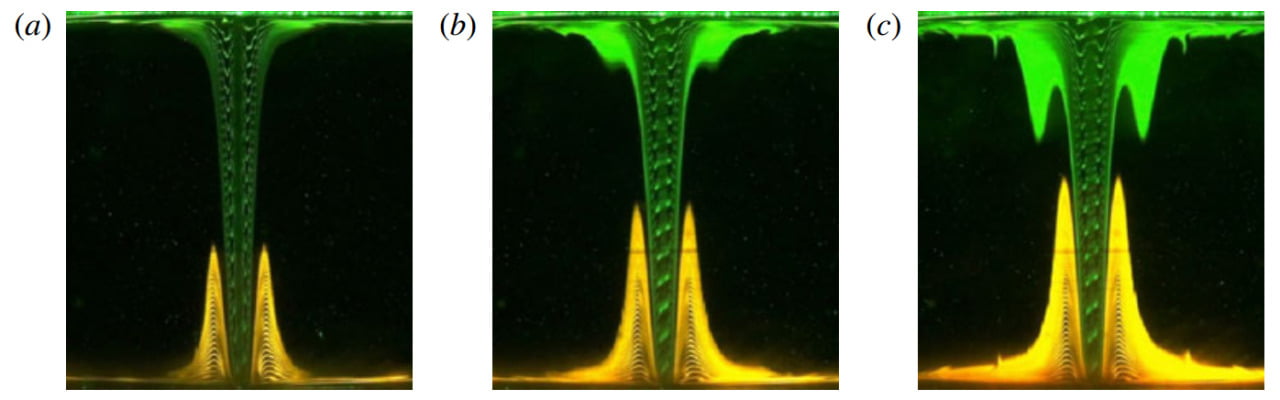
    If you’ve ever watched a swirling vortex disappear down the drain of your bathtub and wondered what was happening, you’ll appreciate these images. This dye visualization shows a one-celled bathtub vortex, created by rotating a cylindrical tank of water until all points have equal vorticity before opening a drain in the bottom of the tank. A recirculating pump feeds water back in to keep the total fluid mass constant. Once a steady vortex is established, green dye is released from the top plate of the tank and yellow dye from the bottom. The green dye quickly marks the core of the vortex. Ekman layers–similar to the boundary layers of non-rotating flows–form along the top and bottom surfaces, and the yellow dye is drawn upward in a region of upwelling driven by Ekman pumping. (Photo credit: Y. Chen et al.)

    Just a reminder for those at Texas A&M University: I will be giving a talk today Wednesday, October 2nd entitled “The Beauty of the Flow” as part of the Applied Mathematics Undergraduate Seminar series at 17:45 in BLOC 164.

  • Ig Nobel Fluids: Shower Curtain Science

    Ig Nobel Fluids: Shower Curtain Science

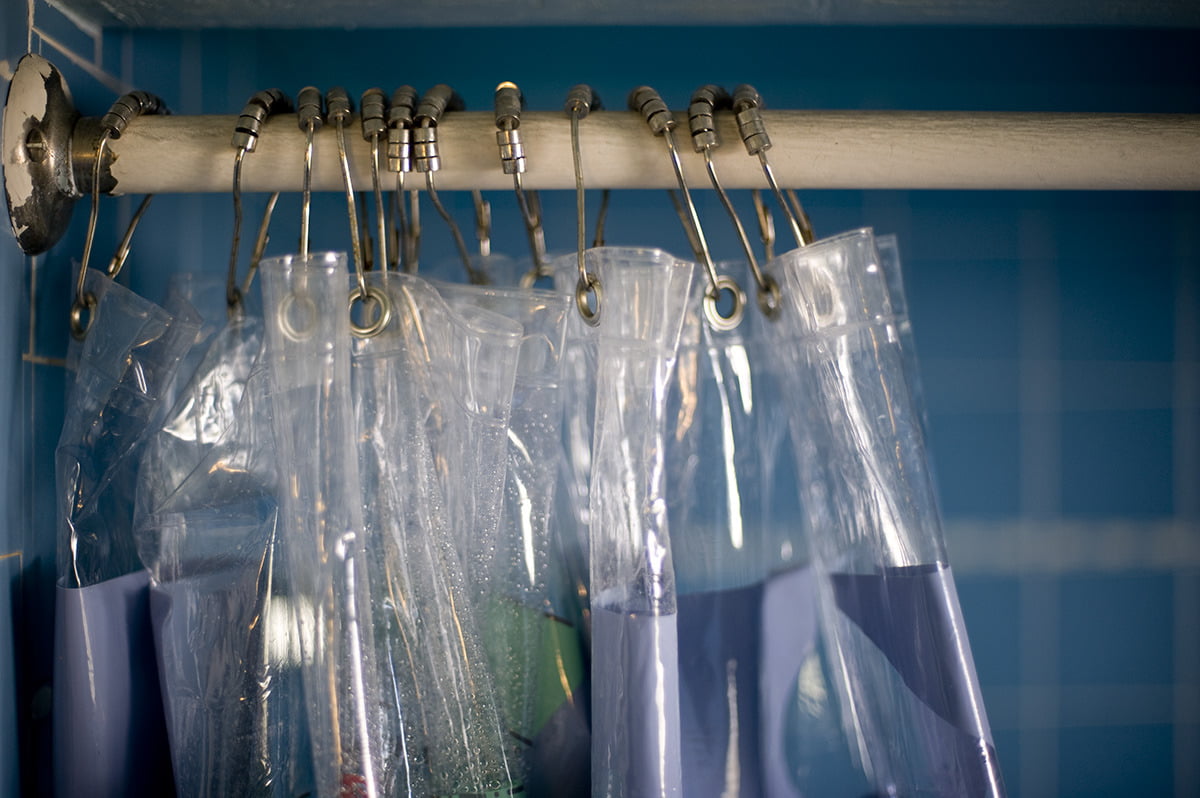
    Nearly everyone has faced the frustration of a shower curtain billowing inwards to stick to one’s leg. Various explanations have been offered to explain the effect, but David Schmidt won the 2001 Ig Nobel Prize in Physics for a numerical simulation suggesting that the spray of droplets from the shower head drives a horizontal vortex whose axis of rotation is perpendicular to the shower curtain. Since vortices have a low-pressure region in their core, this weak shower vortex has the power to suck a light curtain inward, much to the chagrin of the shower’s occupant. Of course, a heavier or weighted shower curtain will help avoid the effect. This post is part of a series on fluids-related Ig Nobel Prizes. (Photo credit: W. Taylor; research credit: D. Schmidt)

  • Flow Over a Delta Wing

    Flow Over a Delta Wing

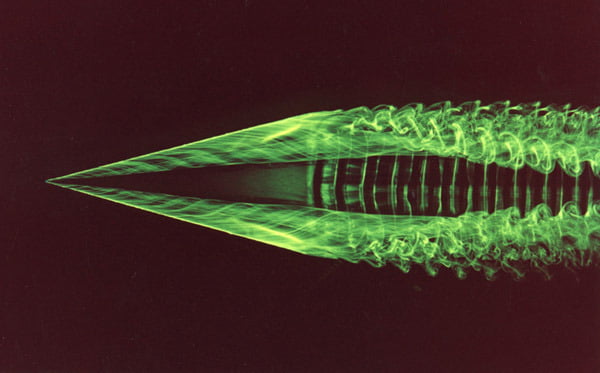
    Fluorescent dye illuminated by laser light shows the formation and structure of vortices on a delta wing. A vortex rolls up along each leading edge, helping to generate lift on the triangular wing. As the vortices leave the wing, their structure becomes even more complicated, full of lacy wisps of vorticity that interact. Note how, by the right side of the photo, the vortices are beginning to draw closer together. This is an early part of the large-wavelength Crow instability. Much further downstream, the two vortices will reconnect and break down into a series of large rings. (Photo credit: G. Miller and C. Williamson)