Tag: vortex

  • Tip Vortices

    Tip Vortices

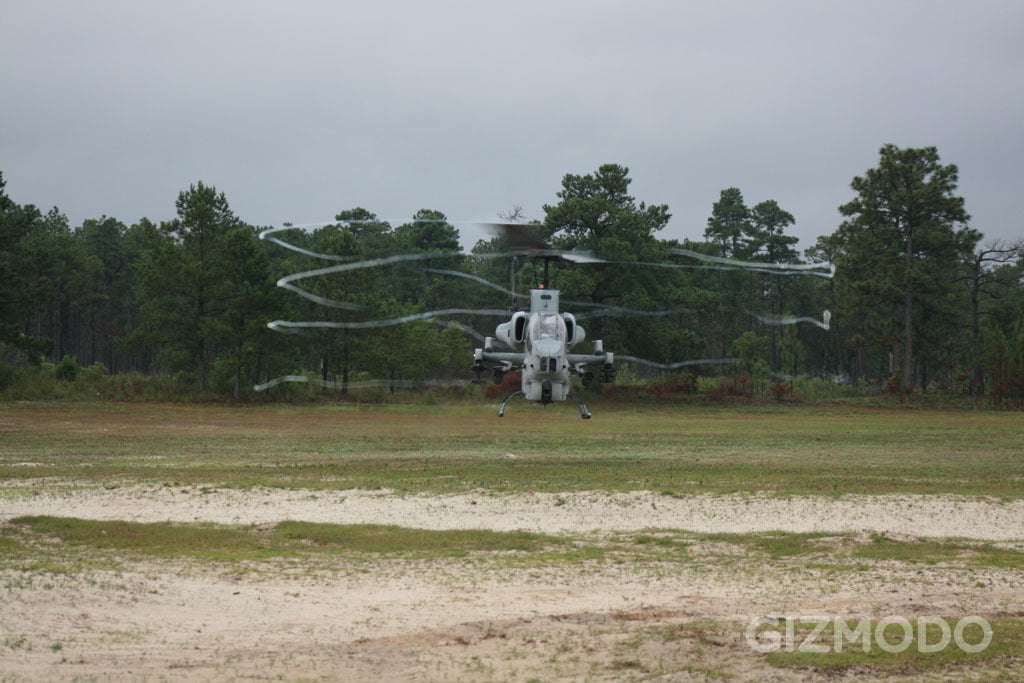
    Like airplane wings, helicopter blades have tip vortices. In this photo, the air’s humidity was great enough that the acceleration caused by the passing of the blades caused a pressure drop great enough to condense the moisture, making the tip vortices visible to the naked eye. (See also Prandlt-Glauert singularity.)

    Photo credit: Gizmodo.

  • The Silence of Owls

    The Silence of Owls

    Owls are among the most silent hunters in nature, thanks to their feathers. The leading edge of the wing, shown in the bottom part of the photo, has a serrated comb-like edge, which breaks flow over the wing into small vortices, which are quieter than larger ones. The fringe-like trailing edge breaks the flow up further and helps absorb the sound produced by the turbulence. The fluffy feathers along the owl’s body can also help muffle noise. Researchers are investigating ways to use these techniques to quiet aircraft. # (via jshoer)

  • Featured Video Play Icon

    Steam Devils

    The formation of the ethereal steam devil is quite similar to the formation of a fire tornado. In this case, the first frost of the season cooled air temperatures substantially below the temperature of the water of the lake, creating conditions for steam and for updrafts of rising, warmer air. A slight breeze across the lake is enough to create pockets of vorticity, which stretch due to the updrafts and intensify due to conservation of angular momentum. This creates the narrow spinning vortex filaments that pull steam up and dance across the lake’s surface. #

  • Wingtip Vortices in Ground Effect

    Wingtip Vortices in Ground Effect

    In this flow visualization, wingtip vortices from an aircraft have been simulated using an apparatus with a couple of flaps that snap together like a book closing. Dye is pooled on the “ground” below the flaps and gets entrained by the vortices and lit up using laser light. The red vortices are the primary vortex generated by the aircraft wingtips and the green ones are secondary vortices generated by interaction with the ground. The lower half of the picture is a reflection off the ground. This photo was part of the 2009 Gallery of Fluid Motion. #

  • Featured Video Play Icon

    How to Blow Bubble Rings

    Next time you’re at the pool, join the dolphins, moss, and volcanoes in blowing vortex rings. Here’s how: first, squeeze your lips like you’re going to give someone a kiss. Second, increase the air pressure in your mouth. Then quickly open and close your lips so a small amount of air pops out. It can require some practice, not even dolphins learn the trick right away. #

  • Featured Video Play Icon

    Volcanic Vortex Rings

    Plants and dolphins are not the only ones in nature creating vortex rings. Volcanoes are known to produce them as well. The vortex ring forms when gas is rapidly expelled from the volcano (much the same way as with a vortex cannon); the rings are visible in the video above because smoke has been entrained into the vortex.

  • Vortex Shedding

    Vortex Shedding

    Whenever a bluff (i.e. non-aerodynamic) body is placed in a flow of sufficient Reynolds number, it will shed periodic vortices, creating a pattern known as a von Karman vortex street. The animation above shows the phenomenon in the wake of a cylinder, but vortex streets form behind many other bodies as well, including islands. Each vortex shed causes forces on the body and alternating vortices can cause the body to vibrate. This is what causes suspended power lines to “sing” in the wind. #