As a followup to yesterday’s question about ways to explain lift on an airfoil, here’s a video that explains where the circulation around the airfoil comes from and why the velocity over the top of the wing is greater than the velocity around the bottom. Kelvin’s theorem says that the circulation within a material contour remains constant for all time for an inviscid fluid. Before the airplane moves, the circulation around the wing is zero because nothing is moving. As shown in the video, as soon as the plane moves forward, a starting vortex is shed off the airfoil. As the plane flies, our material contour must still contain the starting position and thus the starting vortex. However, in order to keep the overall circulation in the contour zero, the airfoil carries a vortex that rotates counter to the starting vortex. This is the mechanism that accelerates the air over the top of the wing and slows the air around the bottom. Now we can apply Bernoulli’s principle and say that the faster moving air over the top of the airfoil has a lower pressure than the slower moving air along the bottom, thus generating an upward force on the airfoil. (submitted by jessecaps)
Tag: vortex

Toroidal Vortex
When instabilities exist in laminar flow, they do not always lead immediately to turbulence. In this video, a viscous fluid fills the space between two concentric cylinders. As the inner cylinder rotates, a linear velocity profile (as viewed from above) forms; this is known as Taylor-Couette flow. If any tiny perturbations are added to that linear profile–say there is a nick in the surface of one of the cylinders–the flow will develop an instability. In this type of flow, an exchange of stabilities will occur. Rather than transitioning to turbulence, the fluid develops a stable secondary flow–the toroidal vortex highlighted by the dye in the video. If the rotation rate is increased further other instabilities will develop.

Hurricane Irene
This August 25th satellite image shows Hurricane Irene over the Bahamas and Florida. Hurricanes are fueled largely by the release of heat as warm water vapor in the rising air condenses. The hurricane requires a body of warm water to sustain the process, which is why hurricanes weaken drastically after they make landfall. Over open water, the heat released by condensation fuels higher winds, which lowers the pressure at the center of the system and helps increase the rate of evaporation near the ocean surface, providing additional warm vapor for future condensation. See more photos of Irene from space, along with video from the ISS. #
Starting Vortices
Whenever a wing stops or starts in a fluid, it produces a vortex. This 2D numerical simulation shows an airfoil repeatedly starting and stopping, shedding a vortex each time. Note how the line of vortices drifts downward in the wake; this is an indication of downwash. (submitted by jessecaps)

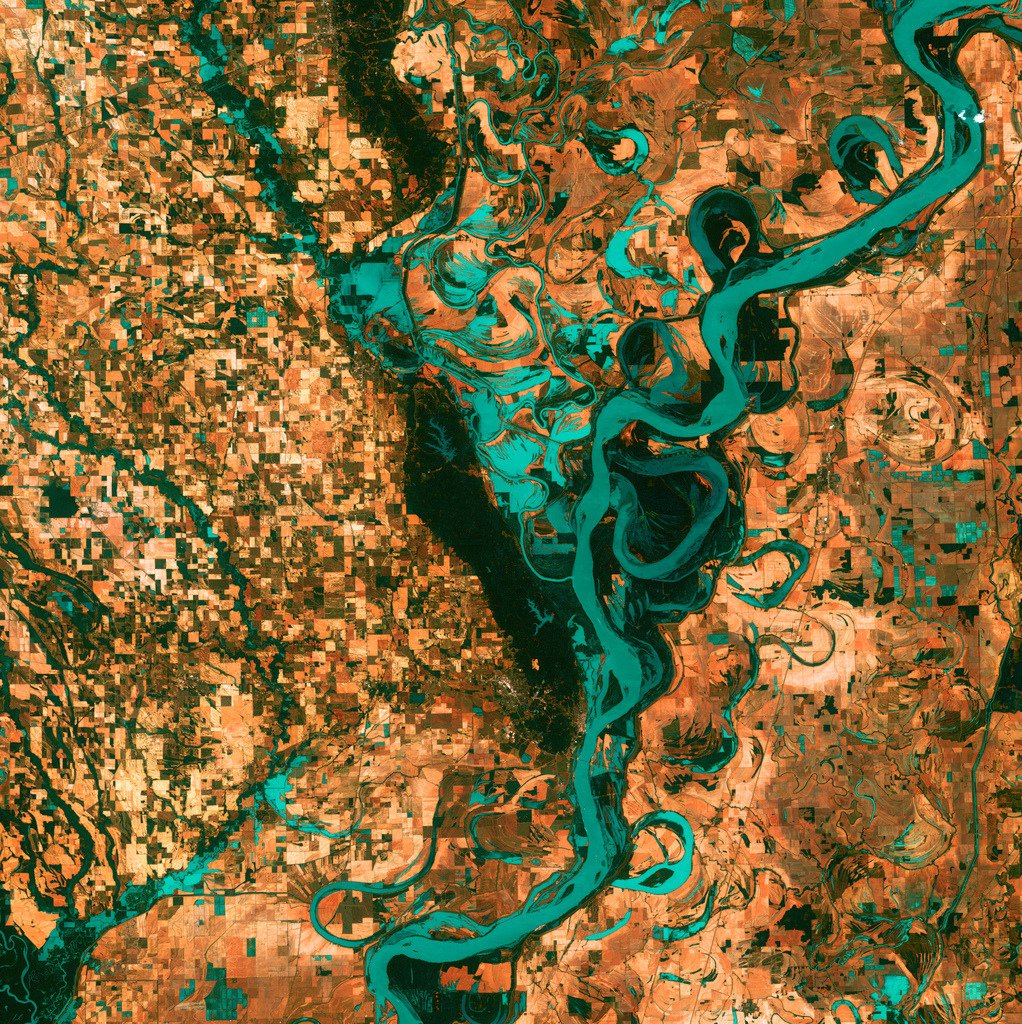
Meandering Mississippi
This satellite photo of the Mississippi River south of Memphis, TN shows how the river’s course has changed over time. When a river bends, the water near the inner bank flows faster than the water by the outer bank. This difference in speeds actually creates a vortical secondary flow in the boundary layer of the river that erodes sediment from the outer bank and deposits it on the inner bank. This increases the meander of the river bend. If this continues long enough, the river bend can get pinched off into an oxbow lake, like the ones scattered to either side of the current river path.
Earthquake-induced Whirlpool
In the wake of the 8.9-magnitude earthquake that hit Japan today, a massive whirlpool has appeared off the coast. It does not appear to have a downdraft, so it’s not a true vortex; it looks as though the residual energy released from the quake has caused circulation in this region.

Discovery Wingtip Vortices
Wingtip vortices mark the path of Discovery as she makes her final landing. Though not always visible, these vortices are generated by any lifting body planform and can be a major source of induced drag on the craft. Here the vortices are visible because the low pressure in the core of the vortex caused a local temperature drop below the dew point, thus causing condensation. Such vortices persist for significant lengths of time in the wake of aircraft; they are a major source of wake turbulence, which limits how frequently aircraft can take-off or land on a single runway. (Photo by Jen Scheer)

Wake of a Rising Sphere
This flow visualization shows the wake left by a freely rising sphere. Observations of rising and falling spheres date at least back to Newton, who observed that the inflated hog bladders he used “did not always fall straight down, but sometimes flew about and oscillated to and fro while falling”. That vibration is caused by the vortices seen here in the wake. There are actually four vortices shed per oscillation cycle–two primary vortices (marked P) and two secondary vortices (marked S). #

Vortex Street
A flow visualization behind a cylinder shows the formation of a von Karman vortex street. The frequency of vortex shedding in the wake is directly related to the speed of the airflow–the higher the velocity, the faster vortices will shed from the cylinder. This relationship is expressed in the Strouhal number, which remains constant for any cylinder. (via freshphotons)