Tag: vortex

  • Vortex Cross-Sections

    Vortex Cross-Sections

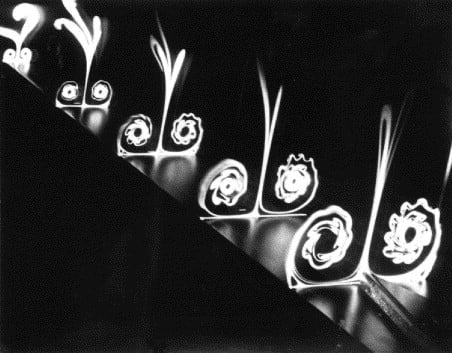
    The photos above show cross-sections through the leading edge vortices on a highly swept delta wing at angle of attack.  Flow in the photos is from the upper left to lower right. Notice how the vortices grow and develop waviness as they move downstream. When perturbations enter the vortex–for example, due to the shear between the vortex fluid and the freestream–some will grow and eventually cause a break down to turbulence, as in the lower picture. (Photo credits: R. Nelson and A. Pelletier)

  • Featured Video Play Icon

    How Maple Seeds Fly

    Maple tree seeds flutter and spin as they descend. The above video, which shows flow visualization of a freely falling seed, demonstrates that the so-called helicopter seed’s autorotation creates a vortex along the leading edge.  Watch as the seed’s “wing” sweeps through and you will notice the vortex along the upper surface. This leading edge vortex generates high lift on the maple seed, allowing it to stay in the air more effectively than other seeds, thereby increasing the maple’s reproductive range. (Video credit: D. Lentink et al.; see also Supplemental Materials)

  • Titan’s Vortex

    Titan’s Vortex

    The timelapse animation above shows a swirling vortex above the south pole of Saturn’s moon Titan. It completes a full rotation in about nine hours, significantly quicker than the 16-day rotation of the moon. The vortex appears to demonstrate open cell convection, in which air sinks at the center of the cell and and rises at the edges to form clouds along the cell edges.  For the most part the dense haze of Titan’s atmosphere prevents scientists from seeing what goes on beneath the clouds, but Titan is thought to have weather cycles similar to Earth’s, except featuring methane rather than water. (Photo credit: NASA, Cassini; submitted by Adam L)

    ETA: This theme sometimes dislikes displaying .GIF images. If you don’t see the animation, click here.

  • Featured Video Play Icon

    Fire Tornado

    An artificial fire tornado makes for fascinating viewing. The box fans are positioned around a central firepit such that they impart the angular velocity needed to create a vortex. I’ve actually seen an even bigger live demonstration than this one at a fluid dynamics conference.  Do not try this yourself. Fire tornadoes occur in nature, too: take a look at how they form. (submitted by acervant)

  • Sunset Vortices

    Sunset Vortices

    Wingtip vortices roll up in the wake of this U.S. Coast Guard C-130J. At the edge of a wing high-pressure, low velocity air is able to creep around the edge of the wingtip toward the low-pressure, high-velocity air atop the wing. This creates a swirling vortex that trails behind each wing, made visible here by the clouds entrained in the plane’s wake.  Over time, these counter-rotating vortices will sink downward and break up due to viscosity and instabilities induced by their proximity. (via Aviationist)

  • Featured Video Play Icon

    Antibubbles

    Antibubbles–a liquid droplet surrounded by a thin film of gas and immersed in more liquid–are fragile things.  This video explores how antibubbles behave when placed in proximity to a tornado-like whirl. When placed near the eye, where fluid motion is primarily vertical, the antibubble is stretched vertically.  When placed in the rotating eyewall, the antibubble is distorted into a ring-like shape before it breaks down. (Video credit: D. Terwagne et al; APS Gallery of Fluid Motion 2009)

  • Featured Video Play Icon

    Brine Shrimp Swimming

    For small creatures, swimming is dominated by viscosity. Here researchers use particle image velocimetry (PIV) to explore the flow field around brine shrimp. Its motion is divided into two vorticity-generating phases–the wide power stroke where the shrimp generates most of its forward motion and the recovery stroke where the shrimp returns its starting position while generating as little motion and drag as it can. (Video credit: B. Johnson, D. Garrity, L. Dasi)

  • Featured Video Play Icon

    Tornado in a Bubble

    In this video, a miniature tornado-like vortex is created inside a soap bubble.  Here’s how it works: after the first bubble is formed and the smoke-filled bubble is attached to the outside, he blows into the main bubble, creating a weak angular velocity, before breaking the interface between the two bubbles.  As the smoke mixes in the main bubble, note how it is already spinning slowly due to the free vortex he created. Then, when the top of the bubble is popped, surface tension pulls the bubble’s surface inward. Because the bubble radius is decreasing, conservation of angular momentum causes the angular velocity of the fluid inside to increase, pulling the smoke into a tight vortex, much like a spinning ice skater who pulls her arms inward.

  • Featured Video Play Icon

    Smoke Flow Viz

    Smoke visualization, illuminated by a laser sheet, shows a 2D slice from an axisymmetric jet as it breaks down to turbulence. The flow is laminar upon exiting the nozzle, but the high velocity at the edge of the jet and low velocity of the surrounding air causes shear that leads to the Kelvin-Helmholtz instability. This instability leads to the formation of small vortices that grow as they are advected downstream until they are large enough to interrupt the jet and it breaks down into fully turbulent flow. (Video credit: B. O. Anderson and J. H. Jensen)

  • Featured Video Play Icon

    Supersonic Flow Around a Cylinder

    This numerical simulation shows unsteady supersonic flow (Mach 2) around a circular cylinder. On the right are contours of density, and on the left is entropy viscosity, used for stability in the computations. After the flow starts, the bow shock in front of the cylinder and its reflections off the walls and the shock waves in the cylinder’s wake relax into a steady-state condition. About halfway through the video, you will notice the von Karman vortex street of alternating vortices shed from the cylinder, much like one sees at low speeds. The simulation is inviscid to simplify the equations, which are solved using tools from the FEniCS project. (Video credit: M. Nazarov)