One day calligrapher Mae Nguyen accidentally squeezed a droplet out of her waterbrush pen, and a fun, new technique was born. Nguyen sometimes uses the arrays of droplets to paint and other times blows on them to create colorful splatters, like in the video above. I’d love to see the latter technique, in particular, in slow motion! I expect there is some really cool mixing as the droplets coalesce. Check out more of Nguyen’s work on her website and Instagram account. (Video credit: M. Nguyen)
Tag: physics

Solar Prominence
Near the surface of the sun, the interplay of magnetic fields and plasma flow creates solar prominences that appear to dance. The prominence shown here was recorded in 2012 by the NASA Solar Dynamics Observatory, and its arc is large enough to easily surround the Earth. This is fluid dynamics – specifically magnetohydrodynamics – on a scale difficult for us earthbound humans to imagine. Scientists are still working to understand the complex processes that drive flows like this one. Fortunately, we can appreciate their beauty regardless. (Image credit: NASA SDO, source; via APOD; submitted by jpshoer)

Bubbling
Many chemical reactions produce gases as a stream of bubbles out of a solution. Here we see the electrolysis of an aqueous sodium hydroxide solution (NaOH), which produces hydrogen gas on the cathode (left) and oxygen gas on the anode (right). In timelapse, the gas bubbles nucleate on the electrode, slowly growing larger. Once the the bubbles are large enough to detach, though, they rise so quickly they look like they disappear! The large buoyant forces on them drive that brief journey to the surface. By contrast, the smaller bubbles rise slowly, held back by their lesser buoyancy and the viscous drag they experience. (Video and image credit: Beauty of Science)

Swirls of Color
These beautiful swirls show the wake downstream of a thin plate. Here water is flowing from left to right and dye introduced on the plate (upstream and unseen in the photo) curls up into vortices. The vortices in the top row rotate clockwise, while the vortices along the bottom rotate anti-clockwise. This pattern of alternating vortices is extremely common in the wakes of objects and is known as a von Karman vortex street. Similar patterns are seen in soap films, behind cylinders, in the wakes of islands, and behind spaceships. (Image credit: ONERA, archived here)

Stall with Pitching Foils
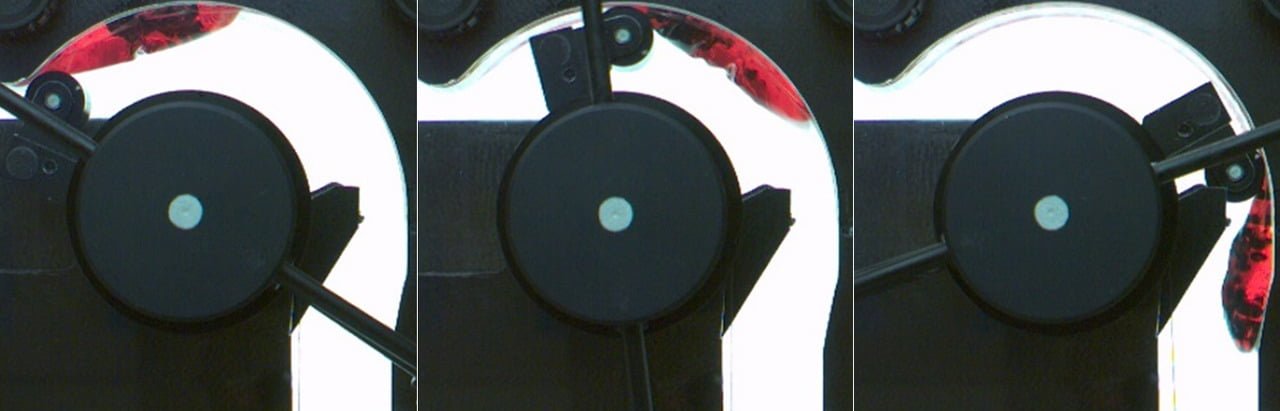
For a fixed-wing aircraft, stall – the point where airflow around the wing separates and lift is lost – is an enemy. It’s the precursor to a stomach-turning freefall for the airplane and its contents. But the story is rather different when the wing is actively pitching through these high angles of attack. In this case, you get what’s known as dynamic stall, illustrated in three consecutive snapshots above.
In the top image, the flow has clearly separated from the upper surface of the wing, but this isn’t a cause for panic. As the middle image shows, there’s a vortex that’s formed in that separated region and it’s moving backward along the wing as the angle of attack continues to increase. That vortex causes a strong low-pressure region on the upper surface of the wing, allowing it to maintain lift.
In the final image, the vortex is leaving the wing, taking its low-pressure zone with it. This is the point where the pitching wing loses its lift, but if the vortex’s departure is immediately followed by a pitch down to lower angles of attack, the aircraft will recover lift and carry on. (Image credit: S. Schreck and M. Robinson, source)
Phytoplankton Swirl
During the warm summer months, phytoplankton blooms pop up in waters around the world. This natural-color satellite image shows a bloom in the Gulf of Finland. The tiny phytoplankton serve as tracker particles for the flow, revealing large-scale features like the spectacular vortex in the center of this image. The presence of the phytoplankton here suggests that this vortex could be pumping nutrients up from the deep.
Researchers also use particles for flow visualization. This can be as simple as adding small, neutrally buoyant particles, illuminating smoke, or even using natural snowfall to see what’s happening in the flow. (Image credit: NASA/USGS/J. Stevens/L. Dauphin)

Ants Avoid Traffic Jams by Giving Up
Both ants and traffic are well-connected to fluid dynamics, even if they are not, strictly speaking, fluids. As it happens, ant traffic has interesting implications not only for human transit but for avoiding clogs in crowds or when pouring granular materials.
Ants tend to dig narrow tunnels. This helps individual ants recover from potential slips, but it also makes clogging more likely. Researchers studying the behavior of individual ants during tunnel digging found that ants entering the tunnel often turn around without collecting a grain and carrying it away. When they encounter heavy traffic, they simply reverse direction and give up. So 70% of the work of digging was done by only 30% of the ants. This seemingly unfair division of labor actually optimizes the overall traffic flow and work output for the ants as a whole. Without this instinct to turn around and ease the jam, incoming ants would cascade the traffic and worsen the jamming. (Image and research credit: J. Aguilar et al.; see also Physics Today)

Settling in Straws
At some point in your life, you’ve probably stuck your finger over the end of a straw and used it to pick up the liquid you’re drinking. If you lift the straw so that the end is still in your drink and remove your finger from the top, the liquid level in the straw will drop, then bounce up and down a couple times before it settles. This is what we see happen in the series of snapshots in the top image. Eventually, the liquid level settles at its equilibrium position, marked by the red arrow at the far right.
The liquid has to bounce before settling because capillary forces and the liquid’s inertia are battling it out moment by moment. Just how long the rebound takes depends on the initial height of the fluid and the depth the straw is immersed at, but it doesn’t depend on the fluid’s viscosity. Lower viscosity fluids do sometimes have a neat jet (bottom image) that forms at the immersed end of the straw, though. (Image and research credit: J. Marston et al.)

Oobleck Under Impact
Fluids like air and water are Newtonian, which means that the way they deform does not depend on how the force on them gets applied. Many other fluids, however, are non-Newtonian. How they behave depends on how force is applied to them. The Internet’s favorite non-Newtonian fluid is probably oobleck, a mixture of cornstarch and water with some fairly extreme properties. When deformed quickly, like when struck with a bat, oobleck doesn’t flow; it shatters.
What’s happening at the microscopic level is that the cornstarch particles in the oobleck are jamming together. They simply cannot move quickly and avoid one another. When they jam together, the friction between them goes way up and so does the apparent viscosity of the oobleck. Because it doesn’t have time to flow, all that energy goes into breaking off “solid” chunks instead. Once they hit the ground, the pieces of oobleck will puddle, just like any other liquid. (Image and video credit: Beyond the Press; via Nerdist)

Making Champagne for Space
Humanity’s ongoing quest to enjoy beloved beverages in space has a new entry: champagne. French champagne maker Mumm has announced a new line with specially designed bottles to dispense champagne in microgravity. The bottles feature an internal piston that allows users to release the contents from the bottle in a controlled manner. Rather than pouring the champagne, one dispenses a blob which can then be caught in the special cups that go with it. They’re shaped somewhat like a miniature coupe.
It certainly looks like a fun way to celebrate in microgravity, although it’s unclear to me that they’ve tested the after effects of consumption. Historically, astronauts have avoided carbonated beverages in orbit because the lack of gravity can cause unpleasant side effects with all those bubbles. (Image credits: Mumm Champagne, source; via Wired)