Tag: physics

  • Forming Asteroids

    Forming Asteroids

    Amidst the swirling gas and dust surrounding young stars, asteroids and planets form. Just how these bodies come together – especially before they are massive enough to exert any significant gravitational potential – is an open question. Researchers are trying to better understand the physics involved by studying how clusters of granular material behave when impacted. 

    Above you see footage from two experiments. Both take place in a drop tower under vacuum conditions. That means the effects of air drag and gravity are removed, just like in space. On the left, the cluster is made up of soft clumps of dust; on the right, the cluster contains hard glass beads. Surprisingly, the researchers found that the two different materials behave the same way. They were able to describe both sets of impacts with exactly the same model. This suggests there may be an underlying universal behavior behind all of these granular materials, though the researchers note more experiments are needed. (Image and research credit: H. Karsuragi and J. Blum; via APS Physics)

  • Making Waves in Cold Atoms

    Making Waves in Cold Atoms

    If you take a glass of water and tap on the side of it, you’ll generate waves on the water’s surface. The form of the waves depends on surface tension and gravity, and viscosity governs how quickly the waves fade away. In a recent experiment, researchers performed an equivalent tap for a container of ultra-cold atoms, and the results they found were odd indeed.

    The researchers used lithium-6 atoms chilled so close to absolute zero that they could form a superfluid. The “glass” they were contained in consisted of intersecting laser beams, and the “tap” came from toggling the intensity of one of the lasers. This created rippling waves through the atoms that the group could observe.

    Measuring at various temperatures, the group found that the waves in the atoms always decayed the way one expects for a classical fluid like water. Even when the atoms transitioned into a superfluid, the wave decay did not change. Since superfluids are considered to have zero viscosity, you’d expect their waves to decay more slowly, but it turns out, that’s not the case! (Image credit: F. Mittermeier; research credit: M. Zwierlein et al., see also; via Physics; submitted by Kam-Yung Soh)

  • Featured Video Play Icon

    Rivers in the Sky

    The water cycle is quite a bit more complicated than what we learn in elementary school, and the environment around us contributes to that cycle in invisible but vital ways. In this video, Joe Hanson of It’s Okay to Be Smart pulls back the veil on this in the context of the Amazon river basin and how the Amazon rainforest itself creates an atmospheric river that carries more water than its namesake river.

    Trees release water into the air almost constantly as they transpire. And to trigger that water to fall as rain, trees can release other compounds that serve as a nucleus around which raindrops can form. The condensing raindrops form clouds, which lower the air pressure and create winds, thereby creating an atmospheric river flowing from the Atlantic back up the Amazon River. That stream carries rain that feeds the rainforest and the Amazon River, continuing the cycle. (Video and image credit: It’s Okay to Be Smart)

  • Turbulent Skies

    Turbulent Skies

    The atmosphere above us is a thin layer enclosing our planet, but it roils with activity and energy. Photographer Camille Seamon captures the grandeur of our turbulent skies in her storm shots. These dramatic atmospheric vistas – including mammatus clouds (top), swirling supercells (middle), and turbulent storm clouds (bottom) – are all driven by the flow of heat and moisture. (Image credit: C. Seaman; via Colossal)

  • Growing Droplets

    Growing Droplets

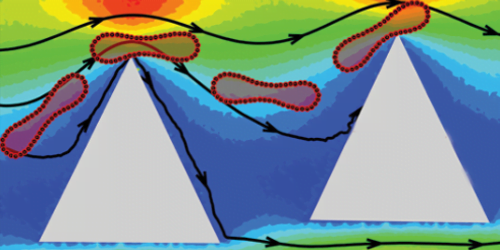
    The moisture in clouds eventually condenses into droplets that grow into raindrops and fall. Some steps in this process are well understood, but others are not. In particular, scientists have struggled with the problem of how droplets grow from about 30 microns to 80 microns, where they’re big enough to start falling and merging.

    Laboratory experiments and numerical simulations (below) have shown that turbulence can help drive small water drops together. When droplets are tiny and light, they simply follow the air flow. But when they’re a little heavier, turbulent eddies (seen in orange below) act like miniature centrifuges, flinging larger water droplets (shown in cyan below) out into clusters, where they’re more likely to collide with one another.

    Although this effect has been seen in experiments and simulation, it’s been difficult to capture in clouds themselves. But a new set of test flights (above) confirms that this mechanism is present in the wild as well! (Image credit: UCAR/NCAR Earth Observing Laboratory, P. Ireland et al., source; research credits: M. Larsen et al., P. Ireland et al.; via APS Physics; submitted by Kam-Yung Soh)
    image
  • Using Instabilities for Manufacturing

    Using Instabilities for Manufacturing

    Manufacturing textured, flexible surfaces can be difficult, but researchers are exploring ways to use fluid dynamical instabilities to make the process easier. They begin with a pourable polymer mixture that cures and solidifies over time. By putting the mixture on a cylinder and rotating it, engineers trigger the Rayleigh-Taylor instability – the same instability that makes dense fluids sink into lighter ones. Here, the instability is driven not only by gravity but by the added acceleration caused by centrifugal force. It causes the fluid film to drain and form arrays of droplets, which then cure into dimples. The researchers can control the size, shape, and spacing of the droplets by changing parameters like the spin rate. And by repeating the process multiple times on the same piece, they can build up spikier shapes, like the ones shown on the poster below. (Image and research credit: J. Marthelot et al., poster)

    image

    Reminder for those at the APS DFD meeting! My talk is tonight at 5:10PM in Room B206. You’ll probably want to come early if you want a seat!

  • Stone Skipping Physics

    Stone Skipping Physics

    The current record for stone-skipping is about 88 skips. For most of us, that’s an unimaginably high number, but according to physicists, human throwers may top out around 300 or 350 skips. In the video above and the accompanying article, Wired reporter Robbie Gonzalez explores both the technique of a world-record-holding skip and the physics that enable it.

    The perfect skip requires many ingredients: a large, flat rock with good edges; a strong throw to spin the rock and hold it steady at the right angle of attack; and a good first contact with the right entry angle and force to set up the skips’ trajectory. The video is long, but it’s well worth a full watch. It gives you an inside look both at a master skipper and at the experts of skipping science. (Video and image credit: Wired; see also: Splash Lab, C. Clanet et al.; submitted by Kam-Yung Soh)

    ETA: Wired’s embed code is acting up, so if you can’t see the stone skipping video here, just go to the article directly.

    Heads up for those going to the APS DFD meeting! You can catch my talk Monday, Nov. 19th at 5:10PM in Room B206. I’ll be talking about how to use narrative devices to tell scientific stories. I’ll be around for the whole meeting, so feel free to come say hi!

  • Sheep as a Compressible Flow

    Not everything that flows is a fluid. And when viewed from above traffic, crowds, and even herds of sheep flow in patterns like those of a fluid. In particular, these conglomerations move like compressible fluids – ones that allow substantial changes in density as they flow. From above, each sheep is just a few pixels of white, but you can see which areas of the herd have the highest density by how white an area looks. The highest density regions also tend to be the slowest moving – not surprising in a crowd.

    Now watch the gates. They act like choke points in the flow and, to some extent, like a nozzle in supersonic flow. As the sheep approach the gate, they’re in a dense, slow moving clump, but as they pass through it, the sheep speed up and spread out. This is exactly what happens in a supersonic nozzle. On the upstream end, flow in the nozzle is subsonic and dense. But once the flow hits the speed of sound at the narrowest point in the nozzle, the opening on the downstream side allows the flow to spread out and speed up past Mach 1.  (Video credit: MuzMuzTV*; submitted by Trent D.)

    *Editor’s Note: I do my best to credit the original producers of any media featured on FYFD, but this is especially difficult with viral videos as there can be many copies, all of which are uncredited. I’ve made my best guess on this one, but if this is your video, please let me know so that I can credit you properly. Thanks!

  • Featured Video Play Icon

    Dinosaurs, Propellers, and Hiding Objects

    The latest FYFD/JFM video is out, and it’s all about the interactions between structures and flows! We learn about plesiosaur-inspired underwater robots, how turbulence affects air-water interfaces, and how adding a tail can help hide an object in a flow. If you missed one of the previous episodes in this series, you can find them all here. (Image and video credit: T. Crawford and N. Sharp)

  • Hovering

    Hovering

    Nectar-drinking species of hummingbirds and bats are both excellent at hovering – one of the toughest aerodynamic feats – but they each have their own ways of doing it. Hummingbirds (bottom) use a nearly horizontal stroke pattern that’s quite symmetric on both the up- and downstroke. To keep generating lift in the upstroke, they twist their wings strongly midway through the stroke. So although hummingbirds get most of their lift from the downstroke, they get quite a bit from the upstroke as well.

    Bats, on the other hand, use an asymmetric wingbeat pattern when hovering. Bats flap in a diagonal stroke pattern, using a high angle of attack in the downstroke and an even higher one during the upstroke. They also retract their wings partially during the upstroke. This flapping pattern gives them weak lift during the upstroke, which they compensate for with a stronger downstroke. Compared to non-hovering bat species, nectar-drinking bats do get more lift during the upstroke, but they’re nowhere near as good as the hummingbirds. The bats compensate by having much larger wings compared to their body size. Bigger wings mean more lift.

    In the end, the two types of hovering cost roughly the same amount of power per gram of body weight. That’s great news for engineers designing the next generation of flapping robots because it suggests two very different, but equally power-efficient methods for hovering. (Image credit: Lentink Lab/Science News, source; research credit: R. Ingersoll et al.; via Science News; submitted by Kam Yung-Soh