
Tag: instability

  • The Best of FYFD 2024

    The Best of FYFD 2024

    Welcome to another year and another look back at FYFD’s most popular posts. (You can find previous editions, too, for 2023, 2022, 2021, 2020, 2019, 2018, 2017, 2016, 2015, and 2014. Whew, that’s a lot!) Here are some of 2024’s most popular topics:

    This year’s topics are a good mix: fundamental research, civil engineering applications, geophysics, astrophysics, art, and one good old-fashioned brain teaser. Interested in what 2025 will hold? There are lots of ways to follow along so that you don’t miss a post.

    And if you enjoy FYFD, please remember that it’s a reader-supported website. I don’t run ads, and it’s been years since my last sponsored post. You can help support the site by becoming a patronbuying some merch, or simply by sharing on social media. And if you find yourself struggling to remember to check the website, remember you can get FYFD in your inbox every two weeks with our newsletter. Happy New Year!

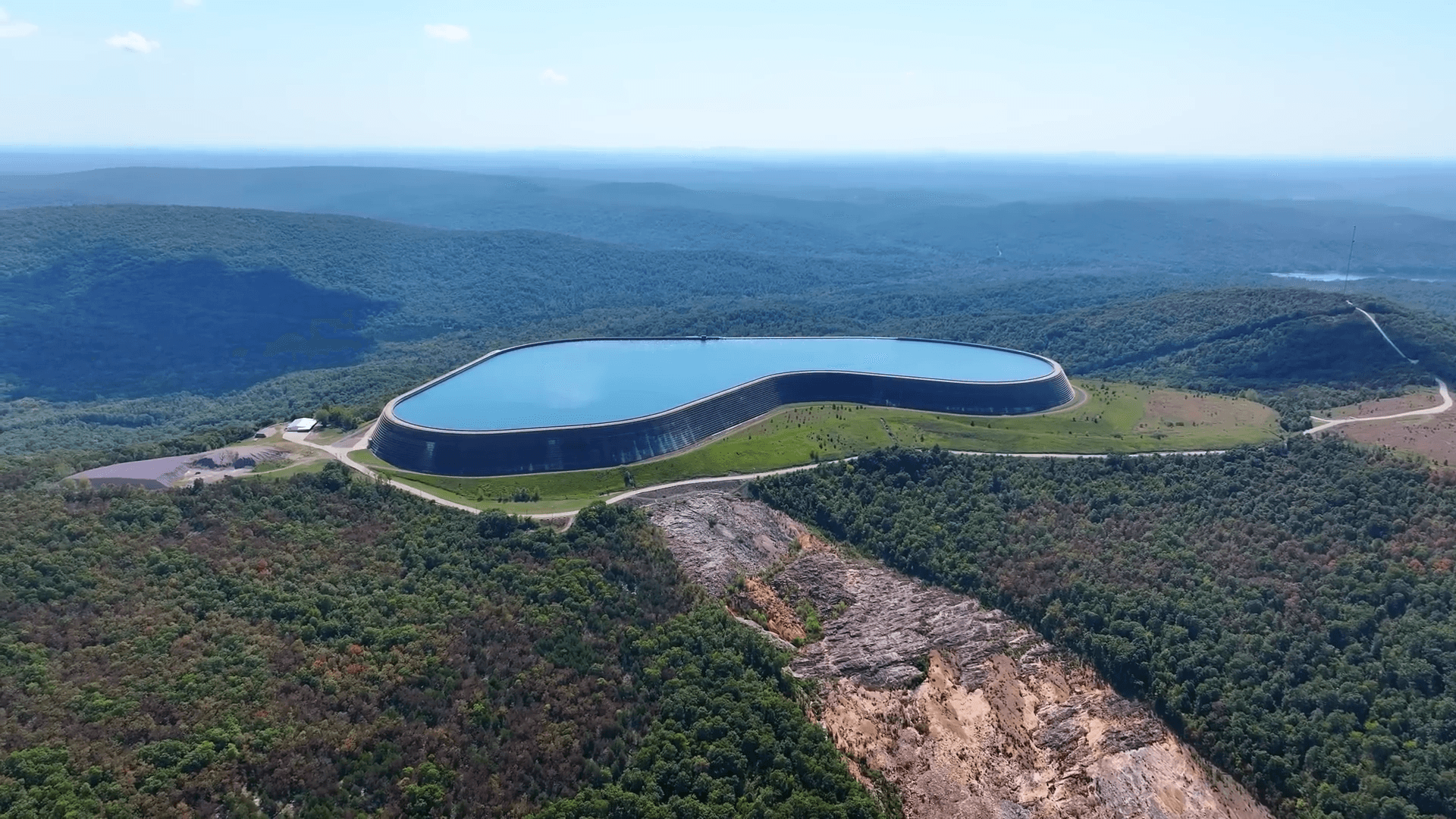
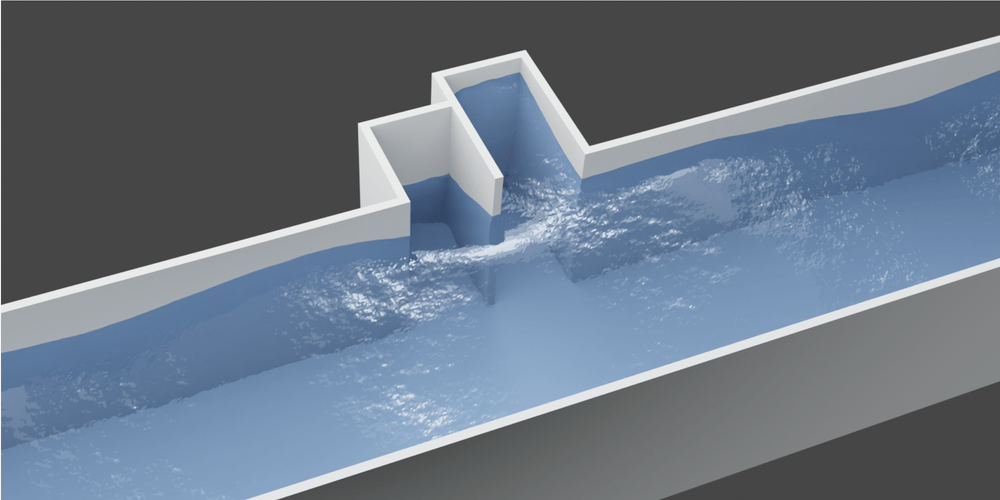
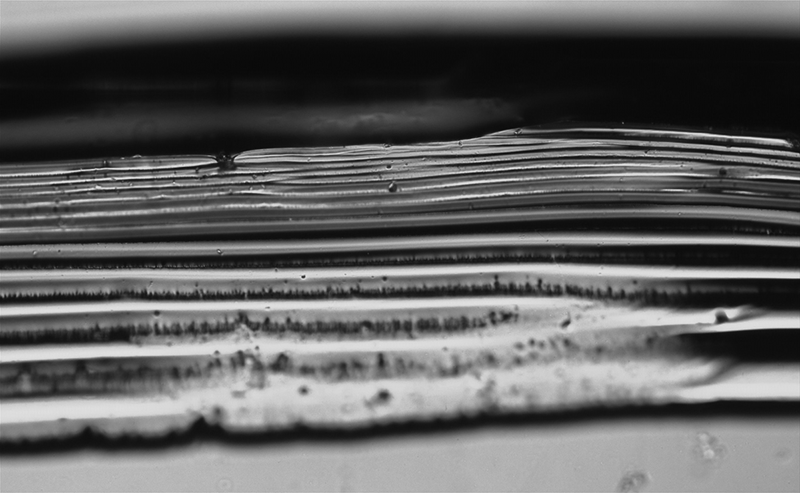
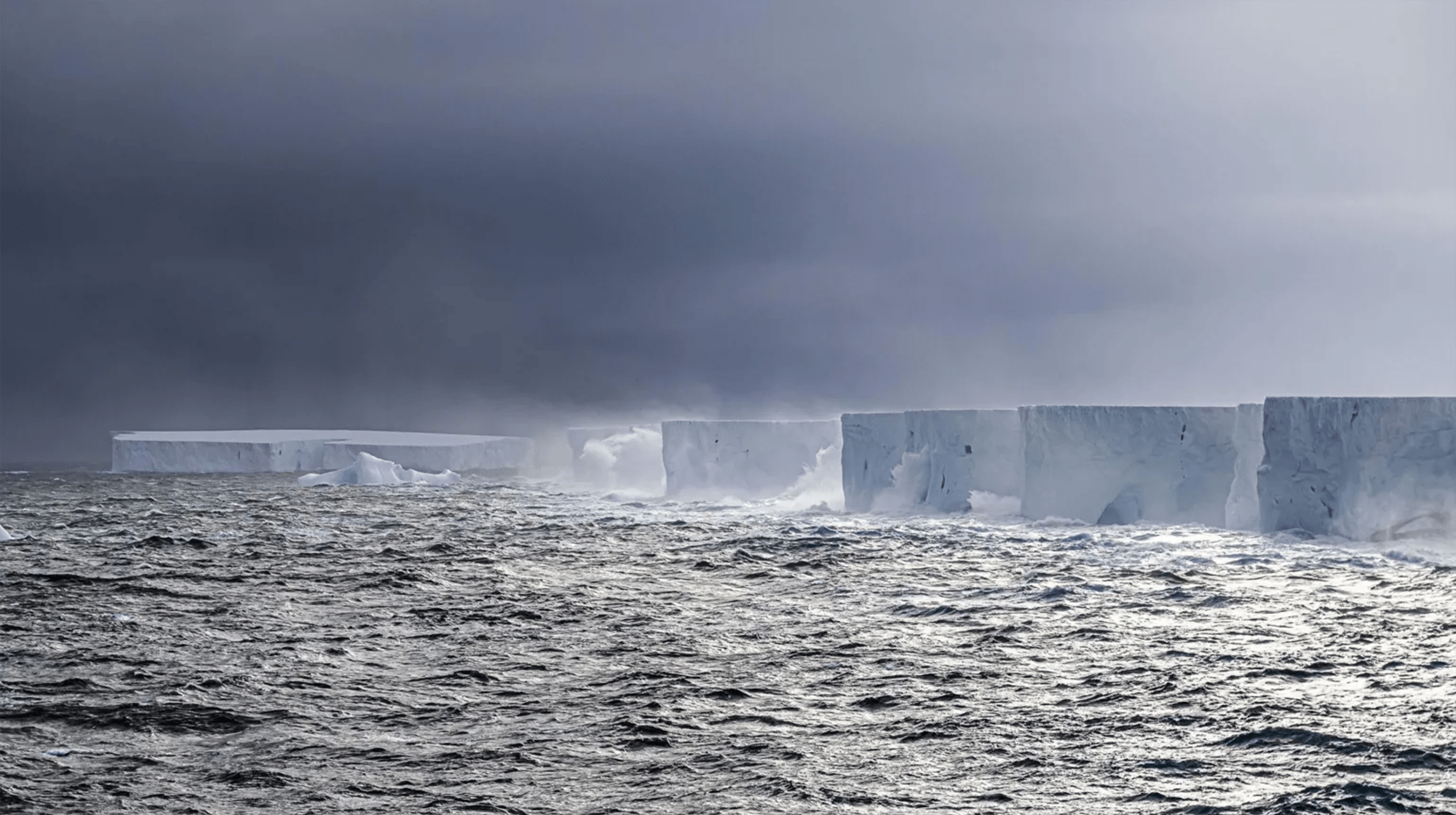
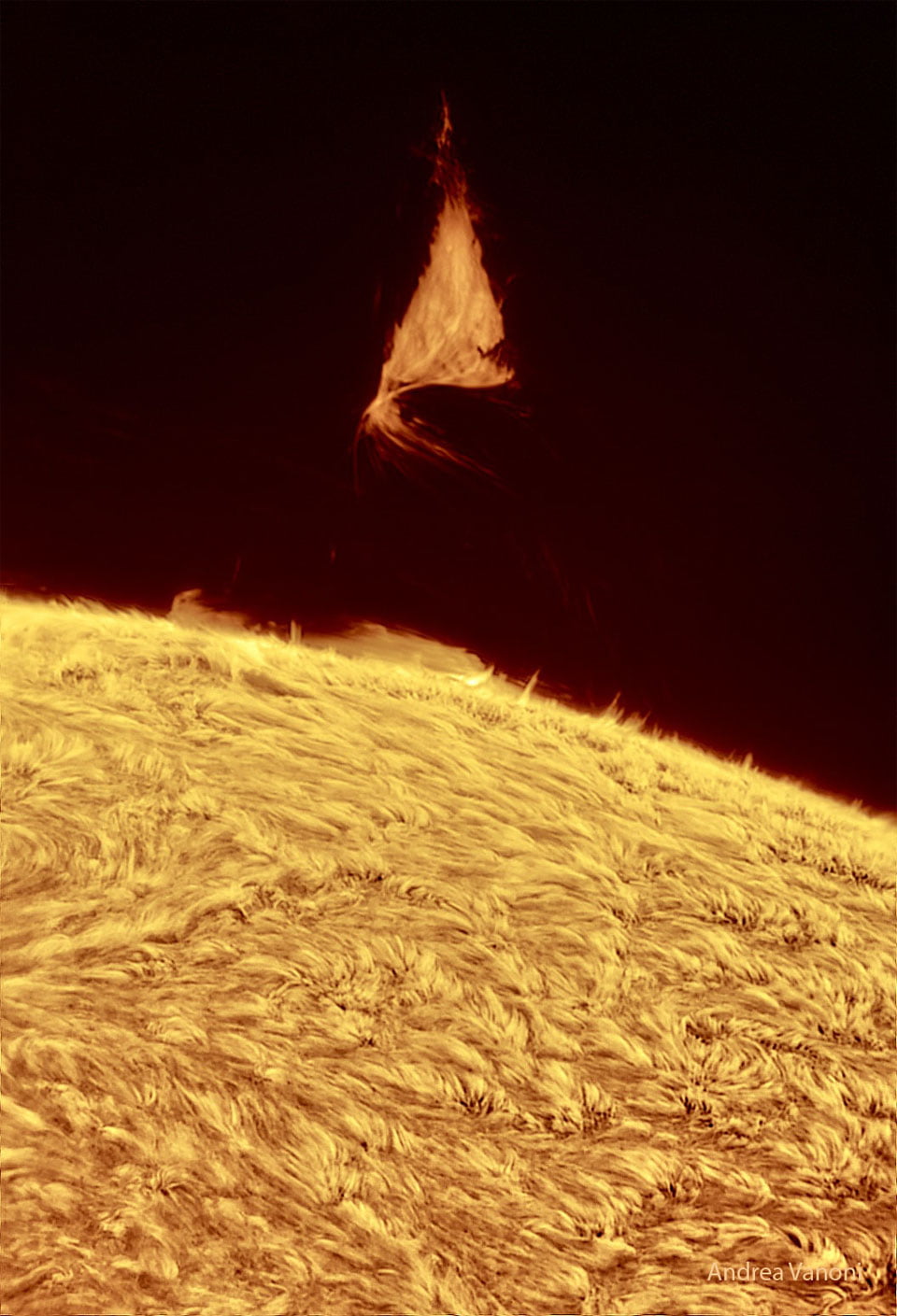
    (Image credits: dam – Practical Engineering, ants – C. Chen et al., supernova – NOIRLab, sprinkler – K. Wang et al., wave tank – L-P. Euvé et al., “Dew Point” – L. Clark, paint – M. Huisman et al., iceberg – D. Fox, flame trough – S. Mould, sign – B. Willen, comet – S. Li, light pillars – N. Liao, chair – MIT News, Faraday instability – G. Louis et al., prominence – A. Vanoni)


    Fediverse Reactions
  • Growing Flexible Stalactites

    Growing Flexible Stalactites

    Icicles and stalactites grow little by little, each layer a testament to the object’s history. Here, researchers explore a similar phenomenon, grown from a dripping liquid. They’re called “flexicles” in homage to their natural counterparts, and they start from a thin layer of elastomer liquid. Though it begins as a liquid, elastomer solidifies over time.

    Timelapse video showing the formation of an initial layer of flexicles from a dripping elastomer.
    Timelapse video showing the formation of an initial layer of flexicles from a dripping elastomer.

    To form flexicles, the researchers spread a layer of elastomer on an upside-down surface and allow gravity to do its thing (above). Thanks to the Rayleigh-Taylor instability, the dense elastomer forms a pattern of drips that, after hardening, creates a pebbled surface. Subsequent layers of elastomer will drip from the same spots as before, slowly growing longer flexicles (below). The team envisions using them for soft robotics, but, personally, I just really want poke at them and wiggle them. (Image and research credit: B. Venkateswaran et al.; via APS Physics)

    A stitched composite photo showing flexicles on a cylinder growing layer by layer.
    A stitched composite photo showing flexicles on a cylinder growing layer by layer.
  • “Alive Painting”

    “Alive Painting”

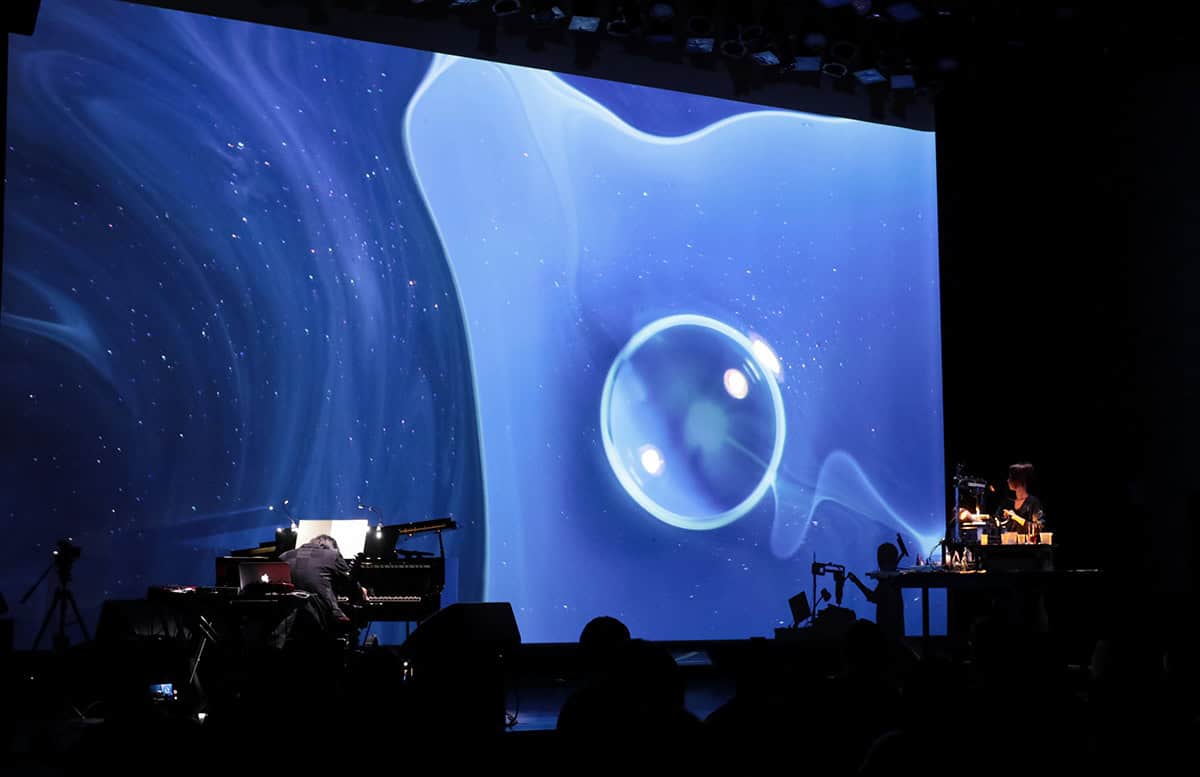
    Artist Akiko Nakayama’s intuitive grasp of fluid dynamics is so good that she manipulates liquids live to musical accompaniment. Her dendritic paintings — made from a combination of acrylic paint and isopropyl alcohol — inspired scientific research papers. There’s no substitute, I’m sure, for seeing her art live, but you can get a taste of her performances in the video below. Then you can head over to Physics World for more on the artist, her inspirations, and her scientific collaborations. (Image credits: H. Akagi and A. Nakayama; video credit: Eternal Art Space; via Physics World)

  • Featured Video Play Icon

    Convection in Blue

    Convection cells like these are all around us — in the clouds, on the Sun, and in our pans — but we rarely get to watch them in action. Convection results from densities differing in different areas of a fluid. Under gravity’s influence, having a dense fluid over a lighter one is unstable; the dense fluid will always sink and the lighter one will rise. When that motion has to take place across a large surface area, we often end up with cells like the ones seen here.

    Convection cells in an alcohol-paint mixture.
    Convection cells in an alcohol-paint mixture.

    What drives the density differences in the fluid? That depends. Often there’s a temperature difference that drives warmer fluid to rise and cool fluid to sink. But that’s not always the source of convection. Evaporating a volatile chemical — like alcohol — out of a mixture can also create the density differences needed for convection. That may be the source of the convection we see here in a mixture of paint and alcohol. (Video and image credit: W. Zhu; via Nikon Small World in Motion)

  • Featured Video Play Icon

    “Chemical Somnia”

    Under a macro lens, even a petri dish worth of fluids comes vividly to life. Here, artist Scott Portingale explores crystallization, Marangoni effects, and other phenomena alongside a haunting soundtrack from musician Gorkem Sen. Enjoy! (Image and video credit: S. Portingale et al.)

  • Featured Video Play Icon

    Marangoni Blossoms

    When surface tension varies along an interface, fluids move from regions of low surface tension to higher surface tension, a behavior known as the Marangoni effect. Here, a drop of (dyed) water is placed on glycerol. The two fluids are miscible, but water has much a lower viscosity and density yet a higher surface tension. The drop’s interface quickly becomes unstable; viscous fingers form along the edge as the less viscous water pushes into the more viscous glycerol. Eventually, the surface-tension-driven Marangoni flow breaks those fingers off into lip-like daughter drops. The researchers also show how the interplay between viscosity and surface tension affects the size of fingers that form by varying the water/glycerol concentration. (Image and video credit: A. Hooshanginejad et al.)

  • Peering Inside Viscous Fingering

    Peering Inside Viscous Fingering

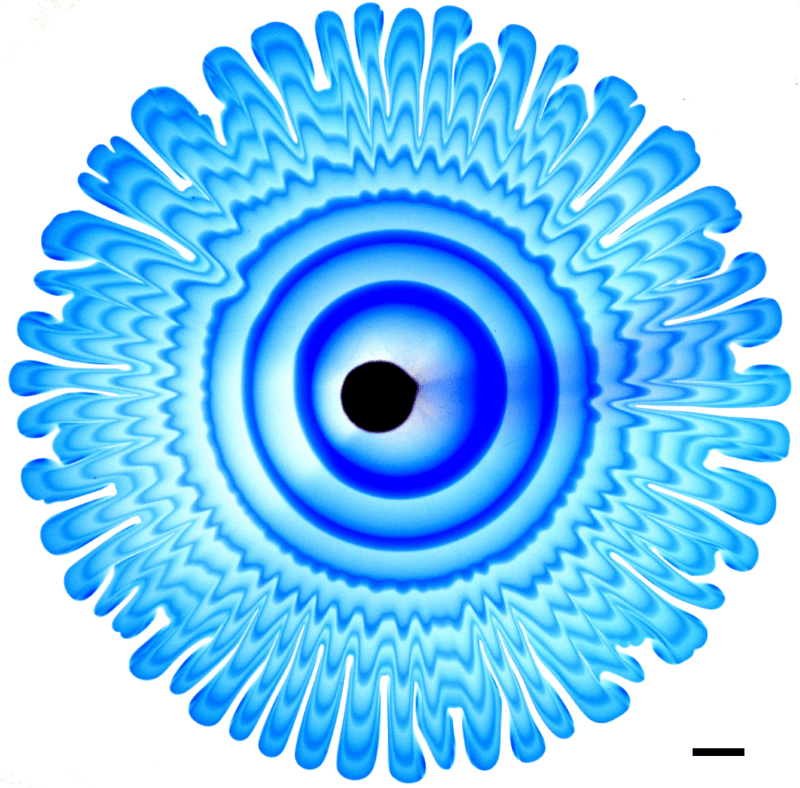
    Viscous fingers form when a low-viscosity fluid is pumped into a narrow, viscous-fluid-filled gap. The branching pattern that forms depends on the ratio of the two viscosities, among other factors. To better understand what goes on inside these fingers, researchers carefully alternated injecting dyed and undyed fluid. This creates a pattern of concentric rings that deform as the fingers spread.

    In this particular study, the initial fluid and injected fluids are miscible, meaning that they can mix into one another. In modeling their experiments, the team found that this mixing created stratification — i.e., layers of fluids with different densities — in the narrow gap between their plates. The stratification’s effects were large enough that the model required a correction term for them; that’s a bit surprising because we’d usually expect that the tiny third-dimension of the gap would be too small to matter! (Image and research credit: S. Gowan et al.)

  • Featured Video Play Icon

    Tweaking Coalescence

    When a drop settles gently against a pool of the same liquid, it will coalesce. The process is not always a complete one, though; sometimes a smaller droplet breaks away and remains behind (to eventually do its own settling and coalescence). When this happens, it’s known as partial coalescence.

    Here, researchers investigate ways to tune partial coalescence, specifically to produce more than a single droplet. To do so, they add surfactants to the oil layer surrounding their water droplet. The surfactants make the rebounding column of water skinnier, which triggers the Rayleigh-Plateau instability that’s necessary to break the column into more than one droplet. (Image and video credit: T. Dong and P. Angeli)

  • Underground Convection Thaws Permafrost Faster

    Underground Convection Thaws Permafrost Faster

    In recent years, Arctic permafrost has thawed at a surprisingly fast pace. Much of that is, of course, due to the rapid warming caused by climate change. But some of that phenomenon lives underground, where water’s unusual properties cause convection in gaps between rocks, sediment, and soil.

    Water is densest not as ice but as water. This is why ice cubes float in your glass. Water’s densest form is actually a liquid at 4 degrees Celsius. For water-logged Arctic soils, this means that the densest layer is not at the frozen depth but at a higher, shallower depth. This places a dense liquid-infused layer over a lighter one, a recipe for unstable convection.

    Illustration of underground convection and permafrost thaw. On the left: temperature and density of the water in Arctic soil varies with depth. The temperature decreases with depth, but because water is densest at 4 degrees Celsius, the density is greatest at a shallower depth than the freezing interface. As a result of this unstable configuration (dense water over less dense water), convection can occur (right side).
    Illustration of underground convection and permafrost thaw. On the left: temperature and density of the water in Arctic soil varies with depth. The temperature gets colder the deeper you go, but because water is densest at 4 degrees Celsius, the density is greatest at a shallower depth than the freezing interface. As a result of this unstable configuration (dense water over less dense water), convection can occur (right).

    In a recent numerical simulation, researchers found that this underground convection caused permafrost to thaw much more quickly than it would due to heat conduction alone. In fact, the effects appeared in as little as one month, so in a single summer, this convection could have a big effect on the thaw depth. (Image credit: top – Florence D., figure – M. Magnani et al.; research credit: M. Magnani et al.)

  • Featured Video Play Icon

    The Shape of Rain

    In our collective imagination, a raindrop is pendant shaped, wide at the bottom and pointed at the top. But, in fact, a falling raindrop experiences much more complicated shapes. Here, researchers blow a jet of air onto a still droplet, a good facsimile for a raindrop falling through the atmosphere. The jet of air first squishes the drop, then inflates it into a shape known as a bag. The thin sides of the bag stretch and eventually break, spraying tiny droplets. As the disintegration continues, the thick rim of the bag breaks up into big droplets. As the video demonstrates, viscosity and viscoelasticity can affect the break-up, too. (Image and video credit: I. Jackiw and N. Ashgriz)