This photo shows the development of a flow instability in an axisymmetric jet. On the left, the jet is smooth and fully laminar, but, by the center of the photo, disturbances in the jet have grown large enough to distort the laminar profile. The jet is then in transition; by the right side of the frame, it has reached a turbulent state, as evidenced by the increased mixing (which causes the smoke to disperse more quickly) and intermittency of the flow. #
Tag: instability

Plugging an Oil Leak
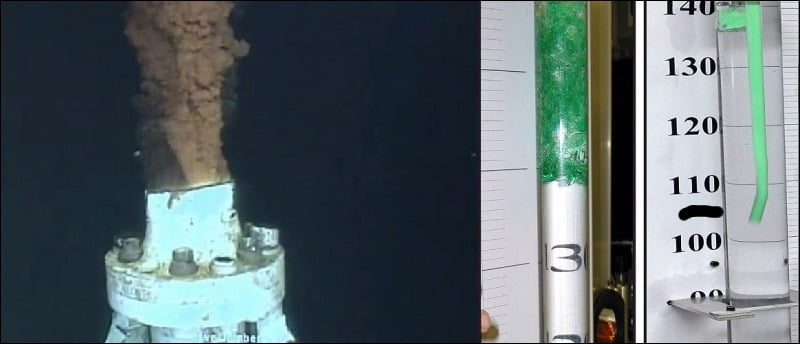
Recent research indicates that adding cornstarch to drilling mud increases the likelihood that a “top-kill” procedure will plug a leaking oil well. Adding cornstarch to water (or mud) turns it into a non-Newtonian fluid with viscoelastic properties that prevent the instabilities that lead to turbulent breakup. On the left, an underwater photo of the Deepwater Horizons leak; in the center, colored water breaks into turbulence when descending into oil; on the right, water with cornstarch maintains its coherence when pumped downward into the oil. # (PDF of research paper)

Vibrating Fluid Interfaces
The Faraday instability forms when a fluid interface is vibrated. This high-speed video shows the differences in the shapes formed by a vibrated fluid interface when the two fluids are miscible–capable of mixing–and when they are immiscible–like oil and water. Note how the miscible interface breaks down quickly into turbulence, but the immiscible interface maintains a complex shape.
DIY Solutal Convection
In this video, the HouseholdHacker heads to the kitchen and uses milk, food coloring, and dish soap to create some solutal convection much like this one with cream and liqueur. The food coloring serves as a tracer for the fluid motion; it’s really the interaction of the milk and the dish soap that drives the motion. The dish soap lowers the surface tension of the milk, causing motion via the Marangoni effect. That motion redistributes some of the dish soap as well, causing further motion in the form of a surface tension instability. As with the cream and liqueur experiment, the fat in the milk is important; you won’t see much (if any) effect with fat free milk because its surface tension properties aren’t as dissimilar to dish soap. (via misterhonk.de)
Waves on Cornstarch
A thin layer of the non-Newtonian fluid oobleck on a vibrating surface (in this case, a speaker) is a great way to show off nonlinear standing waves known as Faraday waves. The waves form because, under these circumstances, the flat surface of the air/oobleck interface has actually become unstable.

Viscous Fingers
This photo shows the Saffman-Taylor instability in a Hele-Shaw cell. Here a viscous fluid has been placed between two glass plates and a second less viscous fluid inserted, resulting in a finger-like instability as the less viscous fluid displaces the more viscous one. This is an effect that can be easily explored at home using common liquids like glycerin, water, dish soap, or laundry detergent. #
Vibrating Oobleck
[original media no longer available]
This video explores some of the non-Newtonian behaviors of oobleck when shaken. The pattern across the surface once the vibrations start is called Faraday waves, a type of nonlinear standing wave that forms once a critical vibrational frequency is passed and the flat surface of the fluid becomes unstable. Toward the end of the video, the frequency of the vibrations is increased until “finger-like protrusions” form. This is a behavior exhibited by shear-thickening non-Newtonian fluids.
Wavy Vortices
Shown above is the flow between two concentric cylinders (Taylor-Couette flow). In the laminar regime, the velocity profile between the two cylinders is linear. As the rate of rotation of the inner cylinder increases, the flow develops toroidal vortices known as Taylor vortices, seen in the video above after 9 seconds or so. This is a fluid instability exhibited by transitional flow. Increasing the rotational rate further can result in wavy Taylor vortex flow. At high enough speeds, the flow will become completely turbulent.
Superfluid Dripping
This high-speed video shows superfluid helium dripping and breaking up. Although superfluid has no viscosity, this does not prevent the Plateau-Rayleigh instability from breaking the helium into droplets once the mass of the liquid is too great for surface tension to contain.

Kelvin-Helmholtz Instability
The Kelvin-Helmholtz instability occurs when velocity shear is present in a single fluid or when two different fluids have a velocity difference across their interface. As shown in this numerical simulation, the instability produces a fractal-like pattern of eddies turning over on themselves. The Kelvin-Helmholtz instability is commonly found in nature between cloud layers. #
ETA: It looks like animated GIFs may not work with Tumblr. Be sure to click on the picture to see the animation on Wikipedia.