Search results for: “convection”

  • Ocean Mixing

    Ocean Mixing

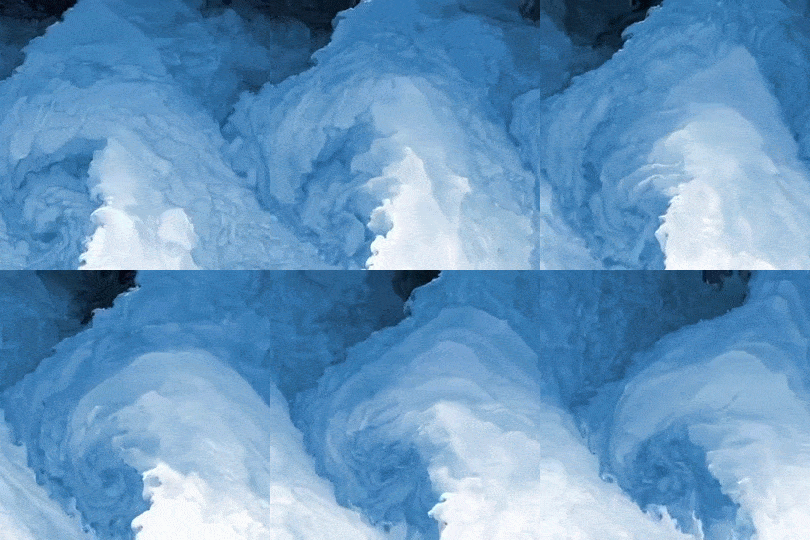
    Movement in Earth’s oceans is driven by a complicated interplay of many factors like temperature, salinity, and Earth’s rotation. Above are results from a numerical simulation of the top 100 meters of ocean contained within a 1 km x 1 km box.  The colors indicate surface temperature. Two major processes create the motion we see. The first is convection, in which water at the surface releases heat to the atmosphere and cools, causing it to then sink due to its greater density. Warmer water rises to replace it. This process happens quickly and dominates the early part of the simulation where we see the puffy convection cells shown on the left animation.

    A slower process is in effect as well. Because of variations in the water temperature, the density of the fluid at a given depth is not constant. We can already see that at the water surface, where the temperature (and thus density) is varying significantly. Those variations in density at the same depth combined with gravity’s tendency to shift fluids create what is known as a baroclinic instability. Put simply, this instability will cause warmer water to slide horizontally past colder water. The result is the large, spinning eddy motion seen in the animation on the right. To see how the whole system develops, check out the full video below.  (Image/video credit: J. Callies)

  • Drying Blood Can Reveal Anemia

    Drying Blood Can Reveal Anemia

    Blood is a remarkably complicated fluid, thanks in part to its many constituents. What we see here is an animation of a drop of blood evaporating at several times normal speed. As water from the blood evaporates, it causes relative changes in surface tension. These surface tension gradients cause convection inside the drop and carry red blood cells toward the outer portion of the drop. As the blood evaporates further, it leaves behind different patterns that depend on which parts of the whole blood mixture were deposited in each region. Interestingly, the final desiccation patterns can indicate the healthiness of a patient. Below are images of dried blood patterns from (left) a healthy individual and (right) an anemic individual. (Image credits: D. Brutin et. al., source)

    image

    Special thanks to our Patreon patrons, who help keep FYFD bringing you daily doses of fluid dynamics.

  • Featured Video Play Icon

    Freezing Soap Bubbles

    I’m not a winter person, but there’s something almost magical about the way water freezes. From instant snow to snow rollers and weird ice formations to slushy waves, winter brings all kinds of bizarre and unexpected sights. The video above is an artistic look at one of my favorites – freezing soap bubbles. Normally, the thin film of a soap bubble is in wild motion, convecting due to gravity, surface tension differences, and the surrounding air. Such a thin layer of liquid loses its heat quickly, though, and, as ice crystals form, the bubble’s convection and rotation slow dramatically, often breaking the thin membrane. Happily photographer Paweł Załuska had the patience to capture the beautiful ones that didn’t break!  (Video credit: P. Załuska; via Gizmodo)

    If you enjoy FYFD and want to help support it, please consider becoming a patron!

  • Jovian Belts and Zones

    Jovian Belts and Zones

    Jupiter’s colorful cloud bands alternate between dark belts and light zones. The bands mark convection cells in Jupiter’s atmosphere, and, like on Earth, powerful jet streams form due to this atmospheric heating and the planet’s rotation. The jet winds can even move in opposite directions, creating strong shear forces between neighboring cloud bands. The shear helps drive Kelvin-Helmholtz instabilities in the clouds, resulting in the regularly spaced waves and vortices seen along the edges of some bands. (Image credit: NASA/ESA; via APOD)

  • Featured Video Play Icon

    How the Grand Canyon Formed

    The Grand Canyon is a monument to the power of water, air, and time. In this video from It’s Okay To Be Smart, Joe Hanson describes the formation of the Grand Canyon – from the ancient oceans that created its many layers to the tectonic upthrusts that eventually created the Colorado River that continues to cut through the Canyon’s rocks today. Fluid dynamics play a major role in the geology of the Grand Canyon, whether it’s in the mantle convection that helps drive plate tectonics or the sedimentation that builds and erodes rock layers.   (Video credit: It’s Okay To Be Smart)

  • Featured Video Play Icon

    Calbuco

    Filmmaker Martin Heck captured incredible timelapse footage of the Chilean volcano Calbuco erupting earlier this year. Fluid dynamics on these enormous geophysical scales is always awe-inducing. In the beginning, clouds bob gently and flow around the landscape. Then the volcano erupts, and the towering ash cloud of the eruption roils with turbulence, displaying eddies with length scales from hundreds of meters down to centimeters. And when the hot ash has risen and cooled, it forms a cap that spreads horizontally. Nature is a wonderful demonstrator of fluid dynamics, but what always amazes me is how very alike flows are whether they are confined to a laboratory or take up an entire planet. (Video credit: M. Heck; via It’s Okay To Be Smart)

  • Espresso in Space

    Espresso in Space

    The International Space Station resupply mission launched yesterday included a long-awaited fluid dynamics experiment that offers astronauts a taste of home: the ISSpresso espresso machine. Built by two Italian companies, the specially-designed espresso maker contains a non-convectional heating system and high-pressure piping to safely enable proper brewing using real coffee while in microgravity. The machine is also ruggedized to withstand launch forces; prototypes were even dropped in drop towers to simulate microgravity brewing conditions. The machine dispenses the brewed espresso into plastic packets, but another experiment aboard the ISS, Capillary Effects of Drinking in Microgravity, includes 3D-printed cups designed to allow orbiting astronauts to sip their beverages from open containers without spilling. They’re an improvement on a design created by astronaut Don Pettit in 2008 while in orbit. The cup’s sharp interior angle causes surface tension and capillary action to wick liquid upward to the spout. (Image credits: Lavazza; NASA/Portland State University/A. Wollman)

  • Blast Waves Visualized

    Blast Waves Visualized

    Typically, shock waves are invisible to the human eye. Using sensitive optical techniques like schlieren photography, researchers in a lab can visualize sharp density gradients like shock waves or even the slight density variations caused by natural convection. But it takes some special conditions to make shock waves visible to the naked eye. The blast wave of the explosion in the photo above is a great example. The leading edge of the shock wave and the heat of the explosion create a strong, sharp change in density. That density change is accompanied by a change in the air’s refractive index. As light travels from the distance toward the camera, it’s distorted–more specifically, refracted–when it travels through the blast wave and its wake. And, in this case, that visual distortion is strong enough that we can clearly see the outlines of the shock waves moving out from the explosion. The apparent horizontal line through the blast wave is probably the intersection of a weaker secondary shock wave with the initial expanding shock wave. (Image credit: Defense Research and Development Canada; via io9)

  • Featured Video Play Icon

    5 Years of SDO

    NASA’s Solar Dynamics Observatory (SDO) is our premiere source for data on the sun. In honor of its five-year anniversary, NASA released this beautiful video compiling some of the highlights among the 2600 terabytes of data the spacecraft has recorded. SDO has captured some truly stunning footage over the years of sunspots, prominences, and eruptions. The latter two are examples of plasma flows and visible magnetohydrodynamics. SDO’s observations are also helping researchers determine what goes on just beneath the sun’s surface, where convection and buoyancy are major forces in the transport of heat generated from fusion in the star’s core. Incidentally, SDO’s launch featured some uncommonly stunning fluid dynamics as well. (Video credit: NASA Goddard)

  • Featured Video Play Icon

    Simplified Schlieren Set-up

    Schlieren photography offers a glimpse into flows that are usually invisible to the human eye. With a relatively simple set-up–a light source, collimating mirror(s), and a razor blade–it becomes possible to see differences in density. The technique lets one visualize temperature-driven flows like the buoyant convection from a flame or other heat source, and it can also be used to visualize shock waves and sound. The video above has several neat schlieren demos, including some non-air examples using hydrogen (lighter than air) and sulfur hexafluoride (denser than air), both of which are transparent to the naked eye.  (Video credit: Harvard University, via Jennifer Ouellette)