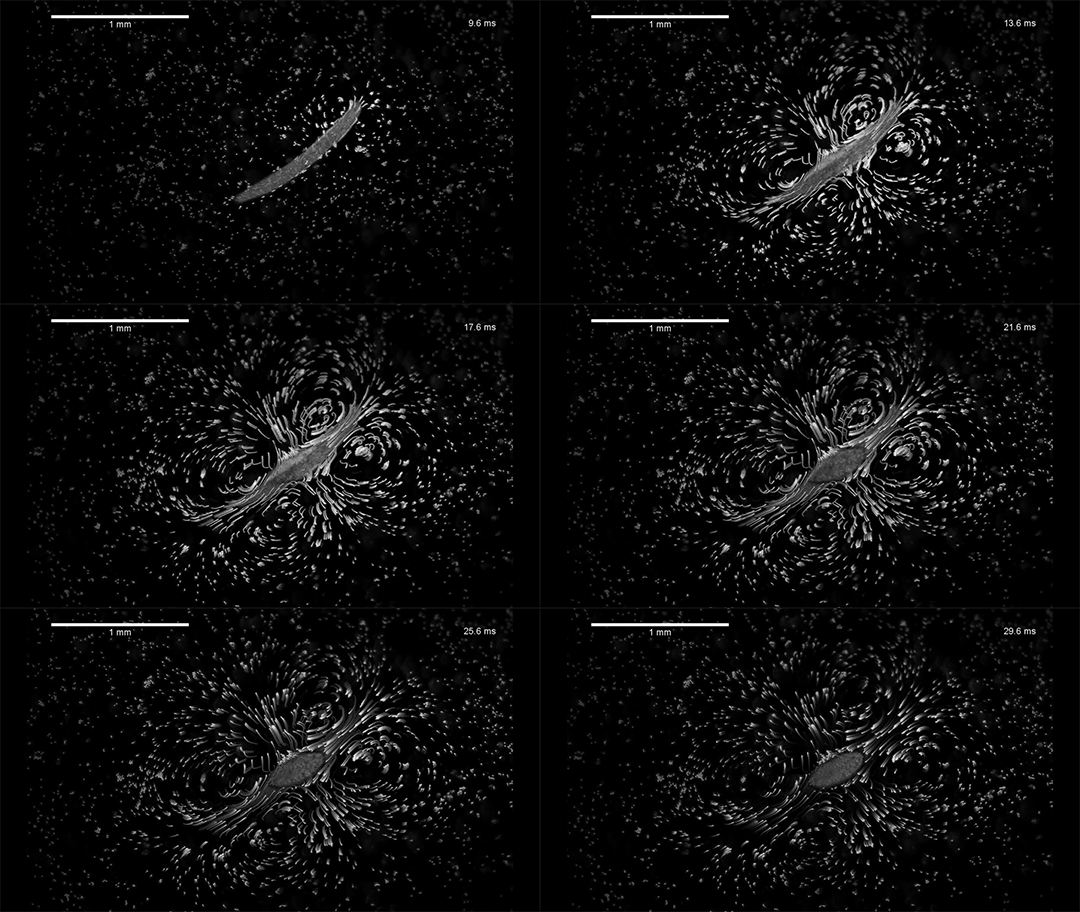
The elongated cells of Spirostomum ambiguum swim using hair-like cilia, but when threatened, the cells contract violently, sending out long-range hydrodynamic waves, like those visualized above. Along with these waves, the cells release toxins aimed at whatever predator threatens them. In a colony, these waves act like a communication beacon. The swirl of a previous cell’s reaction tugs on its neighbors. As they contract, the message–and the toxins–spread. If the colony density is high enough, the hydrodynamic trigger waves will propagate through the entire colony, releasing enough toxins to disable even large predators. (Image and video credit: A. Mathijssen et al.)
Category: Research

Soap Film Evolution


The beautiful colors of a soap film reflect its variations in thickness. As a film drains and evaporates, it turns to shades of gray and black as it gets thinner. More than fifty years ago, one scientist proposed a free-energy-based explanation for how such ultrathin films might evolve. But it’s taken another half a century for experimental techniques to reach a point where the thickness of these ultrathin films could be measured well enough to test that theory. The new mechanism, known as spinodal stratification, has been observed in both vertical films (top) and foam (bottom) but has so far not been observed in any horizontal configuration, suggesting that buoyant effects are likely important, too. (Image and research credit: S. Yilixiati et al.; submitted by James S.)

Paddling
When I lived in New England, I often spent summers paddling around a lake in either a kayak or canoe. Every stroke was an opportunity to stare down into the dark water and watch how the flow curled around my oar. Here you see a bit of what that looks like from underwater.
The animation above shows a flat plate – twice as tall as it is wide – submerged about 20 mm below the surface and accelerated steadily from rest. As it starts moving, there’s a clear vortex ring formed and shed behind it. You can also see how the plate distorts the free surface into large depressions. Both of these cause extra drag on the plate. Eventually, though, the plate reaches a steady state.
All together, what you see here is a good representation of what’s going on when a rower first begins to accelerate their boat from rest. Hydrodynamically speaking, the best way to do that isn’t to dig in with a deep stroke. It’s to use a series of short, relatively shallow strokes to get the boat up to speed. This takes advantage of the efficiency of drag generation during acceleration to get the boat to its cruising speed quickly. (Image and research credit: E. Grift et al.)

Foam Collapse
Introduce the right additive and the bubble arrays in foam will collapse catastrophically. What you see above is high-speed video of a quasi-two-dimensional soap bubble foam collapsing. There are two main mechanisms in the collapse. The first is a propagating mode. When one section of the film breaks, a stream of liquid from the broken film can impact an adjacent section, causing it to break as well. This accounts for much of the breakage you see above.
The second mode is through penetration by droplets. Watch carefully, and you’ll see that some of the breaking films generate tiny droplets which can fly through the wall of the next cell and impact against the far side. With the right conditions, that impact can trigger a new break along a non-adjacent film. Together, these two mechanisms can destroy foam in the blink of an eye. (Image and research credit: N. Yanagisawa and R. Kurita)

The Shaky Life of a Droplet


An evaporating drop of ouzo goes through several stages due to the interactions of oil, alcohol and water. If you turn the situation around by placing a drop of (blue-dyed) water in a mixture of alcohol and anise oil (top image), you get some similarly odd behavior. The drop of water shimmies and grows as alcohol dissolves into it, carrying the occasional oil droplet with it. Eventually, the droplet grows large enough and buoyant enough that part of it detaches and floats to the surface (middle image). If you increase the alcohol ratio in the surrounding fluid, you speed up this process, causing droplets to stream up to the surface (bottom image). (Image and video credit: O. Enriquez et al., source)

Phase-Switching to Avoid Icing
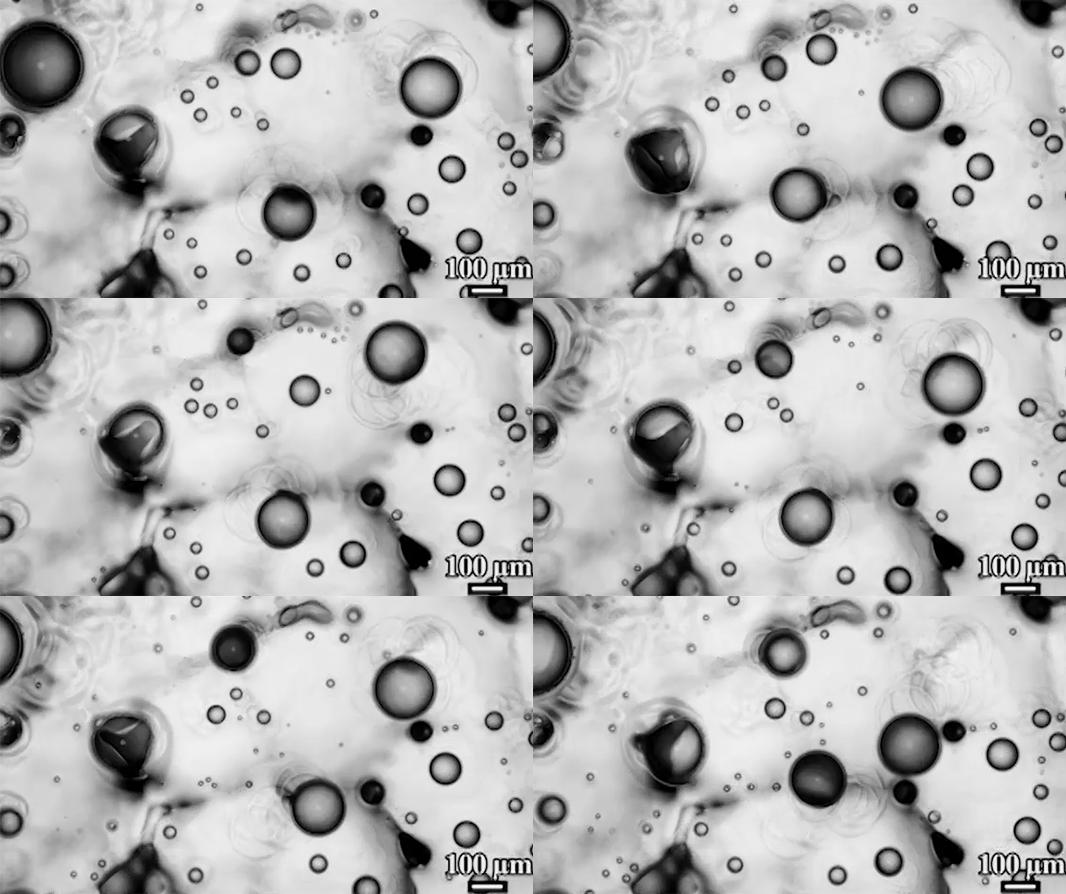
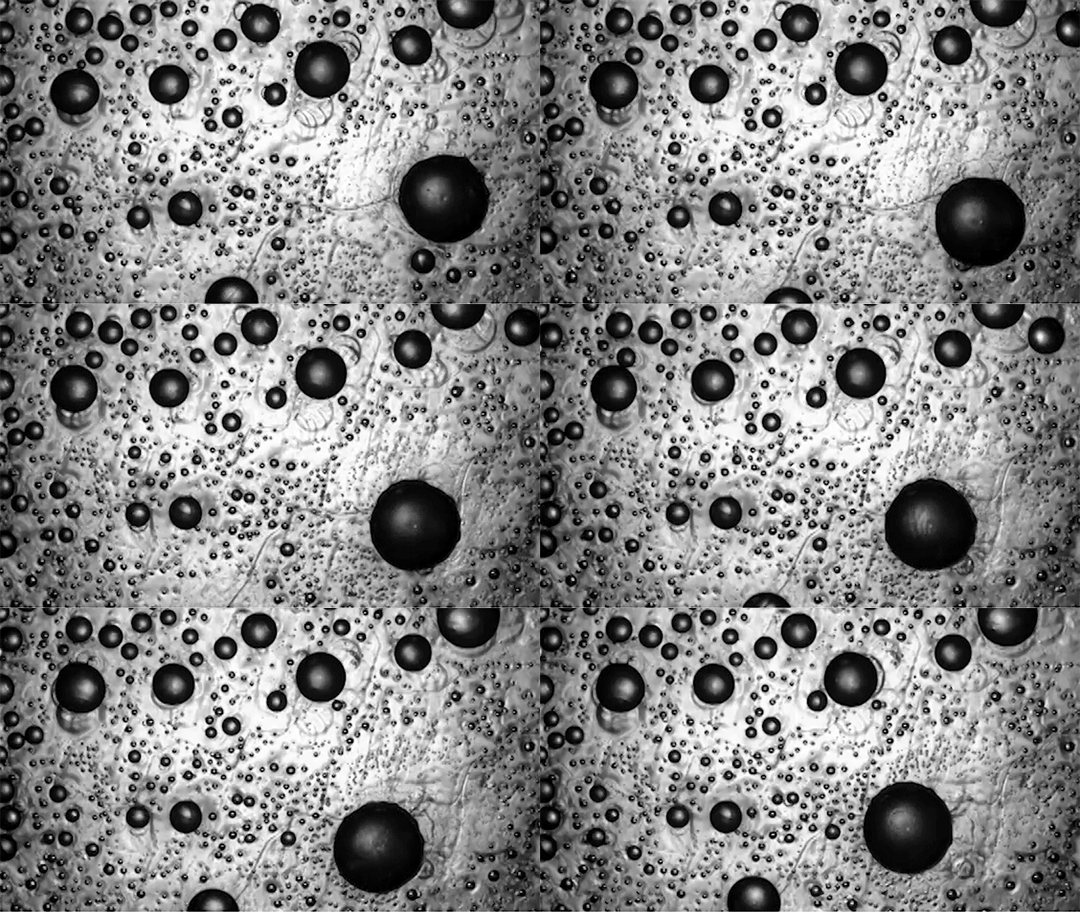
Preventing ice and frost from forming on surfaces – especially airplane wings – is a major engineering concern. The chemical de-icing cocktails currently used in aviation are a short-lived solution, and while superhydrophobic surfaces can be helpful, they tend to be easily damaged and therefore impractical. Another possible solution, shown here, are so-called phase-switching liquids – substances like cyclohexane that have freezing points higher than that of water. This means that they form a solid coating near the freezing temperature of water.
Water droplets on these coatings move in a random stick-slip walk (above) but they tend not to freeze. This is because freezing requires the droplets to release heat, which melts part of the phase-switching liquid. Now, instead of solidifying to the surface, the droplet moves on a film of the phase-switching liquid. Re-freezing that liquid is tough because it’s thermodynamically unfavorable, and the smoothness of the liquid layer makes it harder for ice to find a nucleation point. In lab tests, the phase-switching liquid surfaces resisted ice and frost more than an order of magnitude longer than conventional materials. (Image and research credit: R. Chatterjee et al.; video credit: Univ. of Illinois at Chicago; submitted by Night King)

The Color of Droplets
In nature, color comes from many sources: like the pigmentation of skin and hair, the structural iridescence of a butterfly’s wings, or the refraction of a rainbow from water droplets. Recently, scientists discovered another source of brilliant color in simple, hemispherical water droplets.
When small droplets form on a transparent surface, they form concave shapes capable of total internal reflection. This means that two light rays entering from the same angle can follow different paths inside the droplet. After reflecting several times, the light rays exit the droplet with a phase difference and how large that phase difference is determines the color. Check out the video below for some brightly colored examples of the effect. The researchers hope the technique will eventually be suitable for creating dye-free, color-changing technologies. (Image credit: F. Frankel; video credit: MIT News; research credit: A. Goodling et al.)

Forming a Waterfall
Many factors can affect a waterfall’s formation – changes in bedrock structure, tectonic shifts, and glacial motion, to name a few. But a new study suggests that some waterfalls may be self-forming. Using a lab-scale experiment, researchers created a homogeneous “bedrock” out of polyurethane foam, which they eroded with a combination of constant water flow and particulates. Even without external perturbations, the flow carved out a series of steps.
As a pool deepened, particles built up inside, armoring the bed against further erosion. But further downstream, the chute continued to erode, steepening the area between them until a waterfall formed. On the timescale of the experiment, the waterfalls lasted only 20 minutes or so, but that’s equivalent to up to 10,000 years in geological time. (Image credit: M. Huey; research credit: J. Scheingross et al.; via EOS News; submitted by Kam-Yung Soh)

Water Impacts

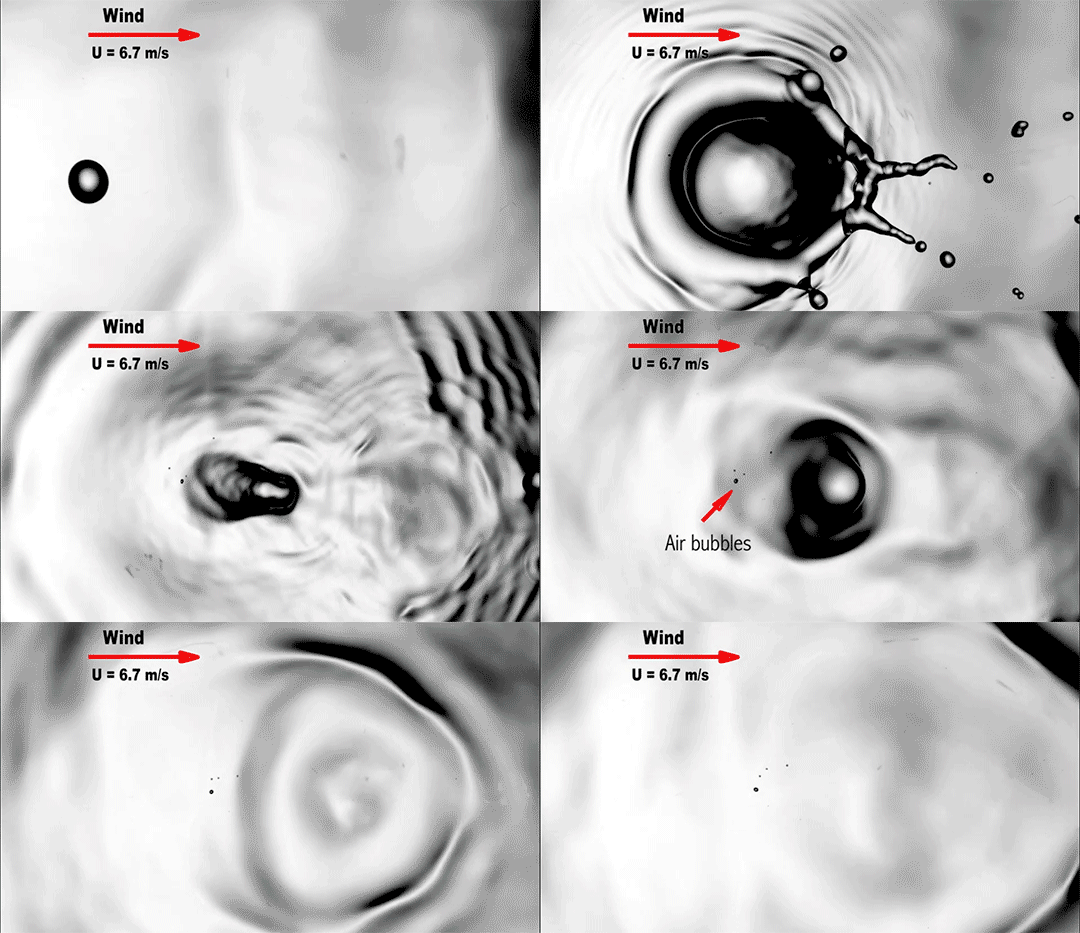
In the clean and simplified world of the laboratory, a droplet’s impact on water is symmetric. From a central point of impact, it sends out a ring of ripples, or even a crown splash, if it has enough momentum. But the real world is rarely so simple.
Here we see how droplets impact when the wind is blowing against them. The drops fall at an angle, creating an oblique cavity. Rings of ripples spread from the impact, but the ligaments of a splash crown form only on the leeward side. As the wind speed increases, so does the violence of the impact, eventually beginning to trap tiny pockets of air beneath the surface. Those miniature bubbles can spray droplets and aerosols into the air when they finally pop. (Image and video credit: A. Wang et al.)

Rogue Waves


After centuries of tales from sailors, in 1995 the Draupner off-shore platform recorded the first ever evidence of a freak wave – a single, wall-like wave steeper and taller than any other waves around it. Theories have been tossed back and forth for the last quarter century as to how the Draupner wave formed, but now a group of researchers report they have recreated a lab-scale version of this is famous wave.
They did so in a wave pool by making two smaller groups of waves cross one another at about 120 degrees (top). The interaction of those wave packets generated a much larger, steeper wave (bottom image sequence) that matched the profile of the Draupner wave. Recreating this past freak wave confirms that wave-crossing can lead to freak waves, which will hopefully help us forecast when conditions may be right for more to occur. (Image credit and research credit: M. McAllister et al., source; via Motherboard; submitted by Kam-Yung Soh)


