Category: Research

  • Fighting a Viscous World

    Fighting a Viscous World

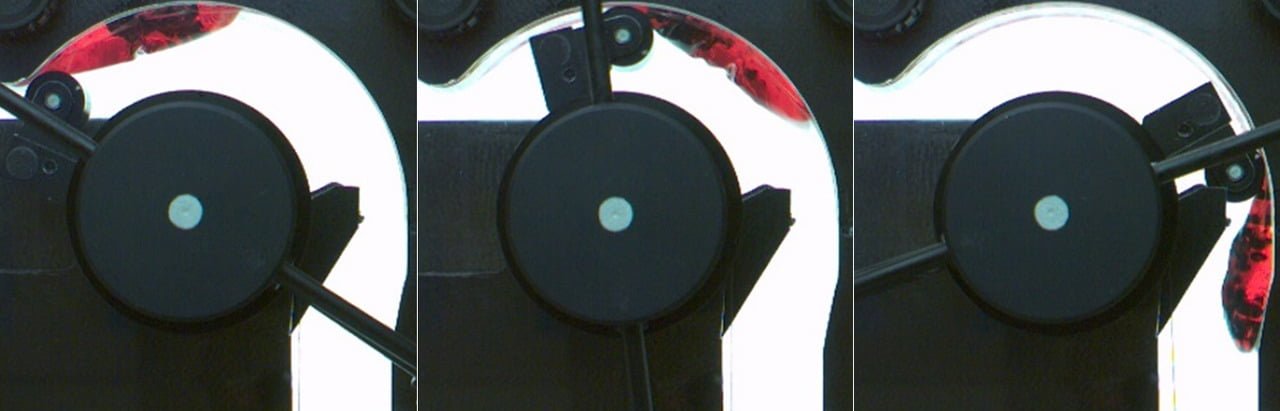
    Vaucheria is a genus of yellow-green algae (think pond scum), and some species within this genus reproduce asexually by releasing zoospores. Once mature, the zoospore has to squeeze out of a narrow, hollow filament in order to escape into the surrounding fluid (top). To do so, it uses tiny hair-like flagella on its surface. Despite the minuscule size of these micron-length flagella, they generate some major flows around the zoospore (middle and bottom). Even several body lengths away, the flow field shows significant vorticity. All this active entrainment of fluid from the surroundings helps the zoospore escape its confinement and swim away to start a new plant. (Image and research credit: J. Urzay et al., source)

  • Water-Walking Geckos

    Water-Walking Geckos

    Many animals can run on water. The tiniest creatures, like water striders, use surface tension to keep themselves atop the water.  Larger creatures like the basilisk lizard or the grebe slap the water’s surface to generate a vertical impulse that keeps them aloft. Geckos, it turns out, can run on water, too, but they’re too big to stay up with surface tension and too small to support their weight by slapping. So they’ve developed their own method.

    As you see in the top image, geckos use the slapping method for part of their support. Their slaps generate a little less than half of the force needed to keep them out of the water. 

    Surface tension is an important component, too. Geckos are extremely water repellent, which helps boost the lift they get from surface tension. In the bottom image, you see a gecko attempting to run on soapy water, which has a lower surface tension. The gecko is mostly submerged and more swimming than running – a clear demonstration that surface tension is important to its water-walking.

    Finally, the gecko undulates its body as it runs, much the way an alligator swims. The researchers suspect this helps the gecko generate forward thrust. Altogether, it creates a water-walking gait that, for now, is unique among observed mechanisms. (Image and research credit: J. Nirody et al.; via Ars Technica; submitted by Kam-Yung Soh)

  • Rattling Feathers for Attention

    Rattling Feathers for Attention

    Peacocks are known for their colorful mating displays, but it turns out there’s more to them than meets the eye. To help them gain a penhen’s attention, peacocks will sometimes rattle their train-feathers. The sound this makes is mostly below the range of human hearing, but the rustle creates subtle vortices in the air that cause the feathers atop a peahen’s head to vibrate. Playing back the sound at peahens from typical train-rattling distances also gets the females’ attention. Researchers found the playback makes peahens’ crests vibrate at a resonant frequency, suggesting that these feathers are for more than display; they’re used for communication as well! (Image and research credit: S. A. Kane et al.; video credit: Science)

  • Featured Video Play Icon

    The Clever Cat’s Tongue

    Cats spend almost a quarter of their waking hours grooming, and their tongues are wonderfully specialized for this task, allowing them to clean, cool, and untangle themselves with ease. Anyone who’s ever been licked by a cat knows their tongues feel sandpaper-y. This is due to rear-facing hook-like structures called papillae that have a stiffness comparable to human fingernails.

    The papillae are hollow, and their U-shaped tip helps them wick up saliva, which the cat deposits deep into its undercoat when it licks. Although the papillae only hold about 5% of the volume of saliva on the cat’s tongue, this wicking action is key because most of the tongue surface can’t reach the inner coat; only the papillae do. The saliva that reaches these dense inner hairs is important not only for cleaning the fur, but for helping the cat cool off. As the saliva evaporates, it carries heat away with it, just like sweating does for us.

    The papillae are key to untangling fur, but their shape also makes it easy to remove hairs caught on the tongue. Researchers built a 3D-printed cat-inspired hair brush to show how efficient and easy to clean a cat’s tongue can be! (Video credit: Science; research credit: A. Noel and D. Hu)

  • What Drives Droplets

    What Drives Droplets

    There’s been a lot of interest recently in what goes on inside droplets made up of more than one fluid as they evaporate. This can be entertaining with liquids like whiskey or ouzo, but it has practical applications in ink-jet printing and manufacturing as well. And a new experiment suggests that we’ve been fundamentally wrong about what drives the flow inside these drops.

    As these drops evaporate, a donut-shaped recirculating vortex forms inside them, as seem in the cutaway views above. Conventional wisdom says that vortex is driven by surface tension. Evaporation of components like alcohol is more efficient at the edges of the drop, and as the alcohol evaporates, it creates a higher surface tension at the drop’s edge than at its peak. Marangoni forces then pull fluid down toward the edges, creating the vortex. That explanation is  consistent with observations of a sessile drop sitting on top of a surface (left side of images).

    But those observations are also consistent with another explanation: evaporating ethanol makes the local density higher, so alcohol-rich parts of the drop rise toward the peak while alcohol-poor regions sink. This difference in density would also create a flow pattern consistent with observations. So which is the real driver, surface tension or gravity?

    To find out, researchers flipped the drop upside-down (right side of images). When hanging, the preferred flow direction due to surface tension doesn’t change; flow should still go from the deepest point on the drop toward the edge. But gravity is swapped; alcohol-rich areas should be found near the edge and attachment points of the drop because buoyancy drives them there. And that is exactly what’s observed. The flow direction inside the hanging droplet is consistent with the direction prescribed by buoyancy-driven flow, thereby upending conventional wisdom. It turns out that gravity, not surface tension, is the major driver of internal flow in these multi-component droplets! (Image and research credit: A. Edwards et al.; via APS Physics; submitted by Kam-Yung Soh)

  • Ricequakes

    Ricequakes

    Rockfill dams, sinkholes, ice shelves, and other geological features often consist of brittle, porous materials that are partially submerged. Over time, pressure and chemical reactions with the fluid around them can cause these structures to collapse, but it can take many, many years. 

    To study the physics behind this, researchers have turned to a new model: puffed rice cereal. Like their counterparts in nature, puffed rice grains contain micropores that slowly soften and get crushed after being wetted. Researchers filled their test container with puffed rice and put it under pressure to give the whole stack a constant stress. Then they injected milk in the bottom section of the container. After an immediate collapse in the wet material (lower left), the remaining grains collapsed slowly in a series of “ricequakes”. 

    As the micropores compacted, the cereal let out audible cracks that corresponded with the motion of a crushing wavefront (lower right). The time between ricequakes increased linearly and depended on pore size. The relationship was so consistent, researchers found, that they could predict how long the puffed rice stack had been wet simply by listening to the time between crackles! Experiments like these offer scientists an exciting chance to understand geological physics that would otherwise take up to millions of years to observe. (Image and research credit: I. Einav and F. Guillard; via Physics World; submitted by Kam-Yung Soh)

  • Forming Asteroids

    Forming Asteroids

    Amidst the swirling gas and dust surrounding young stars, asteroids and planets form. Just how these bodies come together – especially before they are massive enough to exert any significant gravitational potential – is an open question. Researchers are trying to better understand the physics involved by studying how clusters of granular material behave when impacted. 

    Above you see footage from two experiments. Both take place in a drop tower under vacuum conditions. That means the effects of air drag and gravity are removed, just like in space. On the left, the cluster is made up of soft clumps of dust; on the right, the cluster contains hard glass beads. Surprisingly, the researchers found that the two different materials behave the same way. They were able to describe both sets of impacts with exactly the same model. This suggests there may be an underlying universal behavior behind all of these granular materials, though the researchers note more experiments are needed. (Image and research credit: H. Karsuragi and J. Blum; via APS Physics)

  • Making Waves in Cold Atoms

    Making Waves in Cold Atoms

    If you take a glass of water and tap on the side of it, you’ll generate waves on the water’s surface. The form of the waves depends on surface tension and gravity, and viscosity governs how quickly the waves fade away. In a recent experiment, researchers performed an equivalent tap for a container of ultra-cold atoms, and the results they found were odd indeed.

    The researchers used lithium-6 atoms chilled so close to absolute zero that they could form a superfluid. The “glass” they were contained in consisted of intersecting laser beams, and the “tap” came from toggling the intensity of one of the lasers. This created rippling waves through the atoms that the group could observe.

    Measuring at various temperatures, the group found that the waves in the atoms always decayed the way one expects for a classical fluid like water. Even when the atoms transitioned into a superfluid, the wave decay did not change. Since superfluids are considered to have zero viscosity, you’d expect their waves to decay more slowly, but it turns out, that’s not the case! (Image credit: F. Mittermeier; research credit: M. Zwierlein et al., see also; via Physics; submitted by Kam-Yung Soh)

  • Growing Droplets

    Growing Droplets

    The moisture in clouds eventually condenses into droplets that grow into raindrops and fall. Some steps in this process are well understood, but others are not. In particular, scientists have struggled with the problem of how droplets grow from about 30 microns to 80 microns, where they’re big enough to start falling and merging.

    Laboratory experiments and numerical simulations (below) have shown that turbulence can help drive small water drops together. When droplets are tiny and light, they simply follow the air flow. But when they’re a little heavier, turbulent eddies (seen in orange below) act like miniature centrifuges, flinging larger water droplets (shown in cyan below) out into clusters, where they’re more likely to collide with one another.

    Although this effect has been seen in experiments and simulation, it’s been difficult to capture in clouds themselves. But a new set of test flights (above) confirms that this mechanism is present in the wild as well! (Image credit: UCAR/NCAR Earth Observing Laboratory, P. Ireland et al., source; research credits: M. Larsen et al., P. Ireland et al.; via APS Physics; submitted by Kam-Yung Soh)

    image
  • Using Instabilities for Manufacturing

    Using Instabilities for Manufacturing

    Manufacturing textured, flexible surfaces can be difficult, but researchers are exploring ways to use fluid dynamical instabilities to make the process easier. They begin with a pourable polymer mixture that cures and solidifies over time. By putting the mixture on a cylinder and rotating it, engineers trigger the Rayleigh-Taylor instability – the same instability that makes dense fluids sink into lighter ones. Here, the instability is driven not only by gravity but by the added acceleration caused by centrifugal force. It causes the fluid film to drain and form arrays of droplets, which then cure into dimples. The researchers can control the size, shape, and spacing of the droplets by changing parameters like the spin rate. And by repeating the process multiple times on the same piece, they can build up spikier shapes, like the ones shown on the poster below. (Image and research credit: J. Marthelot et al., poster)

    image

    Reminder for those at the APS DFD meeting! My talk is tonight at 5:10PM in Room B206. You’ll probably want to come early if you want a seat!