Highly viscous laminar flows exhibit kinematic reversibility, meaning: if you move the fluid one direction and then execute the same motion in the opposite direction, every fluid particle will return to its initial, undisturbed position. Above, you see a swimming device attempting to move through corn syrup by flapping. Because of this kinematic reversibility, it cannot propel itself. For the same reason, many microscopic organisms do not utilize flapping to move.
Category: Research

Recreating Saturn’s Hexagon
In the 1970s, the Voyager spacecraft discovered a hexagon near Saturn’s north pole that defied explanation for years. However, researchers have since simulated the shape in a laboratory by placing a fast-spinning ring on the top surface of a slowly spinning column of fluid. Fluorescent dye is used to visualize the flow pattern. #
Microfluidics
The field of microfluidics–where fluids are constrained to the sub-millimeter scale–is increasingly important in fields like chemistry, molecular biology, and microtechnology. At the microscale, surface tension often has greater effects than in our everyday world. This video shows how adding small amounts of a polymer drastically changes droplet breakup.

How Cats Drink
While humans use suction and dogs scoop water using their tongues*, cats use a dainty fluid mechanism to drink. Researchers used high-speed video to find that cats drink by touching the surface of their tongue to the water and drawing their tongue rapidly back into their mouth. Friction between their tongue and the water creates a fluid column about which the cat closes its jaw before gravity breaks off the column. They also built an artificial tongue to test different frequencies and found an optimal lapping frequency dependent upon the mass of the feline.
- Reis et al. in Science (11/11/10 edition)
- Wired article
- Scientific American article
*ETA: More recent research show that dogs actually use the same technique as cats, not a scooping method.
(Image credit: P. Reis et al.)

The White Hole in Your Sink
Ever notice the distinctive ring that forms in your kitchen sink when you turn the water on? This phenomenon is known as a hydraulic jump; it occurs when a fast moving fluid (the water just discharged from the faucet) runs into a slow moving fluid (the water that’s been sitting in the sink) and transfers some of its kinetic energy into potential energy by increasing its elevation. Researchers have recently shown that this everyday occurrence is actually a physical analog to a white hole, the cosmological inverse of a black hole. (In theory, a white hole cannot be entered, but light and matter can escape it.) Check out Wired’s article for an explanation of the clever experiment that showed the equivalence of the two. #
Superhydrophobic Carbon Nanotubes
Carbon nanotubes form a superhydrophobic (super water repellent) surface that interacts with water droplets in interesting ways. The droplet is unable to wet the surface and thus the bounces along. When the impact velocities are too great for surface tension to hold the decelerating mass together, it breaks into many, smaller droplets that also bounce along the surface. # (via @JetForMe and @Vinnchan)

Jet-Based Control
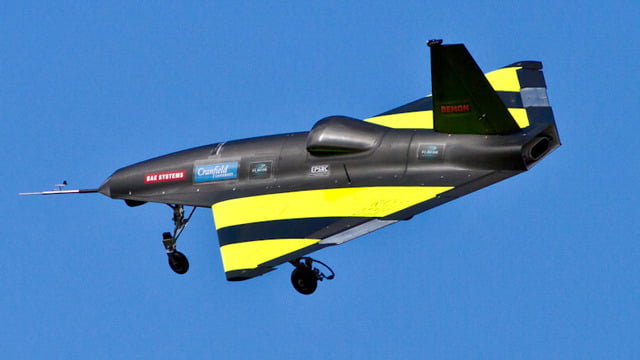
Researchers have flown the first aircraft designed to maneuver without conventional control surfaces like ailerons and flaps. Instead of changing the wing geometry to alter the lift on different parts of the craft, the UAV uses strategically placed jets of air along the wing to control its flight. The plane can also alter the direction of its thrust, not by turning the nozzle as is conventionally done, but by modifying the thrust vector by directing and firing a secondary jet into the exhaust. #

Wind Turbines and Weather
A new study reports that wind turbine farms may be changing local surface temperatures, resulting in warmer temperatures at night and cooler temperatures during the day. The result is neither surprising nor new; the motion of the propellers increases the turbulence downstream of the turbines. Turbulent flow mixes much better than laminar flow, so air from above the ground is getting mixed into surface air in the wakes. At night, the air next to the ground cools more quickly than air higher up, so the mixing of higher, warmer air results in localized warmer air on the ground. Orange farmers use this effect when they put out fans at night to keep their crops from freezing. #

Wingtip Vortices in Ground Effect
In this flow visualization, wingtip vortices from an aircraft have been simulated using an apparatus with a couple of flaps that snap together like a book closing. Dye is pooled on the “ground” below the flaps and gets entrained by the vortices and lit up using laser light. The red vortices are the primary vortex generated by the aircraft wingtips and the green ones are secondary vortices generated by interaction with the ground. The lower half of the picture is a reflection off the ground. This photo was part of the 2009 Gallery of Fluid Motion. #
Human-Powered Ornithopter
A team at the University of Toronto has flown the world’s first human-powered ornithopter, an aircraft that flies by flapping its wings like a bird. The concept dates back all the way to Da Vinci in the 15th century. Part of why it’s taken centuries to realize the dream is that bird flight is much more complicated than simply flapping up and down. Flapping a wing up and down will produce lift equally upward and downward. In order to create usable lift and thrust, it’s necessary to change the angle of attack during each stroke by twisting the wing while flapping. Watch the U of T craft carefully, and you can see this happening. #