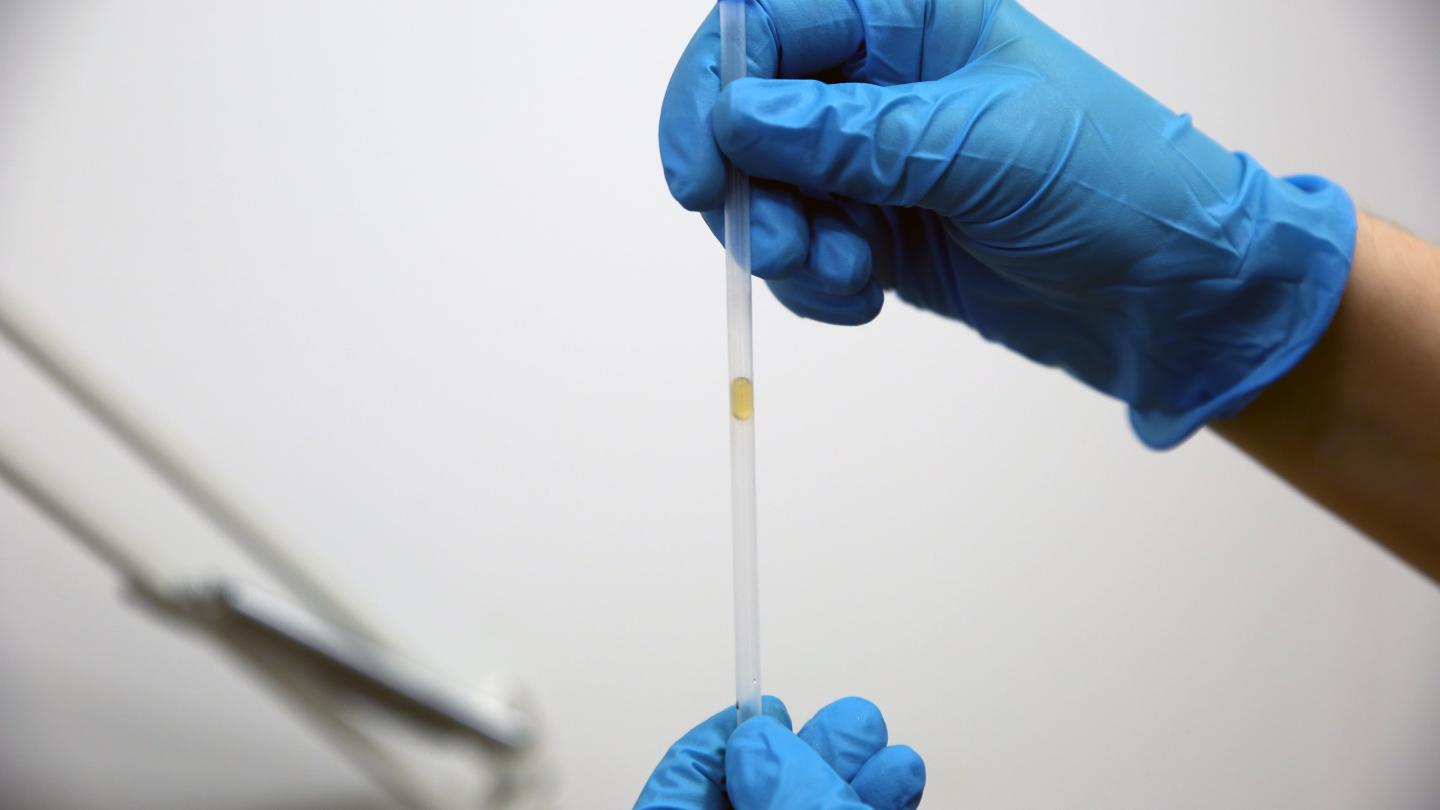
Despite wide differences in ecology and geology, rivers around the world share certain fundamental features. Physicists study these characteristics by creating small-scale rivers in the laboratory, like the experiment featured in this Lutetium Project video. Within these systems, scientists can carefully control variables and discover useful patterns, like the two parameters needed to describe the shape of a river’s profile! (Image and video credit: The Lutetium Project)
Category: Research

Understanding Stars’ Seismology
Our understanding of Earth’s interior is based mostly on observations of seismic waves, which travel differently through our rocky crust and the molten core. Scientists similarly use seismic waves in stars to determine their interiors. But the pressure and temperature conditions in stars are far beyond anything we have here on Earth, which makes predicting how waves will travel in such exotic material difficult.
To better understand these extreme temperatures and pressures, scientists are using Lawrence Livermore’s National Ignition Facility (NIF) to mimic conditions similar to the outer envelope of a white dwarf star, like the one shown in the center of the image above. NIF’s laser array – shown as the blue lines in the artist’s conception above – can generate spherical shock waves that, as they converge on a solid sample, create pressures as high as 450 Mbar, more than 400 million times sea level atmospheric pressure here on Earth. Although the shock wave takes only 9 ns to travel across the sample, it’s enough to give researchers a glimpse into star-like conditions. (Image credit: NASA/ESA/C. O’Dell/D. Thompson, Lawrence Livermore National Laboratory; via Physics Today)

Storm Eyes and Mushrooms in a Drop
In industry, drying droplets often have many components: a liquid solvent, solid nanoparticles, and dissolved polymers. The concentration of that last component — the polymers — can have a big effect on the way the droplet dries, as seen in the video above.
Without polymers, the droplet dries similarly to a coffee ring stain. But at moderate concentration, we see something very different. The droplet forms an eye in the middle, similar to a hurricane’s, and the edges of the droplet sprout mushroom-shaped plumes that grow and merge with one another along the edge. With even larger polymer concentrations, the mushrooms sweep their way inward, leaving a feathery stain behind. (Video, image, and research credit: J. Zhao et al.)

Granular Fingers
Finger-like shapes often form on fluids injected between glass plates, but what happens when that injected fluid contains particles? That’s the situation in this recent study, where researchers sandwiched a fluid between two glass plates and then injected a second, similar fluid laced with particles.
Despite the differences from the traditional Saffman-Taylor set-up, the granular-filled fluid still forms fingers as long as there’s even a slight density difference between the original and injected fluids. It doesn’t even matter which of the two fluids has the greater density! (Image and research credit: A. Kudrolli et al.)

Recreating Infinity
In the ocean, tiny organisms can migrate hundreds of meters through the water column. Recreating and tracking those journeys in a lab is quite a challenge, but it’s one the researchers behind the Gravity Machine have conquered. This apparatus uses a wheel to essentially give micro-organisms an infinite water column to traverse while keeping them fixed in the lab microscope’s field of view.
With the device, researchers can watch organisms switch naturally between rising, sinking, and feeding behaviors as they would in the wild. The group is working to make it so that anyone with a microscope can recreate their set-up for observations. (Image, video, and research credit: D. Krishnamurthy et al.; see also Gravity Machine; submitted by Kam-Yung Soh)
Landings Beyond Earth
With planning for manned and unmanned missions to the Moon, Mars, and many asteroids underway, engineers are using numerical simulations to understand how spacecraft thrusters interact with planetary surfaces. Most practical data for this problem comes from the Apollo program and is of limited use for current missions. Recreating a Martian landing on Earth isn’t straightforward, either, given our higher gravity. Thus, supercomputers and numerical simulation are the best available tool for understanding and predicting how the plumes from a spacecraft’s thrusters will interact with a surface and what kind of blowback the spacecraft will need to withstand. (Video credit: U. Michigan Engineering; research credit: Y. Yao et al.; submission by Jesse C.)
Droplets From Speaking
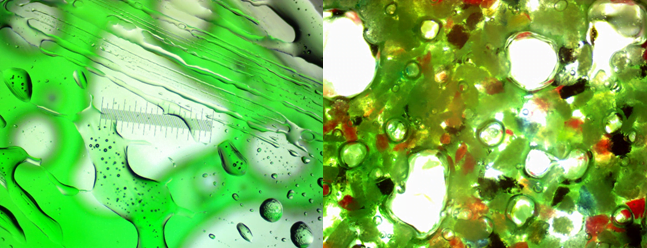
Illnesses like COVID-19 can spread through droplets and aerosols produced by coughing, sneezing, or even speaking. New research looks at how regular speech patterns produce a spray of droplets. Researchers found that pronouncing many consonants causes a sheet of saliva to form between the speaker’s lips. That sheet stretches into filaments that then break into a spray of droplets.
Strong, plosive consonants like /p/ and /b/ create the most droplets (Images 2 and 3), but even milder consonants like /m/ create some (Image 1). Interestingly, the researchers found that wearing lip balm drastically decreased droplet production by altering the saliva sheet formation. Even so, there’s no substitute for wearing a properly fitted mask! (Image credits: masks – K. Grabowska, droplets – M. Abkarian and H. Stone; research credit: M. Abkarian and H. Stone; via APS Physics)

Droplets on Inclined Walls
When a droplet impacts an inclined surface, it spreads asymmetrically. The splash shape is largely elliptical, as researchers found when modeling such impacts over a range of inclination angles. Understanding such splash patterns is important not only for industrial applications like printing but in areas like forensic science. (Image and research credit: P. García-Geijo et al.)

Freezing Splats
When a drop hits a surface colder than its freezing point, there’s a competition between retraction and solidification that determines the final shape of the splat. For many materials, like wax or soldering metals, the contact angle between their liquid and solid phase is zero, so there’s no major shape change once solidification begins. But water — as is so often the case — is an exception.
Water and ice have a non-zero contact angle, which means that retraction can continue even after the drop begins freezing. As a result, the final shape of the splat varies depending on how cold the surface is. For a surface only a little colder than the freezing point, the final splat forms a spherical cap (Image 1). But once the surface is colder, freezing happens before the water can fully retract and the final splat forms a ring (Image 2). (Image and research credit: V. Thiévenaz et al.)