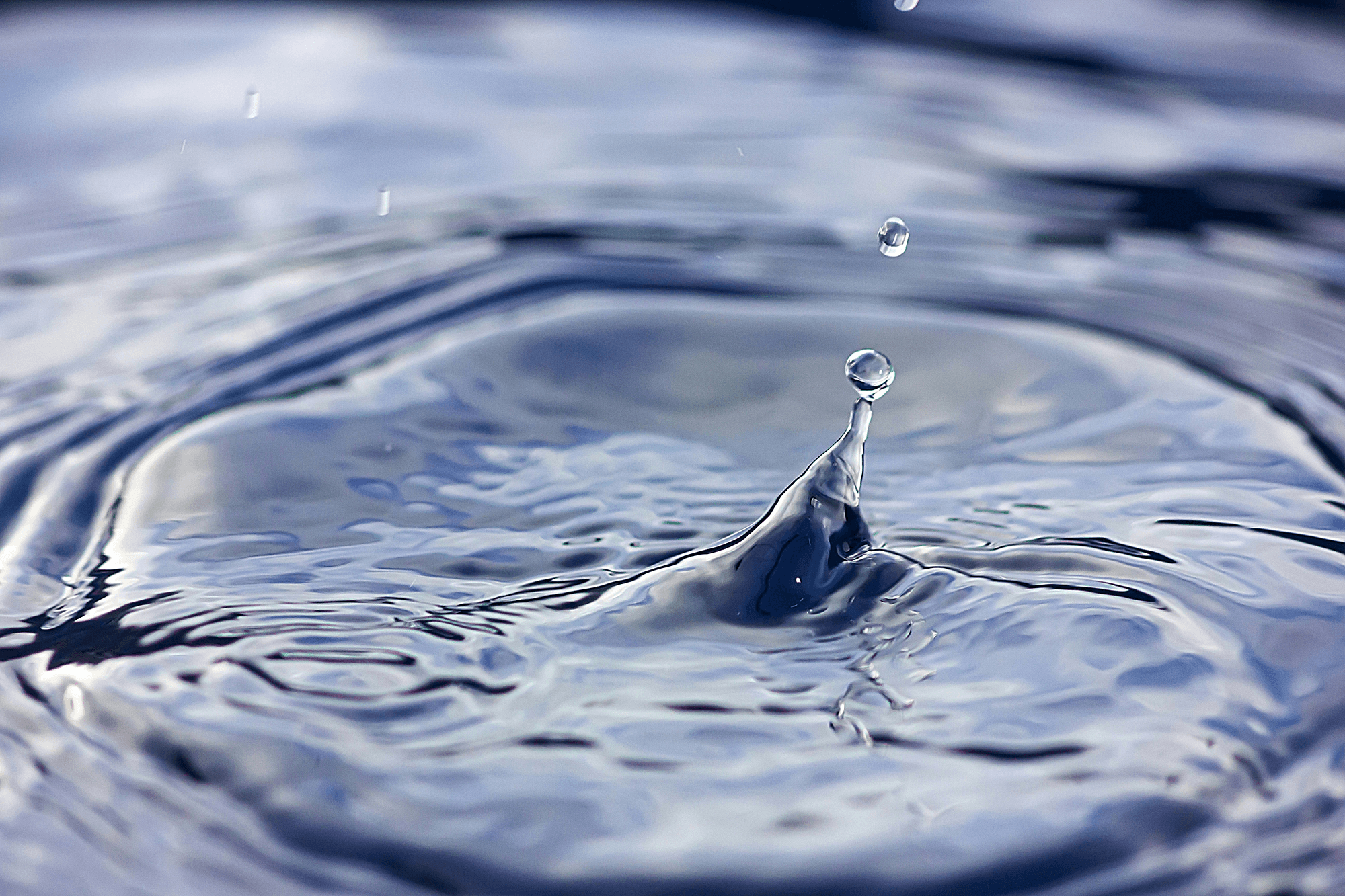
A toad swims across a pond in this award-winning image from photographer Paul Hobson. The shot was actually captured from below the water, with the camera kept dry in a glass housing. Although the frog appears to be mid-leap, the light-distorting ripples around its feet hint at the flow its kick generated. It’s reminiscent of the vortices left by water striders as they move. (Image credit: P. Hobson/BWPA; via Colossal)
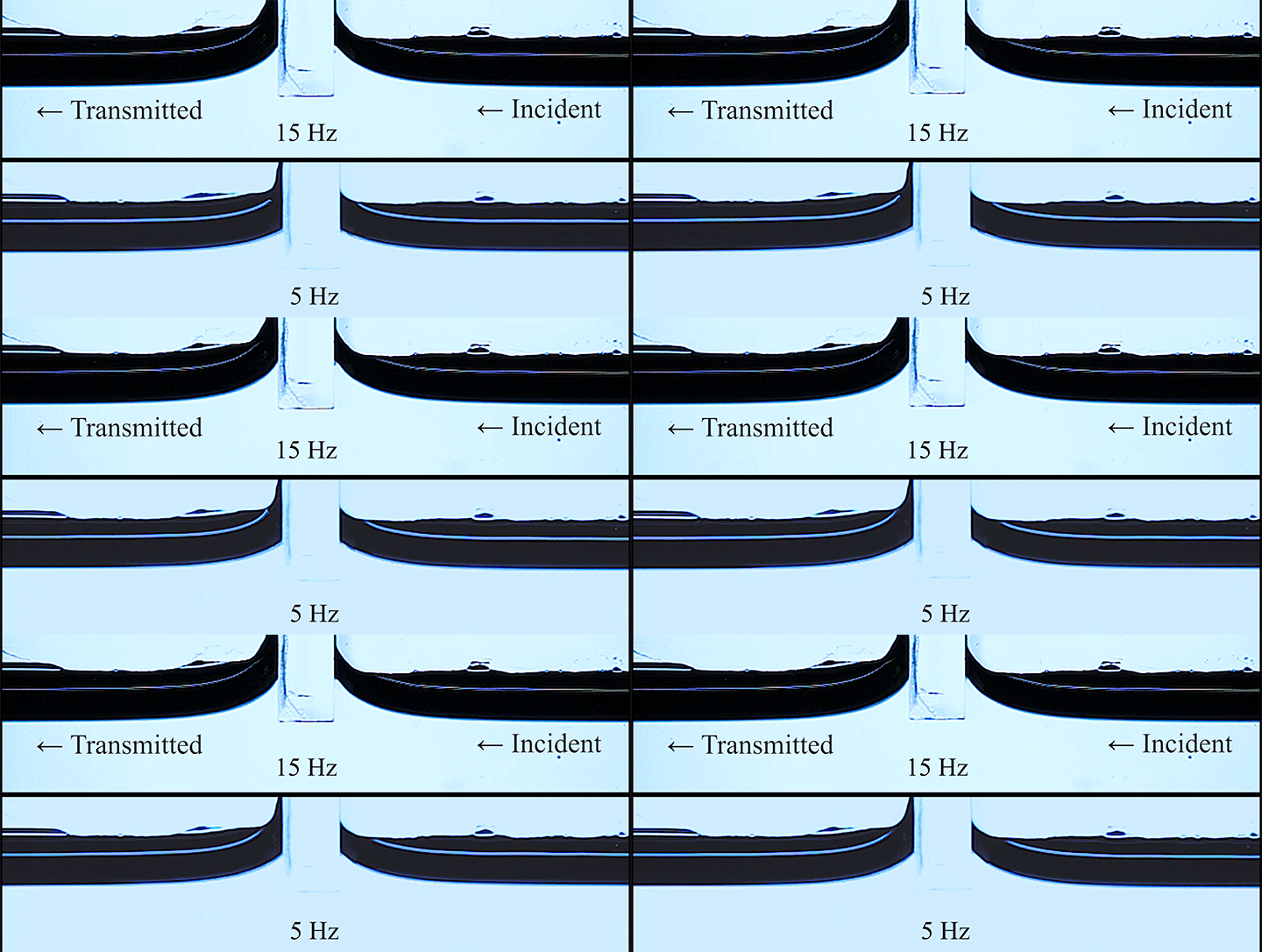
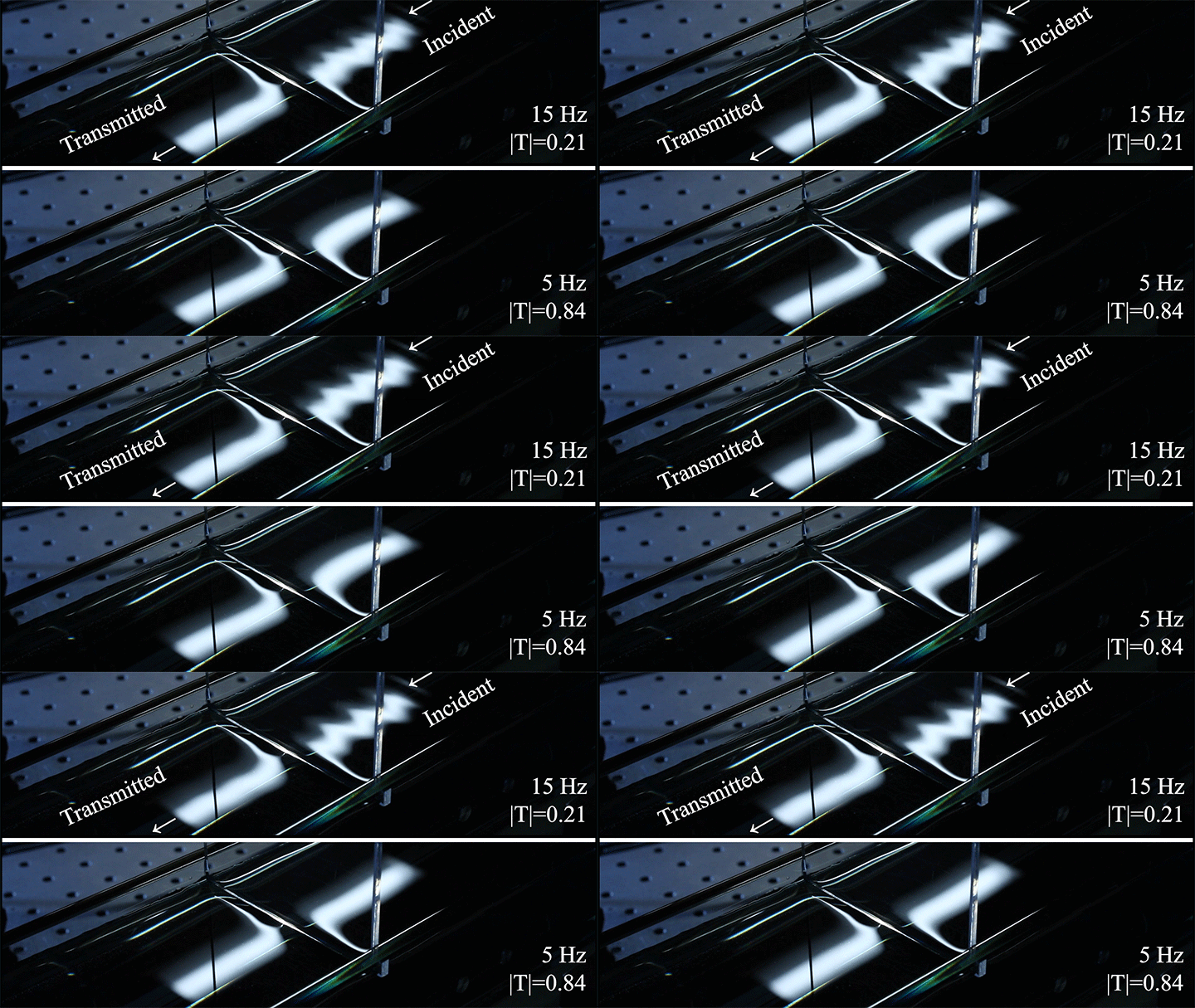
Even small changes to a meniscus can change how much wave energy passes through it. A new study systemically tests how meniscus size and shape affects the transmission of incoming waves.
As seen above, the meniscus was formed on a suspended barrier. By changing the barrier size and wettability as well as the characteristics of incoming waves, researchers were able to map out how the meniscus affected waves that made it past the barrier.
In particular, they found that drawing the meniscus upward by raising the barrier would, at first, enhance wave transmission but then suppressed wave energy as the barrier moved higher. They attributed the change in behavior to an interplay between water column height and meniscus inclination. (Research and image credit: Z. Wang et al.; via Physics World)
When bubbles at the surface of the ocean pop, they can send up a spray of tiny droplets that carry salt, biomass, microplastics, and other contaminants into the atmosphere. Teratons of such materials enter the atmosphere from the ocean each year. To better understand how contaminants can cross from the ocean to the atmosphere, researchers studied what happens when a oil-coated water bubble pops.
The team looked at bubbles about 2 millimeters across, coated in varying amounts of oil, and observed their demise via high-speed video. When the bubble pops, capillary waves ripple down into its crater-like cavity and meet at the bottom. That collision creates a rebounding Worthington jet, like the one above, which can eject droplets from its tip.
The team found that the oil layer’s thickness affected the capillary waves and changed the width of the resulting jet. They were able to build a mathematical model that predicts how wide a jet will be, though a prediction of the jet’s velocity is still a work-in-progress. (Image credit: Р. Морозов; research credit: Z. Yang et al.; via APS)
Here’s another look at SurferBot, a low-cost, vibration-based robot capable of traversing both water and land. SurferBot’s vibration creates asymmetric ripples on the water surface. Because the waves are bigger at the rear of the robot, it gets propelled forward. But there doesn’t have to be water for SurferBot to get around! It’s actually amphibious, moving on both land and water. It can even transition from land to water on its own. (Image and video credit: E. Rhee et al.; research credit: E. Rhee et al.)
A droplet falling on a liquid bath may, if slow enough, rebound off the surface. Its impact sends out a string of ripples — capillary waves — on the bath’s surface and sends the droplet itself into jiggling paroxysms. A new pre-print study delves into this process through a combination of experiment, simulation, and modeling. Impressively, they find that the most of the droplet’s initial energy is not dissipated during impact. Instead it’s fed into the capillary waves and droplet deformation that follow. (Image and research credit: L. Alventosa et al.; via Dan H.)
A droplet falls on a bath, partially coalesces and rebounds. The process repeats until the droplet is small enough to coalesce completely.
When droplets coalesce, they perform a wiggly dance, gyrating as the capillary waves on their surface interfere. When the droplets have matching surface tensions, like the two water droplets in the animation on the lower left, the coalescence dance is symmetric. But for differing droplets, like the water and ethanol droplets merging on the lower right, coalescence is decidedly asymmetric.
Two water droplets merge symmetrically.A water droplet and an ethanol droplet merge asymmetrically.
The asymmetry arises from the droplets’ different surface tensions. The size and speed of the capillary waves that form on a droplet depend on surface tension, so droplets of different liquids have inherently different capillary waves. During merger, the interference of these capillary waves causes the asymmetry we see. (Image credit: top – enfantnocta, coalescence – M. Hack et al.; research credit: M. Hack et al.)
Inspired by honeybees and their ability to surf on capillary waves of their own making, researchers have developed SurferBot, a low-cost, untethered, vibration-driven surf robot. Built on a simple 3D-printed platform, the bot has a vibration motor powered by a simple coin cell battery. As the motor vibrates, it propels the bot forward (Image 2). With the motor placed off-center, the bot’s vibrations create larger capillary waves at the rear of the bot than at the front (Image 3). It’s this asymmetry that drives the robot forward. The flow pattern created by the bot’s propulsion is impressively strong (Image 4) and consists of a pair of counter-rotating vortices trapped ahead of the bot and a strong central jet in its wake.
Best of all: SurferBot is a great platform for educational experimentation, costing <$1 apiece! (Image and submission credit: D. Harris; research credit: E. Rhee et al.)
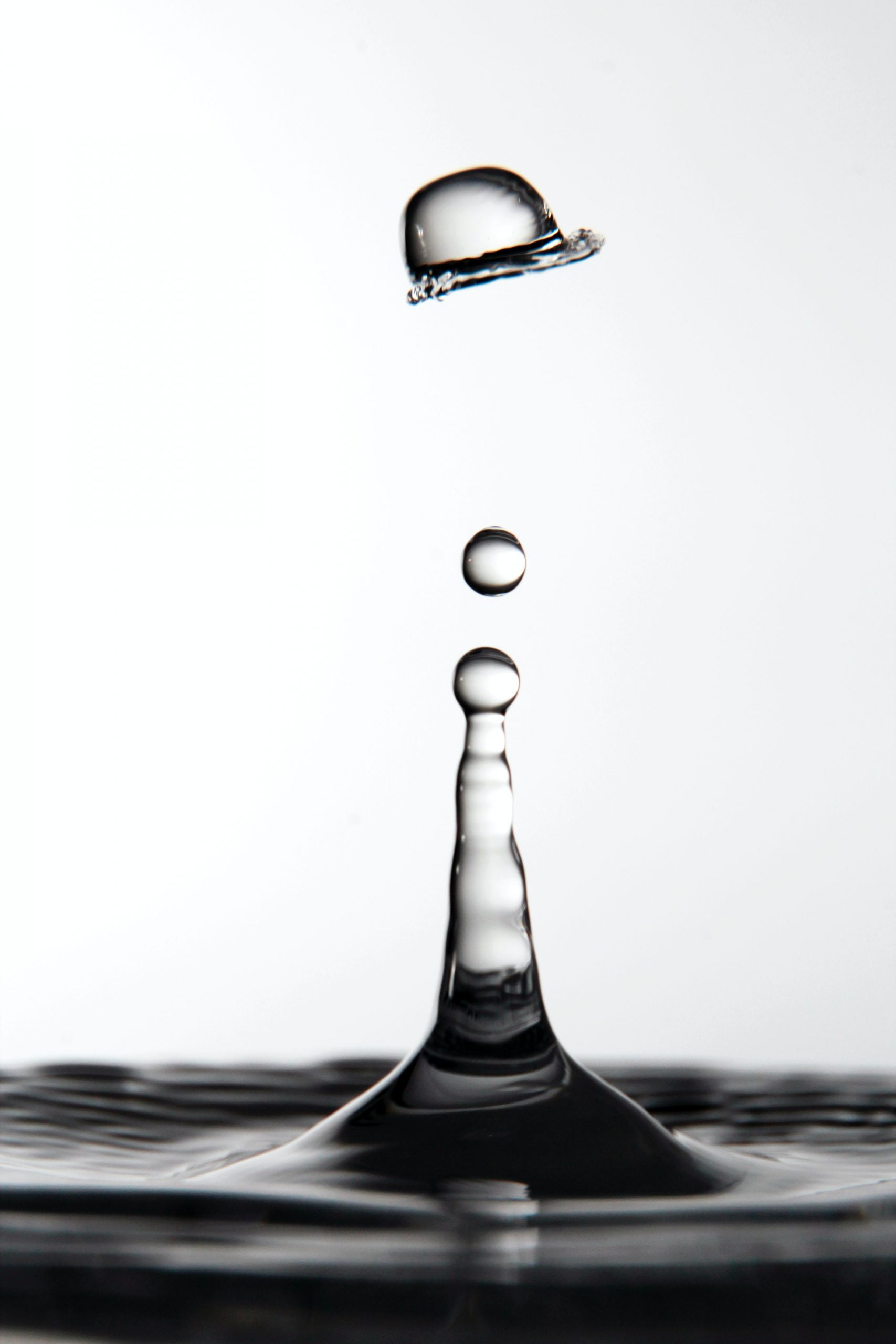
When a droplet impacts, it’s not unusual for converging ripples to form an upward jet, like the one seen here. But under the right circumstances, jets can form downward, too. This study looks at the ultrafast jets that can form beneath an impacting Leidenfrost drop.
These Leidenfrost drops are striking a surface much hotter than their boiling point, so a large vapor cavity forms quickly beneath them. Using x-ray imaging, the researchers were able to capture the dynamics of this cavity’s formation and collapse (Image 2). The field of view in the animation shows only a portion of the drop’s cavity, so Image 3 may help you orient relative to the drop at large.
Initially, we see the center of the droplet hitting the surface, followed by the fast growth of a vapor cavity. Rippling capillary waves converge on top of the cavity, creating a pinch-off. From there, a bubble rises up while a fast jet shoots downward. (Image credit: water jet – A. Min, others – S. Lee et al.; research credit: S. Lee et al.)
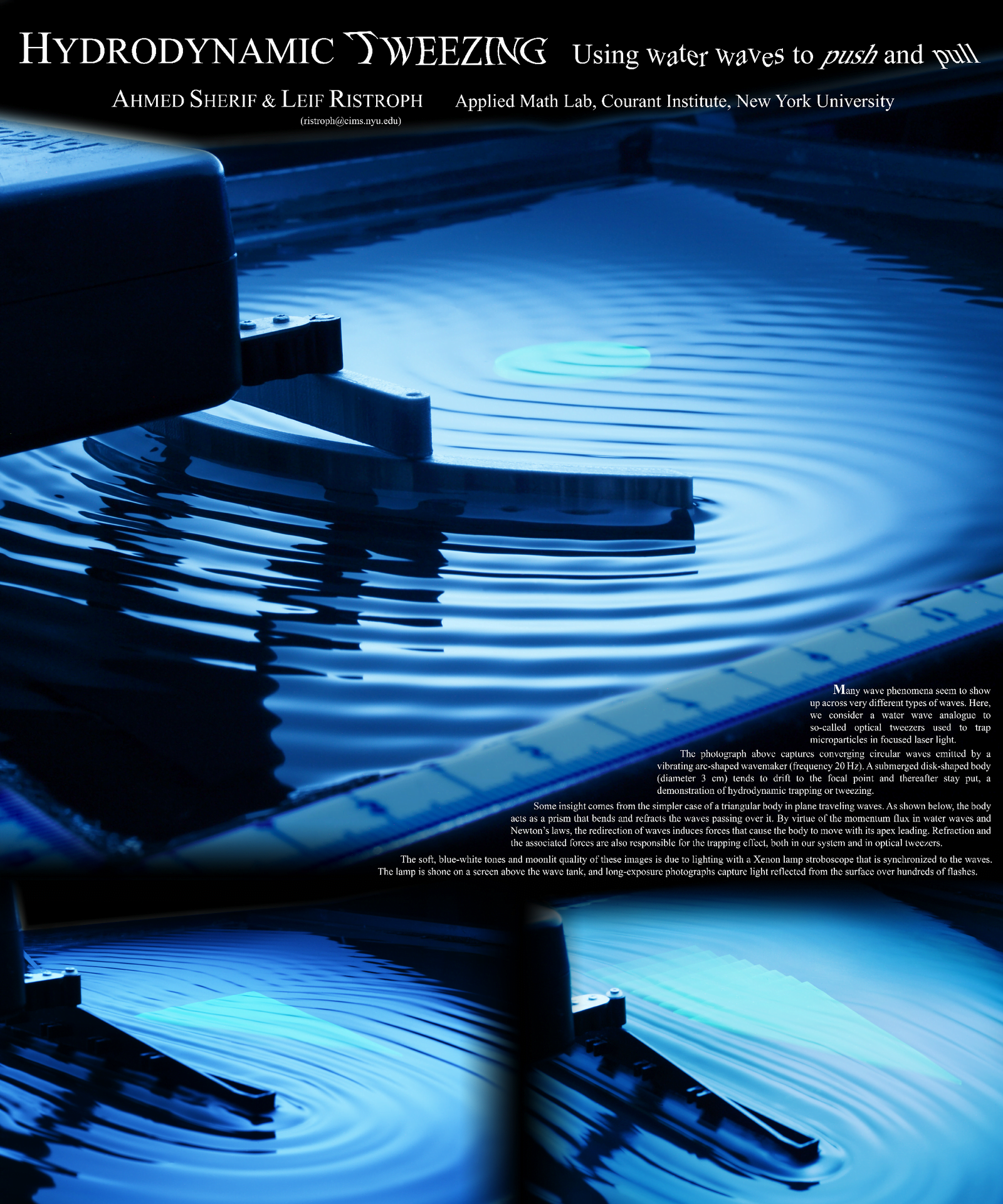
Acoustic levitation and optical tweezers both use waves — of sound and light, respectively — to trap and control particles. Water waves also have the power to move and capture objects, as shown in this award-winning poster from the 2019 Gallery of Fluid Motion. The central image shows a submerged disk, its position controlled by the arc-shaped wavemaker at work on the water’s surface. The complicated pattern of reflection and refraction of the waves we see on the surface draws the disk to a focal point and holds it there.
On the bottom right, a composite image shows the same effect in action on a submerged triangular disk driven by a straight wavemaker. As the waves pass over the object, they’re refracted, and that change in wave motion creates a flow that pulls the object along until it settles at the wave’s focus. (Image and research credit: A. Sherif and L. Ristroph)
High-speed video is wonderful for appreciating fluid motion in ways we can’t on our own. In this video from Warped Perception, we see what happens when a vibrating tuning fork is lowered into water. The tines of the tuning fork create a spray of tiny droplets, reminiscent of what happens in ultrasonic atomization or when blowing through an immersed straw. The ejected droplets fall slowly back onto the disturbed surface; many of them bounce rather than coalescing. This is because the surface’s vibration pushes the drops aloft again before the air layer separating the drop from the surface has the time to drain away. (Video credit: Warped Perception)