Category: Research

  • Flexible Filament Reduces Drag

    Flexible Filament Reduces Drag

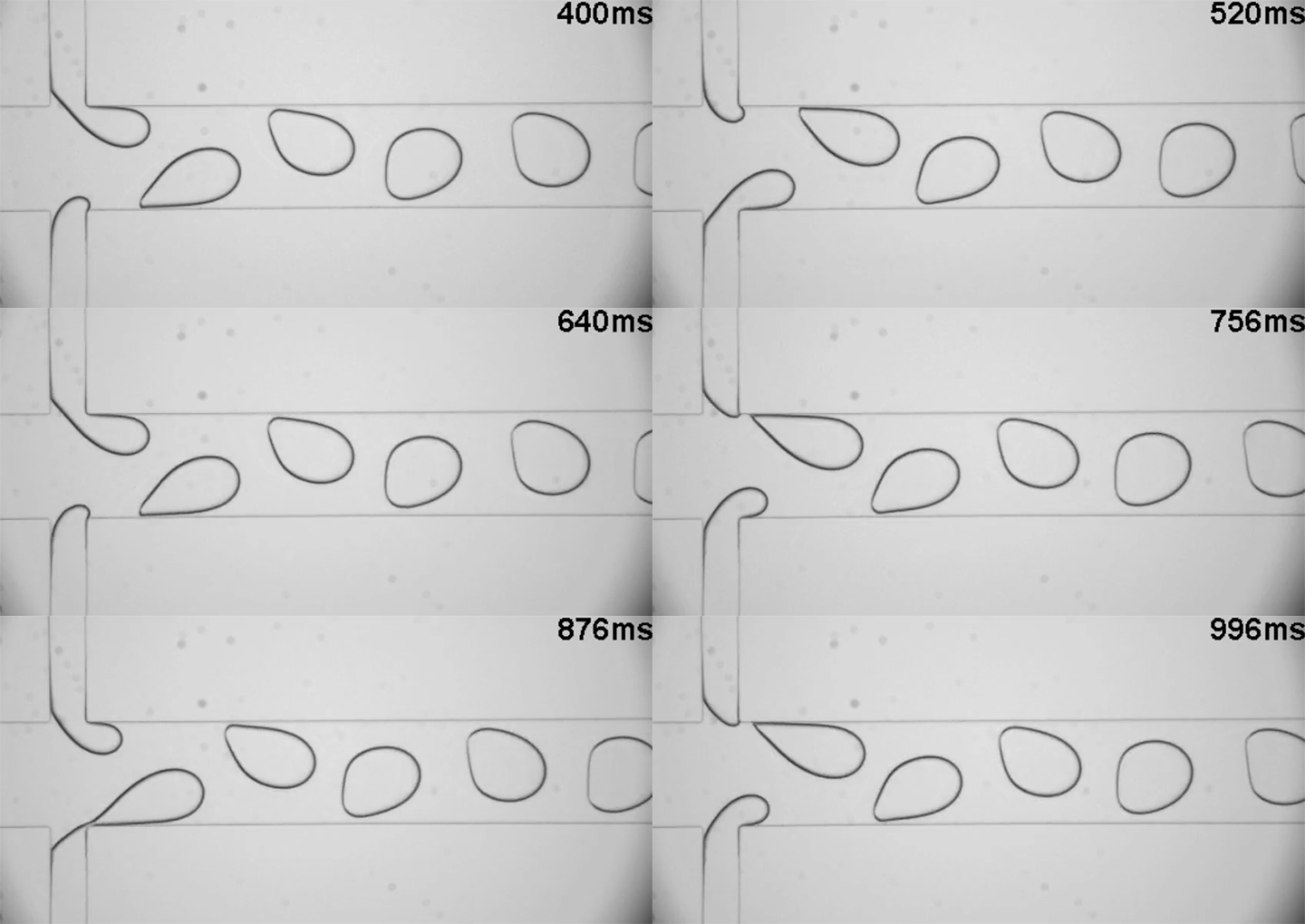
    Most shapes aren’t streamlined for fluid flow. We call these bulky, often boxy shapes, bluff bodies. Above, we see two examples of a bluff body, a flat plate, in a soap film. On the left, the plate sits perpendicular to the soap film’s top-to-bottom flow. Two large, counter-rotating vortices form behind the plate and a wide wake stretches behind it.

    On the right, we see the same flat plate but now a long, flexible filament is attached to either end. As the flow moves past, it deforms the filament, creating a rounded shape. Researchers found that, under the right conditions, this flexible afterbody could reduce drag on the object by up to 10%. (Image and research credit: S. Gao et al.)

  • Branching Gels

    Branching Gels

    If you sandwich a viscous fluid between two plates, then pull the plates apart, you’ll often get a complex branching pattern that forms as air pushes its way into the fluid. But the exact results depend strongly on what kind of viscous fluid you used. A new study looks specifically at what happens when that fluid is a yield-stress gel.

    Yield-stress fluids behave like a solid until a critical amount of force causes them to flow. Think about your toothpaste. When you take the cap off, the toothpaste stays put until you squeeze the tube enough to make it flow. The gels used in this experiment behave similarly.

    The researchers found that their gels required a critical energy input in order to branch and flow. If the energy applied in pulling the plates apart was too low, no branching occurred (Image 1). But beyond that critical energy, separating the plates created intricate branching patterns consistent with those seen in simpler, Newtonian fluids. (Image, research, and submission credit: T. Divoux et al.; via APS)

  • Featured Video Play Icon

    Crystalline Critters

    In 5th grade, I grew crystals by evaporating solutions of salt water from miniature pie tins. The results were white, boxy crystals whose size depended on how much salt I’d managed to dissolve into the water. But it turns out I could have gotten much cooler results if I’d evaporated my salt water a drop at a time on a hot superhydrophobic surface. That’s how these researchers formed the “crystal critters” shown in the video above.

    Initially, the evaporating salt water drop is what we would expect, but once enough water is gone to leave a shell of salt, the drop grows legs and lifts off the surface. From that point, all growth occurs from the surface up. Because the surface is heated, evaporation happens quickest at that point of contact, and the water that remains is drawn down the legs, providing more fluid for evaporation as well as additional salt to grow the crystal. (Video, image, and research credit: S. McBride et al.)

  • Fungal Fluid Dynamics

    Fungal Fluid Dynamics

    Many plants gain the soil-bound nutrients they need by trading with symbiotic fungi. Underground, these fungi spread networks that gather and store phosphorus, which they then trade with host plants to get the carbon they need. Research shows that the fungi can be shrewd traders, moving phosphorus from nutrient-rich areas to poorer ones in order to maximize their trade gains.

    What you see above are snapshots of some of this transport within the fungal network. Notice how flow within the branching network changes direction. The fungus can force these flow reversals in a matter of seconds, allowing it to move nutrients to wherever the best returns are found. (Image and research credit: M. Whiteside et al.)

  • Droplets From Jets

    Droplets From Jets

    On the ocean, countless crashing waves are creating bubbles. When they burst, those bubbles generate jets and droplets that spray into the sky, carrying sea salt, dust, and biological material into the atmosphere. Researchers know these droplets and their evaporation are important for understanding environmental processes, but figuring out how to capture that importance in models continues to be a challenge.

    In a new study, researchers concentrated on a simplified problem: the bursting of a single bubble in pure water. By studying a wide range of conditions, the team found that jets from these bubbles could eject as many as 14 droplets apiece. And though existing models have mostly ignored all but the first droplet, their work showed that all of the droplets should be accounted for in any evaporation models. (Image credit: C. Couto; research credit: A. Berny et al.)

  • The Power of a Penguin’s Rectum

    The Power of a Penguin’s Rectum

    When brooding their eggs, penguins can rarely leave the nest, but answering nature’s call is still necessary. To keep the nest clean, Adélie penguins project their feces up to more than a meter away. A new study refines previous calculations on this subject and finds that the penguin’s rectum develops far higher pressures than that of humans.

    In one hypothetical calculation, the authors estimate that a human of average height, capable of developing penguin-like rectal pressures, would project excrement more than 3 meters. In the authors’ words, “He/she should not use usual rest rooms.”

    Knowing the likely range of contact for penguins is important primarily for zookeepers, who understandably would like to avoid such projectiles. (Image credit: H. Neufeld; research credit: H. Tajima and F. Fujisawa; via phys.org)

  • Artificial Microswimmers

    Artificial Microswimmers

    Tiny organisms swim through a world much more viscous than ours. To do so, they swim asymmetrically, often using wave-like motions of tiny, hair-like cilia along their bodies. Mimicking this behavior in artificial swimmers is tough; how would you actuate so many micro-appendages? A new study offers a different method: inducing cilia-like waves using magnetic fields.

    The researchers’ microswimmers are actually arrays of ferromagnetic particles. The Cheerios effect helps draw the particles together, while magnetic repulsion pushes them apart. Together, these forces help the particles assemble into crystal-like arrays.

    To make the particles swim, the researchers shift the magnetic field. All of the outer particles of the array behave like individual cilia. As the magnetic field moves, the cilia-particles move in waves, much like their natural counterparts. Using this technique, the researchers were able to demonstrate both rotational and straight-line (translational) swimming. (Image, research, and submission credit: Y. Collard et al.)

  • Undulating Keeps Flying Snakes Steady

    Undulating Keeps Flying Snakes Steady

    Flying snakes undulate through the air as they glide. But, unlike on land, these wiggles aren’t for propulsion. A new study shows instead that they are key to the snake staying stable in flight.

    Upon take-off, a flying snake flattens its body, forming a wing-like shape that helps them generate lift and control drag. But while they glide, they also slither and pitch their tail.

    Researchers recorded more than 150 flights by live snakes, then used that data to construct their own digital snake. The model could fly like a real snake or be tested without undulations to see what would happen. The researchers discovered that, without that mid-air slithering, the snake quickly lost control and rolled to the side. (Image and research credit: I. Yeaton et al.; via NYTimes; submitted by Kam-Yung Soh)

  • Featured Video Play Icon

    Branching Light with Soap Bubbles

    By shining laser light through soap bubbles, researchers have demonstrated branching flow in light for the first time. This branching occurs when waves travel through a disordered medium where the typical size of the disordered regions is larger than the wave’s length. Previously, scientists had seen evidence of this phenomenon in electrons, sound waves, and even ocean waves.

    Soap bubbles serve as an excellent platform for branching in light because their exceptionally thin film varies in thickness thanks to the interplay of buoyancy, Marangoni effects, and evaporation. It’s also comparable to — but still slightly larger than — the wavelength of light. The experiment is far from simple, though. Lining the laser up with the soap bubble is tough, especially when your bubble is likely to pop! (Video credit: Nature; research credit: A. Patsyk et al.; submitted by Kam-Yung Soh)
  • Quantifying Bioluminescence

    Quantifying Bioluminescence

    Some single-celled organisms, like dinoflagellates, light up when disturbed. This bioluminescence is considered a defense mechanism, triggered by threats to the organism. Now researchers are quantifying just what it takes to light up a single dinoflagellate.

    Dinoflagellates respond both to stress caused by the fluid flow around them and to mechanical deformation — in other words, getting poked. Both methods involve bending and stretching the dinoflagellate’s cell wall, which stretches calcium-ion channels connected to bioluminescence. The researchers found that the intensity of the light produced depended both on the amount and speed of cell wall deformation.

    The model built from their observations should help scientists better understand what forces cause a specific response. That means dinoflagellates could be used as a non-invasive means of understanding fluid flow around swimmers like dolphins or sea lions! (Image and research credit: M. Jalaal et al.; via APS Physics)