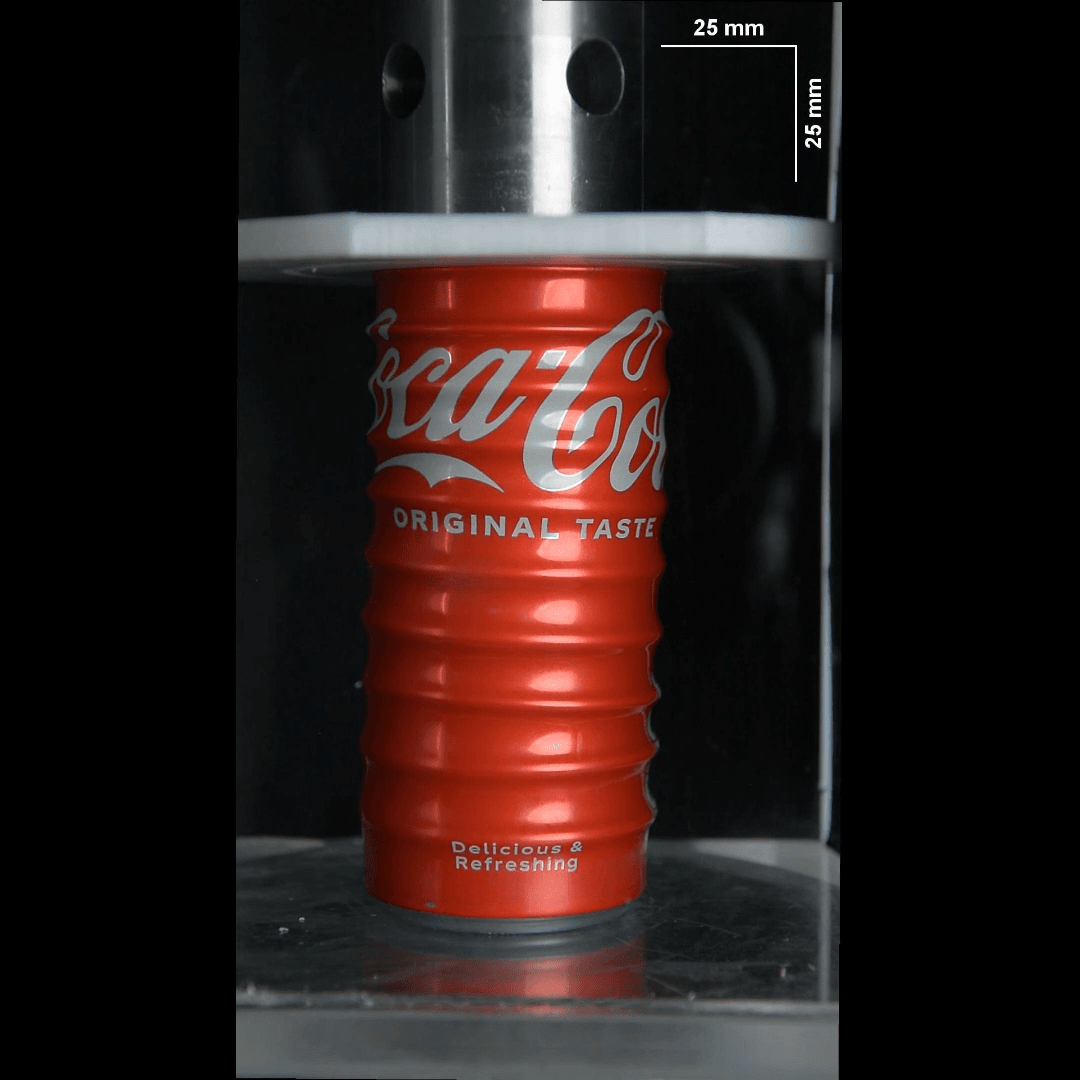
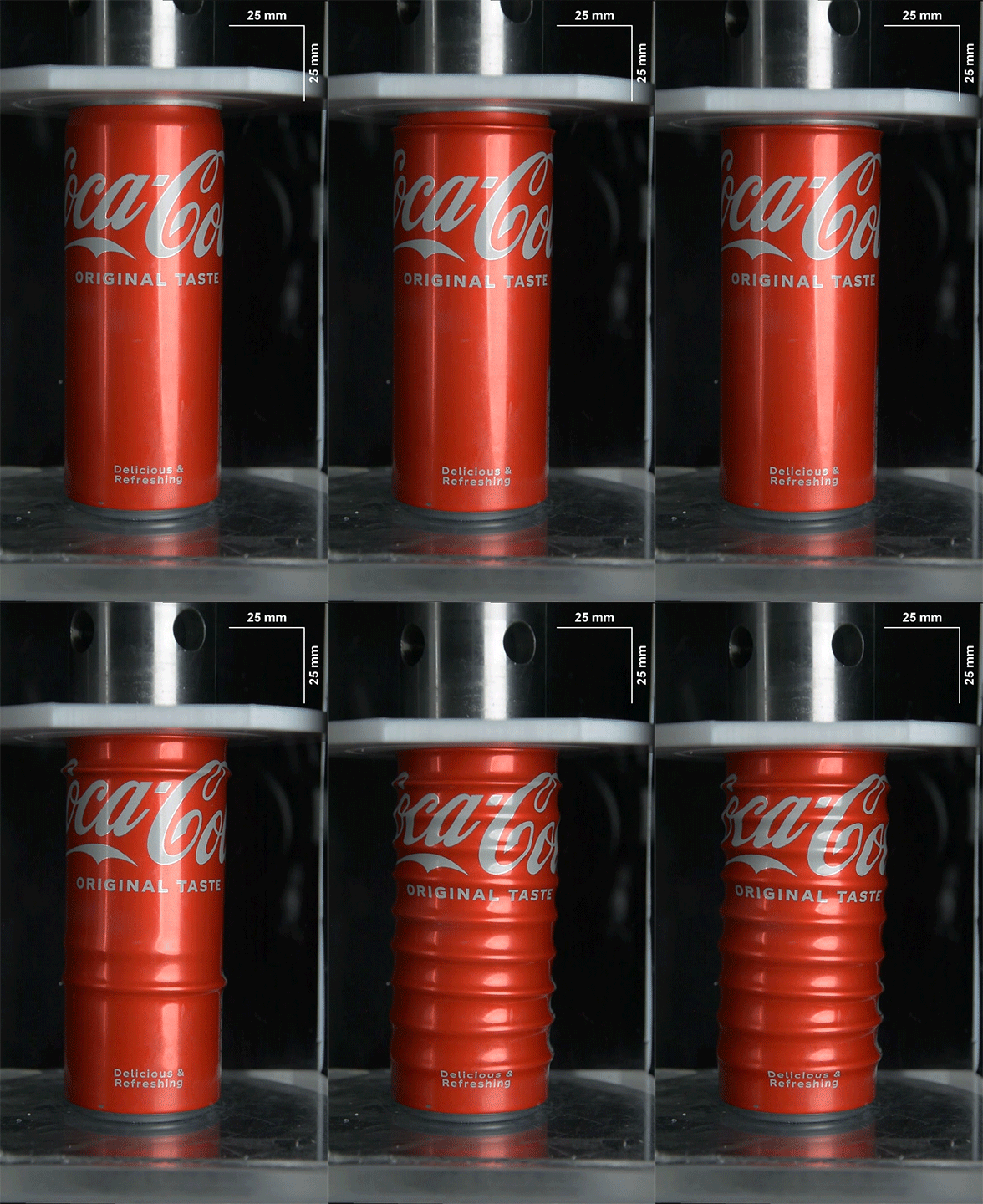
From oil drums to–yes–soda cans, liquid-filled cylindrical shells are everywhere. And, it turns out, these structures fail differently than empty shells or ones filled with a solid. Liquid-filled cylinders buckle in sequential rings, as seen in the video below. Researchers found that the buckling resulted from the shell softening and re-stiffening under the compressive load–repeating that process over and over for each ring. Their findings could help us detect containers that are in danger of failing. (Video, image, and research credit: S. Jain et al.; via Ars Technica)
Animation of a liquid-filled cylindrical shell buckling sequentially under compression.
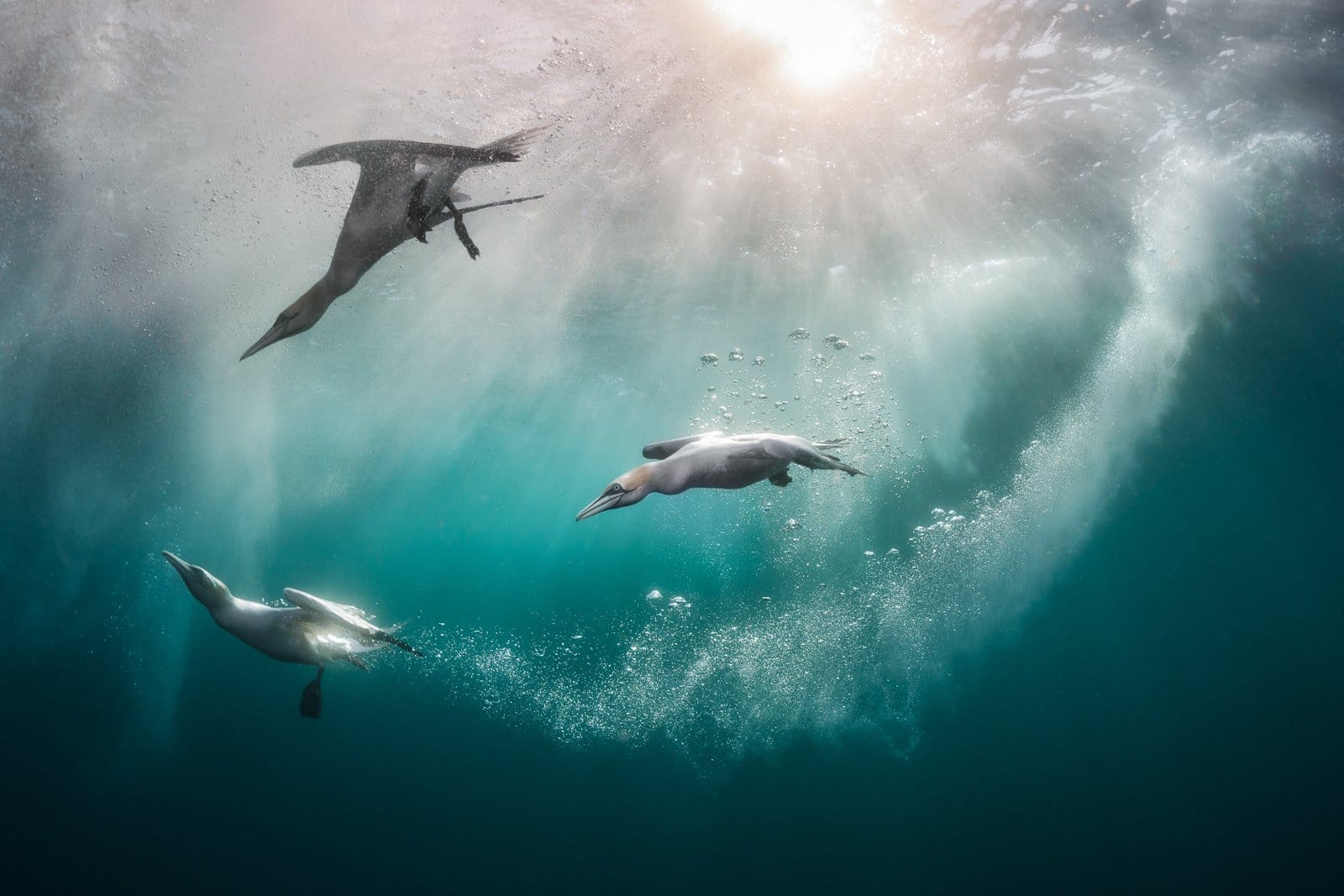
Some seabirds, including gannets and boobies, feed by plunge diving. From high in the air, they fold their wings and dive like darts into the water, impacting at speeds around 24 m/s to help them reach the depths where their prey swim. With their narrow beaks and necks, the critical moments in this feat come when the bird’s head is submerged but its body remains out of the water. At this point, the bird’s head is decelerating quickly and its body is still moving at full speed; if the neck cannot withstand this combination of forces, it will buckle.
But plunge divers, it turns out, have a secret weapon that helps them handle impact: their head shape. A study of water entry dynamics using 3D-printed models of birds’ heads found that plunge divers have a shape that increases the amount of time it takes to enter the water. The impact forces stretch out over that longer period of contact, which also stretches out the time it takes for the bird to reach its maximum deceleration. The end result? That extended contact time protects birds from unsafe levels of deceleration, just like a crumple-zone in a crashing car keeps its occupants from experiencing the worst decelerations. (Image credit: K. Zhou/BPOTY; research credit: S. Sharker et al.; via Colossal)
A viscous bubble wrinkles when it collapses, and scientists long assumed this behavior was caused by gravity. But a new experiment shows that the buckling is, instead, driven by surface tension.
To test gravity’s influence on bubble collapse, the researchers popped bubbles in three orientations: the (normal) upright orientation (Images 1 and 2), upside-down (Image 3), and sideways (Image 4). In all cases, the bubble’s thin film wrinkled as it collapsed, indicating that gravity had little influence on the process. Instead the authors concluded that surface-tension-driven collapse causes the dynamic buckling of the film. (Image and research credit: A. Oratis et al.; submitted by Zander B.)
There’s a common demonstration of surface tension where a loop of string is placed in a soap film and then the film inside the loop is popped, making it suddenly form a perfect circle when the outer soap film’s surface tension pulls the string equally from every direction. In this video, researchers study a similar situation but with a few wrinkles.
Here the loop of string is replaced with an elastic ring, which has more internal stiffness and starts out entirely round within the soap film. Then the researchers pop the outer film. That burst instantly creates a stronger surface tension inside the ring, which causes it collapse inward. As the researchers note, this is the equivalent situation to applying an external pressure on the outside of the ring. The form of the buckling ring and film depends on just how large this “pressurization” is.
Thickening the elastic from a ring to a band alters the collapse, too. The thicker the elastic band, the harder it is to buckle in the plane of the soap film. So instead it wrinkles as the film collapses, which creates wrinkles in the soap film, too! (Image, video, and research credit: F. Box et al.; see also F. Box et al. on arXiv)
Carnivorous plants live in nutrient-poor environments, where clever techniques are necessary to keep their prey from getting away. The aquatic bladderwort family nabs their prey through ultra-fast suction. This starts with a slow phase (top) in which water is pumped out of the trap. Because the internal pressure is lower than the external hydrostatic pressure, this compresses the walls of the trap, and it leaves the trap’s door narrowly balanced on the edge of stability. A slight perturbation to the trigger hairs around the door will cause it to buckle.
That’s when things get fast. As the door buckles and the trap expands to its original volume, water gets sucked in, pulling whatever prey was nearby with it. The door reseals as the pressure inside and outside the trap equalizes, and, in only a couple milliseconds total, the bladderwort has its snack. It secretes digestive enzymes to break down what it’s caught, and over many hours, it pumps out the trap to reset it. (Image and research credit: O. Vincent et al.; submitted by David B.)
Sound can manipulate fluids in fascinating ways, from levitation to vibration. Here researchers use sound to levitate and manipulate droplets and turn them into bubbles. Increasing the acoustic pressure on the levitating droplet flattens it, then slowly causes the drop to buckle. When the buckled film encloses a critical volume, the sound waves resonate inside it. That causes a big jump in acoustic pressure, which makes the drop snap closed into a bubble. (Image and research credit: D. Zang et al.; via Science News; submitted by Kam-Yung Soh)
One of my favorite things to do while we were sailing along the Galapagos was watching the blue-footed boobies hunt. Like the gannets shown above, boobies are plunge divers. They circle overhead until they spot their prey, then they fold their wings and dive headfirst into the water, impacting at speeds of more than 20 m/s (~45 mph). It’s absolutely incredible to watch. The physics involved are impressive, too, especially considering how badly a human would be injured diving at their speeds!
Fluid dynamically speaking, there are three important phases to the birds’ entry. The first is the impact phase, which lasts from initial contact until the bird’s head is underwater. In the second phase, an air cavity forms behind the head and around the neck as it enters the water. Finally, when the chest – the widest point of the bird – hits the water, the bird reaches the submerged phase.
Mechanically, the most interesting part is the air cavity phase. During this time, the bird’s head is slowing down due to high hydrodynamic drag from the water, but the rest of the bird is still moving fast. That means the bird’s slender neck experiences strong compressive forces, which would tend to make it buckle. Researchers at Virginia Techexamined this very problem and found that the birds’ sizing – its head shape, neck length, and so forth – combined with their typical diving speeds kept these birds well away from the conditions that would cause their necks to buckle. With the added stabilization from the birds’ neck muscles, they estimated that gannets and other plunge divers might be able to safely dive at speeds twice what would kill a human! Check out the BBC video below to see high-speed footage of gannets diving. (Image credits: G. Lecoeur; B. Chang et al.; research credits: B. Chang et al., pdf; video credit: BBC)
Tomorrow will be the final day of Galapagos Week. Catch up on previous posts here.